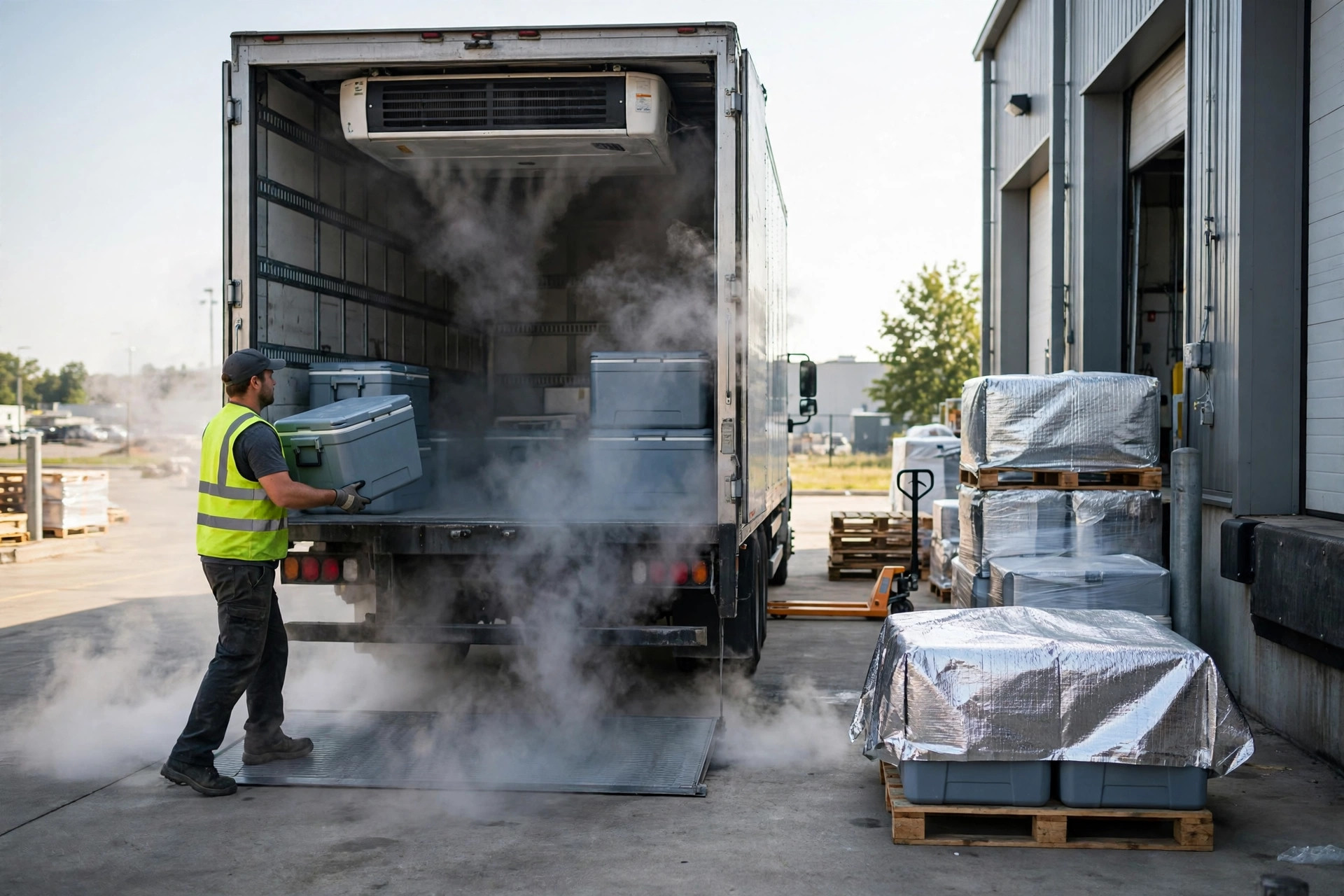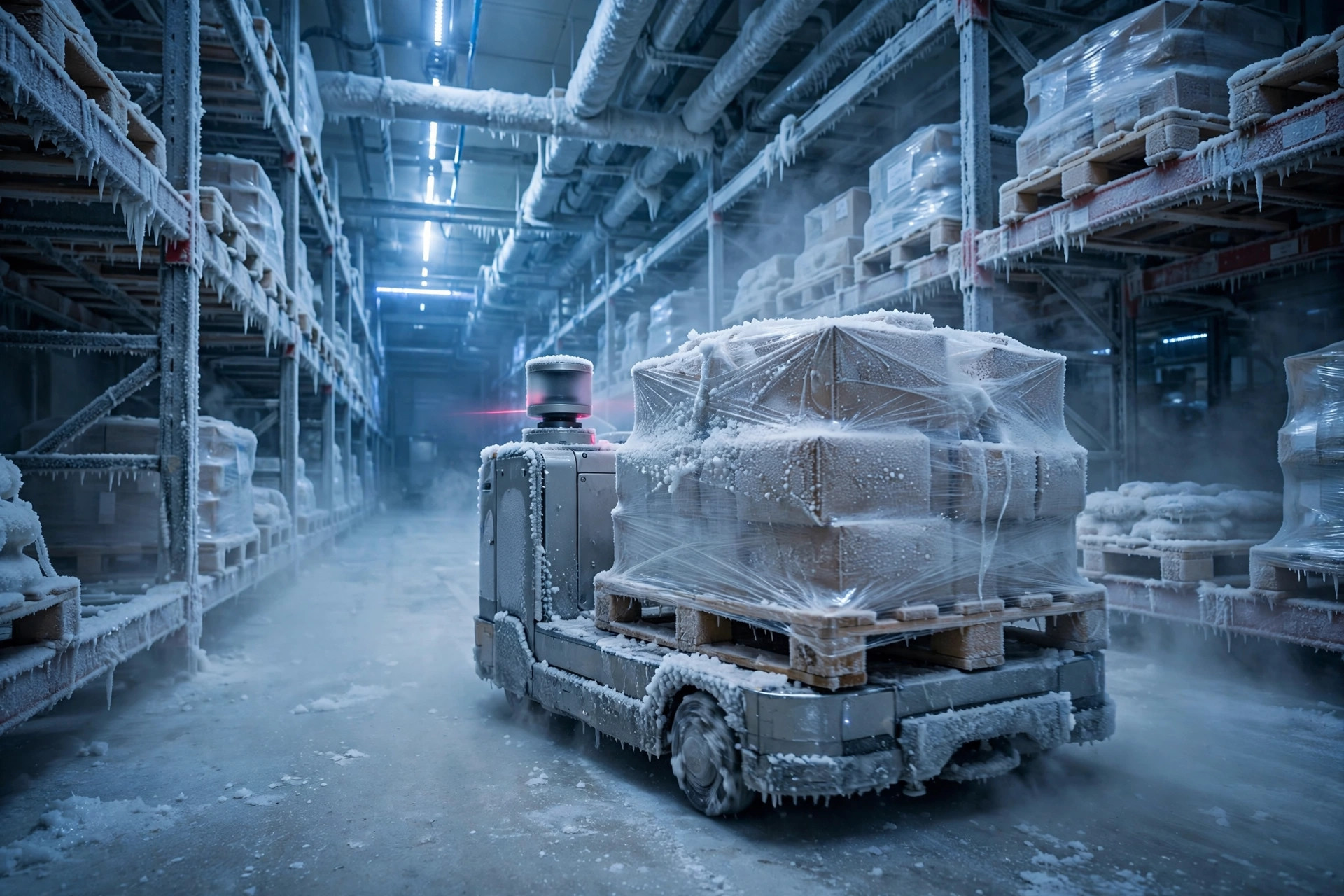
Here's a number that quietly kills freezer automation budgets: the same AMR that runs a full 8-hour shift in an ambient warehouse can drop to half that runtime in a -25°C freezer. Not because the motors got weaker — because the battery gave up. When people talk about amr battery cold storage performance, they're really asking one question: how much of the battery is still usable when everything is frozen solid?
What the Cold Actually Steals
Get the physics straight before a sales rep gets to you. Lithium batteries don't fear the cold because the charge "escapes" — they fear it because the charge can't get out. As temperature drops, electrolyte viscosity rises, lithium-ion diffusion slows, and internal resistance climbs. Same throttle input, voltage sag hits much faster than at room temperature. NCM chemistry holds roughly 70% of usable capacity at -20°C; LFP fades harder in the cold. That's electrochemistry, not something a firmware update fixes.
| Chemistry | Usable capacity at -20°C | Verdict for freezers |
|---|---|---|
| NCM | ~70% | The mainstream pick; fade is predictable |
| LFP | Noticeably worse fade | Think twice; demand a measured curve first |
Then there's the hidden tax: many freezer AMRs heat their battery packs with heating films or insulated enclosures — and heating burns energy. A vehicle with sloppy insulation is basically carrying an electric space heater on its back. Real-world runtime becomes "derated capacity × heating overhead," a double hit. It's like running in freezing air: your lungs fight the cold so your pace drops, and then someone hands you a heavy coat to run in.
The Spec Line: Cross-Zone or Freezer-Dedicated? (amr battery cold storage performance)
Strip away the brochures and there are really two architectures, with a bright line between them:
| Cross-zone | Freezer-dedicated | |
|---|---|---|
| Operating range | -13°F to 104°F, freezer to ambient | -25°C inside the freezer |
| Payload | 2,645 lbs | 300–1,500 kg |
| Runtime | ~8 hours between charges | 2-hour charge → 12–18 hours autonomous |
| Killer feature | No condensation crossing temperature zones | One charge covers the day |
Case one: a frozen-food distribution center in eastern China whose routes thread through frozen, chilled, and ambient zones. They went cross-zone — one vendor's unit covers -13°F to 104°F, hauls 2,645 lbs, and runs about 8 hours between charging windows. Trucks cross temperature zones all day with no condensation, which buys back the dwell time at dock buffers and kills the repair tickets for condensate-fried boards.
Case two: a pure -25°C frozen warehouse in northern China where vehicles never leave the freezer. The freezer-dedicated unit (300–1,500 kg payload, 2-hour charge for 12–18 hours of runtime) charges once across two shifts — top up over lunch and the battery schedule stays dead simple.
The line is one sentence: does your route cross temperature zones? Now run the staffing math. On a 24/7 operation, an 8-hour-runtime vehicle needs charging scheduled to the hour, plus extra spare batteries and standby units. A 12–18-hour vehicle cuts the spare-battery pool roughly in half. Half the runtime difference, more than double the difference in spares and scheduling cost.
Notice what both cases have in common: the battery spec was matched to the route, not to the brochure. Nobody bought "the longest runtime on paper" — they bought the runtime curve that fit their temperature zone and shift pattern. That's the whole discipline in one sentence.
Time to call out the fake requirements. The fakest one: "let's try a standard AMR in the freezer first and see." An ambient-rated vehicle's battery, BMS low-temp strategy, and structural cold rating were all designed for room temperature. Running it at -25°C is slow suicide — when it dies, don't blame the battery, blame whoever signed the PO. The second fake: "we only compared nameplate runtime." A runtime number with no test temperature attached is a scam. Measured at -25°C versus rated at ambient can differ by 2×.
Three Maintenance Traps Nobody Warns You About
Trap one: charging strategy. At low temperatures the BMS clamps charge current; force-feeding fast charge is abuse. Put the charging area at the temperature-zone boundary so packs warm up before charging. Opportunity charging works, but re-derive the rhythm from the low-temp curve — don't copy the ambient charging schedule into the freezer.
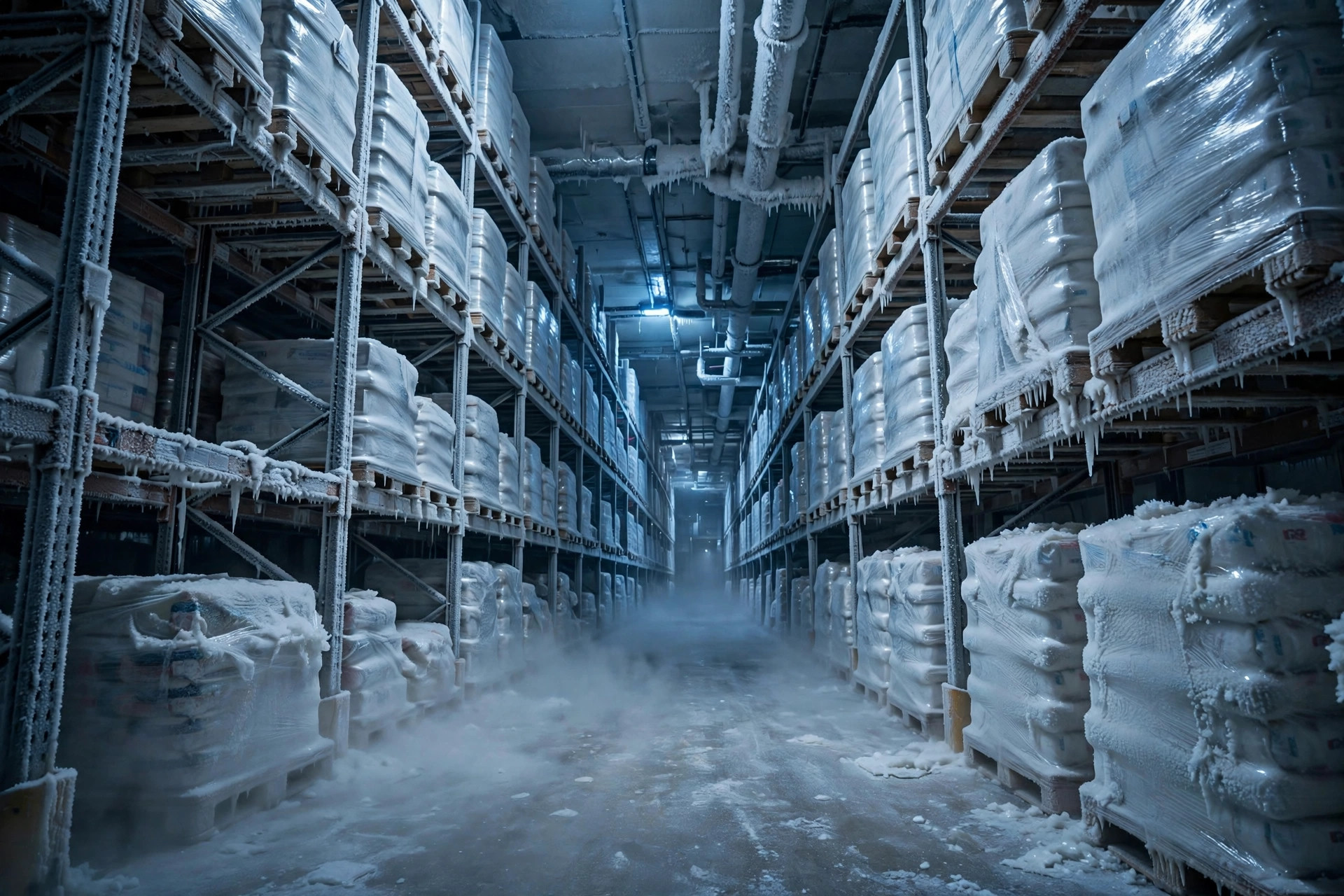
Trap two: condensation. Move a vehicle across a big temperature delta and condensate creeps onto control boards and LiDAR; tires slipping on frosted floors are just daily life. "No condensation across temperature zones" is the core capability you're paying for in a cross-zone unit. Bought a freezer-dedicated one? Then keep it in the freezer — don't send it out to "grab a quick ambient load" on the way.
Trap three: how many spare battery packs. Here's a sizing rule of thumb (illustrative): spare packs ≈ 24 ÷ single-charge runtime in hours + 1. An 8-hour vehicle on three shifts needs at least 4 packs in rotation; a 12–18-hour one gets by with 3. That "+1" covers surprises and age-related fade — don't cut it. The pack you save today will bill you double on peak-season day.
Three Questions for the Vendor Before You Sign
One: at what temperature was that runtime measured? If they can't produce a measured curve at -25°C (or your actual storage temperature), take the nameplate 8 hours and plan shifts around 5. Two: what exactly is the BMS low-temperature charging strategy? Down to what fraction is charge current clamped at -20°C — and will they put it in the technical annex? Three: how does the cross-zone unit actually prevent condensation — sealed structure with positive internal pressure, or just "we've handled it"? If they can't answer, don't sign no matter how cheap the quote looks. Whatever you save on purchase price will come back doubled in the first winter's repair tickets.
So here's my verdict, and it's a purchase rule, not a slogan: track effective handling hours per vehicle-day — total time actually moving goods, after subtracting charging, warm-up, and waiting, divided by 24. If a freezer AMR can't clear 60%, don't sign anything. Fix the spec or the schedule first, then talk ROI. Everything else is decoration.
By Da Liu, Automation Engineer