
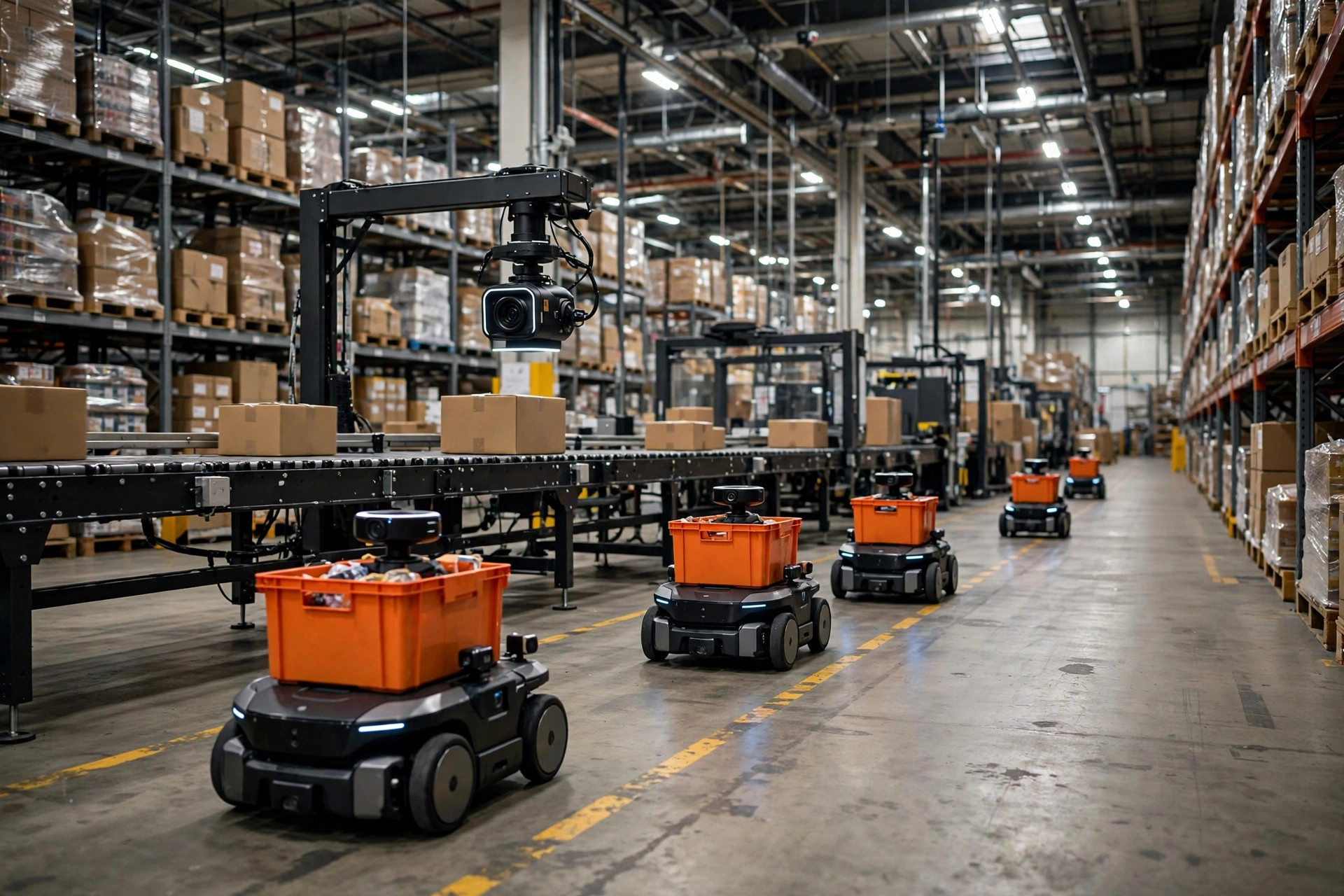
The shorthand version of the China–US warehouse AI adoption comparison fits in one sentence: America bets on AMRs, China bets on algorithms. In 2025, Amazon announced that its global warehouse robot fleet had crossed one million units, roughly matching the headcount of its frontline fulfillment workforce. Around the same time, Interact Analysis reported that China accounted for 58% of global mobile robot shipments in 2024, and forecast that share would fall to 46% by 2030. Put the two numbers side by side and the story looks complete — America stacks hardware, China stacks algorithms. But that story is only half told, and the other half is the interesting one.
The Same AMR, Living Two Different Lives in Chinese and American Warehouses
Start with the United States. In September 2024, Amazon opened a 3.1-million-square-foot fulfillment center in Shreveport, Louisiana, deploying nine categories of robotic systems including Sequoia, its AI-and-computer-vision inventory handling platform. The company said next-generation sites would run about 25% faster, with robots touching more than 75% of customer orders. Then in 2025 came DeepFleet, an AI model that coordinates traffic and routing for the entire robot fleet. Note the detail: the most hardware-heavy player in the US is managing its million robots with the heaviest algorithms. The idea that America "doesn't do algorithms" is a misunderstanding.
Now look at China. The other road is shelf-to-person: Cainiao's Huiyang warehouse, commissioned in 2018, once deployed several hundred AGVs and ranked among the largest robot warehouses in the world at the time. Geek+'s shelf-to-person systems were then replicated across e-commerce warehouses at scale, and industry press citing Interact Analysis has ranked the company first in global AMR shipments for several consecutive years. What is more revealing is how the robots are used: many e-commerce cloud warehouses in eastern China rent extra AMRs ahead of the Singles' Day peak and return them afterward — robots hired elastically, on the rhythm of the shopping festival. That usage pattern barely exists in the capex logic of large American warehouses. America buys assets; China rents flexibility.
Three Sets of Numbers That Explain the China–US Warehouse AI Divide
| Dimension | The American road | The Chinese road |
|---|---|---|
| Starting motive | Expensive labor, post-pandemic hiring pain: swap opex for capex | Volatile e-commerce peaks, rising labor costs: flexibility first, algorithms for throughput |
| Dominant form | AMR fleets plus robotic arms in giant fulfillment centers — Amazon alone runs over a million units | Shelf-to-person and tote-to-person AMRs plus scheduling algorithms — China took 58% of global mobile robot shipments in 2024 |
| Representative players | Amazon (builds for itself), Locus (leads in person-to-goods picking robots), Ocado (absorbed 6 River Systems) | Geek+, Hikrobot, Hai Robotics, Quicktron |
| Where the algorithm sits | DeepFleet orchestrating a million robots: the algorithm is the traffic cop | Waving, slotting, pathing, vision: the algorithm is the foreman |
| Current bottleneck | High integration costs, long 3PL sales cycles | Domestic demand plateauing, price wars, US tariffs scrambling supply chains |
The third set of numbers is about penetration. Interact Analysis forecasts that by 2030, only about 13% of warehouses worldwide will have deployed even a single fulfillment AMR. Whichever side of the Pacific you stand on, warehouse AI is still in its very early innings — it is far too soon to declare a winner.
Why the Roads Diverged: Three Causal Chains
The first chain is the shape of the labor market. The American logic is substitution: labor is expensive and hard to hire, so automation is capex that hedges labor risk, and ROI is measured in headcount avoided. The Chinese logic is elasticity: e-commerce peaks can run several times the trough, so a fixed automation fleet makes less sense than algorithms plus rentable, flexible capacity, and ROI is measured in peaks survived and idle time avoided. The divergence is first a function of labor pricing and volatility, and only second a matter of technology preference. That causal order matters.
The second chain is the industrial base each side is comfortable in. The US has Amazon-scale fulfillment scenarios; after the $775 million Kiva acquisition in 2012, the road was build-it-yourself and closed-loop, with slow technology spillover. China has the world's largest manufacturing supply chain and the densest e-commerce scenarios, so the AMR body quickly became a commodity and competition was forced toward algorithms, delivery speed, and cost. China's "algorithm-first" posture was not a free choice — it was the optimal response that cutthroat competition produced.
The third chain is the tide of capital and policy. From 2016 to 2021, Chinese capital chased robotics startups on top of "machine-replaces-man" policies, producing the world's largest population of AMR vendors — and overcapacity. Once domestic demand plateaued, going global became the mandatory question. On the American side, tariffs are reshaping supply chains: Interact Analysis has explicitly flagged shelf-to-person systems, heavily served by Chinese vendors, as the category hit hardest by US tariffs. There is an irony here that deserves attention: as the US tries to reduce dependence on Chinese supply chains, its own AMR deployments may get slower and more expensive.
Who Is Copying Whom: Three Timelines for the Second Half
The most counterintuitive point is that the "America does AMRs, China does algorithms" dichotomy is already breaking down. Amazon's DeepFleet proves that the hardest hardware player is the most aggressive on algorithms; what Chinese vendors sell abroad was never just the robot body, but a packaged deal of algorithms, delivery, and cost. Hardware is becoming a commodity. The real fork was never hardware versus algorithms — it is about who sits closer to the order flow.
Back to the China–US warehouse AI adoption comparison: the second-half outlook lands on three timelines. In the near term (2026–2028), Chinese vendors keep pushing abroad, with the US market as the must-win and tariffs as the biggest variable; American 3PL procurement cycles are long, so deployments land slowly but at large single-site scale — each side is taking the other's remedial classes. In the medium term (2028–2030), if Interact Analysis's forecast holds, China's shipment share falls to 46% and its revenue share to 27%, while the US and EMEA accelerate and the two roads converge. There is also a long-term variable: humanoid robots and general-purpose vision models could rewrite the whole "AMRs versus algorithms" taxonomy — but that is a post-2030 story, and the evidence is not there yet, so I will leave it out.
So, who is copying whose homework? Perhaps the question itself is wrong. America uses robots to hedge labor risk; China uses algorithms to hedge volatility risk. Nobody is copying the other's answer — each is learning how the other frames the question. When the AMR body becomes a commodity, and when nearly nine in ten warehouses still run zero fulfillment robots in 2030, the question worth asking might be: where does the next fork begin?
By Dr. Chen, Supply Chain Researcher





