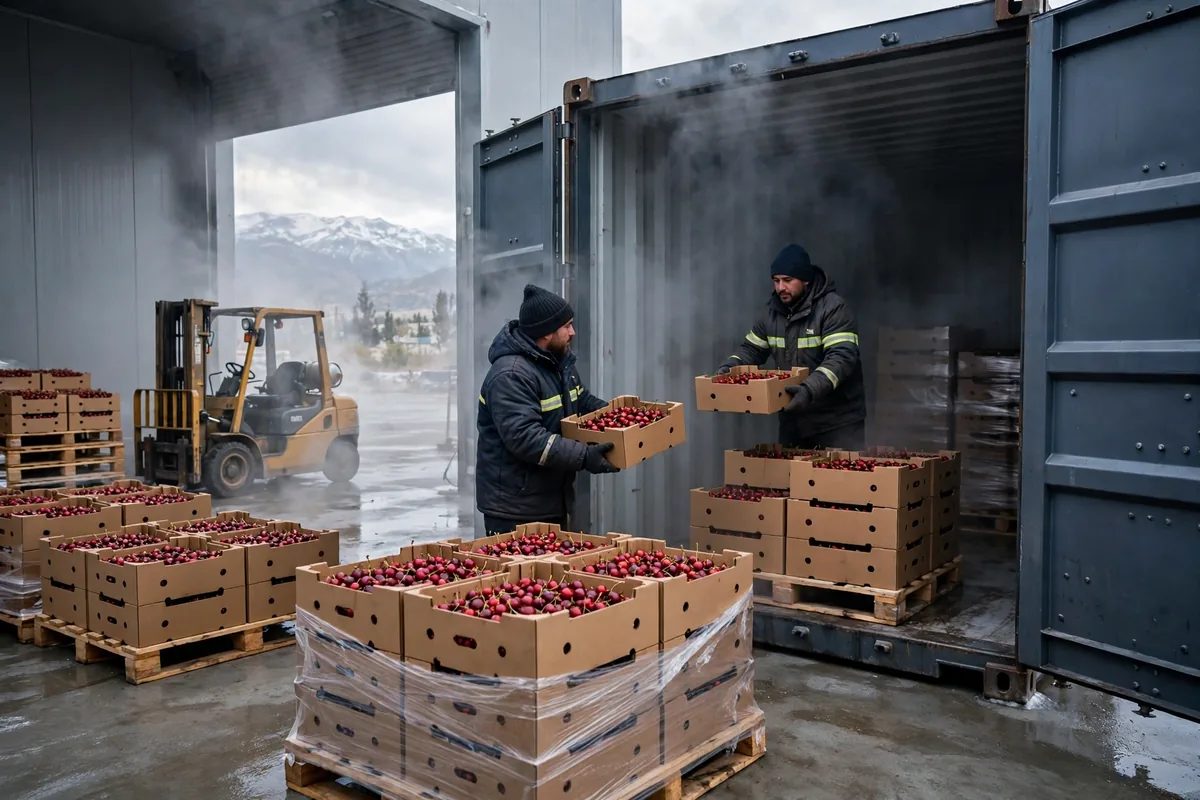
On paper, the Chile cherry ocean freight cold chain looks like a shipping problem. In practice, it is a thirty-day exercise in never letting the temperature slip. According to Chilean industry figures, cherry exports reached 625,200 tonnes in the 2024/25 season, up 51.1 percent to a new record. Ninety-five percent moved by ocean freight, 3 percent by air, and 1 percent by land. China took 90.8 percent of the total, or 567,600 tonnes. Nearly every cherry a Chinese consumer eats in winter spends about a month at sea, and the cold chain cannot break for a single hour of it. This article examines the three points where it most often does.
The baseline parameters are unforgiving. Cherries travel at minus 0.5 degrees Celsius, plus or minus 0.5 degrees, at 90 to 95 percent relative humidity. That is a narrow window. At zero degrees, respiration runs at roughly one-seventh of its rate at room temperature, so every degree of warming accelerates aging sharply. There is also a quarantine layer: fruit bound for China must undergo cold treatment at no more than 0.5 degrees Celsius for fifteen consecutive days. If the temperature exceeds the threshold at any point, the treatment restarts from day one. A break in the chain costs more than a few days of shelf life. It can cost the phytosanitary eligibility of an entire container.
Breakpoint One in the Chile Cherry Ocean Freight Cold Chain: Pre-Cooling Falls Short
The first breakpoint in this cold chain is not at sea. It is before loading. Cherries come off the tree near ambient temperature and must be hydrocooled to between zero and one degree Celsius as quickly as possible. When pre-cooling is incomplete, fruit goes into the reefer carrying field heat, and the container's refrigeration unit spends hours pulling the core temperature down. During those hours, the fruit respires several times faster than it should.
The scale of the 2024/25 season made this worse. Export volume rose 51.1 percent in a single year, but packing-house pre-cooling capacity did not grow at the same pace. At peak harvest, picking, packing, and pre-cooling all ran at full load, and some lots waited extra hours in the packing shed before entering the pre-cooling room. A few hours sounds trivial. For a cherry in its post-harvest respiratory peak, it can cost several days of shelf life. The damage is invisible at loading: the data logger shows the container temperature is normal, and the soft fruit and browning only appear when the box is opened in China, by which time responsibility is impossible to assign.
The arithmetic is clear. A 40-foot reefer holds roughly 2,560 to 2,880 five-kilogram boxes, or 12.8 to 14.4 tonnes. Every degree of excess fruit temperature raises the refrigeration load and the aging rate of the whole container. Our assessment is that investment in origin pre-cooling has the highest return anywhere in the chain: building one more pre-cooling room costs far less than losing one container at sea.
Breakpoint Two in the Chile Cherry Ocean Freight Cold Chain: Stuffing and Waiting at the Terminal
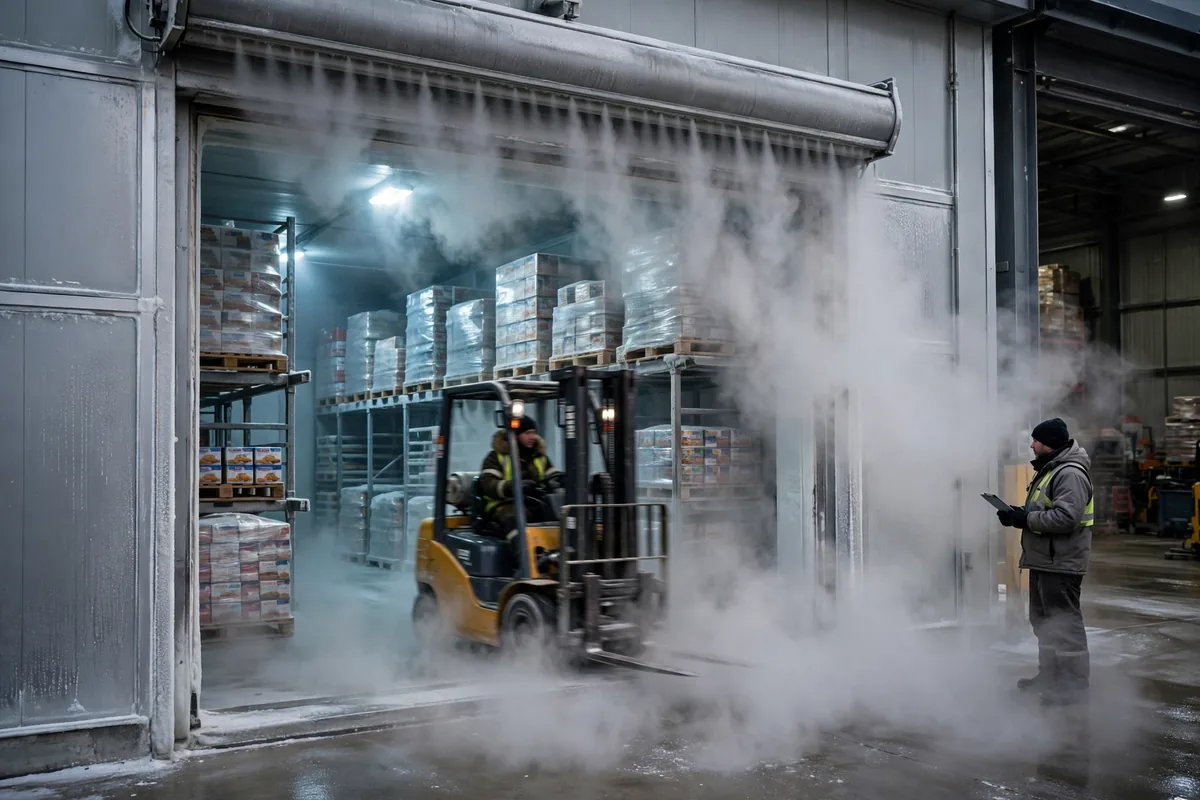
The second breakpoint is stuffing and waiting at the terminal. A reefer sitting in the yard needs a power plug, and the number of plugs is a hard constraint. San Antonio is Chile's main cherry export port, where DP World operates more than 2,700 reefer plugs. In 2024/25 the terminal handled over 12.8 million boxes of cherries, double the previous year. Even so, at peak season, if plugs, trucks, and the loading plan fall out of sync, a reefer can end up waiting in the yard.
Waiting itself is manageable. The risk concentrates in the transitions: the container moves from the cold store to the yard, then from the yard onto the vessel, with brief power interruptions, door openings, and direct sun on the box. Each event moves the internal temperature a little. Two or three such events in one voyage add up. For the 2025/26 season, CMA CGM scheduled eight Cherry Express sailings from Chile to China, up from six, at 23 days per voyage. The industry as a whole doubled direct sailings to 32. A direct sailing takes 23 days against roughly 30 for a standard service. Those seven saved days are, in effect, slack built into the cold chain.
Here is a counterintuitive point: a shorter transit is not always cheaper. Express sailings cost more than standard services, and shippers hesitate at the booking desk. But run the loss rate through the calculation and the picture changes. If cutting the loss rate from 5 percent to 2 percent saves more in cargo value than the express premium costs, the faster ship is the cheaper option. All amounts above are hypothetical examples used to demonstrate the costing method. Actual rates are subject to the latest published tariffs. The real question is whether the shipper prices freight per container or prices saleable fruit at arrival. Most still price the freight, and that is where the calculation goes wrong.
Breakpoint Three in Chile Cherry Ocean Freight: Arrival, Discharge, and Distribution
The third breakpoint comes after arrival. China is the destination, and the stakes are concentrated: Chilean cherry exports were worth 3.1 billion US dollars in 2024, with more than 90 percent going to China, and the peak selling window sits just before the Lunar New Year. With DP World San Antonio alone expecting 13 cherry vessels for the 2025/26 season, vessels arrive in clusters, and the pressure on port cold storage and distribution capacity doubles with them. Discharge, inspection, transfer into cold storage, and dispatch to wholesale markets across Chinese cities all have to queue. Every queue adds hours outside controlled conditions.
Arrival also carries a documentation risk that is invisible at origin. Temperature sensors must record at least once an hour, accurate to plus or minus 0.1 degrees Celsius, and the data must be complete. If part of the voyage's temperature record is missing or shows an excursion, the validity of the entire cold treatment can be questioned, and the process may have to be repeated. That is a cost discovered at the destination, where it is most expensive to fix.
The industry is responding in two directions. First, sailings are getting shorter and more frequent, with the 23-day direct service becoming the standard configuration as forecast exports rise to 670,000 tonnes for 2025/26. Second, temperature data is becoming transparent end to end, from cold store to yard to vessel, so a failure can be traced to a specific step instead of triggering a dispute over the whole container. Neither idea is new. What they share is a shift in where reliability comes from: less from individual experience, more from data and process.
The 3 Percent Air Versus 95 Percent Sea Calculation
Finally, the overall trade-off. Why does 95 percent go by sea and only 3 percent by air, when air freight takes days and carries far less temperature risk? The cost structure answers it. Air suits the first shipments of the season, when prices are highest and can absorb the freight. Once volume peaks and prices soften, air freight's share of the landed cost becomes unsustainable, and sea freight is the only option. Export volume rose 51.1 percent in 2024/25, yet air's share did not rise with it. That alone shows sea freight is the industry's default and air is a supplement.
The real question for the Chile cherry ocean freight cold chain was never whether sea freight works. It is whether the three breakpoints can each be held: pre-cooling done properly, stuffing and terminal waiting controlled, and arrival and distribution sequenced smoothly. Hold all three and the loss rate stays within commercial tolerance. Lose any one of them and the loss multiplies in the pre-New Year selling peak. The open question for the industry is whether pre-cooling rooms, reefer plugs, and port cold storage can grow as fast as export volume. If they cannot, the next season's breaks will appear in exactly the same places.
By Dr. Chen, Supply Chain Researcher