Here's the uncomfortable truth: a warehouse shipping 800 orders a day can fund an extra packer's salary for a year just by moving its main carton down one size. Dimensional weight doesn't charge you for your product. It charges you for the air around it.
I've watched too many warehouses bleed money at the pack station, and it was never laziness. It was math nobody did. A bigger box costs a few cents more at purchase, so procurement shrugs. Packers grab whatever's handy, toss in some void fill, and seal it. Everything looks fine until the month-end freight bill lands and the number makes no sense. The culprit is sitting right there on the bench: the empty space inside the box.
What you're actually paying for
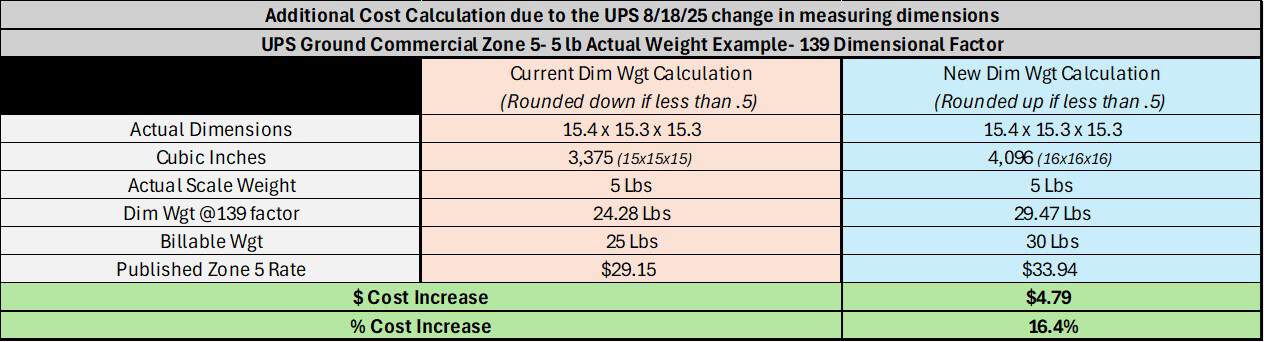
Dimensional (DIM) weight is how major US parcel carriers have priced shipments for the better part of a decade, and the logic is brutally simple: on a truck or a plane, space is worth more than weight. Ship a box of down jackets that weighs almost nothing but eats the space of a far heavier parcel, and the carrier will bill you for the space. Billable weight is whichever is greater: the actual scale weight, or the dimensional weight, calculated as length × width × height in inches divided by the carrier's DIM divisor. The divisor currently sits at 139 for most domestic account rates, and the postal parcel services moved from 166 down to 139 earlier this year, so the industry has effectively converged. Carriers revise these policies regularly, so check the carrier's latest published policy before you model anything.
Run the numbers on a real scenario. You sell desktop organizers; the product weighs 3 pounds. The packer reaches for an 18×14×12-inch box: 3,024 cubic inches divided by 139 gives a DIM weight of 21.76, rounded up to 22 pounds. You get billed at 22 pounds for a 3-pound product. Now the 14×12×10 box: 1,680 cubic inches ÷ 139 = 12.08, rounded up to 13 pounds. Same product, one box size down, and billable weight drops from 22 to 13 pounds. At typical zoned parcel rates, that's several dollars per shipment. Multiply by 800 orders a day and you're looking at six figures a year, evaporating into thin air — literally.
Where the money really goes
The cruel part of DIM weight is that it's invisible. Scale weight gets measured every day; DIM weight gets measured by nobody. Plenty of warehouses don't even keep SKU dimensions in their WMS. Box selection runs on packer instinct, which means "this looks like it fits." The gap between "fits" and "fits well" is pure cost.
I once diagnosed an e-commerce warehouse in Southern California's Inland Empire selling small home goods. Six carton sizes on the bench, 400-plus SKUs, and the box-selection rule was a sheet of paper taped to the wall: small items get small boxes, big items get big boxes. More than half their orders were billing at a DIM weight over double the actual weight. The worst one I found: a 2-pound decorative item shipped in a box with a 19-pound DIM weight — billable weight nearly ten times the product weight. The packer's explanation? "That box was closest." Two words, and a month's worth of freight overcharges could have bought a new case sealer.
There's a second, quieter leak: void fill. Oversized boxes need filling — bubble wrap, kraft paper, air pillows — and none of it is free. On an oversized carton, void fill can run to a third or more of total packaging cost. Worse, the fill itself adds weight. So the oversized box taxes you twice: inflated DIM charges on the freight side, and extra packaging spend on the materials side.
The five-step fix
Theory is cheap. Here's the sequence I'd run in any warehouse; one to two weeks gets you through the first pass.
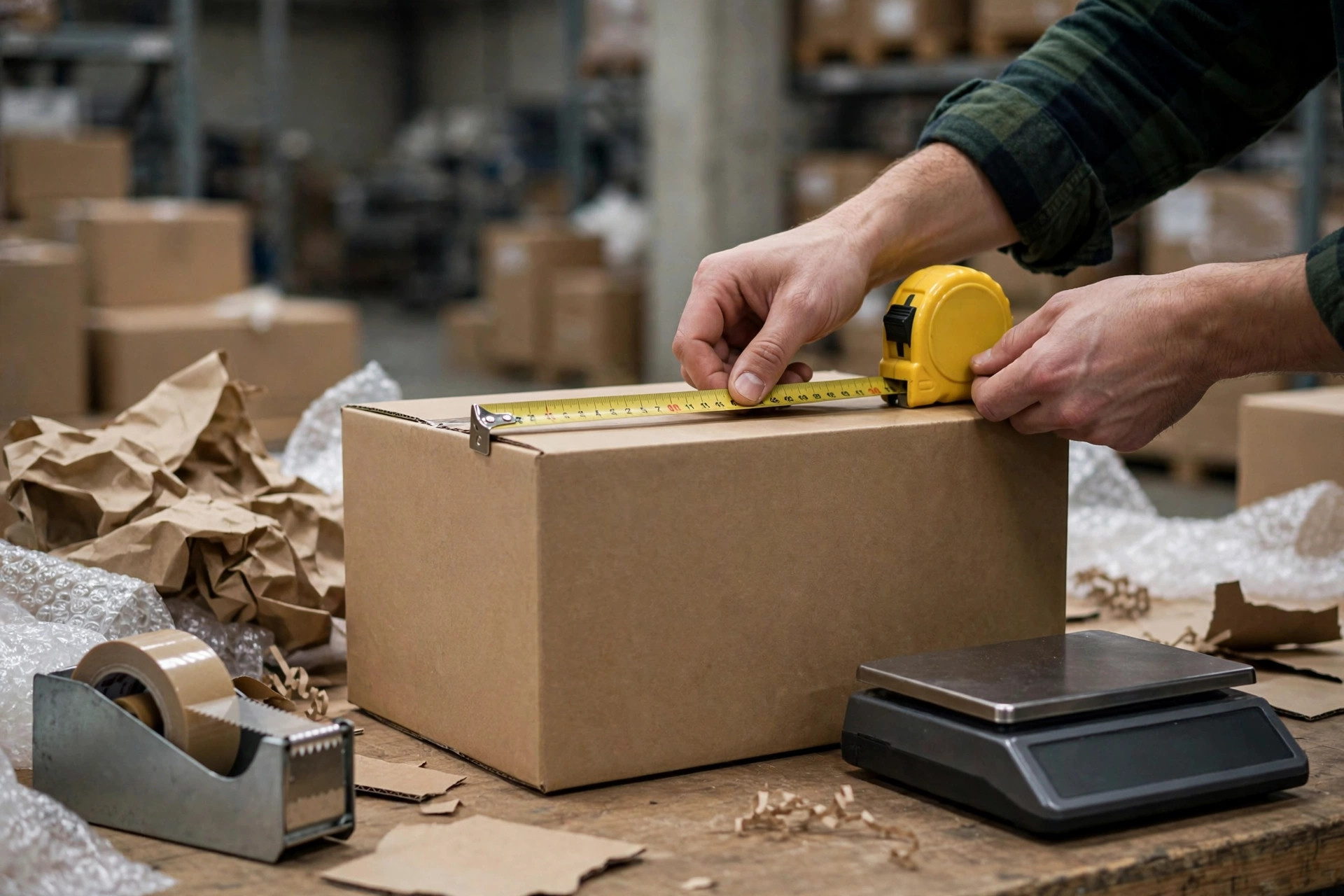
Get real measuring tools first. Don't hand packers a tape measure — it's slow and sloppy. The serious setup is an automated dimensioning station on the line that captures length, width, height, and weight in one pass and feeds it straight into the system. Smaller operations can start with a decent scale, a laser measure, and a disciplined spreadsheet. The non-negotiable part is that the data lives in the system, not on paper.
Then build a dimension record for every active SKU. Measure the product in its smallest sales packaging, not the bare product — this is where most people fail. They measure the item, but it ships in a retail color box, and that extra inch on each side invalidates every carton assignment downstream.
Third, run the carton match with data, not gut feel. Export three months of order history, compute the shipped dimensions of each SKU combination, and look at each carton size's actual usage frequency and void ratio. The rule of thumb I use: leave half an inch to an inch of clearance on each side. More than that is waste; less than that and you're crushing product. Any carton size running a void ratio above roughly a third for months should be downsized or retired.
Fourth, encode the selection rule and put it in front of the packer. Keep it dead simple: single-SKU orders get the carton assigned in the SKU master data; multi-SKU orders get a recommendation based on total cubic volume plus a buffer. Put a scan gun at the station so scanning the order pulls up the recommended box on screen — that kills the "grab whatever's closest" habit. After launch, audit weekly. If the recommendation compliance rate drops below about ninety percent, go to the bench and find out whether the rule is wrong or the people are ignoring it.
Fifth, review monthly. Pull the numbers: usage by carton size, the ratio of average DIM weight to actual weight, void-fill purchasing volume. Cartons that stay stubbornly high on that ratio get adjusted next month. This never ends, because your SKU mix never stops changing — every new product launch can quietly break last quarter's rules.
The small-box trap
Someone always asks: why not just use the smallest box for everything? Because the cost just moves somewhere else.
First, damage. A box with zero clearance leaves no room for cushioning, and transit shocks go straight into the product. One return costs multiples of the original freight, plus customer-service time and marketplace rating damage. I saw a ceramics warehouse squeeze cartons to the limit to beat DIM weight; their damage rate went from a fraction of a percent to around two percent. Every dollar of freight savings went into replacements and reships, with interest.
Second, pack speed. Tight boxes are fiddlier to fold and seal. Packers slow down, units per labor hour drop, and US warehouse labor isn't cheap. If the freight savings get eaten by extra labor hours, you've just rearranged the expense.
Third, box strength. Downsizing while downgrading board grade to save money is a classic own goal — weak boxes collapse in stacking, and one crushed pallet layer ruins every order in it. Size, board grade, and price have to be optimized together with your box supplier; optimizing size alone is tunnel vision.
So here's my verdict: the goal isn't the smallest box, it's the right box. The standard is one sentence — minimize billable weight without letting the damage rate move. Tape that to the pack-station wall.
One thing to do tomorrow
Don't try to re-box the whole warehouse at once. Tomorrow morning, pull 50 random orders from yesterday's shipments, compute the DIM weight for each from the carton dimensions, and count how many billed on DIM rather than actual weight. If it's more than half, your warehouse is paying an air tax.
Then take the single worst SKU, move it down one carton size, and run it for two weeks, watching freight cost and damage rate side by side. If it works, move to the next SKU. Chew through them one at a time; three months of this and the savings will speak for themselves. No project charter, no new equipment — one spreadsheet and one SKU is enough to start. The money hiding in dimensional weight is hard to see, but it's easy to recover, once you bother to measure.