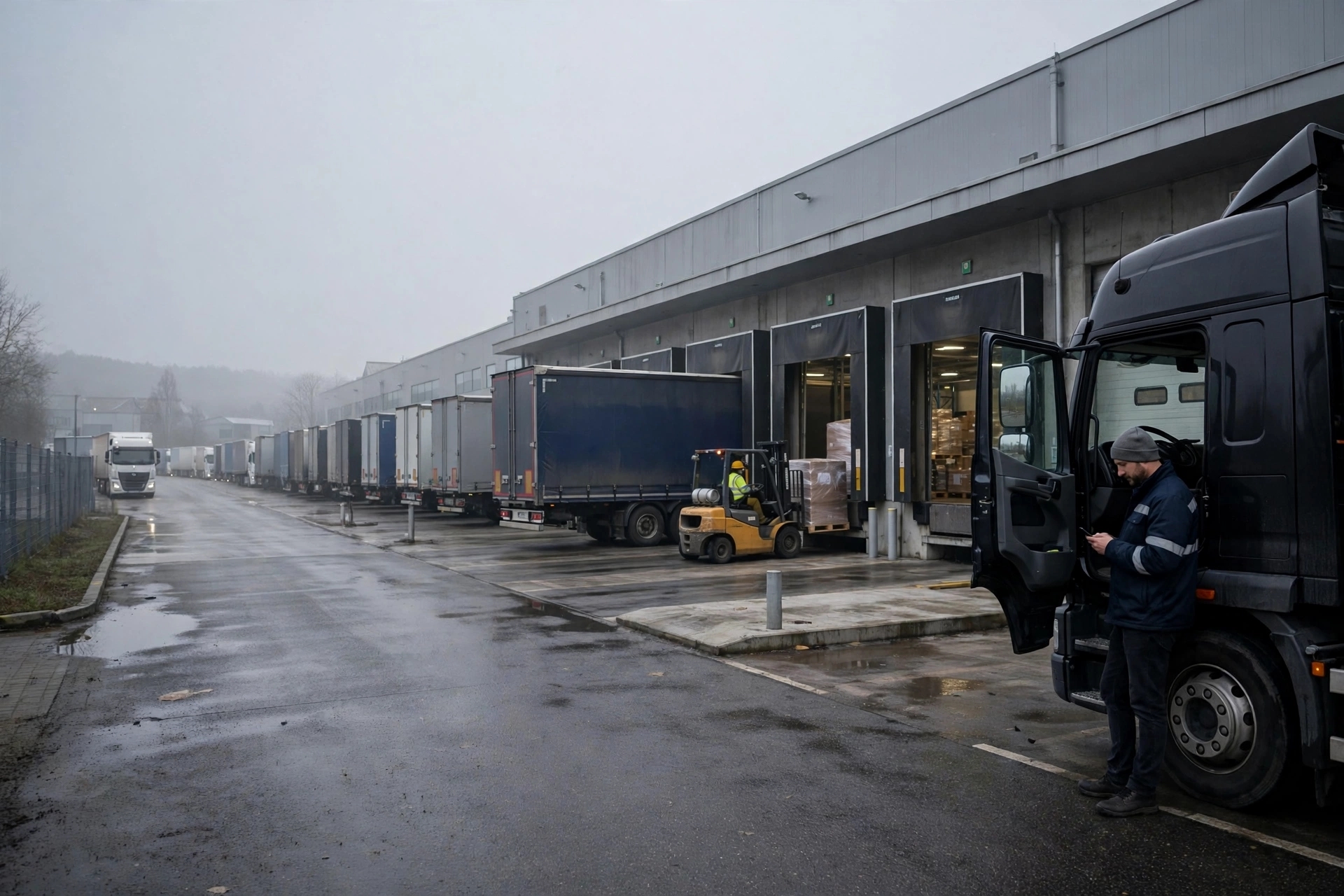
Let me tell you, cargo warehouse slot booking is the kind of thing you only really understand from the cab. Last fall I was sitting outside a warehouse in Ontario, California, at seven in the morning, and the truck ahead of me had been parked there since six-thirty, the driver asleep on his steering wheel. When my turn came, a guy leaned out of the dock door and said the booked truck hadn't shown, the freight wasn't ready, and I should just wait. I waited more than two hours, and my whole day fell apart. After fifteen years on the road, I've seen this scene more times than I can count: the truck books a slot and never comes, the truck comes and the freight isn't ready, the freight is ready and there's nobody at the dock. Nobody wants it this way, but everybody thinks it's the other guy's fault.
This is not about lazy people. The American Transportation Research Institute found in its 2023 survey that drivers were detained at 39.3% of all stops, costing the U.S. trucking industry $3.6 billion in direct expenses and $11.5 billion in lost productivity in a single year. An earlier study sponsored by the Federal Motor Carrier Safety Administration found detention at roughly one stop in ten, averaging 1.4 hours beyond the usual two-hour window. And here's what makes it sting: a driver can drive 11 hours, all inside a 14-hour window that starts the moment he comes on duty and never pauses. Two hours waiting at a dock isn't two hours of lost pay. It's two hours off a day that can't be stretched.
Cargo warehouse slot booking has to be tiered, not one-size-fits-all
Most warehouses run cargo warehouse slot booking with a single mold: a half-hour box, same for everybody. But freight isn't the same, so the work isn't the same. A truck full of uniform pallets can be unloaded in fifteen minutes. A mixed load that has to be counted piece by piece can take over an hour. Stuff both jobs into the same half-hour box and you get the worst of both worlds: the on-time truck waits in line while the no-show's box sits empty.
I know a warehouse that got this right by splitting its slots into three tiers. Fast tier for uniform pallets, single product, freight staged in advance: half an hour. Middle tier for mixed products that need sorting: one hour. Slow tier for loads that need inspection or quality checks: scheduled after ten in the morning, clear of the early rush. Tiering also shrinks the damage when somebody no-shows. A fast slot opens up, dispatch can pull a truck straight out of the queue to fill it. A slow slot opens up, and it was already built as a buffer for difficult work, so the loss is small. The logic is simple: booking isn't first come, first served. It's sort the work first, then hand out the time.
Tiering only works if rescheduling is easy. A driver hits traffic or gets held up at the previous warehouse, calls two hours ahead, and should be able to move his slot, no penalty, no no-show mark. The warehouses that get this wrong are the ones where rescheduling is harder than showing up late: nobody answers the phone, the system won't let you change anything, so the driver just comes at the original time, can't get in, and both sides log a complaint. Open the reschedule door wide and the no-show rate goes down, which sounds backwards until you've driven the route. People don't break appointments because they feel like it. They break them because there was no other way out.
Cargo warehouse slot booking no-shows need a ledger, and the ledger has to blame the right party
Tracking a no-show rate is useless if you don't track who didn't show, why, and how long the dock sat empty. I know a fleet owner who has dispatch pull a weekly sheet: how many trucks booked, how many came, and the no-shows split three ways, the carrier's own fault, the shipper's freight not ready, or the warehouse changing the time. After three months the sheet told the truth. The carrier's own fault was only about three in ten. Freight not ready was nearly half. The warehouse had been saying the carriers were unreliable for years, and the sheet shut that conversation down.
A ledger also separates the repeat offenders from the one-time misses. A carrier who books twenty times in a month and no-shows five times is a different problem from a driver who missed once in a year. For the repeat offender, tighten up: confirm the next booking in advance, and after repeated no-shows, take away the priority slots. For the one-off, a phone call is enough. And it cuts the other way too. When the warehouse leaves a driver sitting for two hours because the freight wasn't staged, that goes on the ledger as well. If nobody writes it down, the driver gets stood up at the same door next week.
One more thing, and it's an old saying among drivers: a no-show record is for fixing the work, not for getting even. I've seen warehouses pull up a driver's old record at the gate before he's even parked, and the driver walks in angry, and the whole load goes badly. Put the record on the table and talk about next time, not about who's right and who's wrong.
When a slot goes empty, don't just stand there
The biggest waste in cargo warehouse slot booking is an empty slot nobody fills. A truck no-shows, a dock sits empty for an hour, the forklift crew stands around, and the next truck waits outside for its own slot. That's the worst possible deal: people with work have no dock, and the dock has no work.
A good warehouse moves the minute a no-show happens. The booked truck is 15 minutes late, dispatch makes one phone call to confirm. Confirmed not coming, they pull a truck out of the queue at the gate and bring it in early. The truck that jumps in doesn't get a freebie: it takes that slot's job, finishes, and leaves without eating the next slot. Another approach is to hold flex slots: one or two slots every morning that are never offered to the public, kept for soaking up no-show gaps and urgent loads. A flex slot looks like waste on paper. In practice it's insurance: without it, a single no-show can turn the whole day's schedule into a mess.
None of this works without information moving. The driver has to know a slot opened up, and the warehouse has to know what the waiting truck is carrying. Some warehouses just put a board at the gate or run a group chat, and the moment a gap appears somebody shouts, and it's filled in ten minutes. The technology costs nothing. What's worth money is somebody willing to shout the moment the gap appears.
There's a related corner worth knowing: the rules for booking a drayage terminal appointment are the same game under a different name, booking time, holding a resource, and dreading the no-show. Terminals run it tighter, appointment, gate, and pickup linked step by step, and a warehouse can borrow the whole playbook: confirm, remind, allow reschedules, and backfill. If you want the terminal version of the same discipline, the drayage terminal appointment booking guide lays out how that side of the fence does it.
At the end of the day, a booking system manages people, not boxes on a calendar. Draw the boxes as fine as you like, if people won't keep them, nothing works. If people want to keep them, rough boxes will do. The driver wants in on time and out on time. The warehouse wants the dock busy and the freight moving. It's the same ledger, both sides of it. Whoever reads it first, and gives a little ground first, gets the road open. Fifteen years out here taught me one thing: if you booked it, show up, and if you can't show up, say so early. Say it early, and there's still something to work with.
By Shifu Zhao, Trucking Veteran (15 yrs)