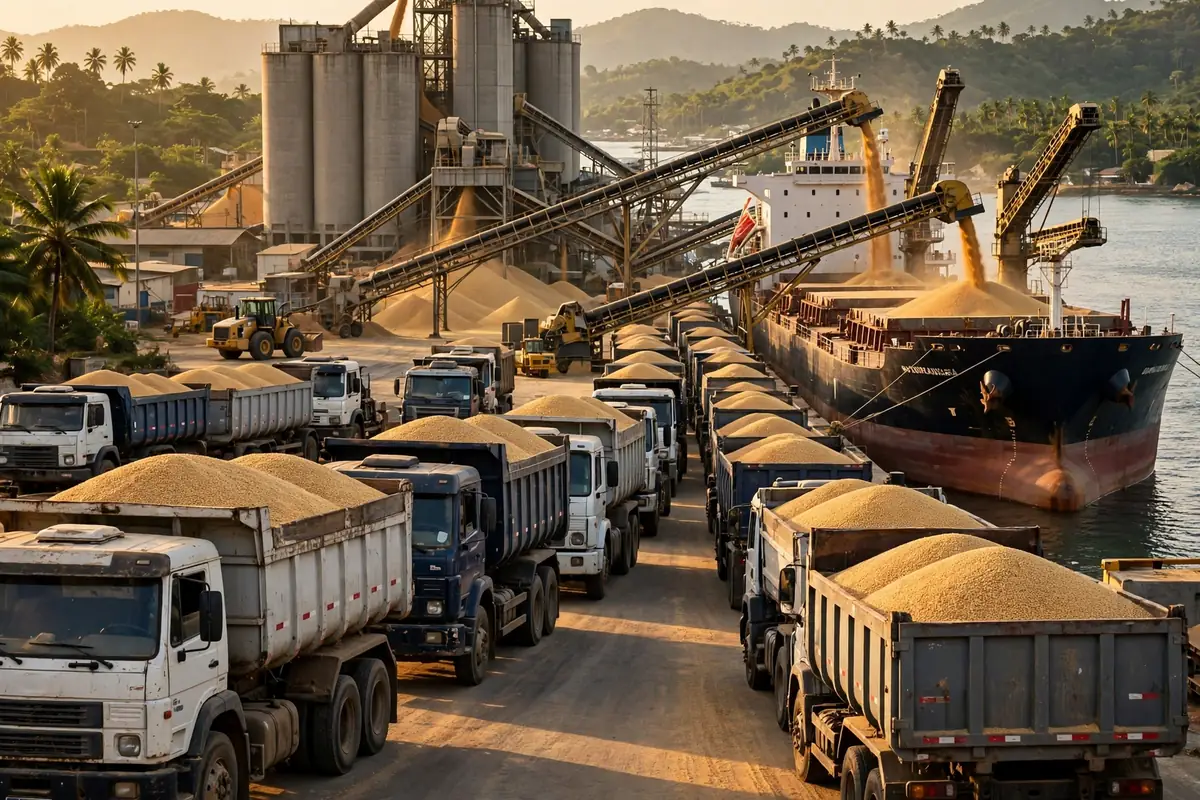
Let me tell you something about the Brazil soybean export run: what drivers fear most is not the distance, it is getting stuck where the highway meets the port of Santos and not being able to move. I once rode along with a soybean truck out of Mato Grosso, and the convoy sat in the queue outside the port burning fuel and burning time while the driver ate dry bread in the cab and said this is just normal life in Brazil's soybean season. The Brazil soybean export warehouse storage story looks like a port story on the surface, but its roots are on the road.
Brazil's soybeans grow mostly in Mato Grosso, in the center-west of the country, with the north of the state around Sorriso at the heart of it. From the field, the beans have to get to Santos to be loaded onto a ship. According to the U.S. Department of Agriculture's Soybean Transportation Guide: Brazil 2025, published in September 2026, the all-truck route from Sorriso to Santos runs about 1,190 miles. Think about what that means: a driver sets out from the producing region and drives day and night for days to reach the port. Road conditions, weather, fuel stops, rest — everything along the way is a variable, and by the end of one trip both the driver and the truck are worn out.
The Brazil Soybean Export Road Starts at the Farm, Not the Port
All-truck is not the only way. The other route is truck first, then rail: about 382 miles by truck from Sorriso to the rail terminal at Rondonópolis, then about 1,019 miles by rail to Santos. Look at the mileage alone and the combined route comes to about 1,401 miles — longer than the all-truck 1,190 miles. But mileage is the wrong way to judge it. Once the beans are on a train, no driver has to sit in traffic watching them, and the rail leg gives you a certainty that a truck never can.
Rondonópolis is where the whole chain jams up. The guide records that the transload terminal there once had a queue of 3,500 trucks. Picture 3,500 trucks lined up end to end, stretching out of sight, drivers waiting in their cabs not for hours but for days to unload. Getting beans from the farm region to the terminal is not the hard part. The hard part is unloading them at the terminal and getting them onto a train. Beans pour in from the producing region like a tide, and the terminal's throughput is the bottleneck. If you work in Brazil soybean export warehouse storage and you only watch the port, you are watching the wrong end — first check how long the queue is at the terminal.
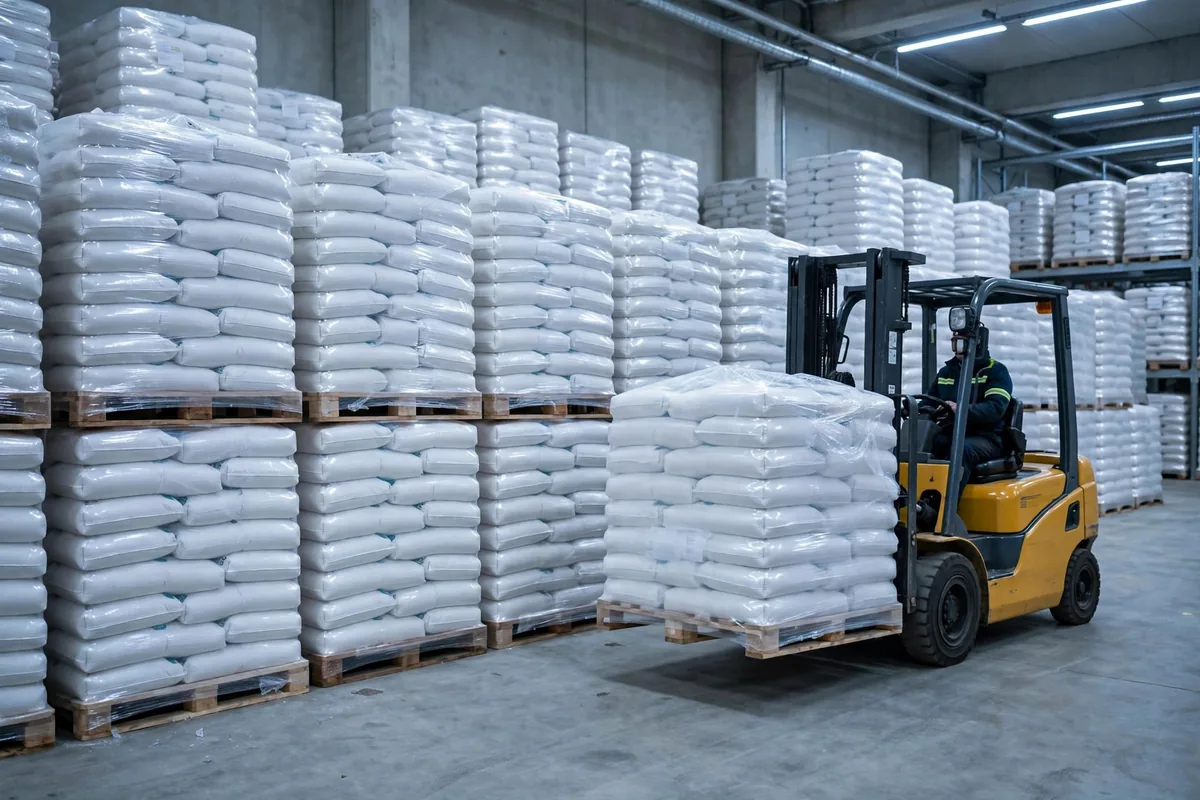
I know a man who runs a small restaurant near the terminal. He says when soybean season comes, his place is full of drivers waiting to unload — business is wonderful, but every driver at his tables looks miserable. A meal costs little; a truck sitting in the queue for another day costs real money on the freight bill, with the cargo owner calling and the vessel schedule pressing. The job of warehousing on this chain is not to build a giant shed and pile beans in it. It is to keep the beans from sitting still — in a truck, in a queue. Farm-region storage, terminal storage, and port storage have to move at the same rhythm. If any one of the three falls behind, the queue is there to stay.
Put the two routes side by side, and the choice is not about mileage — it is about whether your cargo can afford to wait:
| Route | Truck leg | Rail leg | Total, about | Worst bottleneck |
|---|---|---|---|---|
| All truck | Sorriso to Santos, about 1,190 miles | None | About 1,190 miles | Queues around the port |
| Truck plus rail | Sorriso to Rondonópolis, about 382 miles | Rondonópolis to Santos, about 1,019 miles | About 1,401 miles | Rondonópolis terminal — once a 3,500-truck queue |
All-truck is shorter on paper, but the driver and the truck are on the road the whole way, and when the port jams, the whole road jams with it. Truck-plus-rail is longer in miles, but the rail leg is predictable and the jam concentrates in one place, the Rondonópolis terminal. Cargo that has to meet a vessel schedule is steadier on the rail route; small volumes with time to spare go fine by all-truck. That is the first decision in Brazil soybean export warehouse storage: no route wins outright — the right one depends on what your cargo can tolerate.
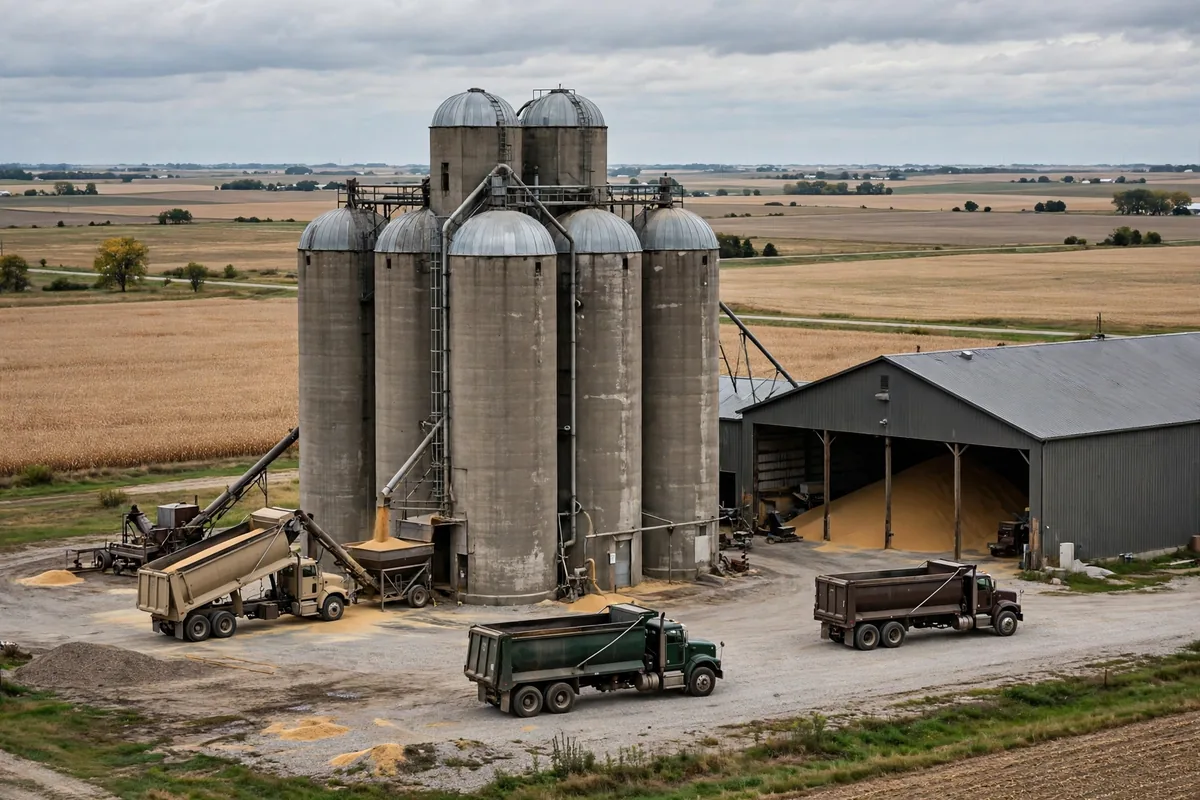
One detail people miss: whichever route you pick, the first truck leg cannot be avoided. The roughly 382 miles from Sorriso to Rondonópolis are shared by both routes, and farm-region storage sits at the start of that leg. A farm warehouse close to the fields can take beans in as soon as they are harvested, giving you a buffer while trucks and rail plans are arranged. A farm warehouse far from the fields means harvesters and trucks crowding country roads at peak season, beans on the road and an empty warehouse, and nothing to do about it. The value of farm-region storage is not how big it is — it is how close it sits to the fields and whether it can catch the beans when the harvest peaks.
The Santos Port Ledger for Brazil Soybean Exports: A New Terminal Does Not End the Queue
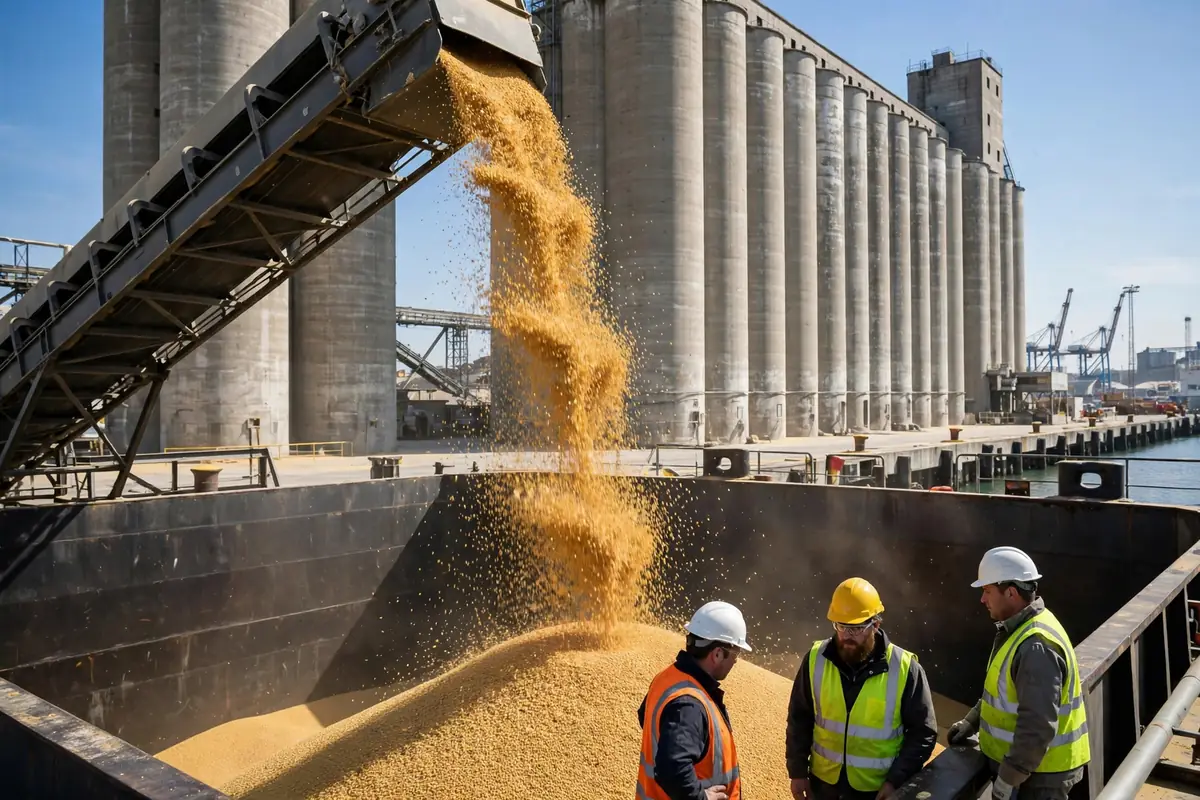
The good news is that the port end is moving. According to the guide, COFCO International's new STS11 terminal at Santos holds a 25-year concession, and once it is operating, Brazil's port capacity will reach 14 million tonnes. For anyone in the soybean export business, that is a genuine improvement: more loading capacity at the port means beans move from warehouse to vessel faster, and port storage turns over with more breathing room.
But here is the counterintuitive part, and it needs saying plainly: more port capacity does not mean no queue this year. Fourteen million tonnes is capacity after the terminal is operating, and a terminal takes time to go from construction to operation — the beans in the fields will not wait for it. This season, the queues will be there as always. More important, once the port opens up, the 3,500-truck queue at Rondonópolis may not shrink with it. Bottlenecks move upstream along the chain: the port loosens, the terminal tightens. Warehouse planning along the route has to follow the bottleneck, not just stare at the port. Faster turnover at the port warehouse is worth little if beans cannot get down from the terminal — the biggest capacity in the world sits idle with an empty warehouse.
So here are three straight pieces of advice for cargo owners and warehouse operators. First, do not judge a route by miles from farm to port — judge it by waiting time at the terminal and the port. The shortest road is not always the fastest to the vessel. All-truck is about 1,190 miles and looks close, but one jam at the port stops every truck on the road; truck-plus-rail is about 1,401 miles and looks far, but the rail leg is predictable and the jam sits in one place. Judge the whole trip in time, not in miles.
Second, farm storage, terminal storage, and port storage have to be matched in rhythm. If any one of them is full, the whole chain jams with it. Farm storage catches the beans, terminal storage catches the trucks, port storage catches the vessel schedule — the three have to move together. Whichever one is always full and always queuing is where the money should go. Spend it in the wrong place and the queue just moves from one point to another.
Third, a new terminal is good news, but plan on the timetable after it opens — do not bet this year's cargo on capacity that is not operating yet. COFCO International's STS11, with its 25-year concession and 14 million tonnes of capacity once running, changes the picture for the years ahead, not the queue this season. After all these years on the road, I believe one thing: a port's promise is measured by its vessels, and a warehouse's promise is measured by its queue. However long the queue is, that is how long the bill runs.
The Brazil soybean chain is not won by whoever has the biggest warehouse. It is won by whoever keeps the steadiest rhythm. From Sorriso to Santos — about 1,190 miles by truck, or about 382 miles by truck plus about 1,019 miles by rail — the road that works is the one where the beans wait less and move more.
By Shifu Zhao, Trucking Veteran (15 yrs)