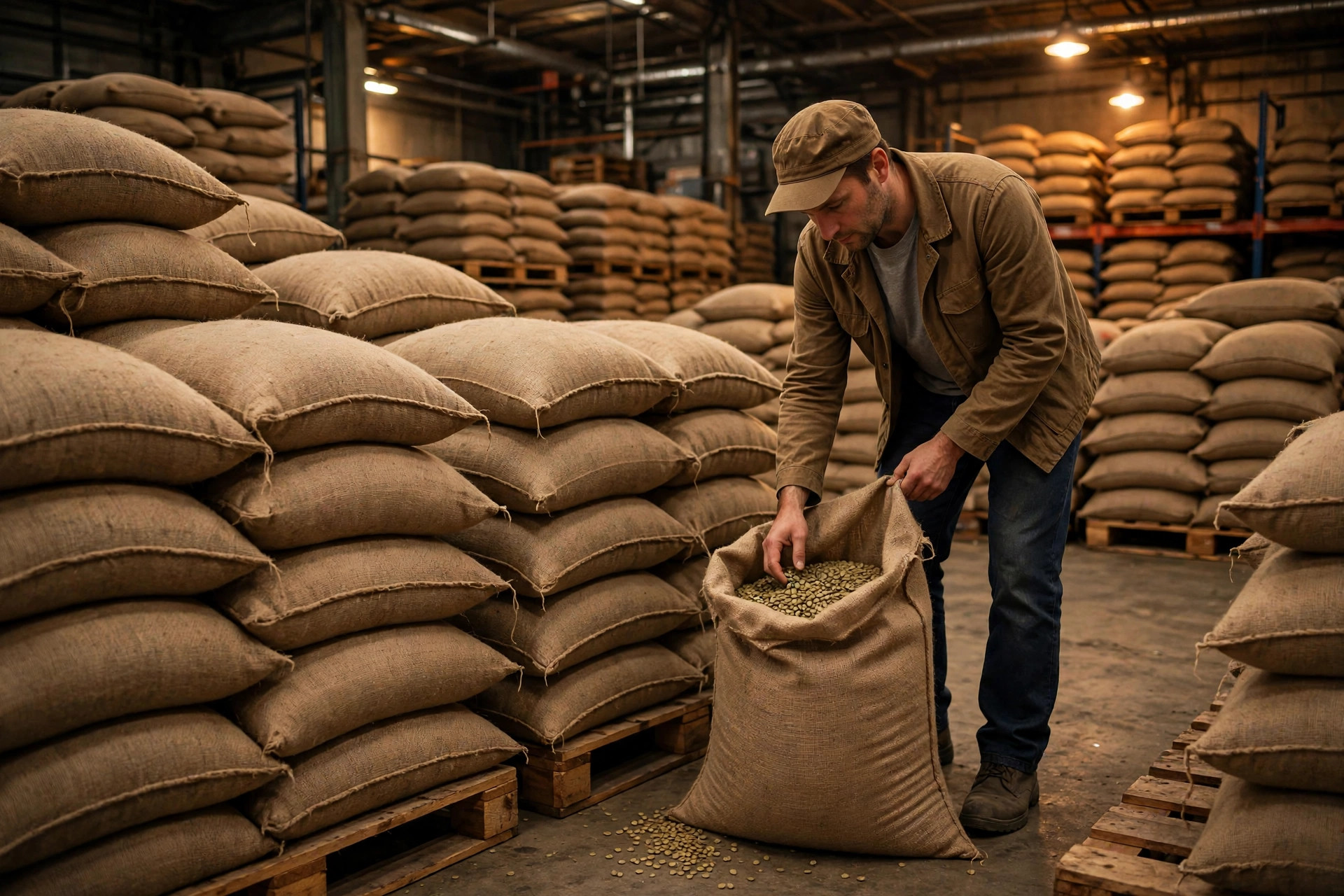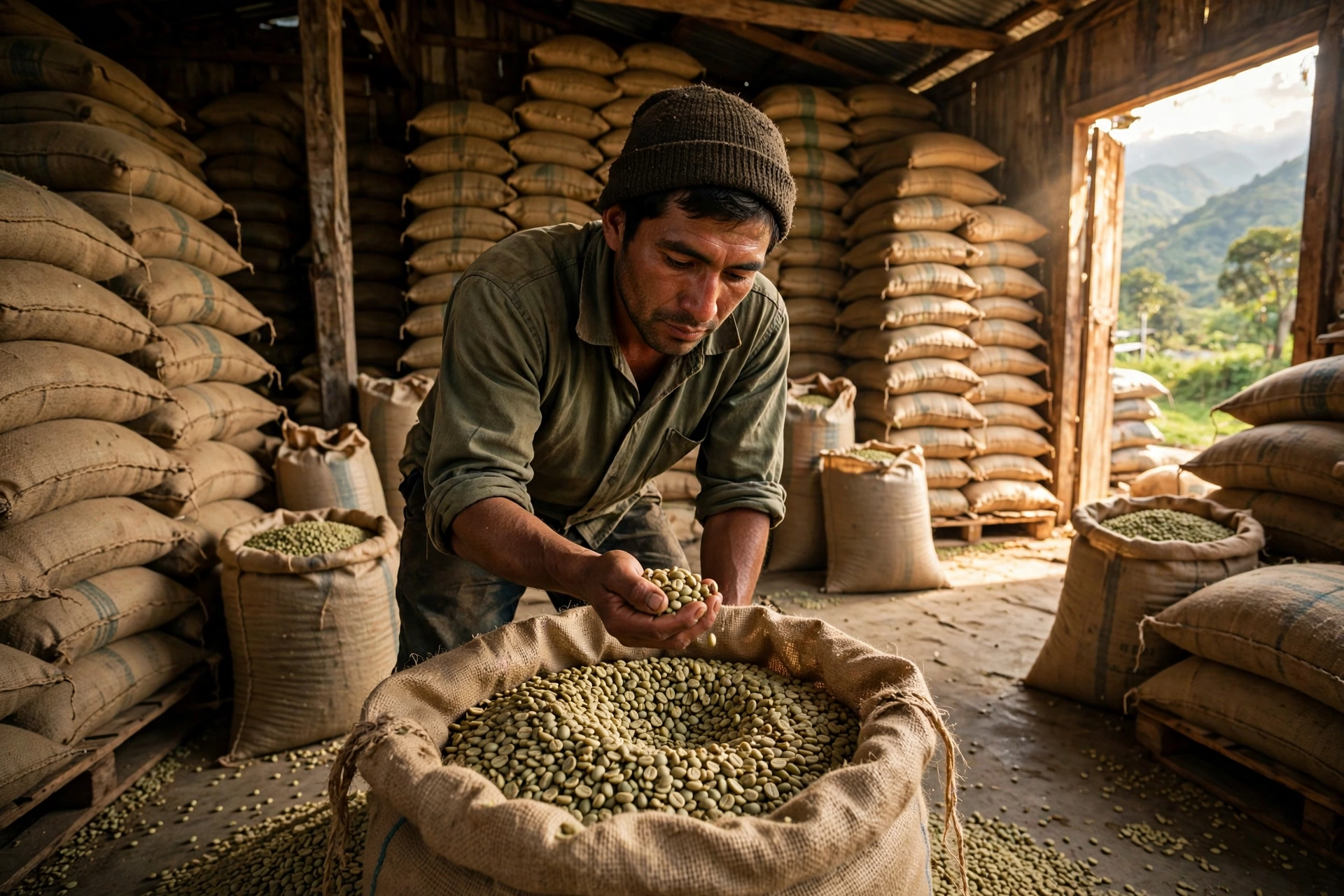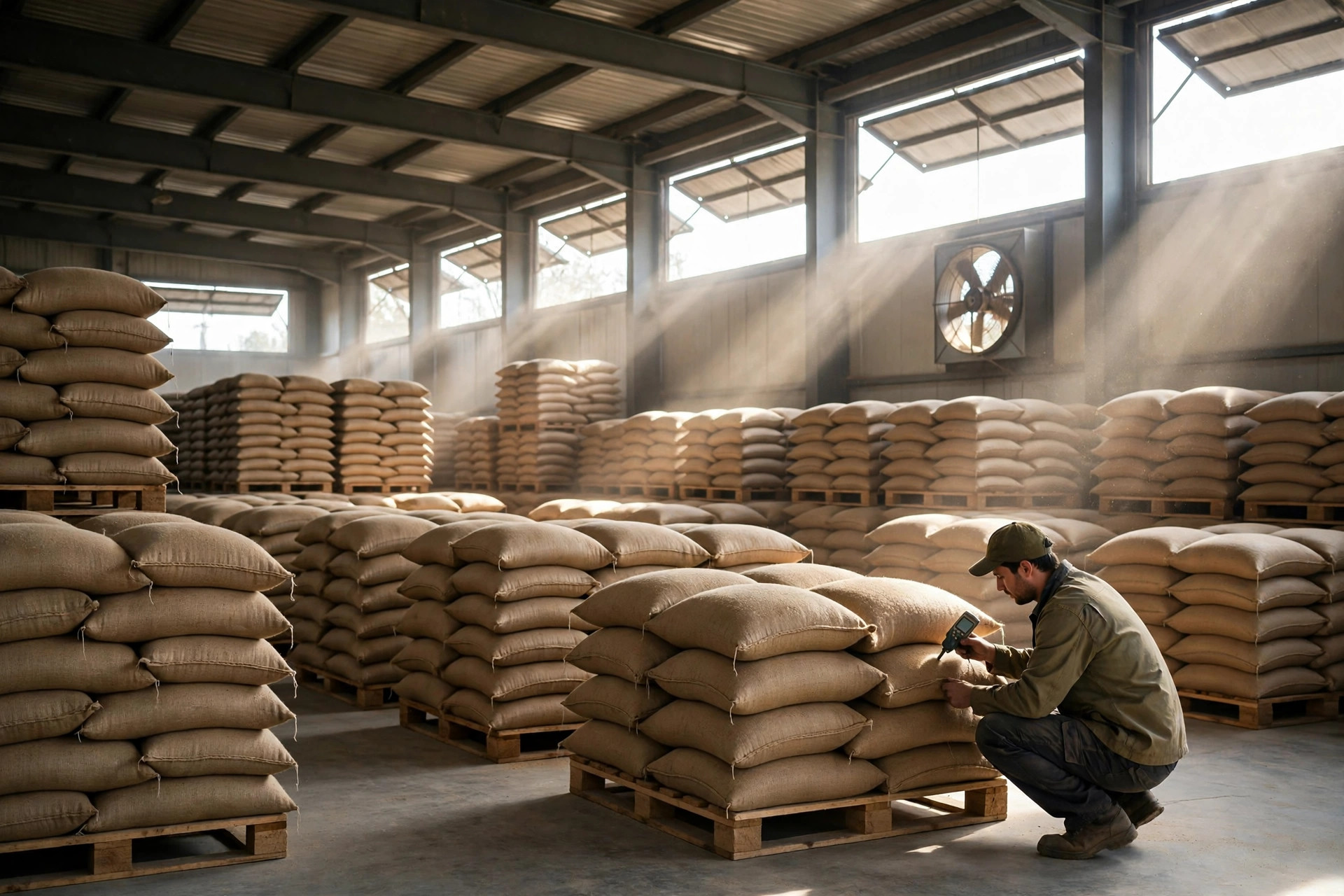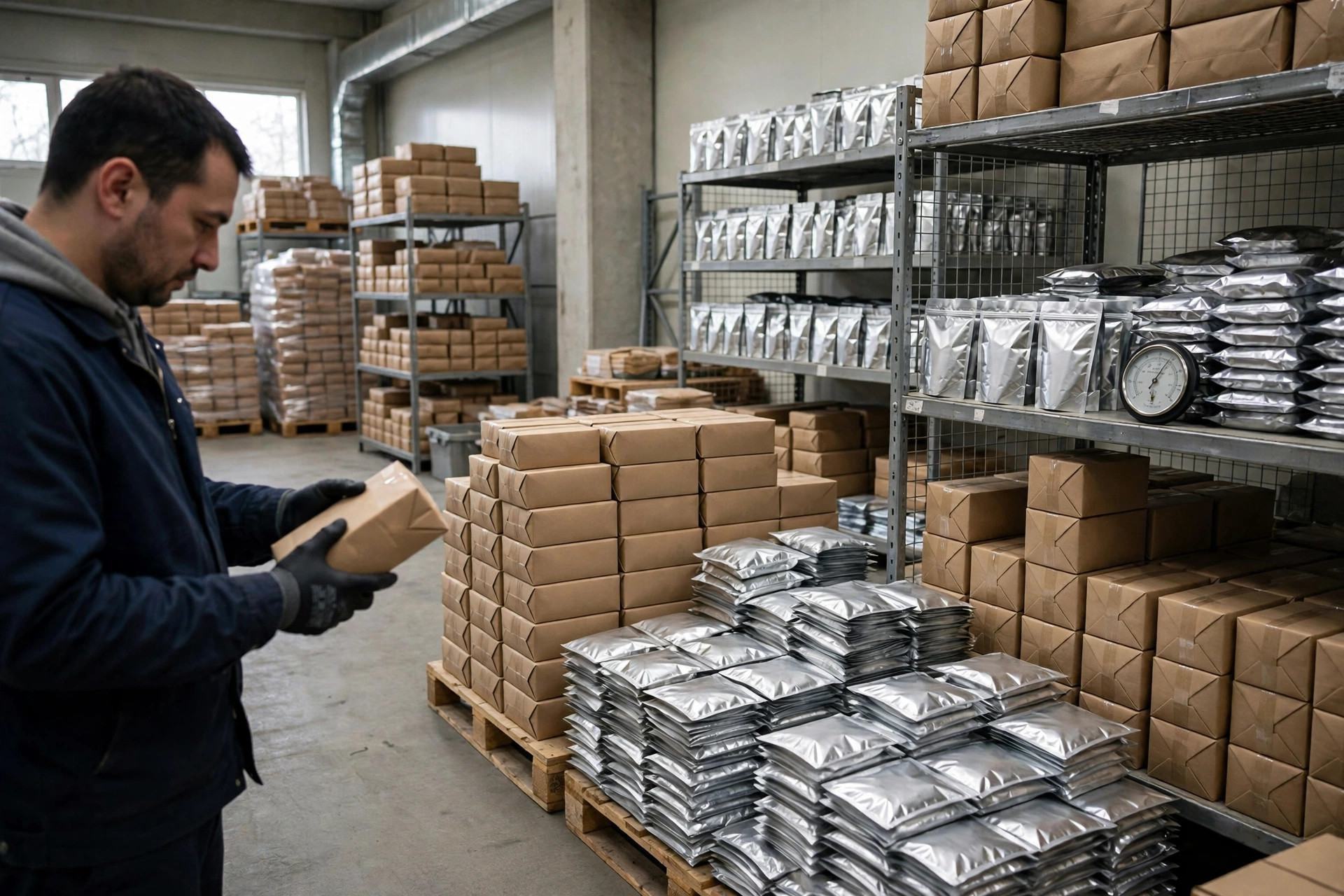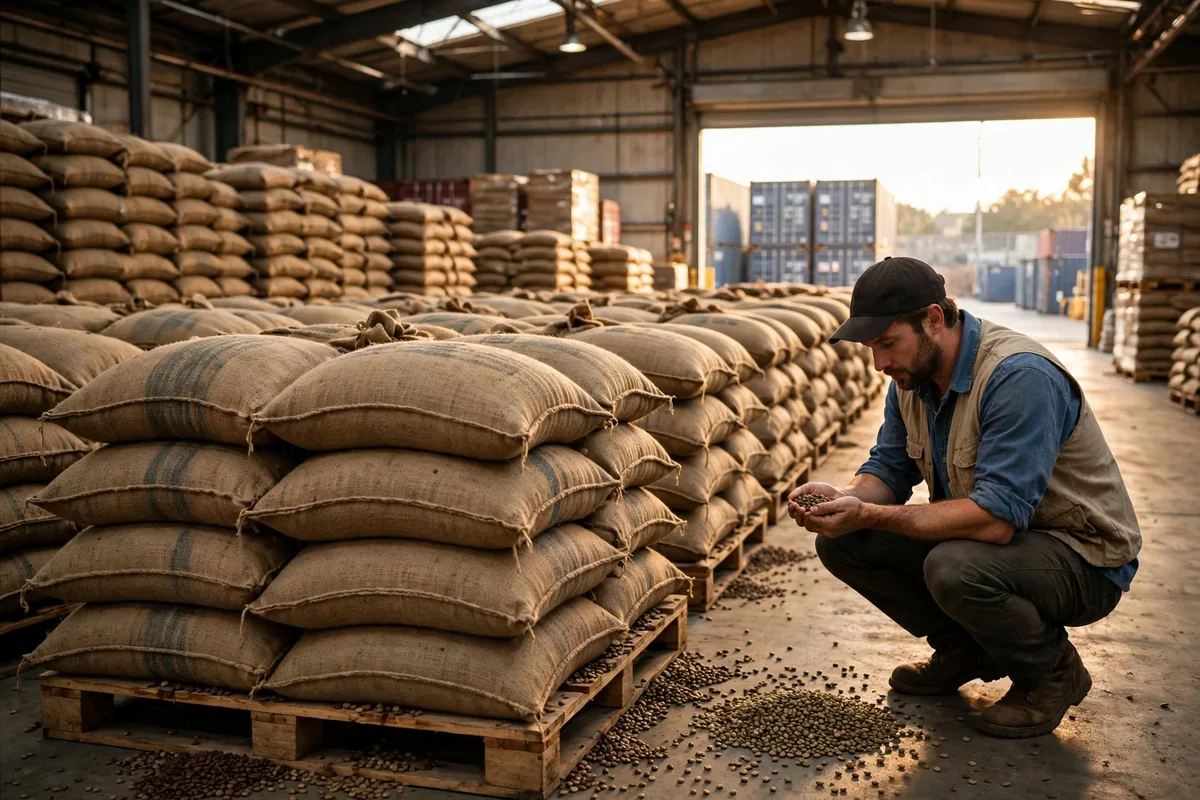
We had a client who learned that Brazil coffee export warehouse logistics decides whether green beans arrive dry and on grade. In the spring of 2025. He bought a container of arabica from Brazil, and when it was opened in Shanghai, the green beans were damp and moldy. The whole container was downgraded. The beans had spent a month at sea, and nobody could say where the moisture got in: the farm-area warehouse, the dry warehouse, the port warehouse, or the container. Four legs, four different handlers, and every one of them said it was not their problem. The client ate the loss. In this trade, value is rarely lost on the ocean. It is lost in the warehouses. Green beans fear moisture, they pick up smells, and they miss sailings — and all three are warehouse problems.
Start with the big picture so the stakes are clear. Brazil's National Supply Company, Conab, estimates Brazil's 2025 coffee production at 55.3 million bags of 60 kilograms each, up 2% year on year. Arabica accounts for 35.2 million bags, down 11%, while robusta accounts for 20.1 million bags, up 37% to a record. Exports reached a record 50.5 million bags in 2024. From January to October 2025, exports were 34.2 million bags, down 17.8% year on year, while export value hit a record $12.9 billion. The US Department of Agriculture estimates 2025/26 production at 63 million bags and exports at 40.75 million bags. Global stocks at the start of 2025/26 stood at about 21.8 million bags, the lowest in 25 years. When stocks are that low, every container of good beans is precious, and one warehousing mistake costs far more to replace than it used to.
The Brazil Coffee Export Warehouse Logistics Chain: Four Legs, Four Risks
The first leg is collection at the farm-area warehouse. Minas Gerais and Espirito Santo are the main producing regions, and farms are scattered, so harvested coffee is gathered into local warehouses first. The risk here is mixing grades: arabica and robusta must be stored separately and bagged separately, or the whole lot loses its grade. The other risk is moisture testing at intake. If beans go into storage with moisture content above the limit, no amount of careful storage later will fix them. Buying teams always negotiate the ocean freight and never ask about this leg. Ask who does the moisture test and to what standard. One question here saves half the arguments later.
The second leg is the dry warehouse, where beans wait for consolidation and a sailing. The risk is damp. Inland Brazil is humid in the rainy season, warehouse floors sweat, and jute bags sitting straight on concrete absorb moisture overnight. The fixes are simple: pallets to lift the bags, ventilation gaps from the walls, and a humidity log. Simple, but someone has to actually do it. Before I sign a warehouse, I ask for the humidity log and whether they will send me a copy every week. A warehouse that cannot produce a log is a warehouse I will not recommend to a client, whatever the price. Scenario example: in May 2025, a lot from Minas Gerais sat in a dry warehouse for 12 days with no humidity record. At the port, 40 bags were found damp at the bottom and had to be sold down to local roasters at a discount — a loss of about 8% of that lot's value on an assumed example.
The third leg is consolidation at the port warehouse near Santos. The risk is missing the sailing and loading the wrong container. Sailings run weekly, so a late consolidation means another week of storage charges. Worse, cargo for different buyers can end up in the wrong container, and the mistake is only discovered at the destination port, where swapping it costs more than the cargo is worth. Watch the loading list: bag count, batch number, and shipping marks must all match before the container is sealed. Photograph the sealed container and send the photos to the buyer. That is standard practice in our business, and the photos are your evidence if anything goes wrong.
The fourth leg is loading and sailing. The container itself needs checking: holes in the walls, damp inside, smells left by the previous cargo. Coffee absorbs odors — if the last load was spices, the next load of coffee carries the taste. Inspect the container before loading, lay moisture-proof matting, and add desiccants. All three steps, every time. Scenario example: in November 2024, a container of robusta bound for Qingdao picked up an off-flavor from residue inside the container. Cupping at arrival showed contamination, the buyer deducted 5% of the price, and the seller and the forwarder argued for two months before splitting the loss.
Brazil Coffee Export Warehouse Logistics: Where the Money Actually Goes
Most buyers price an export on ocean freight and port charges, and the warehousing money hides across the four legs because nobody adds it up. These are the brazil coffee export warehouse logistics costs that buyers usually miss until the invoice lands. Worked example with assumed figures: one container of 320 bags from Minas Gerais to Santos. Collection and testing at the farm-area warehouse, assumed $1.20 per bag. Ten days in the dry warehouse, assumed $0.15 per bag per day. Consolidation and loading at the port warehouse, assumed $2.00 per bag. Inland transport, assumed $6.00 per bag. Moisture-proof materials and desiccants, assumed $0.80 per bag. That totals about $11.50 per bag, or about $3,680 per container. Treat these as assumed figures — actual quotes vary, and prices can differ by 30% between seasons and port warehouses.
| Cost item | Assumed example (per bag) | Note | | Collection and testing | $1.20 | Includes moisture testing and grading | | Dry warehouse, 10 days | $1.50 | $0.15 per bag per day | | Port consolidation and loading | $2.00 | Includes loading list and photos | | Inland transport | $6.00 | Producing region to Santos | | Moisture-proofing and desiccants | $0.80 | Subject to actual quote | | Total | About $11.50 | About $3,680 per 320-bag container |
Here is the counterintuitive part: the cheapest way to handle warehousing is usually not the cheapest warehouse. It is one provider that takes responsibility for all four legs. Hire four separate cheap providers and the total comes out higher, because nobody owns the handover points, and when something goes wrong they blame each other while the clock and the damage run on your account. One provider covering the whole chain looks more expensive per line, but responsibility is clear, and there is one throat to choke. There is a trade-off too: waiting to fill a container before sailing cuts the per-unit freight, but the beans sit another week in the dry warehouse, and moisture risk and storage charges both rise. Ship early and the freight is higher but the cargo risk is lower. My rule is simple: specialty beans do not wait, commercial beans can wait. The grade of the bean decides whether you can afford to wait.
Three Questions for Your Next Contract
I always end with three questions you can use word for word. First: who produces the humidity log, and will you send me a copy every week — written into the contract, with my right to change warehouses if the log is missing. Second: arabica and robusta stored and loaded separately, with downgrade compensation if they are mixed — written into the liability clause. Third: the loading list checked on all three items before sealing, with sealing photos sent to me within 24 hours, and final payment delayed three days if the photos are missing.
Next time you negotiate a contract, remember to ask those three questions. In the Brazil coffee trade, the winner is not whoever negotiates the lowest ocean freight. It is whoever delivers beans that are still good beans when they arrive. By Susan, 3PL Sales Director