Start with the money, because in coffee warehouse storage the money is the whole story. A mid-sized roaster in eastern China took in 20 metric tons of green coffee in the autumn of 2024. At the settlement price of the time, roughly 32,000 yuan a ton, that lot was worth 640,000 yuan sitting on pallets. One damp corner by the wall cost them 24,000 yuan: three tons came out musty, were downgraded, and sold for 8,000 yuan a ton less, before sorting labor and two weeks of blocked pallet positions. It is a value discussion, not a flavor discussion: what the beans were worth when they went in, and what they are still worth when they come out.
Green beans in a warehouse face three enemies: moisture, foreign aromas, and time. Each one has its own bill, and once you price all three, the storage plan mostly writes itself.
Coffee Warehouse Storage Bill One: Moisture Eats the Price Spread
Moisture does not announce itself. It finds the gap in management. In the roaster's case there was no roof leak. The pallets against the wall had no ventilation gap, condensation formed during the rainy season, and the bottom sacks went first. The upper layers looked fine until someone opened the stack and found the mold had already spread. By then the loss was not one or two sacks. It was a whole stack position.
Price moisture control against the whole lot, not against one sack. A set of temperature and humidity loggers costs a few hundred yuan. Raising pallets and cutting ventilation channels amortizes to tens of yuan per ton. A single downgrade from damp costs thousands of yuan per ton. Those two numbers are not in the same league, so there is nothing to deliberate: prevention is the cheap line item, damage is the expensive one.
Receiving discipline is short and non-negotiable: record moisture for every lot on arrival, keep stacks off the floor and off the wall with air channels between them, and inspect hardest at the bottom layer and the wall side in the rainy season. When one sack smells musty, isolate it before moving the stack, or you will spread spores across the whole position. Treating one sack costs labor plus one sack; ignoring it costs the whole stack's price grade.
Coffee Warehouse Storage Bill Two: A Tainted Aroma Costs a Customer, Not Just a Lot
Green coffee absorbs odors readily. A southern trading company learned this the expensive way in the summer of 2023. It stored Ethiopian beans in the same warehouse zone as spice raw materials, separated only by an aisle. Two months later the beans carried a distinct spice note, and the roaster rejected the lot outright. Nothing was moldy, nothing was infested, the paperwork was complete — but the coffee no longer tasted like itself, and there was nothing left to negotiate with. Six tons were eventually sold at a discount, losing more than 30,000 yuan in price spread, while freight and storage charges stayed put.
So the first zoning rule for a green coffee store is absolute: never share a room with spices, chemicals, or anything strongly scented. An aisle is not separation. A solid wall and independent ventilation is separation, and a dedicated zone is better still. Aroma damage is invisible on arrival and fully visible on the invoice, and the real cost runs past the discounted lot: once a buyer decides your beans carry foreign notes, the next order is in doubt too.
The same logic applies inside the coffee itself: keep origins and processes stacked separately and labeled clearly. The worst cost of a mixed stack is shipping the wrong lot, having it rejected, and paying freight both ways on your own mistake.
Bill Three: Age Takes Money Straight Out of the Selling Price
Green coffee does not improve with age in a warehouse. Aroma fades, roast performance slips, and every buyer gains a reason to push the price down. Run the holding cost honestly. Take a 10-ton lot at 30,000 yuan a ton: 300,000 yuan of stock. If poor rotation leaves it sitting six extra months, financing alone at an illustrative 6 percent a year costs 9,000 yuan. That counts no aroma loss and no discount at all — just the cost of money sitting still. Holding stock is never free, even when the warehouse looks quiet.
Rotation has no clever trick. First in, first out, sequenced by arrival lot and roast-date plan, with the lot number written on the dispatch note. A system that lets stock leave without a lot number is a system that will eventually ship new beans while old beans rot behind them. Human memory cannot run rotation. Paperwork can.
Here is the counter-intuitive judgment most warehouse managers resist: a full warehouse is not a safe warehouse. Extra stock feels like insurance against stock-outs, but on the ledger it is the opposite — every extra ton pays interest, occupies a position, and risks aging out. Real safety stock is the few tons your turnover rate justifies. The most dangerous moment is a full floor, because the next delivery buries the oldest lot at the back, and nobody remembers it until six months later.
Jute Versus Liner: Compare the Whole Bill, Not the Bag Price
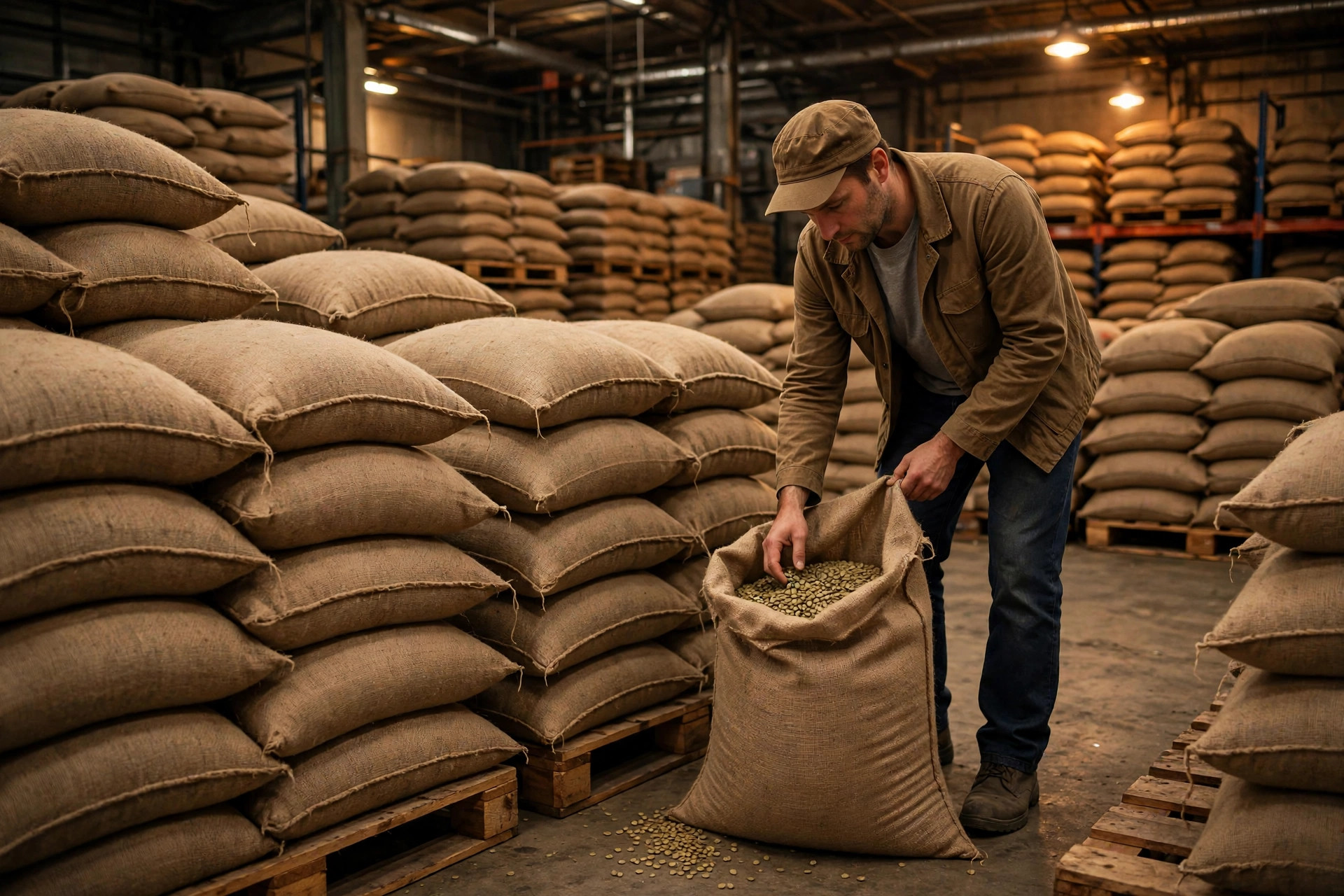
Bag choice is where green coffee storage budgets most often go wrong. Plain jute is cheap, breathable, and easy to handle. A jute bag with a high-barrier GrainPro-style liner costs several times more but puts a shield between the beans and the warehouse air. The table below uses a 20-ton lot in 60-kilo bags, with costs stated as orders of magnitude — the structure matters more than any single price:
| Option | Cost per bag | Bag cost for 20 tons | Moisture and odor protection | Best fit |
|---|---|---|---|---|
| Plain jute | Low | A few thousand yuan | Weak, depends on the building | Fast turnover, dry store, short holding |
| Jute plus high-barrier liner | Several times higher | Roughly twenty to thirty thousand yuan | Strong, its own barrier | Long holding, rainy season, cross-region transit |
Never compare bag prices alone. The liner option adds only a few hundred yuan per ton, while one damp or tainted incident costs several thousand yuan per ton. Stock turning over within three months, in a dry and well-managed store, justifies plain jute. Stock held beyond six months, through a rainy season, or in a marginal building makes the liner the cheaper decision in total — it is insurance priced against the full lot value, not an upgrade. Saving on bags and downgrading the lot is the definition of money spent badly.
Pests and Shrinkage: Small Numbers That Compound
Pest bills hide inside the shrinkage rate. Skip receiving inspection, skip sweeping the stack positions, leave a torn bag unrepaired, and an infestation moves from one bag to a whole stack. The fix jumps from a few hundred yuan to full-stack fumigation plus sorting. Receiving checks, regular sweeping, and immediate repair of torn bags cost almost nothing per ton. Waiting until the problem spreads costs both money and saleable beans.
There is also the quiet leak nobody budgets: spillage and weighing differences. A little spilled at every move adds up across 20 tons — at 30,000 yuan a ton, 50 kilos is 1,500 yuan. Prompt repair of torn bags, gentle handling, and regular stock counts are dull chores, and they are all cash.
A Decision Framework: Three Questions Before Anything Goes Into Store
Before a lot enters the warehouse, run these three questions. The answers choose the storage plan:
- How long will it sit? Under three months, jute plus strict management is defensible. Beyond six months, go straight to a high-barrier liner.
- What is the building like? Dry, ventilated, and logged, you can economize. Damp walls and humid rainy seasons mean moisture spending is not optional.
- What sits next to it? Spices, chemicals, or any strong odor source mean zoning comes first, before any other discussion.
Two out of three bad answers — long holding, poor building, noisy neighbors — and the liner and the dedicated zone are mandatory spending. Zero bad answers, and jute plus discipline is the most economical plan. There is no fourth answer, and there is no version of this decision where hoping for a dry season counts as a plan.
The calculable conclusion is this: in coffee warehouse storage, on a 20-ton lot worth 640,000 yuan, the full package of moisture control, zoning, and liner bags costs a few hundred yuan per ton, while one damp downgrade or one tainted lot costs several thousand yuan per ton. That is a tenfold gap. Money spent preventing moisture, contamination, and aging is money well spent. Money spent sorting, discounting, and apologizing afterward is money thrown away.
By Lao Zhou, Logistics Cost Analyst