Best Buy Marketplace traffic is genuinely good. Electronics shoppers there have real budgets and haggle less — my noise-cancelling headphones sell at a noticeably higher average order value on Best Buy than on Amazon, with better conversion on top.
But the flip side will kill you: sky-high return rates and switch fraud. That same $329 headphone runs a 6% return rate on Amazon and 14% on Best Buy. Half of those extra returns aren't even the product I shipped — used units, empty boxes, random third-party knockoffs. I've seen it all.
If your fulfillment operation is unprotected, every ad dollar you spend is just subsidizing scammers. Here's the playbook I built over two years of getting schooled by switch fraud on Best Buy.
First, some context on why Best Buy electronics are such a headache. Best Buy shoppers behave differently from Amazon shoppers: a lot of them are "buy it, try it at home" types — wear the headphones for a week, play with the camera for two days, return it if they don't love it. Electronics are a natural magnet for serial triallists, so the return base is huge, and switch fraud and accessory theft ride along inside it. That's not the platform's fault — it's the customer mix. If you're taking the high-AOV upside, you have to model this shrink into your costs.
Cage It First: Best Buy Electronics Fulfillment Starts With Security
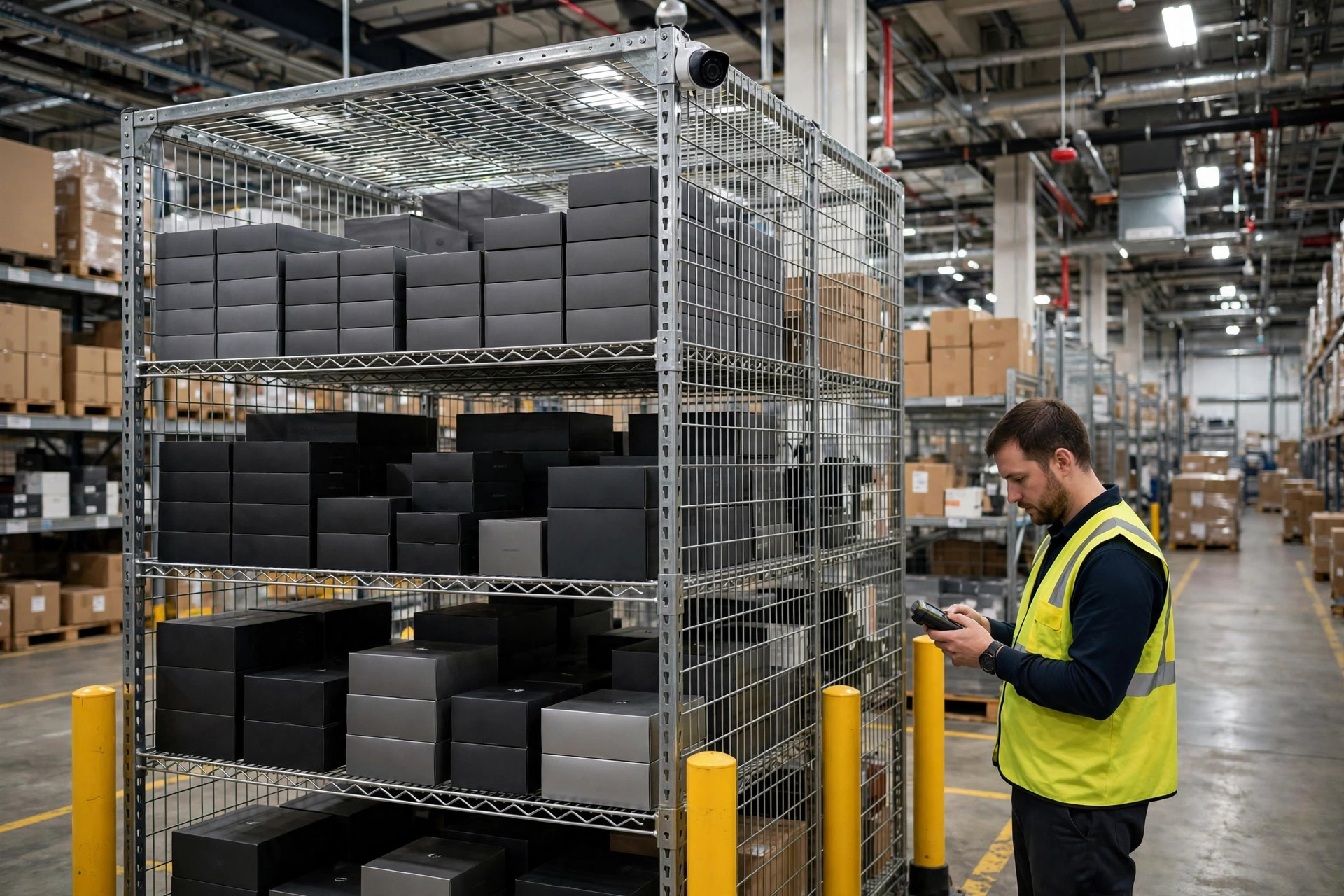
Every SKU over $200 goes into locked wire cages now — never on open shelving. Only pickers and the shift supervisor have keys, and every pull is scan-verified with a system log behind it.
Cameras must cover two spots: the cage door and the pack station. Keep footage for 30 days — and get that in writing in your 3PL contract. A verbal promise means nothing. When something goes missing and they tell you "the footage got overwritten," you have zero recourse. When negotiating with a 3PL, say it straight: if security terms for high-value SKUs can't go in the contract, I'll switch warehouses. That one line gets it done, almost every time.
Don't get lazy with key management either: log every handover — who took the keys, what time they came back. I've seen warehouses hang the cage keys on a wall hook for "anyone to grab." That's the same as no lock at all.
Two-person verification at outbound: one person picks and scans, another verifies before sealing. The critical step is logging the unit's serial number into the system, with a photo on file. Every electronics unit has a unique serial — it's your hardest evidence in a dispute.
In March 2025, my 3PL warehouse in Ontario, California shipped a $899 action camera. The buyer returned it claiming a "quality issue." The serial number didn't match my outbound record — they'd returned their own two-year-old unit. I sent the platform my outbound serial photo and scan log; the dispute was resolved in my favor in three days, $899 saved. Without that photo, the money was gone.
Tamper-Evident Packing: The Cheapest Insurance in Electronics Fulfillment
Most sellers treat packaging as just a box. Wrong. For high-value electronics, packaging is your first — and cheapest — line of defense.
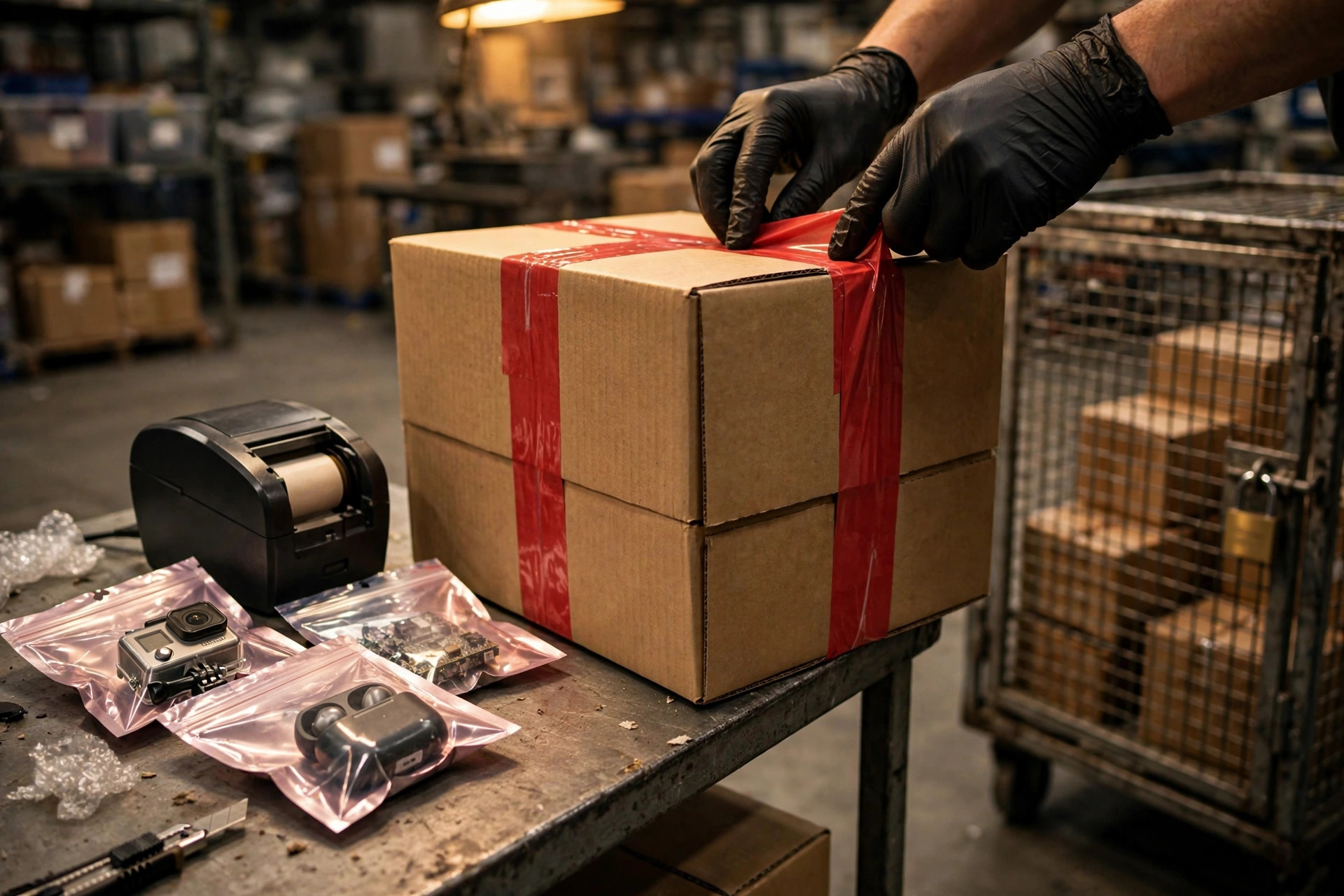
Three moves, under $0.60 per order:
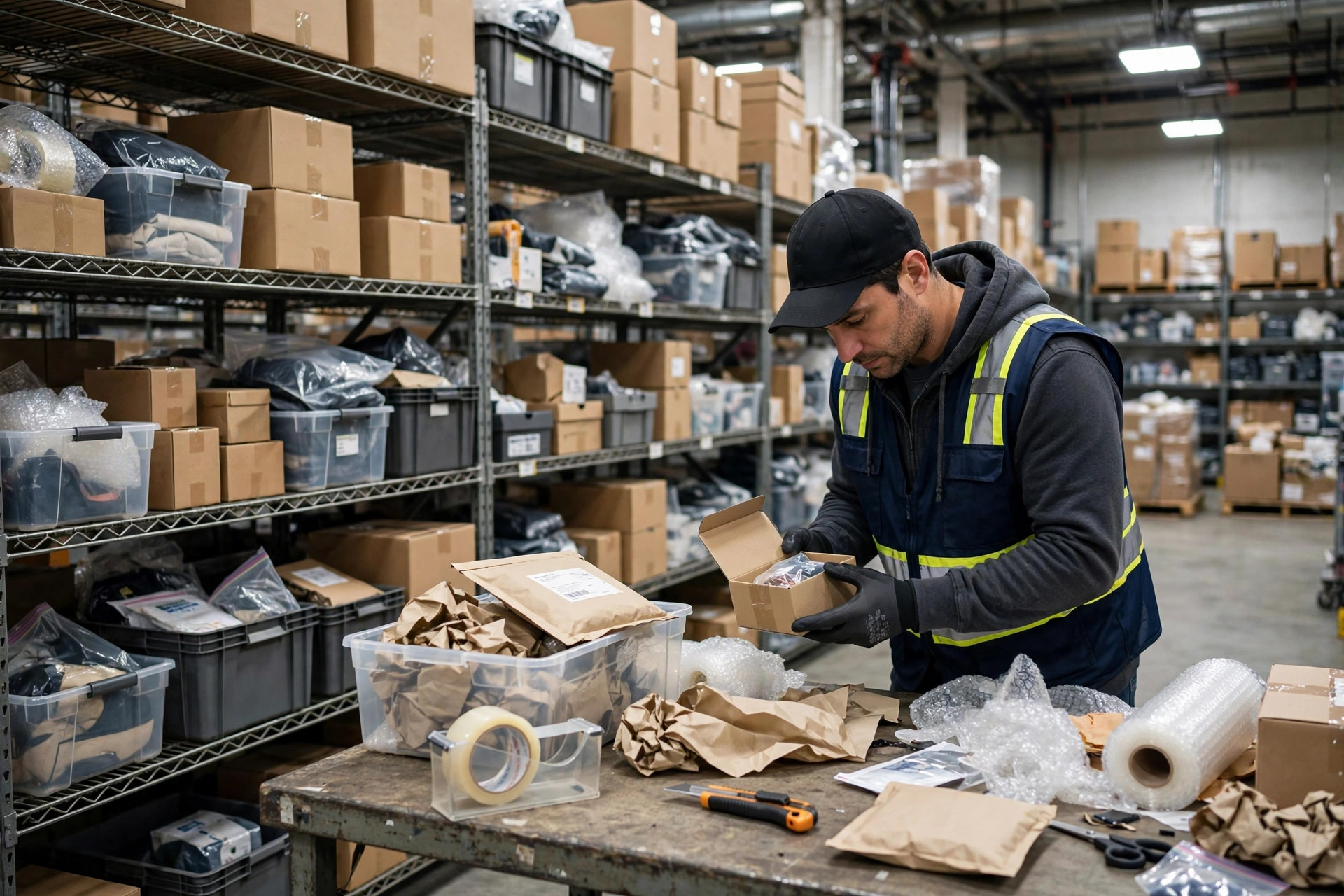
First, tamper-evident tape. Swap plain clear tape for the kind that leaves a mark or changes color when peeled — it can never be re-stuck invisibly. Costs an extra $0.30 per order, and "it was opened in transit" disputes basically disappear.
Second, outbound weighing. Every parcel hits the scale before it leaves, weighed to 0.1 lb, with the weight logged in the order notes. When a return comes back, weigh it first — if it's off by more than 50 grams from the outbound record, open it on camera. This catches "arrived empty" claims cold.
Third, seal photos. A fixed camera over the pack station snaps one photo per sealed box, kept for 90 days. Storage amortizes to under five cents an order.
Buying tips: don't cheap out on tamper tape — the bargain stuff leaves a faint mark that's basically invisible, which defeats the whole point. I tested three brands and settled on a mid-priced one that leaves a clear "VOID" pattern. For the scale, 0.1 lb resolution is the sweet spot; a fussy 1-gram kitchen scale is actually worse — parcel weighing is about stability, not decimal places.
During Black Friday 2025, a buyer claimed a $149 Bluetooth speaker "arrived as an empty box." I pulled the 2.3 lb outbound weight record and the seal photo; the platform ruled in my favor in two days. Without those, I'd have eaten the $149 plus return shipping — and a one-star review.
The math: tamper tape $0.30 + photo storage $0.05 + serial logging labor $0.20 = roughly $0.55 per order in anti-theft cost. One switch-fraud loss is $329 in product value plus $12 return shipping, plus the account health hit. $0.55 / $341 ≈ 0.16% — the system pays for itself if it cuts switch fraud by just 0.2%. In practice I went from 7–8 disputes a month to under one. Absurd ROI.
I tier security by average order value — steal this directly:
| AOV tier | Security level | Measures |
|---|---|---|
| Under $100 | Basic | Tamper tape + outbound weighing |
| $100–$300 | Standard | Basic + serial-number logging + seal photos |
| Over $300 | Strict | Standard + locked cages + two-person verification + 30-day footage |
Returns Inspection: Catching Switch Fraud on Best Buy Marketplace
Never put returned electronics straight back into sellable inventory. My flow: weigh the return, match the serial number, then run a three-point appearance check — seal integrity, accessory completeness, power-on test. Only units passing all three go back on the shelf.
Power-on testing has its own craft: headphones get a Bluetooth pairing and charging check, cameras get a power-on and shutter test, speakers get a sound check. Photograph the accessory list at outbound — charging cable, manual, warranty card, every single piece. Plenty of sellers check the main unit and skip accessories, and that's exactly what switch-fraud pros count on: OEM charging cables and ear tips walk away first, $20–30 a pop at retail, and it adds up terrifyingly fast.
Here's the counter-intuitive part: most sellers treat returns inspection as a cost center, pure wasted labor. But run the numbers. An inspector at $18/hour clears 25 units an hour — $0.72 per unit. Stopping one switch fraud saves $300 and up. Meanwhile my Best Buy ad ACoS burns at 30% without guaranteeing a single order, while $0.72 of inspection protects $300. Returns inspection has a better ROI than advertising. The endgame of saving money isn't cutting costs — it's spending where it counts.
There's a trade-off nobody talks about: every security step slows down your pack station. Two-person verification and serial logging add about 40 seconds per high-value order. During peak season that hurts throughput, and your 3PL will grumble about labor. My answer: don't apply strict security to everything. The tiered table above exists precisely so cheap accessories keep flying through the fast lane while only the $300+ units get the full treatment. Security that treats a $19 cable the same as a $899 camera isn't thorough — it's just expensive.
A few things to avoid:
Don't store high-value goods in the same pick zone as general merchandise. Separate zones, separate people, separate workflows — most internal theft is "convenient" theft.
Don't copy Amazon return habits onto Best Buy. The two platforms differ on return windows and who eats return shipping — always go by the latest policy in Best Buy's seller center, and update your process when policies change.
Stock up on cages, tape, and scales before peak season. Discovering you're out of tamper-evident tape during Black Friday means rush-ordering at double the price.
This playbook has basically eliminated switch-fraud disputes in my Best Buy store, and inspection has even caught a few "accessories walked away" cases along the way. Tested it myself — it works. If you sell high-ticket electronics, just copy the homework.
By Ah K, E-commerce Seller (5 yrs)