Belgium chocolate export warehouse storage temperature is the line item that quietly eats a whole shipment's margin. A consignment leaves a Brussels workshop glossy and intact, then arrives at the port of Antwerp with bloom across the surface. The buyer rejects it, the freight still has to be paid, and the stock gets sold off at a discount. That money was wasted, and it was wasted because nobody priced temperature, packaging, and liability as three separate lines.
Belgium Chocolate Export Warehouse Storage Temperature Starts at 18 Degrees
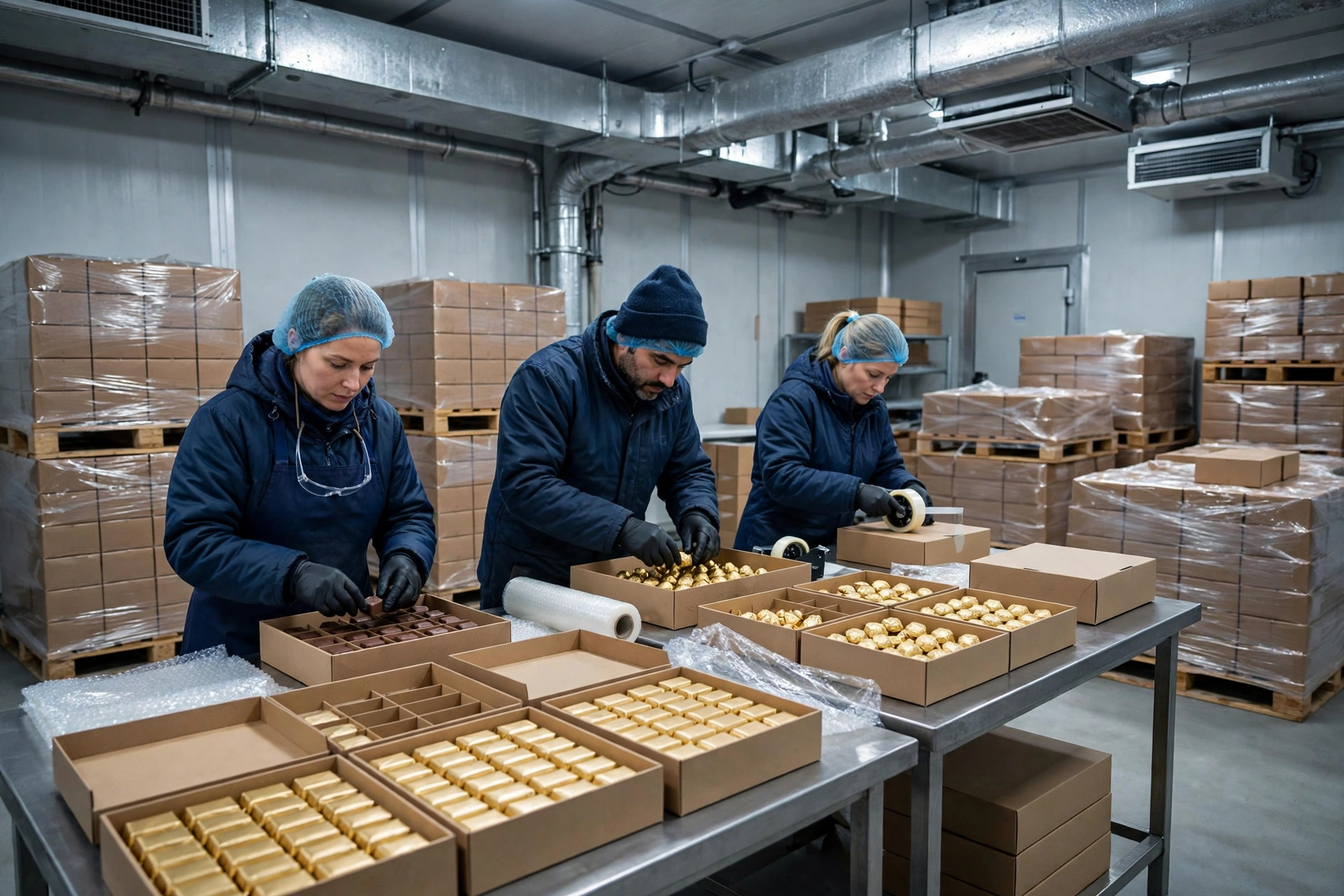
Chocolate does not fear cold the way it fears fluctuation. A temperature-controlled warehouse holds stock in a stable band, so cocoa butter does not repeatedly migrate to the surface and bloom stays unlikely. The Chocolate Box distribution center in Lokeren, Belgium, is often cited in the trade as a large chocolate hub: held at roughly 18 degrees Celsius and close to the port of Antwerp. The lesson is the combination, not either fact alone. Keep the temperature steady, keep the distance to port short, and every handover in between is one fewer place where control can slip.
I have seen the failure happen in two familiar patterns. In one, a Brussels workshop ships 200 cartons of gift boxes in summer. The van is cool in the morning, then waits in the port queue through midday, and the load softens at the edges before it ever reaches the container. The warehouse did not ruin that stock. The unmanaged leg between warehouse and port did. In the other pattern, stock sits perfectly well in a temperature-controlled warehouse, then moves on a cheaper ambient shuttle to save a fee, and arrives at destination with bloom across the batch. The claim drags on for two months, and the fee saved does not cover the discount on one shipment.
Do not compare a temperature-controlled warehouse with an ambient warehouse on rent alone. Compare total cost:
| Cost line | Temperature-controlled warehouse | Ambient warehouse |
|---|---|---|
| Storage and energy | Higher, climate equipment and power are charged in | Lower, no climate burden |
| Packaging upgrade | Standard export packaging usually suffices | Insulation and thermal layers often needed |
| Bloom and softening risk | Lower, temperature swings are small | Higher, summer risk concentrates fast |
| Claims and lost customers | Lower, evidence is easy to keep | Higher, one bloom incident can lose a buyer |
| Best fit | Gift boxes, premium pralines, summer shipments | Short winter storage, hardier products |
The arithmetic is one line: total cost equals storage plus the allocated climate energy cost, plus the packaging upgrade, plus a provision for loss and claims. Ambient storage wins the first term. Temperature-controlled storage wins the last one. For summer shipments, gift-heavy orders, and warm destination ports, the last term carries the most weight, and choosing ambient storage is a bet on the weather.
Who Pays for Bloom? Put the Evidence Chain in the Contract
Bloom comes in two forms, and confusing them confuses liability. Fat bloom follows temperature swings as cocoa butter migrates out, leaving a greyish white film. Sugar bloom follows moisture, leaving a whitish powdery surface. A handover note that says only that the goods looked fine is worthless. The receiving record should state inbound temperature, outbound temperature, whether packaging was intact, and whether pallets showed damp. A temperature-controlled warehouse should keep a continuous temperature log by batch, because a claim is only arguable when a curve can be produced.
Write the same discipline into the contract: who maintains the temperature band, how many degrees over the band and for how long counts as a breach, what inspection standard applies, and what sampling rate is used. A verbal assurance that everyone has always been careful is worth nothing at claim time. Here is the counterintuitive point: colder is not automatically better. Chocolate moved from an excessively cold environment into warm, humid air condenses on the surface, and that moisture invites bloom. The value of climate control is stability, not low temperature. Repeated swings damage stock more than a steady temperature slightly above the ideal.
Belgium Chocolate Export Warehouse Storage Temperature Is Hardest to Hold on a Consolidated Load
Small workshops often export by consolidation, and consolidation saves freight while pooling risk. In one container, chocolate sits beside other cargo, and the outcome depends on loading order, whether the chocolate sits near the door or deep inside, and how long the container stays open during port inspection. Before consolidation, confirm three things: whether the container was pre-cooled, where the chocolate is stowed, and who controls door openings. Cargo that can fill a container should not be consolidated to save a small freight difference. Cargo that must be consolidated should have thermal packaging rated for the worst leg of the route, not for the average temperature along it.
Packaging format is the same kind of trade-off. Gift boxes look good, insulate poorly, and crush easily. Bulk cartons are cheap and sturdy, but need repacking at destination, and that labor and loss come back into the bill. A small workshop shipping gift boxes direct avoids repacking, but takes on a higher temperature requirement. A larger shipper moving bulk and repacking at destination spreads the temperature risk and may land at a lower cost per carton. No format is inherently cheaper. A format is only cheap when it matches the temperature curve of its route.
Expiry and Batch Control: First In, First Out Is a Discipline, Not a Slogan
Chocolate keeps for a long time, which is exactly why sloppy batch handling goes unnoticed until it matters. When batches are mixed on the shelf, one bloom incident cannot be traced to the customers who received the same batch, so the recall scope widens and the loss widens with it. Register every inbound batch, put short-dated stock on the outside, and write first-in-first-out into the picking rule instead of relying on memory. Expiry control is also a ledger item: near-expiry stock sold at a discount gives away margin, and every point shaved off the near-expiry share is money kept.
Run one final check before export: is the temperature log continuous, is packaging free of damage and damp, do batch and expiry records match, is the consolidated stowage position confirmed, and does the contract state the temperature liability clause clearly. If any item fails, the shipment is not ready, because each gap is an opening left for the next claim.
The conclusion is one computable comparison. Take a summer shipment, estimate the loss and claim provision from the historical bloom rate, and set it against the premium for temperature-controlled storage. When the provision is higher than the premium, the temperature-controlled warehouse is the cheaper option. Once that comparison is made, whether the chocolate melts stops being a matter of luck.
By Lao Zhou, Logistics Cost Analyst