AMR human collaboration safety in the warehouse — let me tell you, I figured this one out standing on a dock, waiting for a signature.
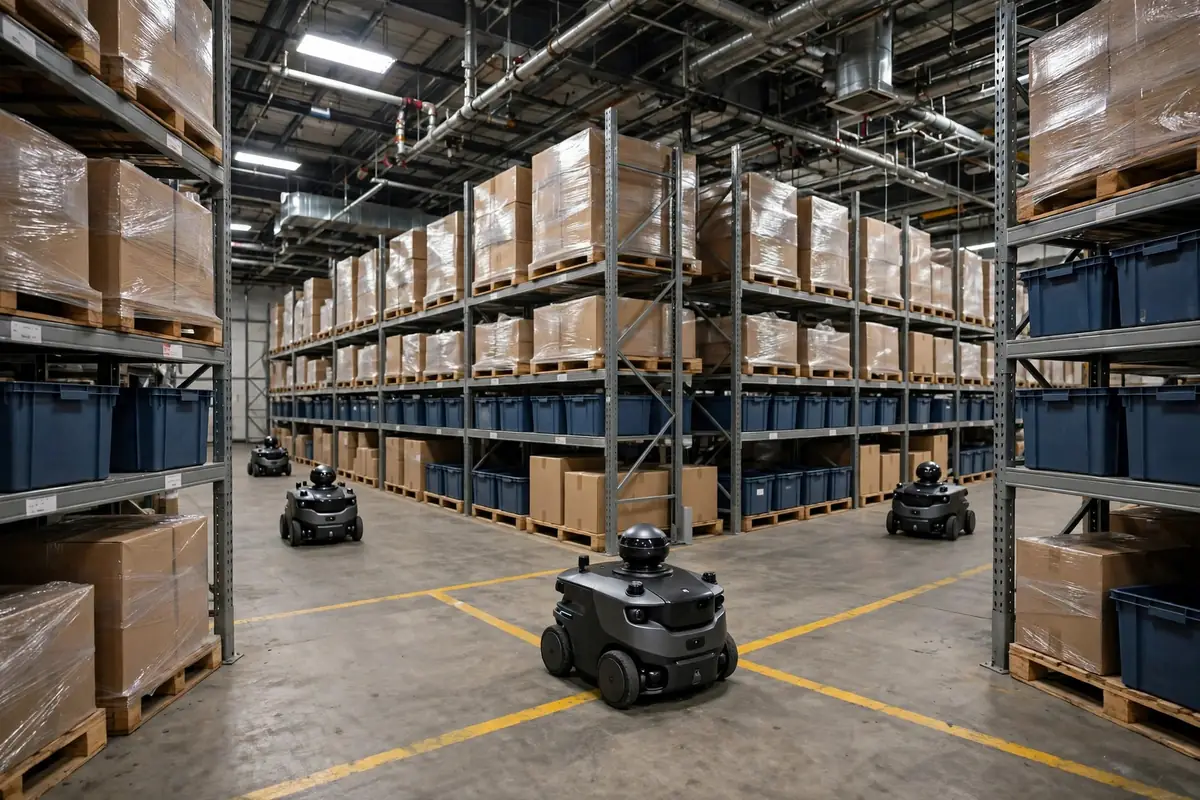
It was last fall. I was delivering to a distribution center out in the Midwest, one of those places that had just put AMRs on the floor. While I waited for the paperwork, I watched a pallet-carrying AMR roll down the main aisle toward a picker coming the other way, earbuds in, pushing a cart. They met at the aisle mouth. The AMR stopped dead. The picker jumped, squeezed around the back of the thing, and the AMR sat there a few more seconds before rolling on. A supervisor standing next to me said it had happened again that month — nobody hurt, nothing broken, but every time somebody had to walk over, push a button, move something, and the aisle jammed up for minutes.
I have spent fifteen years in and out of warehouses, and here is the difference people miss. A forklift has a driver: eyes, a voice, a foot on the brake. An AMR runs a program. It only knows the road it drew for itself. To the machine, a person is just an obstacle. It stops, and the whole rhythm of the floor breaks. Worse, when people and machines share one lane, the accident usually isn't the machine hitting the person. It's the person walking around the machine — into places they should never be.
AMR Human Collaboration Safety Starts on the Floor, Not in the Settings
The first step in AMR human collaboration safety is not a parameter. It is paint on the floor. In North America the safety standard for AMRs and AGVs is ANSI/ITSDF B56.5 — the 2019 edition, with the 2024 edition already out. The international counterpart is ISO 3691-4:2020, and there is also RIA R15.08. I don't memorize clauses. But all three point the same way: where people live and where machines run, separate them when you can, and set rules where you can't.
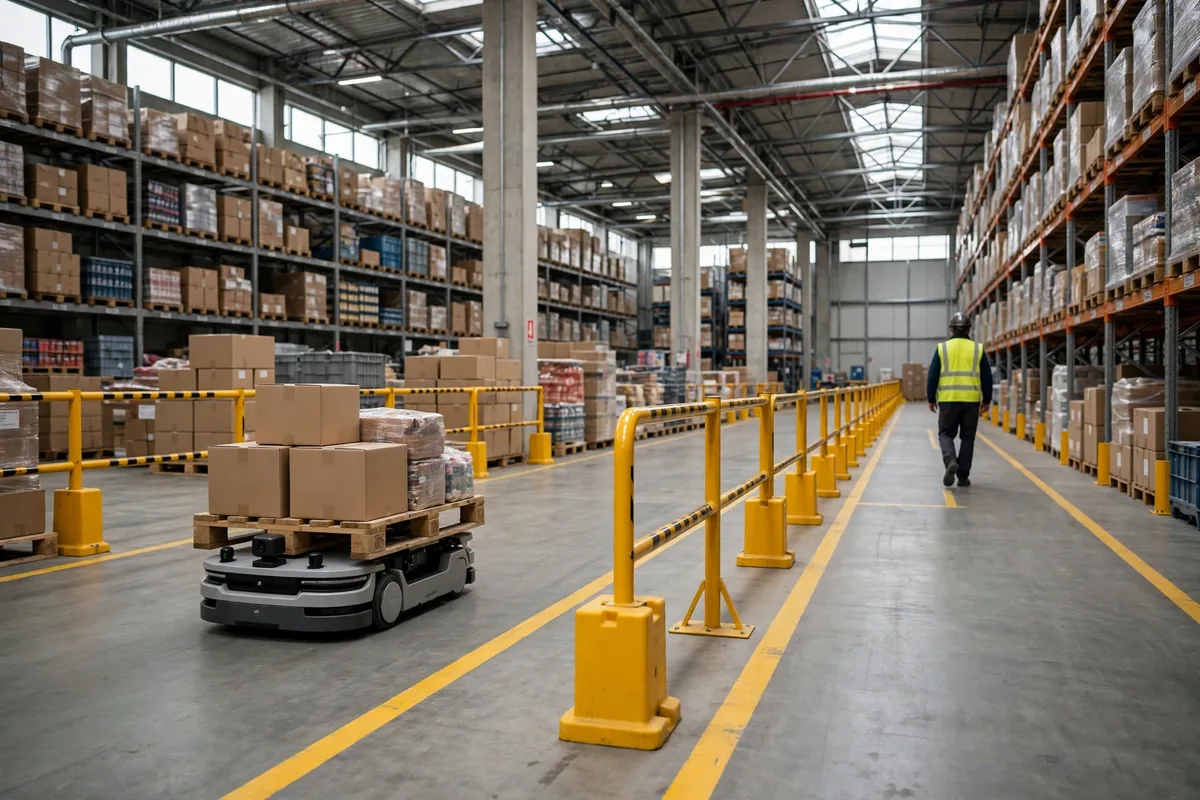
The division that works, in the warehouses I've seen, has three layers:
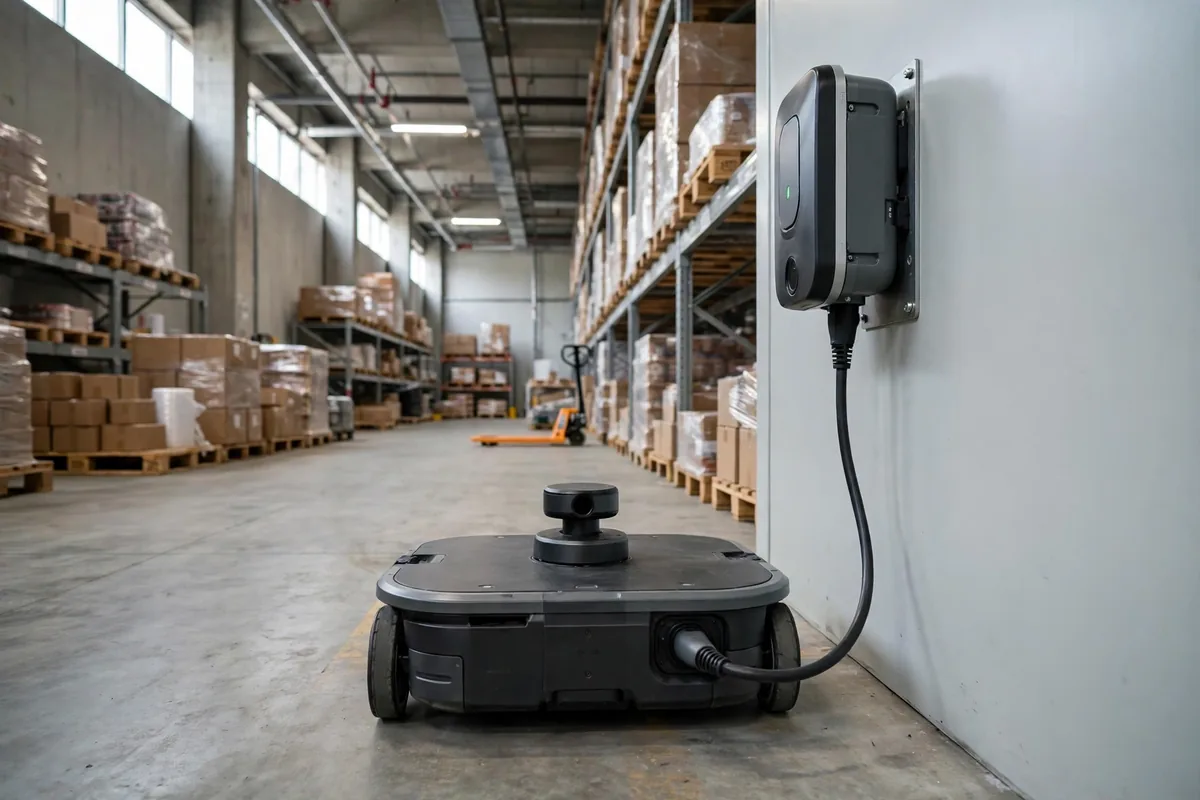
- Machine-only zones: the AMR main lanes and charging areas. People don't go in. Leave a maintenance opening, and stop the machines first when someone does.
- Shared zones: the crossings and load points where both have to pass. Painted lines, a sign, and the machine slows down here. People cross like they cross a street — look first.
- People-only zones: picking, packing, break areas. Machines don't enter. A rail across the opening does the job.
Draw those three layers and most of AMR human collaboration safety is done. I've also seen warehouses with no division at all: AMRs everywhere, people dodging everywhere, supervisors shouting all day, nothing changing.
1.2 Meters per Second: The Speed Line in AMR Human Collaboration Safety
There is one number in B56.5 I remember cold: in a hazardous zone, operating speed is 1.2 meters per second — about 2.6 miles per hour, roughly a brisk walk. The logic is plain. A machine running next to people can't go much faster than a person walks, or nobody can get out of the way.
Here's the counterintuitive part: slowing the AMR down can make the whole warehouse faster. Let me run a hypothetical example — the numbers below are a scenario, not a measurement. One main aisle, an AMR making 40 trips a day, losing 20 seconds per trip to dodging people in the shared zone. That's 800 seconds a day, about 13 minutes. Sounds small, until the aisle jams and the forklifts and tuggers behind it start stacking up, and half an hour is gone. Flip it around: hold the speed under 1.2 meters per second where people walk, keep people and machines on their own sides, and the AMR stops braking all the time. The single machine is slower. The floor is faster.
So don't argue with the parameter. Argue with the aisle. Slow where people are, open up where they aren't. The standard gives you a ceiling, not a target. In practice the split looks like this:
| Zone | How to run the speed |
|---|---|
| Machine-only | Run at the equipment's capability — nobody is in there to accommodate |
| Shared zone | Hold under 1.2 m/s; slow first when meeting a person |
| Crossings and blind corners | Slow down whether or not anyone is visible, speed up after |
You don't need to memorize that table. Tape it next to the dispatch desk. One rule behind it: the more people, the slower the machine; the faster the machine, the fewer people.
Right-of-Way Belongs on the Floor, Not on the Wall
I've seen two kinds of right-of-way rule. One lives on a poster: "Pedestrians have priority." Read out in three meetings, forgotten by everyone the day something happens. The other lives on the floor: a stop line at the crossing where the AMR always halts, a crosswalk painted in a color you can't miss where forklifts and AMRs both wait, a convex mirror on the blind corner so the driver and the picker can see each other.
Let me tell you what happened at that same Midwest warehouse. They painted crosswalks and hung mirrors at the two worst crossings, then changed the AMR routes into a one-way loop so machines stopped meeting head-on. The supervisor told me that in the first month after the change, aisle jams fell by more than half and the AMRs stopped braking for people all the time. I didn't verify his numbers, so take them as his word, not mine — but the logic holds: once the rule is on the floor, people don't have to remember it and machines don't have to guess it.
One more thing: don't let the AMR's route be a mystery. Fixed route, fixed direction, fixed stops. Two days of walking the floor and workers know where the machine comes from and where it goes. The worst case is a route that changes every week — people just learned it, and now they're driving on a strange road again.
And decide in advance who handles an AMR after an emergency stop. I once saw a warehouse where an AMR stopped in a crossing and two workers went over, one pushing, one pulling, trying to move it. The machine reset and rolled forward on its own, nearly taking one of them with it. The right way is one sentence: when the machine stops, hands off — call the supervisor and reset it by procedure. Block the area around it first, so nobody walks around behind it. And a new hire's first day shouldn't start at a workstation. Walk them around the AMR routes with an experienced hand first, so they know which ground belongs to the machine and which belongs to people, before they ever watch a training video. New people get hurt because they don't know where the machine is going to appear from.
That 0.5 Meters in the Very Narrow Aisle Belongs to the Machine
The very narrow aisle — VNA — is spelled out in the standard: where the clearance on both sides of a restricted zone is less than 0.5 meters, unauthorized people are not allowed in. That half meter isn't stinginess. It's the machine's survival space. The AMR turns and extends its forks in there; put a person beside it and there is nowhere to dodge.
I saw a near miss like this years ago on the road. A warehouse left a narrow-aisle entrance unguarded, and a new worker cut through it as a shortcut while an AMR was working inside. The machine sensed the person and stopped hard, and the load nearly slid off the pallet. Nobody was hurt, but the whole building broke into a sweat. After that, the aisle entrance got a badge gate — only maintenance staff could enter, and the gate locked outright while the machine was working.
So what does all this come down to? Safety in human-machine collaboration doesn't rest on everybody being careful. It rests on making carelessness unable to cause an accident. Zones, speed, right-of-way: zones are the foundation, speed is the line, right-of-way is the daily habit. Get all three and the AMR finally helps. Miss one, and the harder the machine works, the more nervous the whole warehouse gets.
An old saying on the road goes: the road belongs to people and to trucks alike. If you can't tell whose is whose, nobody moves fast.
By Shifu Zhao, Trucking Veteran (15 yrs)