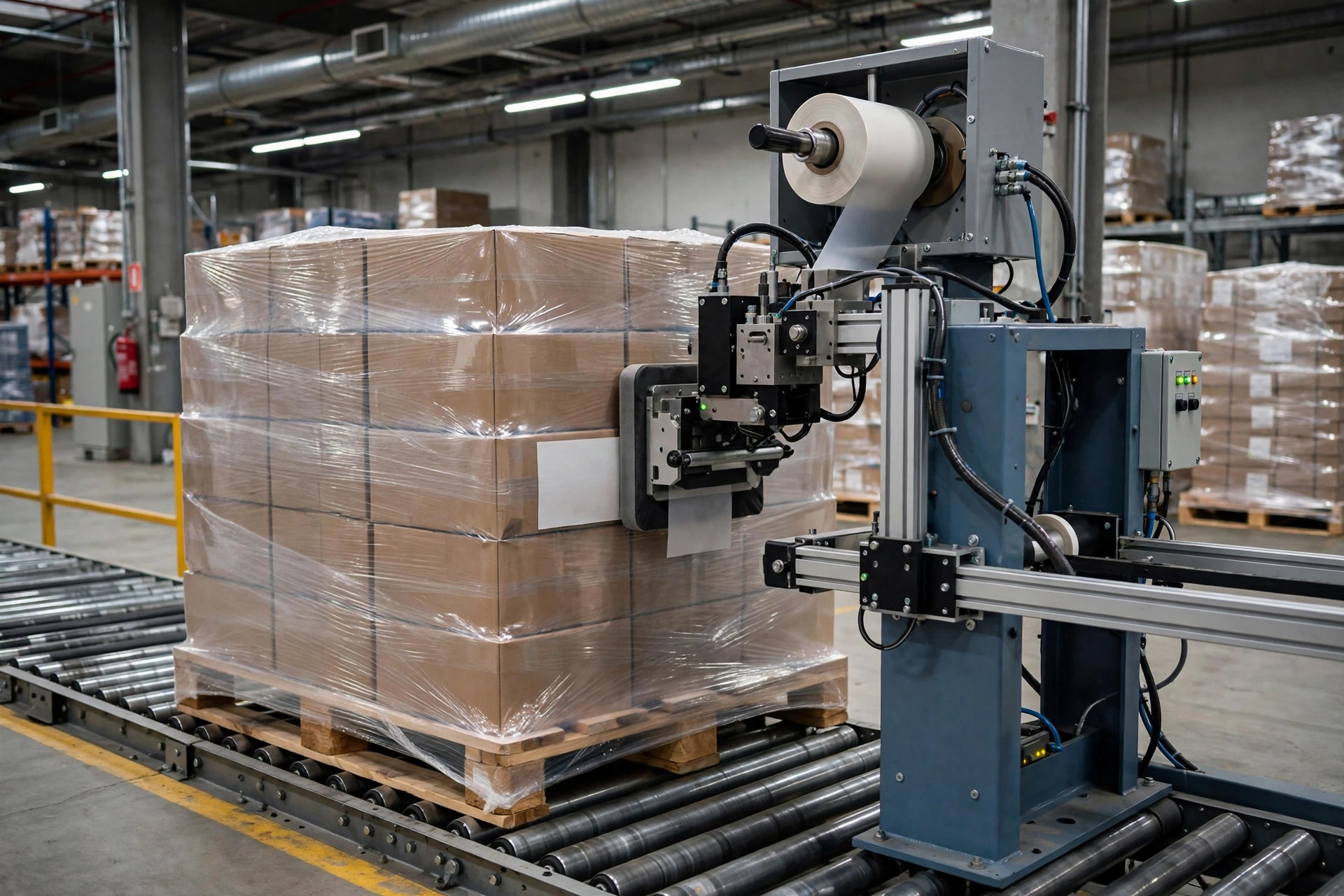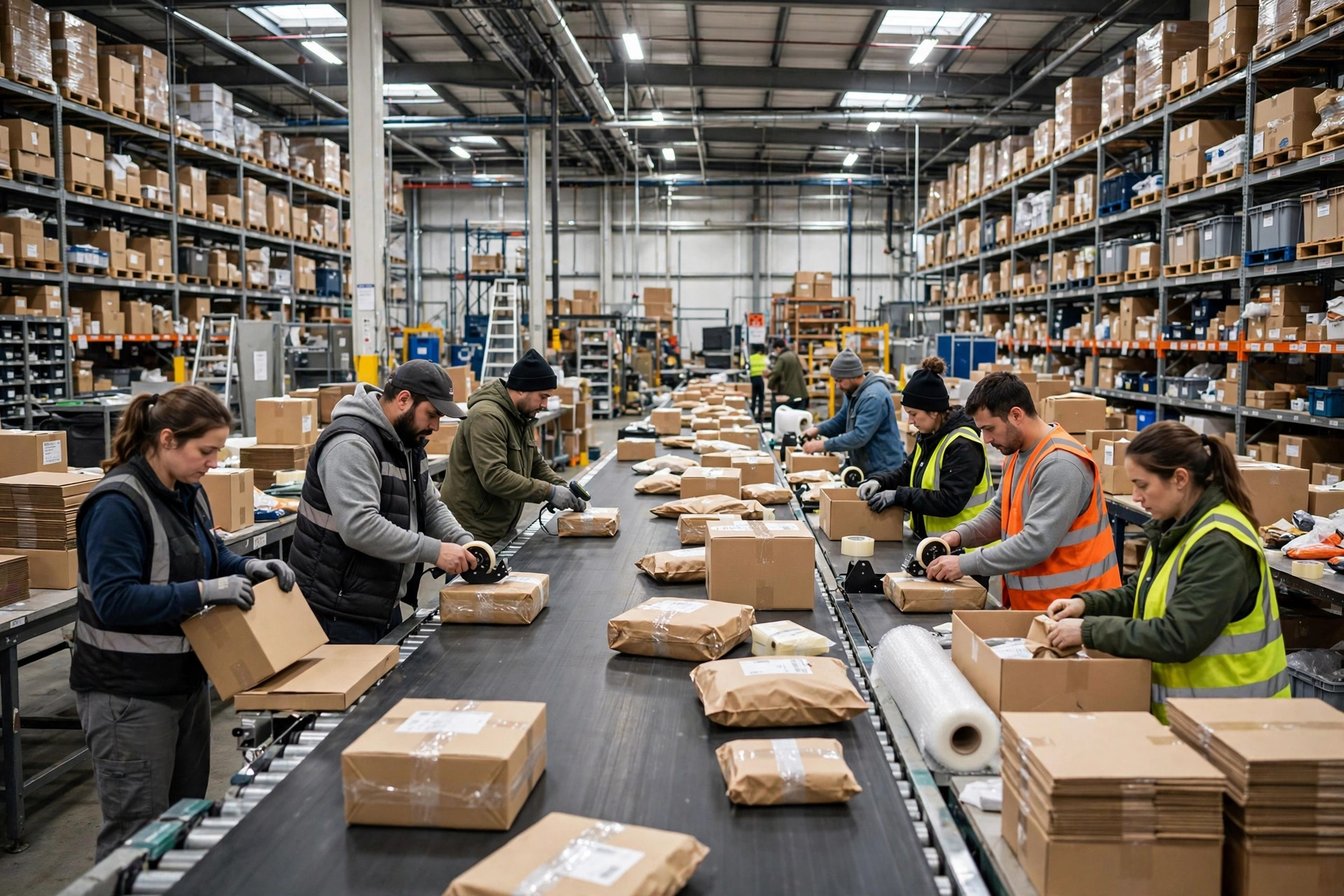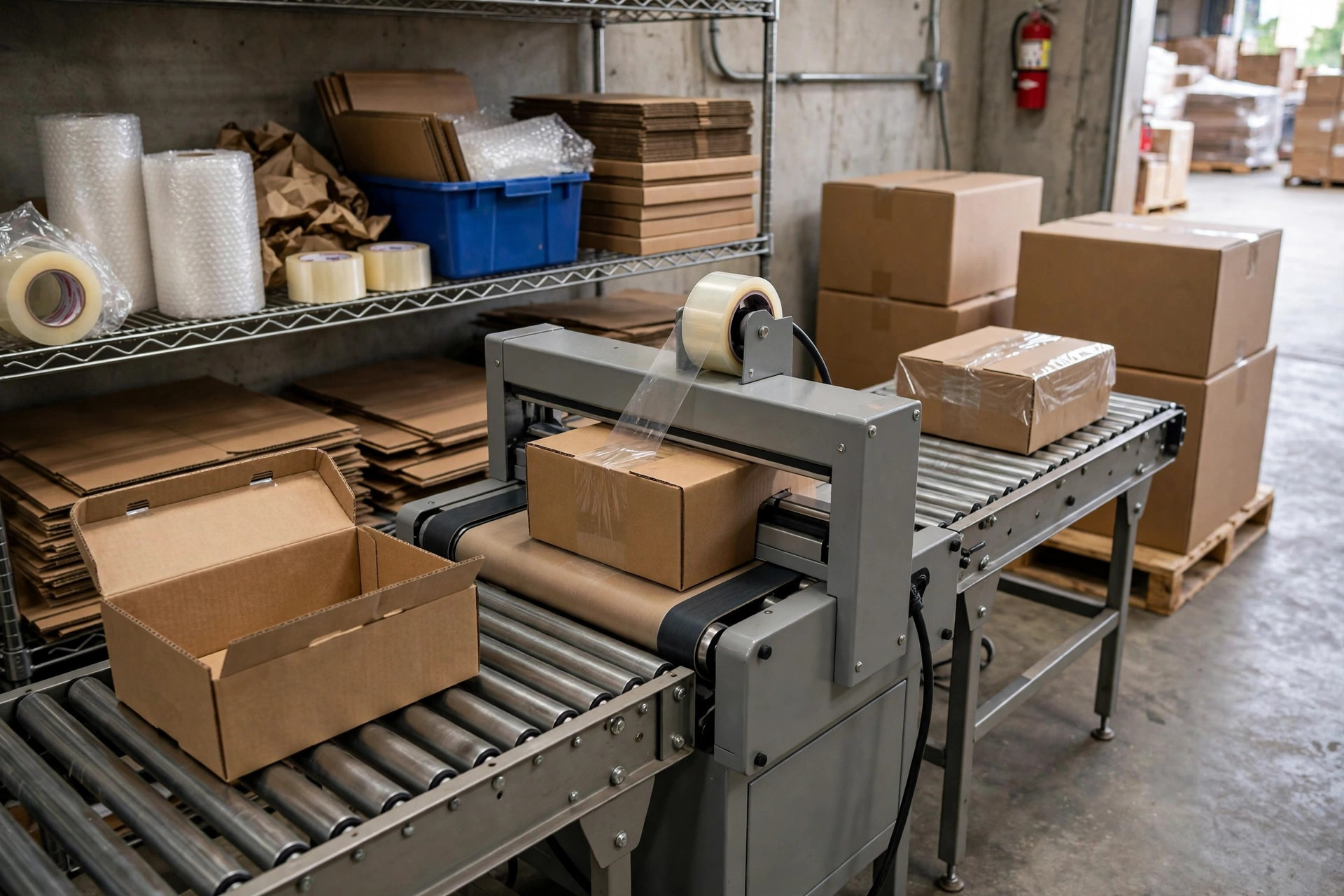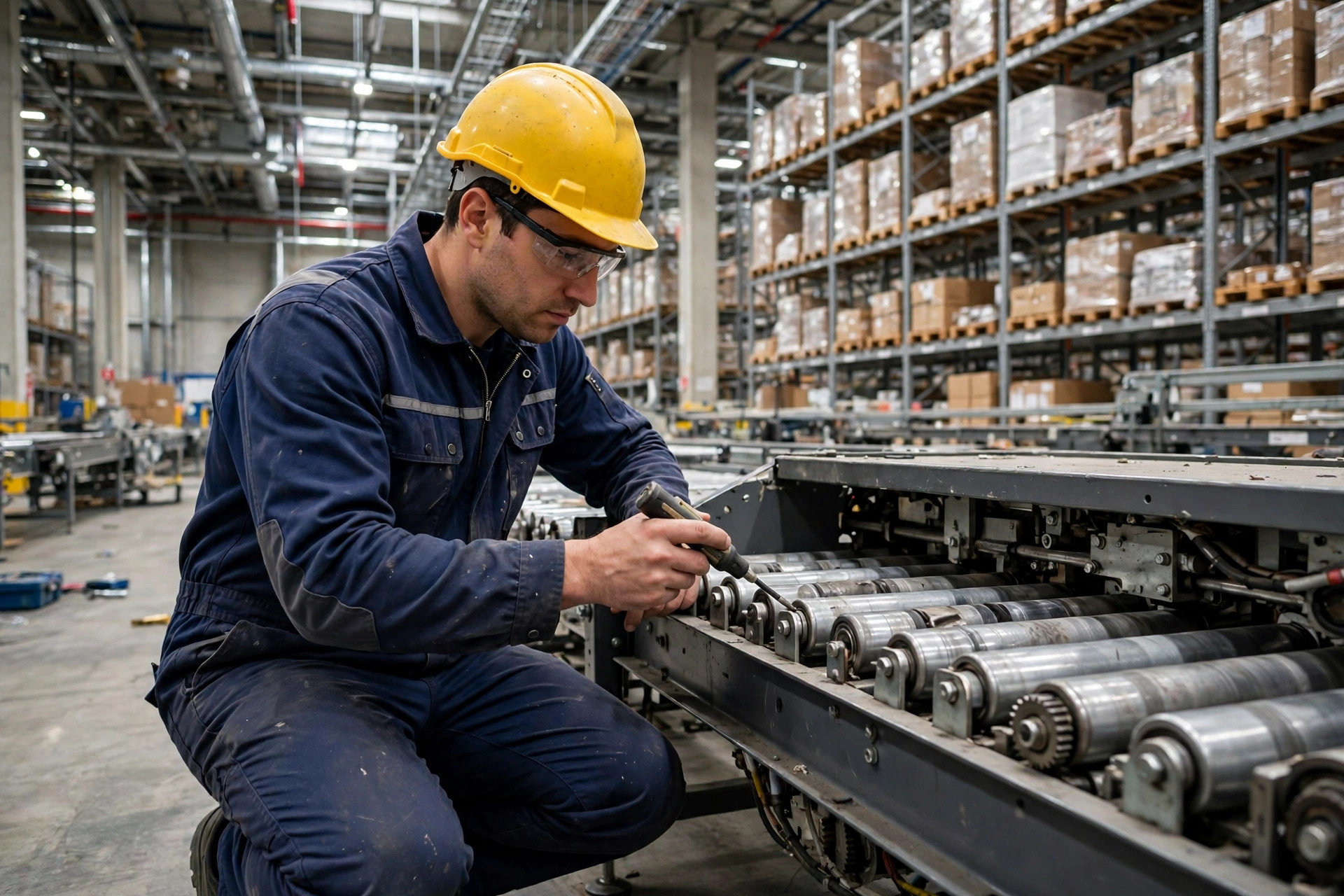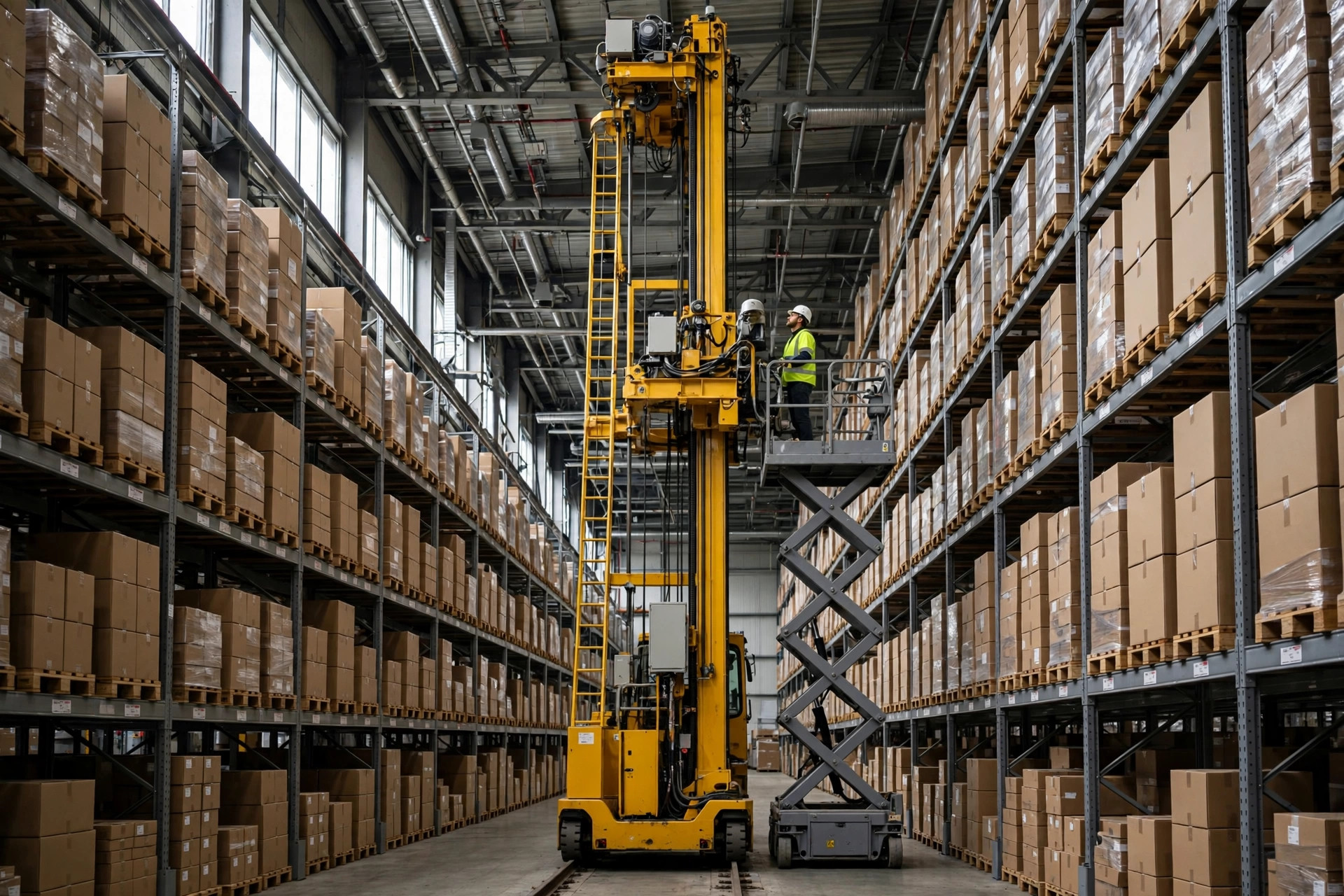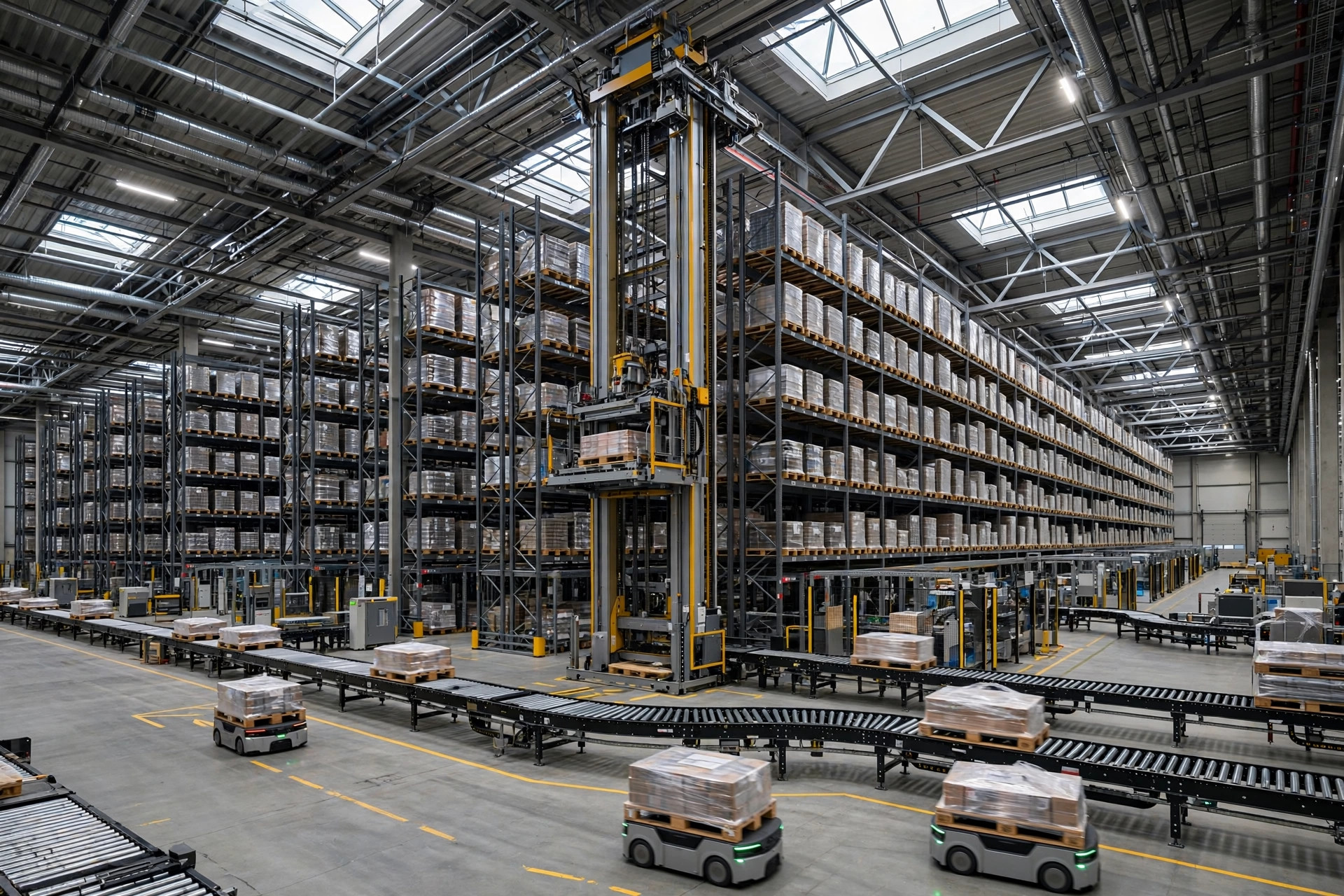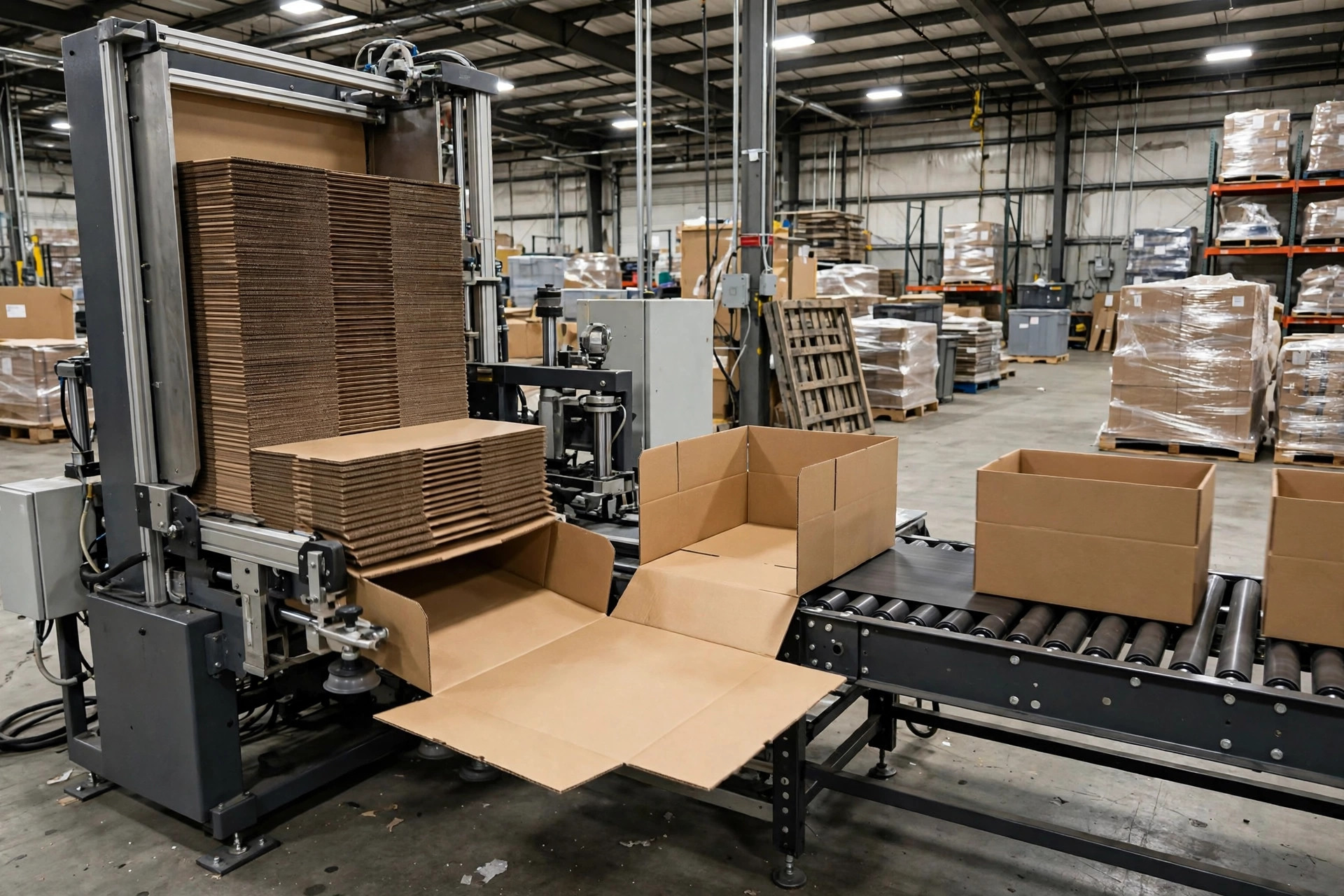
Same packing line, two warehouses. In warehouse A, the case erector jams every three minutes and the operator spends half the shift fishing out crushed cartons and hitting reset. In warehouse B, a machine in the same class runs all day with one stop at most. Did B pay $40,000 more? No. The difference is whether anyone did the math on cartons and throughput before buying, and whether anyone owns the machine after it arrives.
Let me start with the money. Published pricing references are blunt: manual case forming runs about one person at 4 cases per minute, roughly $0.15 per case in labor. An entry-level fully automatic erector costs $35,000–$60,000 and runs 10–15 cases per minute. At 4,000 cases a day, hand-forming eats 1,000 minutes — nearly 17 labor-hours, more than one full shift just to open boxes. A $40,000 machine saving $0.15 a case pays for itself in a little over two months of that volume. Plenty of warehouses have done this math. Then the machine jams constantly, the labor savings get spent digging cartons out of it, and the investment quietly goes to zero.
The case erector is the most neglected link on the packing line. Budgets go to sorters and palletizers; the erector gets whatever is cheapest. And then half the line's downtime starts at the erector. Here is the whole subject in one pass.
Start With the Carton, Not the Machine
In my experience, more than seven times out of ten, a chronic jammer turns out to be a carton problem, not a machine problem. Off-register score lines, rough slot edges, moisture-softened board, out-of-spec dimensions — no machine, however expensive, fixes those. So step one of selection is not the brand or the price. List every carton you run: length, width, height, flute count, single-wall or double-wall, coated or not.
Then check the machine's case-size window. A common class of machine covers roughly 8 to 22 inches of case width, with limits on length and height too. Your smallest and largest cartons both have to sit inside that window, with margin. Plenty of warehouses size the machine to their hero carton, then add a promo-size large case for peak season and discover the machine physically cannot open it. My advice: list every case you might run in the next year, including promo packs and odd sizes, and size the window one notch above your largest.
Magazine capacity matters more than people think. A typical magazine holds around 100 knocked-down blanks — at 12 cases a minute, that is a refill every eight minutes. Check whether refills require stopping the machine. Watch this during the demo, not in the brochure.
Carton storage is part of the equation. Moisture-softened board deforms under vacuum cups and is a top cause of jams. Keep the blank inventory close to the packing line and out of the damp corner of the building. And one hard rule: send carton samples to the vendor for a trial run before you buy — at least 50 blanks, a mix of good and bad. Watch the full trial video, not just the smoothest minute. Bring your corrugated supplier into the contract with score-line tolerances in writing. Saving a penny a carton is a bad trade when one jam costs you more in downtime than a truckload of cartons.
Don't Oversize the Speed: Match Your Sealer and Your Real Rate
Erector speed tiers are well documented: entry-level fully automatic at 10–15 cases per minute ($30,000–$60,000), mid-range at 15–25+ per minute ($60,000–$90,000), high-speed at 25–45+ per minute ($90,000–$150,000 and up). I have cross-checked these bands across multiple vendors; configurations move the numbers, but the tiers hold.
Here is the catch: most e-commerce and 3PL packing lines never actually run 20 cases a minute. The bottleneck is usually manual packing or the case sealer. A 25-case-per-minute erector feeding a 12-case-per-minute sealer wastes the extra $30,000. An erector slower than the sealer starves the whole line. Either mismatch is money burned.
My verdict is blunt: size the erector to your sealer's real speed plus 10%–20% headroom, and stop there. A warehouse shipping 20,000 cases on a peak day is well served by the entry tier. Only a near-fully-automated line with automatic case packing justifies mid or high speed. Do not pay for "what if we double capacity someday" — by the time that day comes, your case mix and line layout will have changed and you will likely replace the machine anyway.
Two integration points with the sealer, both practical. First, leave a buffer conveyor between the erector and the sealer instead of hard-coupling them. When the sealer stops for a tape change or a jam clear, the erector needs somewhere to stage formed empties, or the whole line stops together. Second, wire the interlock: when the sealer faults, the erector must stop automatically and restart on recovery. Confirm this at order time, not on installation day when it suddenly costs extra.
Vacuum Cups or Mechanical Jaws? Let the Board Decide
An erector opens a flat blank with either vacuum cups or mechanical jaws/pins. Which one to pick is not about machine price — it is about your board.
Vacuum cups suit flat, cleanly scored, standard-weight board. The action is gentle and does not mar the surface. But cups have three enemies: moisture-softened board that will not hold vacuum and deforms, rough or unevenly coated surfaces that leak air, and heavy double-wall board that exceeds the cups' grip — and can pull up two blanks at once. Mechanical jaws and pin-style openers handle heavy board far more reliably and are less fussy about board condition, but they are sensitive to dimensional variation and will crush corners if misadjusted.
Air pressure is the lifeblood of a vacuum machine. Manufacturer manuals commonly call for a minimum of 80 psi, and a leaking air line or an undersized compressor cuts cup grip directly. Many warehouses share one air drop among the erector, the pneumatic coder, and the sealer — at peak, when everything runs at once, pressure sags and the erector is the first to quit. Give the erector its own air drop, or at minimum put a gauge on it and check it at shift start every day.
The trade-off, stated plainly: stable carton quality, one or two case sizes, a long-term corrugated partner — go vacuum, it is the low-drama choice. Mixed case sizes, rotating carton vendors, inconsistent board — go mechanical, it is the tougher machine. Neither technology wins outright; only the fit with your cartons matters.
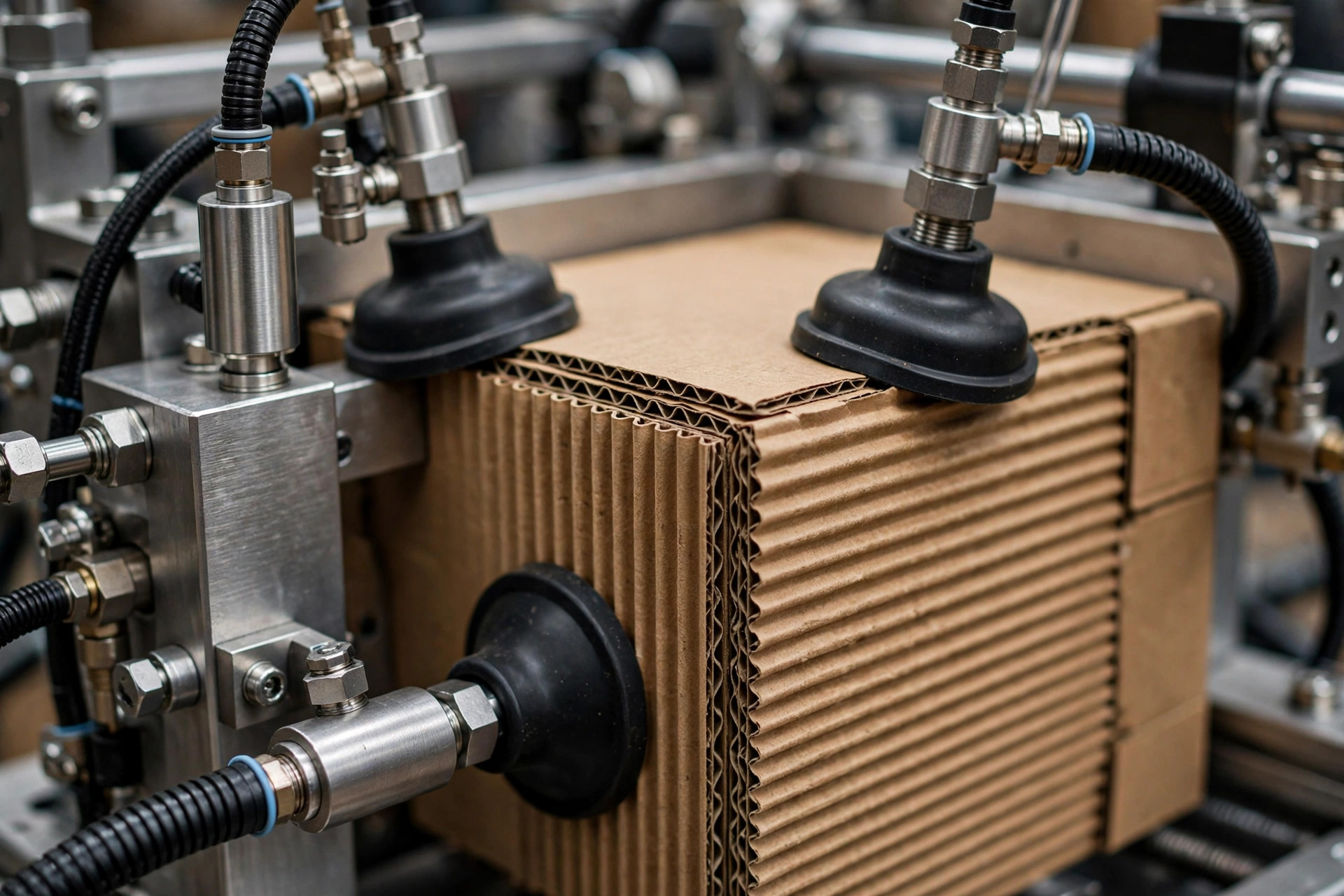
Maintenance is a 15-minute job — until you skip it.
A well-kept industrial erector easily lasts 10–15 years. A neglected one is a basket case in three. The difference is not the machine; it is whether someone follows a checklist.
Five minutes at shift start: check the air gauge, check the magazine level, feel the vacuum cups for cracks and dust buildup. Cups are consumables — a cracked rubber cup costs tens of dollars to replace, so replace it before it fails outright. When the jam rate spikes, change the cups first and investigate second; eight times out of ten, that is the fix.
Fifteen minutes a week: lube the guides and chains, check belt tension, blow paper dust off the photo-eye sensors. A loose belt slips, cases track crooked, and the bottom tape lands off-center. A dust-blinded sensor throws false empty-magazine alarms or lets the machine dry-cycle.
When it jams, do not call the vendor first. Work this sequence: one, the carton — run ten minutes on a known-good batch; if the jams stop, it is a carton lot problem, go talk to your supplier. Two, the air — is the gauge reading right, are the fittings leaking? Three, the mechanics — cup positions, belt width settings; belts set too wide or too narrow both cause jams. Only after those three come up clean is it time to call the factory. I have watched too many warehouses idle a line waiting for a service tech who replaces a cup in ten minutes and bills a $500 trip charge.
Three things you can do tomorrow: if you are selecting, send carton samples for a trial run and ignore the brochure speed number; if you already own one, tape the maintenance checklist to the machine, assign an owner, and protect those 15 minutes a week; and get score-line quality into your corrugated contract, because every penny saved on board can come back doubled as downtime.
One question to take with you: the last time your erector jammed, was it the carton's fault or the machine's? And if it was the carton — how much downtime tuition have you paid for board quality?