Start with a bill. A client selling everyday consumer goods across the Mediterranean put stock in the athens warehouse market in the summer of 2025 for Southern European distribution, and after three months the numbers told an awkward story: the warehouse rent itself was the smallest line on the invoice. The big lines were peak-season temp labor, extra trucks booked at short notice, and transfer losses on the island leg. Spread across every unit shipped, the real cost per unit came in well above the budget drawn up in January. That is the first lesson of Athens: you are not choosing a warehouse quote, you are choosing a whole cost structure.
I am not a market researcher. I am a cost analyst, so this piece will not deal in grand trends. It deals in where money leaks out and where it can be plugged back in. All case figures below are illustrative operational examples, used to show the arithmetic — not published market statistics. For actual rents, rates, and tax treatment, check the latest local listings and official policy.
The Athens Warehouse Market Bill: Where the Money Actually Goes
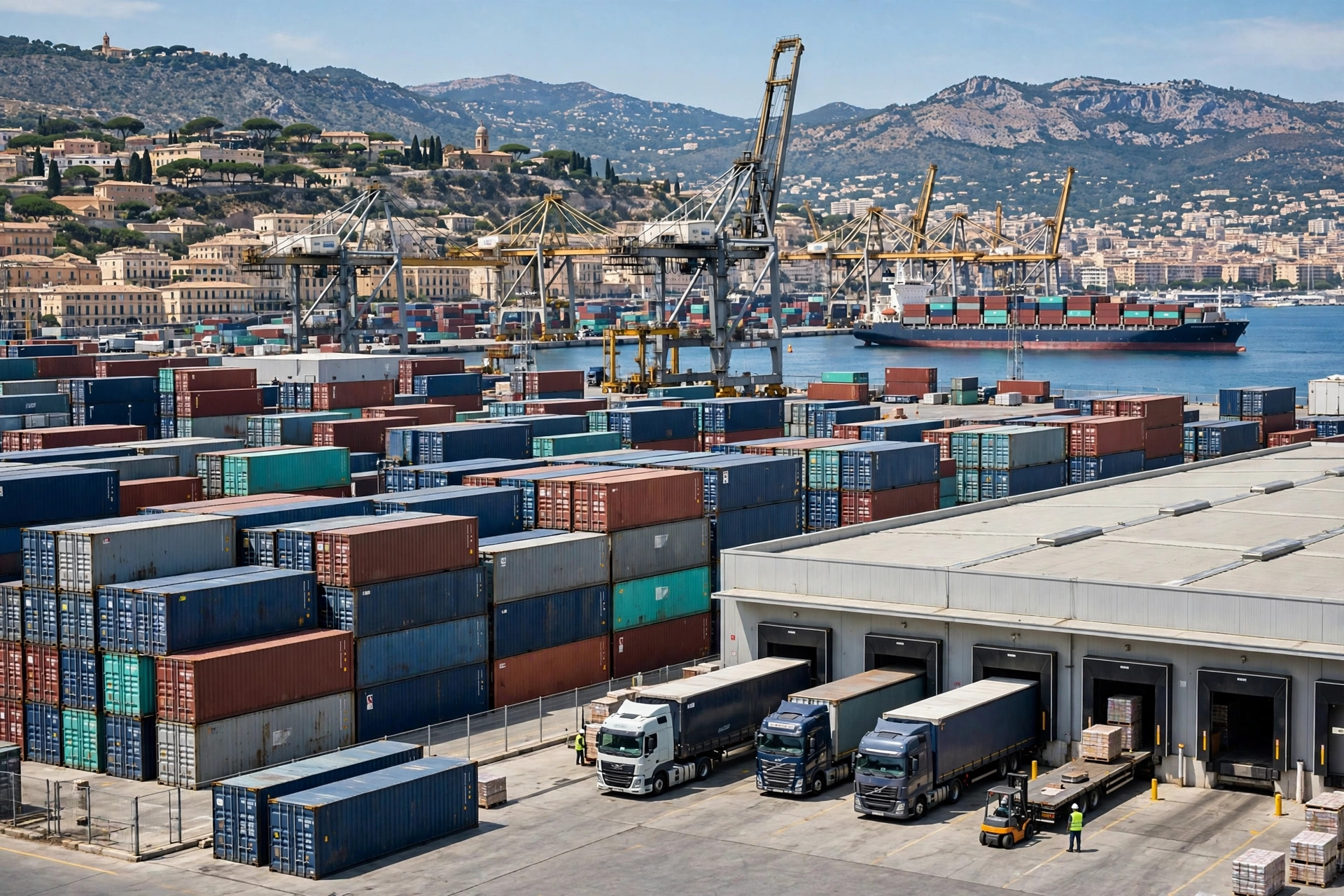
Athens warehousing revolves around three corridors. The first is the Piraeus port corridor: freight comes off the ship and straight into the warehouse, which suits import distribution and re-export, but peak-hour traffic around the port and tight pickup windows eat time, and waiting time is money — trucks idling, crews standing by, unloading slots missed. The second is the inland warehouse cluster across Attica, a little further from the port, suited to bulk storage and slow-moving stock: linehaul gets cheaper, but the last-mile delivery radius gets longer. The third is the airport area, suited to high-value, small-batch, time-critical goods with fast air connections, but where flexibility and operating space are often constrained.
A proper total-cost sheet has at least five lines: rent, labor, linehaul and delivery transport, damage and exception handling, and capital tied up in stock. Most buyers compare only the first line, and that is where the arithmetic goes wrong. A port-corridor warehouse can look expensive on rent and still come out even on cost per unit, because it saves linehaul and waiting time. An inland warehouse can look cheap on rent and still lose the comparison, once the extra delivery miles and an extra transfer are added up at month end. Compare like with like: the same shipment, run through the same chain, end to end.
| Location direction | Best suited to | Where the cost piles up | The line most people forget |
|---|---|---|---|
| Piraeus port corridor | Import distribution, re-export | Pickup waiting and peak-hour transport | Overtime trucks caused by missed port windows |
| Inland Attica cluster | Bulk storage, slow-moving stock | Delivery mileage and transfers | Empty return legs on the last mile |
| Airport area | High-value, small-batch, urgent goods | Time guarantees and tight operating space | Emergency labor and packaging for rush orders |
When Peak Season Hits, the Bill Changes Shape
Athens seasonality is not a talking point; it is written on the invoice. Take an illustrative example from July 2025: a supplier to hotels and resort areas saw orders more than double in peak weeks, with 1,200 cartons of toiletries to split across Attica and several island customers within two weeks. Island sailings that normally ran twice a week did not suddenly become daily in peak season, so stock waited at the quay an extra day, and every extra day was another day of stockout risk at the hotel end. The client booked two extra truck runs and hired temp workers, and the cost per unit jumped. That money was wasted, and the waste was avoidable: the rhythm had simply never been planned into the schedule.
Now look at the other side of the year. After October 2025, the same client's outbound rhythm slowed and empty slots appeared in the warehouse. The instinctive reaction is to give space back and shrink the footprint. Run the numbers the other way around: the premium paid for a warehouse found at short notice in peak season, plus temp labor and rebooked sailings, often exceeds several months of off-season empty space. Empty space is not pure waste; it is insurance against running out in peak season, and insurance has a price. What should actually be cut is the dead stock sitting in prime positions all year, not the flexibility reserved for the peak.
Island distribution is another leak. Deliveries to Crete, Santorini, and similar destinations depend on sailing schedules, weather, and quay handling, and damage and returns cost more to resolve than a mainland delivery. Shipping direct to an island looks like one leg saved, but it concentrates all the risk on a single sailing; sorting and consolidating on the mainland first, then shipping in bulk by sailing, is usually steadier. Steadiness is itself a saving.
There is also a line people overlook: the inland Balkan route north through Thessaloniki. Freight leaving Athens northbound faces border procedures, intermediate nodes, and the question of return loads. A route with no reliable return freight will hand back on the empty return leg whatever it saved on the outbound leg. Before committing to that route, ask one question: what rides back, and who absorbs the cost if it rides back empty.
Capital tied up in stock is the quietest of the five cost lines, and the easiest to forget. Stock shipped early to an island and parked in a shop's back room looks like good availability, but it converts cash into island inventory that cannot be sold elsewhere or shipped back if sailings are disrupted. My rule of thumb is to hold island cover only until the next sailing plus three days of safety stock; one extra day is interest paid for nothing. In peak season, shipping to the islands in two smaller sailings beats staking all the cash on one big island load. Rent saved on paper is often outweighed by cash trapped in stock, and that only shows up when the month-end cash flow is reconciled.
Three Ways to Cut the Athens Warehouse Market Bill
The first cut goes to the contract. Peak-season flexibility clauses, off-season space adjustment mechanisms, and stepped pricing for overstay storage should be negotiated before signing, not accepted as emergency terms in July. Wherever settlement can follow actual shipped volume, let it; where a minimum volume must be committed, commit to a floor, not the full volume — committing to the full volume means paying for the off-season as well.
The second cut goes to operating rhythm. Cut island orders to sailing cut-offs, fix hotel replenishment into weekly waves, and turn overtime from an emergency into a rostered shift. The word "urgent" on an invoice is almost always a synonym for "premium." Lock the roster two weeks ahead, and demand for temp workers and extra trucks falls on its own.
The third cut goes to the location mix. There is no need to stake everything on one warehouse: fast-moving goods in the port corridor, slow-moving goods inland, urgent goods near the airport. A mix beats a single bet on total cost, though it carries a cost of its own — one more set of inventory records to reconcile. Put that management cost in the calculation; pretending it does not exist is how a good plan quietly goes over budget.
Here is a conclusion you can calculate. Take one complete recent month of real data and work out cost per unit shipped: rent, labor, transport, damage and exceptions, and capital tied up in stock, added together and divided by units actually shipped. Run that formula separately for the port corridor, the inland cluster, and the airport area, and put peak-season overtime and island exceptions on their own line for comparison. Whichever option gives the lowest cost per unit is your answer; if the options land within a reasonable margin of each other, pick the one with the most stable operation and the fewest exceptions. Once the bill is broken down this far, choosing a warehouse stops being a matter of gut feel.
By Lao Zhou, Logistics Cost Analyst