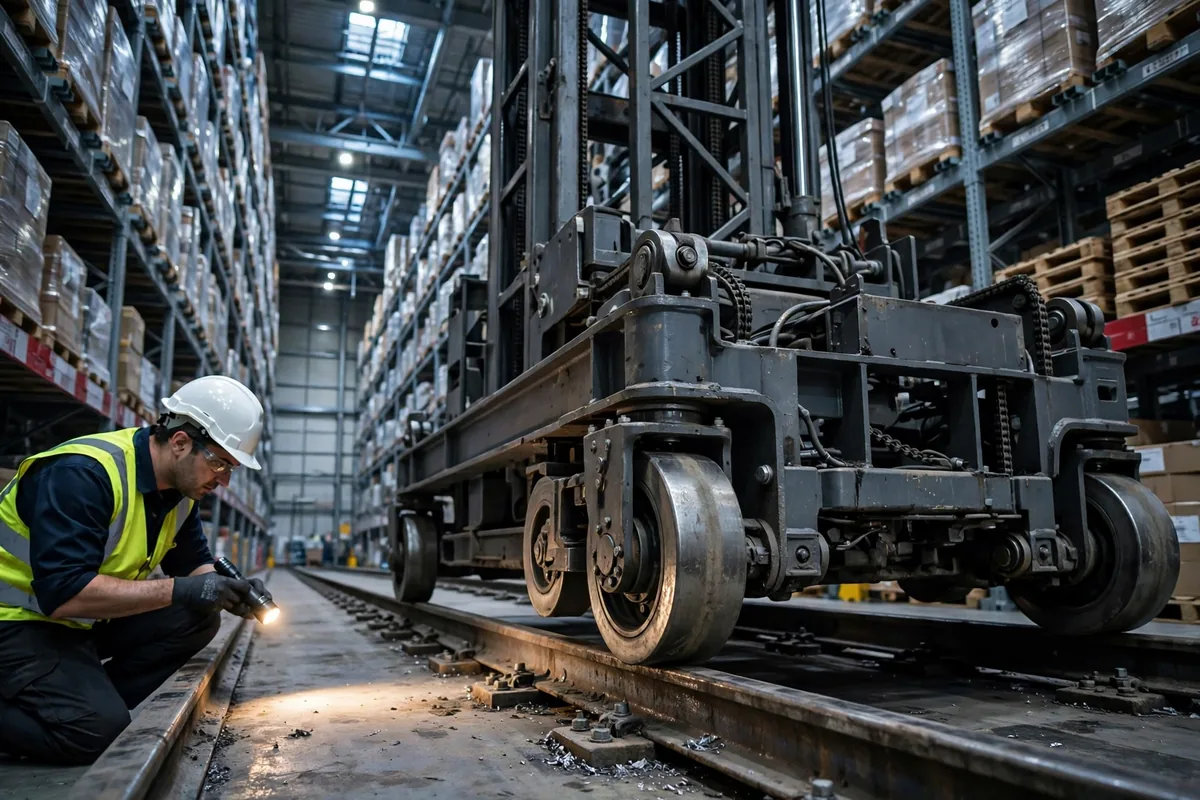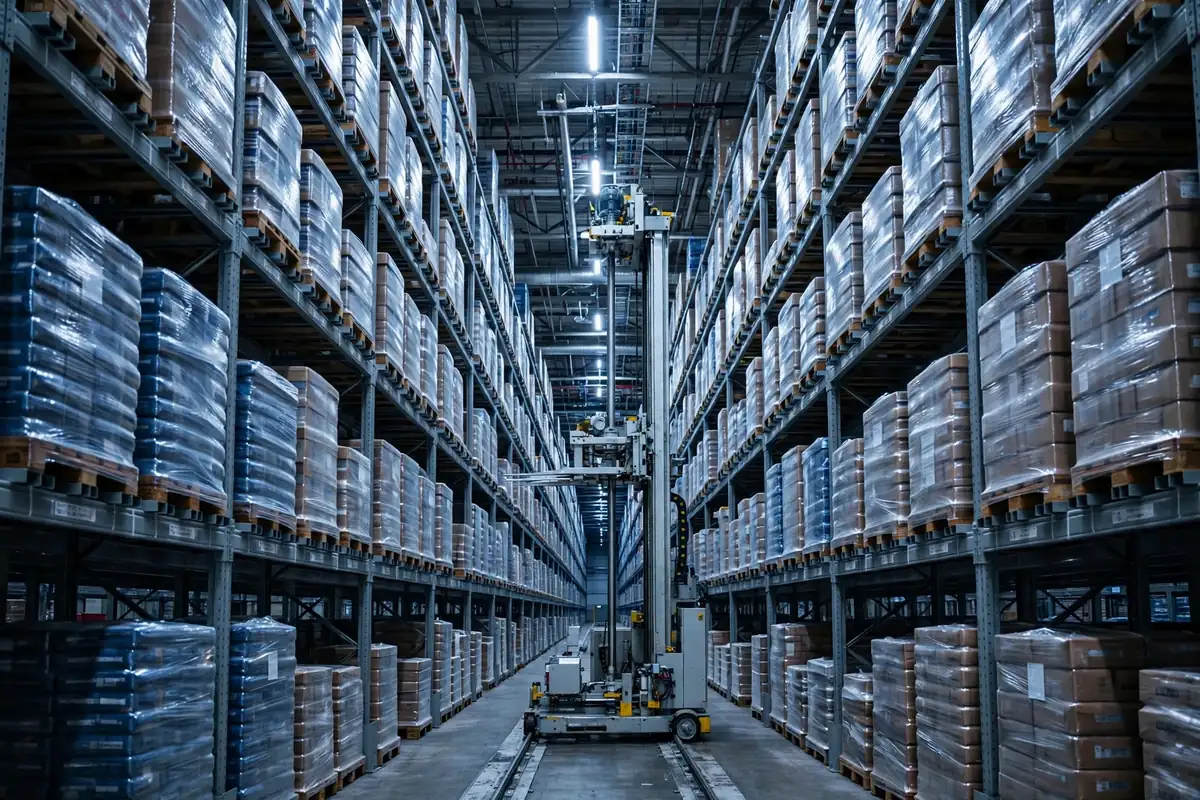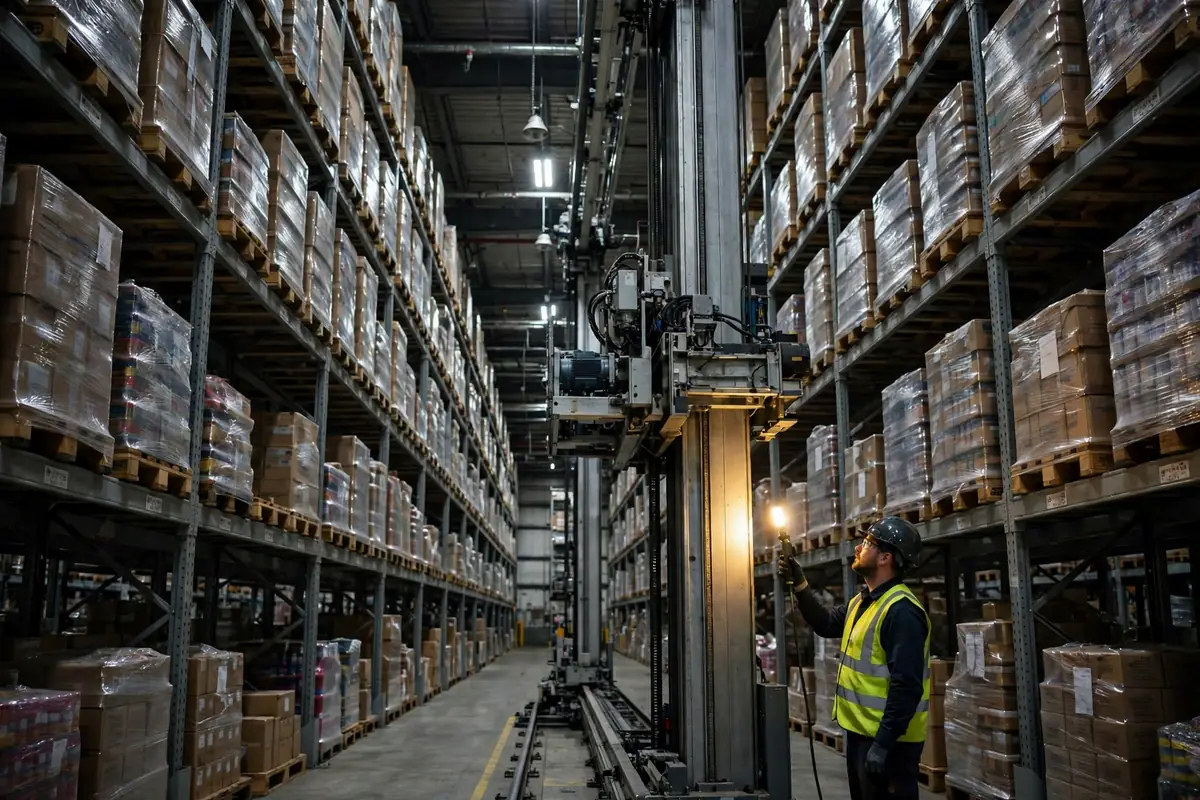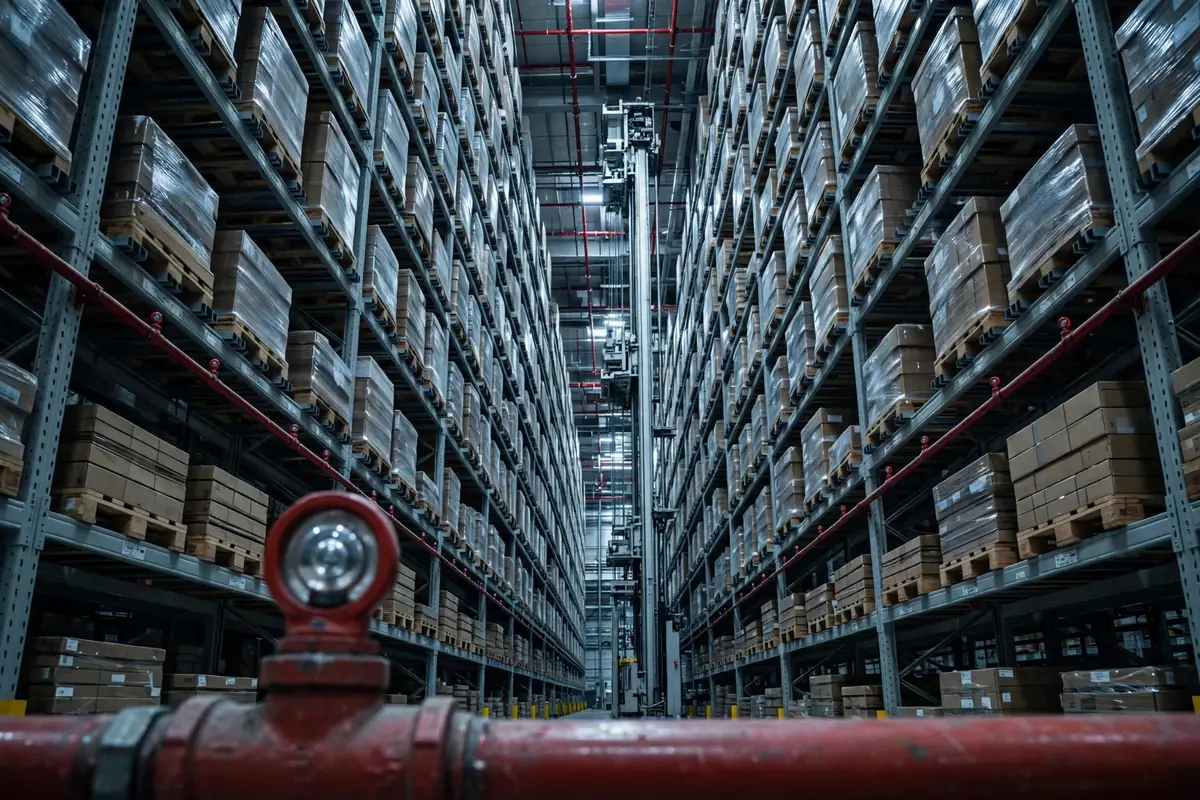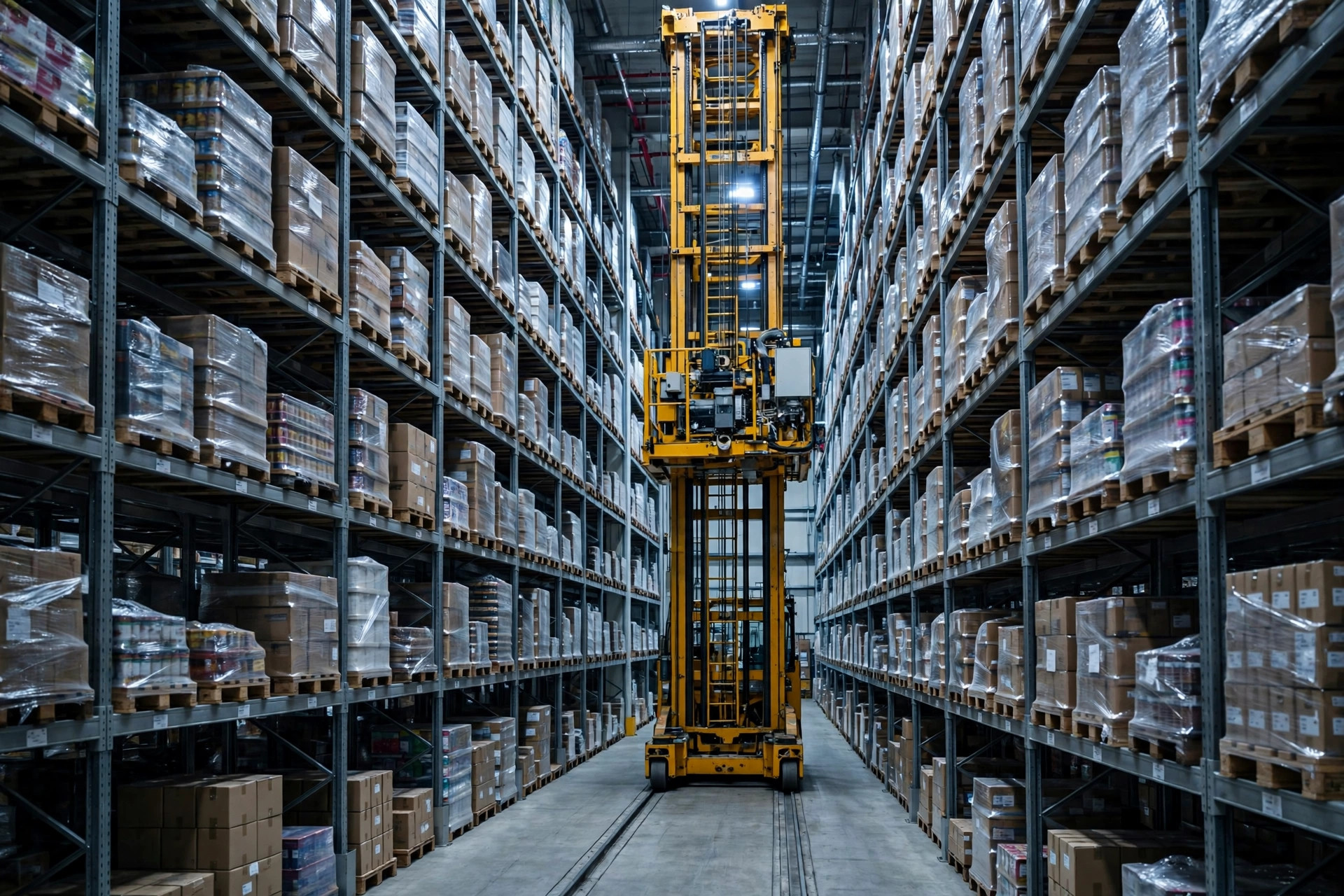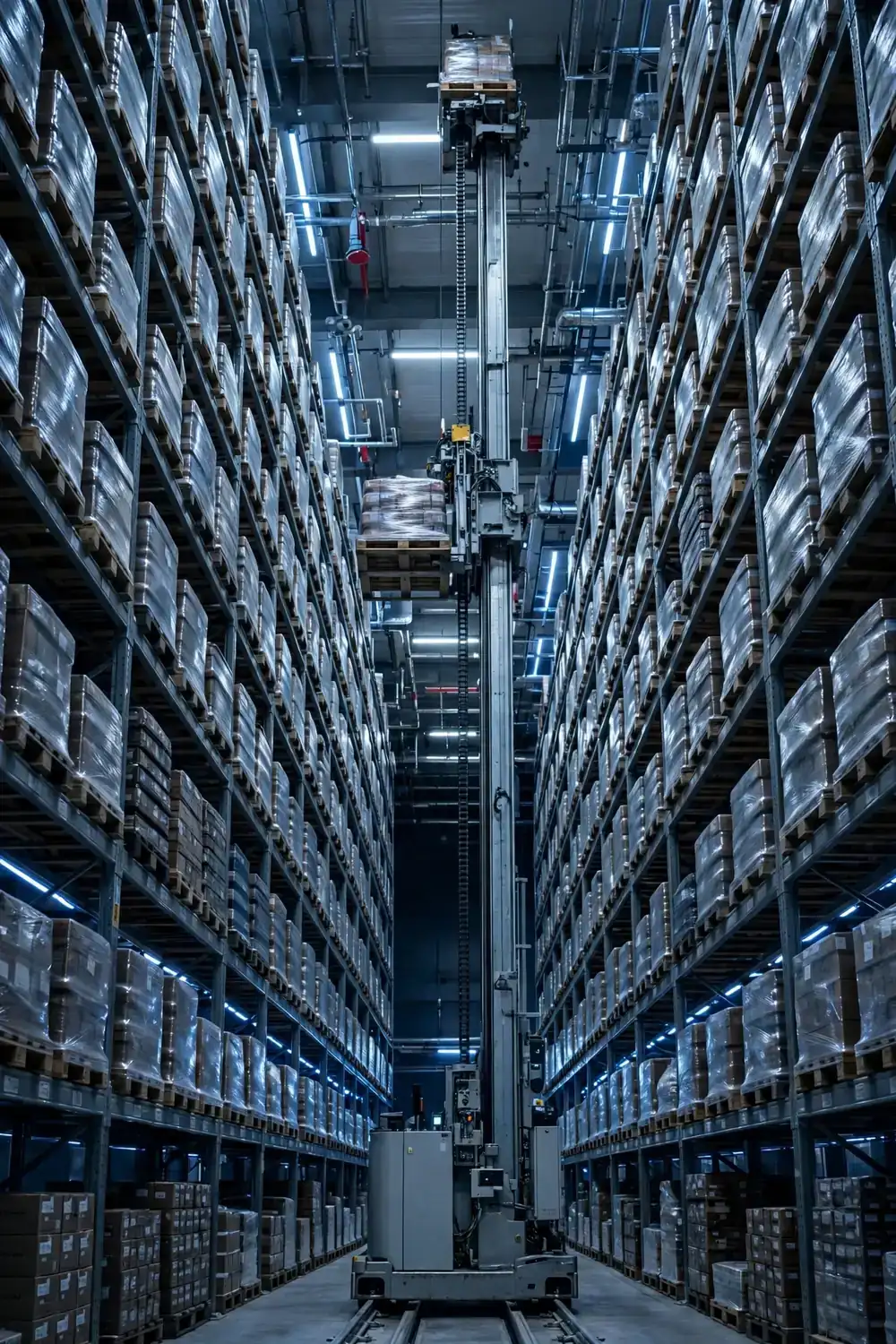
Start with the principle, because most people start in the wrong place. The moment an automated warehouse falls behind on outbound orders, somebody says the stacker crane isn't fast enough, and the fix must be a faster machine. You can think of a stacker crane as an elevator crossed with a forklift, running on rails down an aisle: it travels horizontally, lifts vertically, extends its forks to pick a pallet, and then drives all the way back. That round trip is one cycle. ASRS stacker crane empty travel utilization is simply the share of that cycle spent actually carrying something, and in most warehouses I have seen, it is barely half. Only the loaded half of the trip creates value. The other half is an empty run, burning time.
A mainstream pallet stacker crane travels at 120 to 160 meters per minute, with high-performance machines reaching 240, and lifts at around 60 meters per minute. Those numbers come straight off the manufacturers' datasheets, and I don't dispute them. The problem is that no speed on a datasheet survives a cycle that is half empty travel. The machine isn't slow. The road is wasteful. That gap is what asrs stacker crane empty travel utilization measures: how much of the crane's time actually carries a load.
Two years ago I worked on an e-commerce warehouse: eight aisles, 12 meters high, cranes rated at 150 meters per minute horizontal travel. The owner kept pushing for another crane because peak-season outbound couldn't keep up. I spent two days on site with a stopwatch, timing dozens of cycles, and found that in single-command cycles the empty return trip ate nearly half the cycle time. Adding a crane wouldn't have fixed that. It would have meant two machines running empty together. That is the bill I want to break down.
Three Causes of Empty Travel
Empty travel isn't one problem. It's three problems stacked on top of each other.
The first is task sequencing. A single-command cycle does one job per trip: store or retrieve, then drive back empty. A dual-command cycle does two jobs in one trip: it carries a pallet in for storage and brings another one out on the way back. The difference is not subtle. In a single-command cycle, roughly half the travel distance carries a load. With dual-command cycles, that share climbs to around 70 percent. Plenty of warehouses never switched dual-command on, or switched it on with pairing logic so crude that storage and retrieval tasks never actually meet. Getting that pairing right is the single biggest lever on asrs stacker crane empty travel utilization. The crane keeps running empty because the scheduler never gave it a reason not to.
The second cause is slotting. Put your fastest-moving products at the far end of the aisle and you make the crane run the full distance on every single trip. I once saw a warehouse that had parked its highest-volume SKUs at the dead end of the aisle, because "those slots were empty." The slots were filled, and the crane paid for it in wasted travel every day. Flip it around: the higher the velocity of a product, the closer it belongs to the aisle entrance, and the lower the level. Saving a few dozen meters per trip doesn't sound like much until you multiply it by a few thousand cycles a day. Then it is real throughput.
The third cause is aisle conflict. When inbound and outbound tasks collide in a single aisle, or several machines share one aisle, cranes end up waiting on each other. One crane works deep in the aisle while another waits at the entrance to get in — two cars facing each other on a one-lane road, neither moving. Worse still is putting the inbound and outbound ends on the same side of the aisle, so all traffic squeezes through one opening and jams at peak hours. Nothing is wrong with the machine. The layout is eating its speed.
Of these three, the first is the one most often misdiagnosed. The owner sees slow outbound and reaches for more speed or more machines. But the crane is already running at 150 meters per minute. Push the speed higher and you shave almost nothing, because speed was never the bottleneck. Empty travel was.
The Time Budget of One Cycle: How Much Is Empty Travel
Don't take my word for it. Let's run the numbers on a typical pallet crane. I'll state the assumptions up front: a 60-meter aisle, a slot halfway down at 30 meters and 12 meters high, horizontal travel at 150 meters per minute, lift at 60 meters per minute, and fork handling time estimated from field experience.
| Move | Time | | Outbound leg, loaded | 30 m travel, about 12 s; 12 m lift, about 12 s; fork pick, about 8 s | | Return leg, empty | 30 m travel, about 12 s; 12 m lower, about 12 s; fork deposit, about 8 s | | Single-command cycle, total | About 64 s, of which about 32 s is empty travel |
There it is, in plain numbers: a 64-second cycle, 32 seconds of it empty. Half the machine's time produces nothing. Now run the same trip as a dual-command cycle — store one pallet on the way in, retrieve one on the way out — and the same round trip completes two tasks. Empty travel per task drops by nearly half. The speed didn't change by a single digit. Throughput still went up.
For comparison, miniload cranes running small totes and cartons, with good dual-command operation, deliver roughly 100 to 150 dual cycles per hour per aisle. Pallet cranes don't reach those numbers, but the logic is identical: cycle count is decided by the empty-travel share, not by top speed. Speed is the ceiling. Empty travel is the floor. If the floor is leaking, a higher ceiling buys you nothing.
Dual-Command Cycles and Re-Slotting, in Practice
Dual-command first. The warehouse control system has to do two things: pair storage and retrieval tasks by aisle and by time window, so one trip does two jobs; and batch outbound tasks by aisle, so the crane picks up several retrievals along a single run instead of one at a time. Neither change needs new hardware. Both are scheduling logic. Run it for a week after the change and compare the share of single-command cycles. The numbers will speak for themselves.
Then re-slotting. The method is unglamorous, but it works: pull three months of outbound data, rank SKUs by velocity, and move the top 20 percent to the slots nearest the aisle entrance, lower levels first. Slow movers go deep and high. Yes, moving stock costs a shutdown and labor hours, and that cost is real. But once it's done, the crane's average travel distance drops, and the benefit pays out every single day. Some warehouses avoid re-slotting for three years because it's a hassle. The stock gets messier, the crane runs farther, and the efficiency quietly bleeds away. That is laziness, billed as an operations problem.
Finally, aisle conflict. Separate the inbound and outbound ends wherever the building allows — don't force all traffic through one opening. Spread tasks across aisles instead of hammering the same one. If separation is impossible, shift inbound tasks by half an hour during peak outbound windows. Staggering is the cheapest capacity expansion there is.
While I'm at it, let me take a shot at a fake requirement I see all the time. Some projects open with "we need the fastest stacker crane available" and write a 240-meters-per-minute figure into the tender. But the aisle is 60 meters long. The machine barely finishes accelerating before it has to brake. The headline speed never actually happens. Speed matters less the shorter the aisle. Fix the empty travel first, and only then ask whether the speed is enough. That's the honest order of work.
So, is the money worth it? Watch one number: asrs stacker crane empty travel utilization — the share of cycle time the crane spends running empty. Bring that down, and outbound throughput follows.
By Da Liu, Automation Engineer