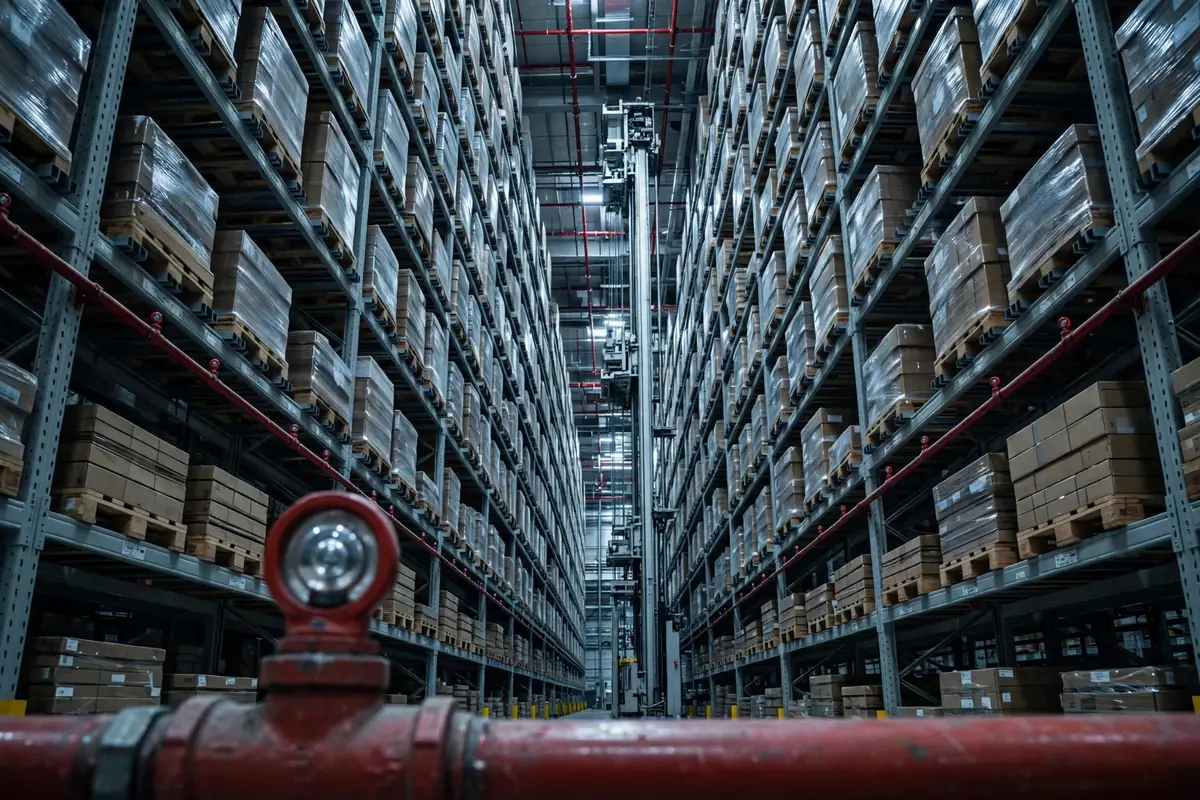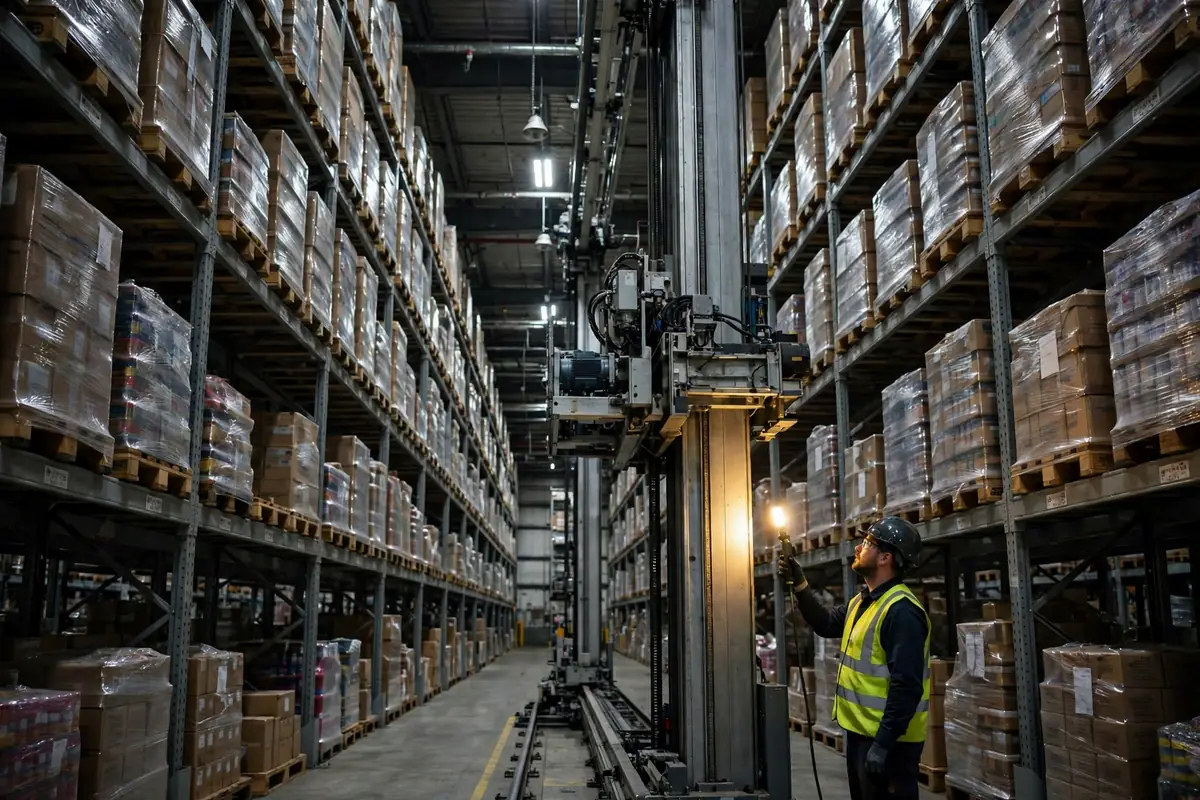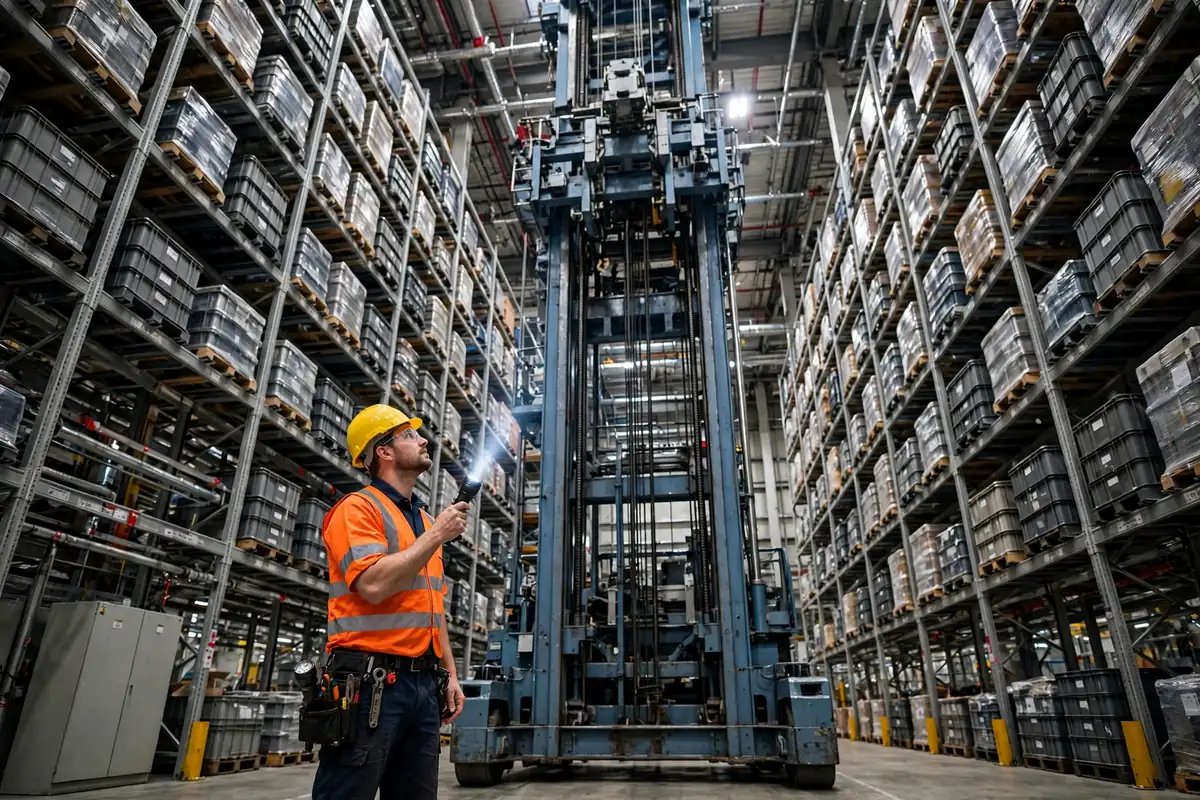
An ASRS preventive maintenance annual inspection is not a paperwork exercise. Last year I watched a stacker crane stop dead high up in an aisle, a full pallet still on its forks, three outbound lines waiting below. It took most of the day to get the crane down and running again. The cause was a hoist rope worn past its limit. A ten-minute diameter check would have caught it. That is the whole point: not a health report, but stopping that kind of failure before it happens.
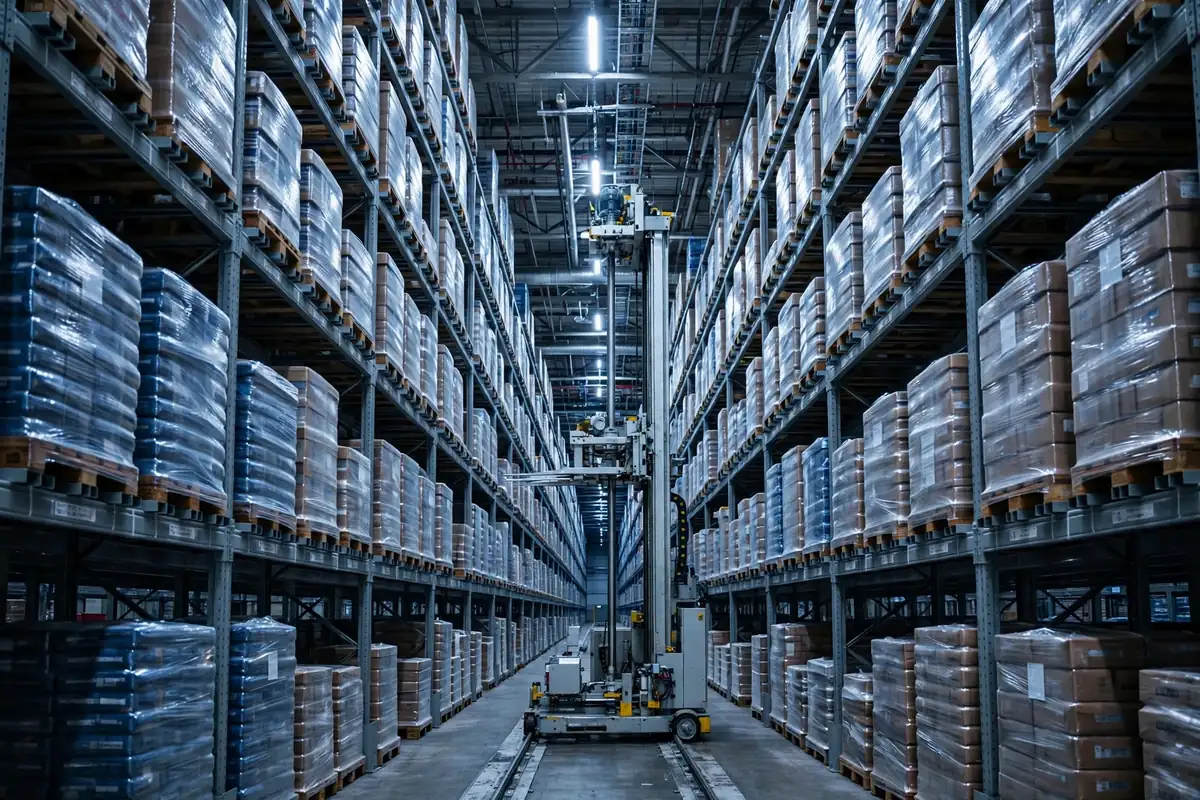
You can think of an automated storage and retrieval system as a precision elevator scaled up several dozen times. The crane runs a thousand cycles a day, and any small fault gets multiplied by speed and height. Plenty of managers treat the inspection as buying peace of mind. I see it the other way round: skipping it buys an expensive lesson. One hour of unplanned downtime often costs more than two or three years of inspections.
Stacker Crane Preventive Maintenance — Three Numbers First
The stacker crane is the hardest-working machine in the building, so the inspection starts with three numbers: speed, positioning accuracy, and the hoist system. Speed is not about hitting the nameplate value. What matters is the change against last year's inspection. If horizontal travel speed has dropped by more than about a tenth, the usual suspects are worn travel wheels or a drive unit short on oil. Check the wheels before touching the parameters.
Positioning accuracy matters more. The recognition plates, the laser distance sensor, and the encoder have to agree, because trusting only one of them is digging your own hole. It is like driving by the dashboard and never looking at the road.
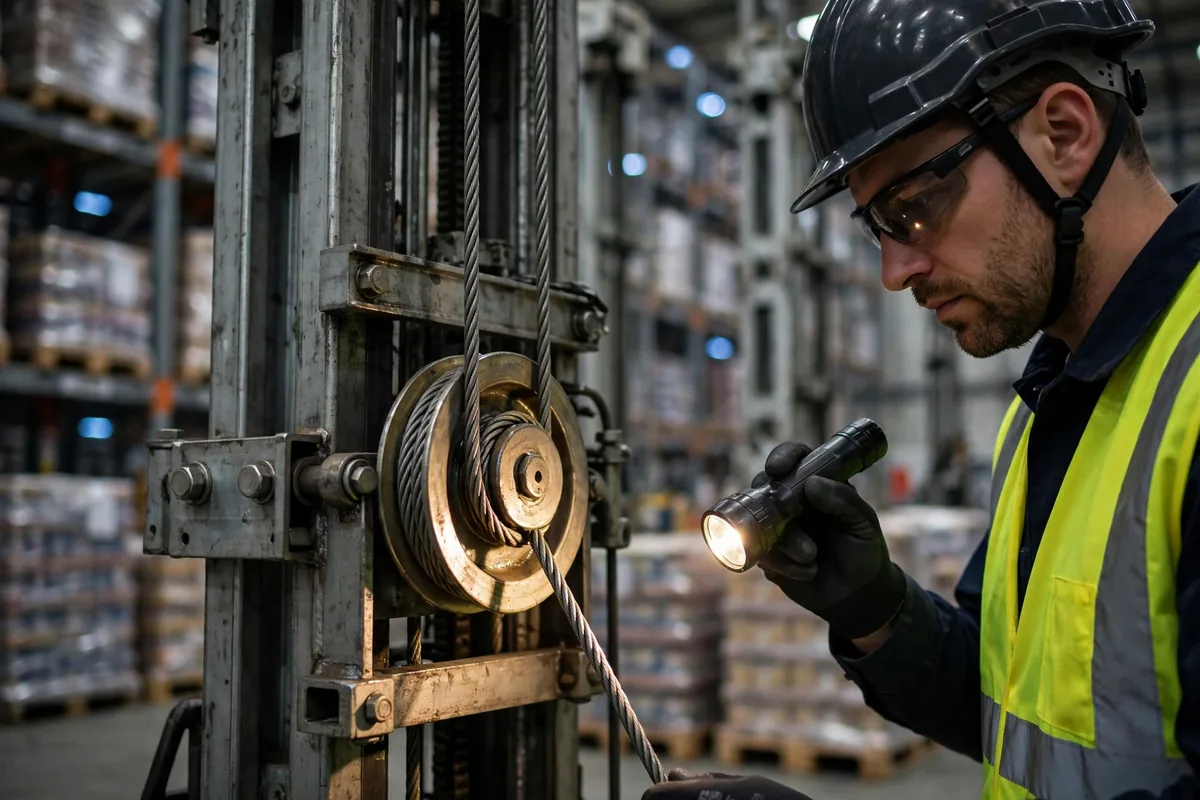
The hoist system is the top priority of the whole inspection. Measure the wire rope diameter section by section. Wear, broken wires, or corrosion past the limit means replacement, not one more cycle. For chain hoists, check elongation against the manufacturer's manual. Test the anti-fall device for real, not by looking at it. Measure the fork extension and retraction times. If one side is much slower, a chain or a cylinder on that side is already out of balance. Limits differ by brand, so use your own manual rather than borrowing numbers from another site.
In the autumn of 2024, at an auto parts warehouse in northern China, hoist motor current ran about 20 percent above its historical curve. The operators said the crane ran fine and refused to stop. I insisted on opening the gearbox, and we found pitting on the input shaft bearing. A new bearing cost half a day. Had it seized mid-aisle, recovery would have taken at least two days. The dates and figures here are an illustrative scenario, but the lesson is real. A current curve does not lie. People do.
Rack and Rail Inspection — Deformation Is Always Slow
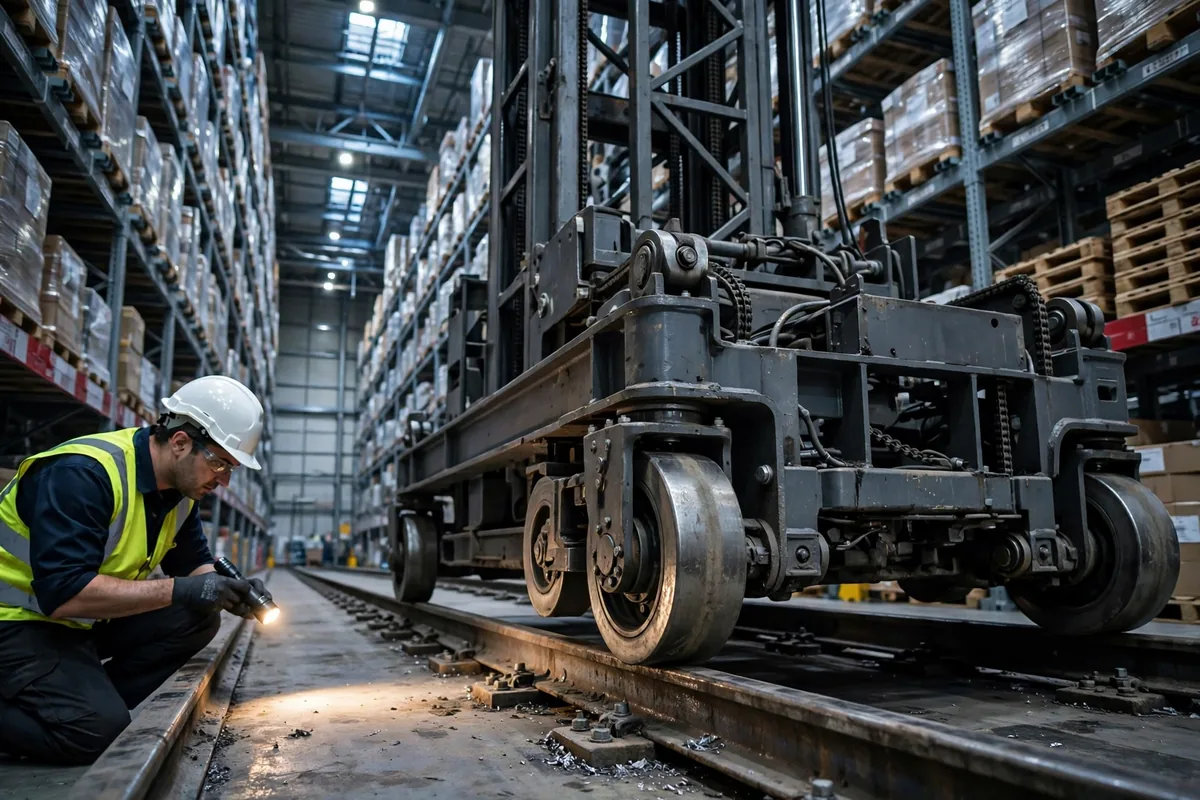
Rack and rail problems never appear suddenly. They develop slowly, and by the time you can see them, it is late. Check the floor rail for level and straightness, especially at the joints. The crane bumps over each joint every cycle, hundreds of thousands of times a year, and once the bolts loosen, the rail steps out of line. The top rail is the same story. Loose suspension points let the crane sway at height, at first only a few millimetres that nobody on the floor feels.
Check a sample of rack uprights for verticality. Hit uprights are obvious, but untouched ones still need measuring. Inspect beam safety pins and connection bolts level by level: one missing pin is enough for a beam to lift with the fork. Re-torque loose anchor bolts, and replace any with serious corrosion. I have seen an upright rusted through at the base after an unreported forklift hit, and that kind of deformation never heals itself.
End stops and buffers get skipped far too often. If a stop is loose, there is no last line of defence when a crane overruns. Check buffers for oil leaks and deformation. A hydraulic buffer can fail without any visible sign, and only a press test will show it. The annual inspection exists for exactly these parts, the ones nobody looks at all year. Every line on the checklist corresponds to a real accident. It just happened in somebody else's warehouse.
Controls Preventive Maintenance — Don't Trust the Alarm Log
Controls inspections are the easiest to fake. Plenty of people flip through the alarm log, find no major fault, and sign off. I will say this bluntly: an alarm log only tells you what has already broken, nothing about what is about to break. The real check is inside the electrical cabinet. Burned contactor contacts, loose terminals, a dead cooling fan, cabinet temperature running high — none of that appears in any alarm log. That gap is why ASRS preventive maintenance has to go beyond the alarm log.
The conductor bar and the cable chain are the other half of the controls. Replace collector carbon brushes at the wear line, and check chain cables for worn sheaths and tight bend radii. Encoder cables are the most delicate of all. Once the shielding is damaged, interference makes positioning drift, and one drifted position is enough for a fork to pick the wrong slot. Do not forget the backup. On inspection day, take a full backup of the program and parameters, and store it in two places. I have seen a warehouse lose its program and restore from a three-year-old version. Every parameter was wrong, and it took a full week to tune back.
Test the safety circuits for real, not on paper. Emergency stop, aisle door interlocks, light curtains, overspeed protection — trigger each one and confirm the machine actually stops. Safety devices suffer most from never being used, and when the moment comes, they have to work. This step takes very little time, but it is what gives your signature its weight.
Is the Money Worth It — Look at One Number
When you cost an ASRS preventive maintenance programme, do not count only the inspection fee. Count what the inspection prevented. The figures below are order-of-magnitude illustrations.
| Inspection area | Inspection cost scale | Cost of skipping it |
|---|---|---|
| Crane hoist system | Inspection plus consumables | Crane stuck at height, recovery measured in days |
| Rails and racks | Measurement and re-torquing | Deformed rack, worst case a whole row out of service |
| Controls and safety | Replacement parts mainly | Positioning drift, wrong picks, failed safety circuit |
| The shutdown window itself | One planned stop | Unplanned stop with every order backing up |
Here is the counterintuitive part. The most expensive part of an annual inspection is not the replacement parts. It is the shutdown window itself. Many warehouses try to save one shutdown by splitting the inspection into a dozen small repairs. Each one stops half an aisle, the total stopped time ends up longer than one focused inspection, and the checking is never thorough. My advice is once a year, one concentrated shutdown of one to two days, and check everything. Systems with high uptime need the inspection most. The smoother a machine runs, the lower people's guard drops, and the easier it is for small faults to accumulate into a big one.
There is also a dividing line when choosing an inspection provider: one that only does visual checks, measures nothing, and gives no year-on-year comparison is not worth hiring at any price. A report must carry numbers, this year against last year, a list of out-of-limit items, and a recommended action for each. A report without numbers is waste paper, however good it feels to sign. And since I am being blunt, here is one pseudo-need worth naming: some warehouses replace a batch of sensors every year that were never faulty, calling it preventive replacement. Real prevention is measuring data, watching the trend, and replacing at the limit — not before it, and immediately once it is passed.
Back to the crane that stopped mid-aisle. The review found three warning signs: the rope, the current curve, and the positioning accuracy. All three had appeared, and nobody had put them together. That is the value of the inspection, joining scattered signals before the machine stops itself. So is the money worth it? Look at one number: your total unplanned downtime loss over the past year, divided by the inspection cost. Above three, your inspection is not tough enough, and next year you should add items. Below one, congratulations — your warehouse is better run than most of your peers.
By Da Liu, Automation Engineer