Here is my verdict up front, because this is the question every warehouse manager types into Google the week the automation quotes land on their desk: in an honest amr vs conveyor cost comparison, most buyers only compare equipment quotes — and the equipment itself is usually just 30–40% of the 5-year total cost of ownership. Comparing quotes without the rest of the TCO is like buying a car on sticker price and ignoring fuel, insurance, and repairs. By year five, the "cheaper" option often loses.
Let us fix a concrete task so we are not arguing in the abstract: Zone A to Zone B, 80 meters in a straight line, 400 pallets a day on a single 8-hour shift — that is 50 pallets an hour. Uniform pallets, flat floor. Both options must hit the takt. Which one costs less over five years?
The Physics: A Highway vs a Taxi Fleet
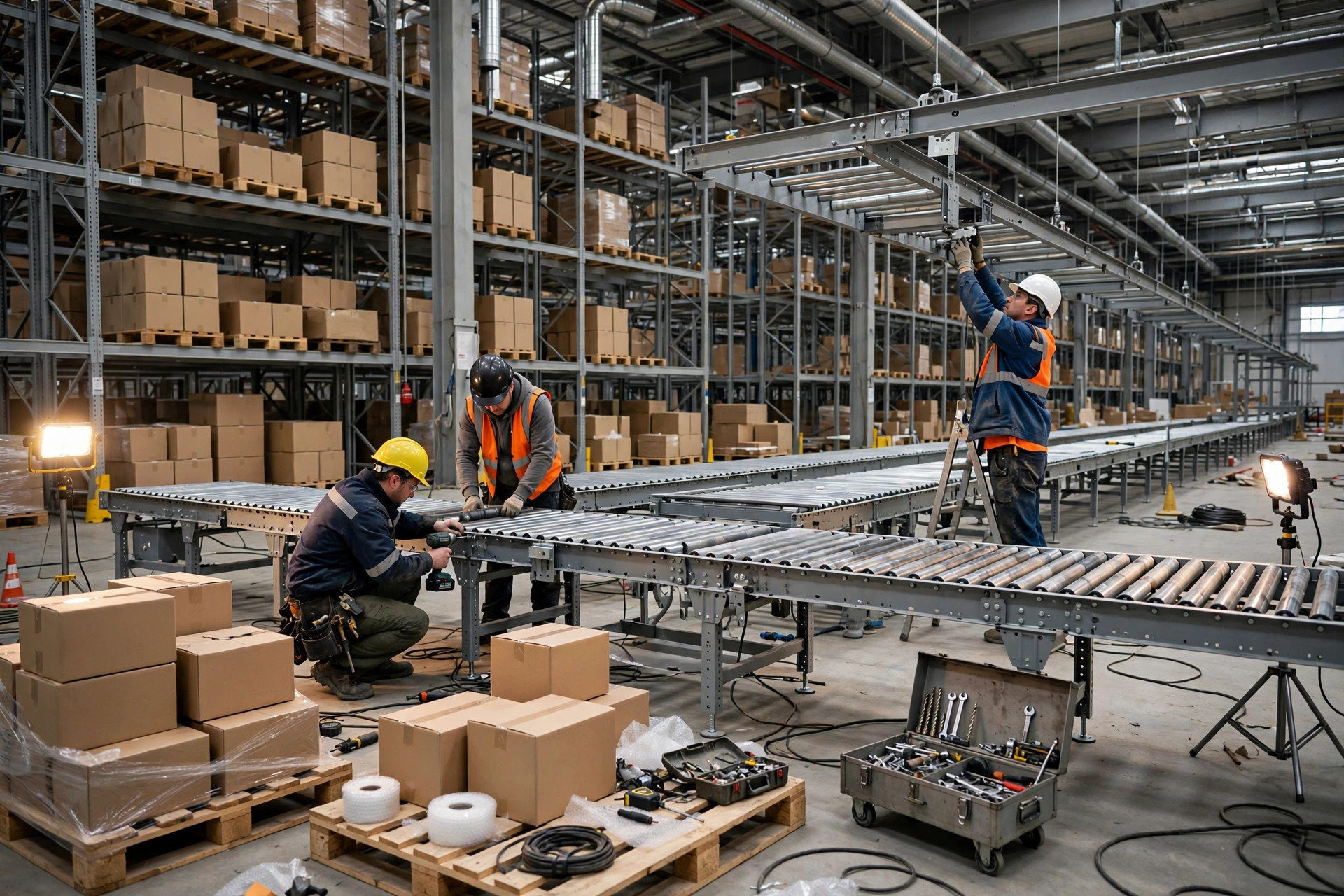
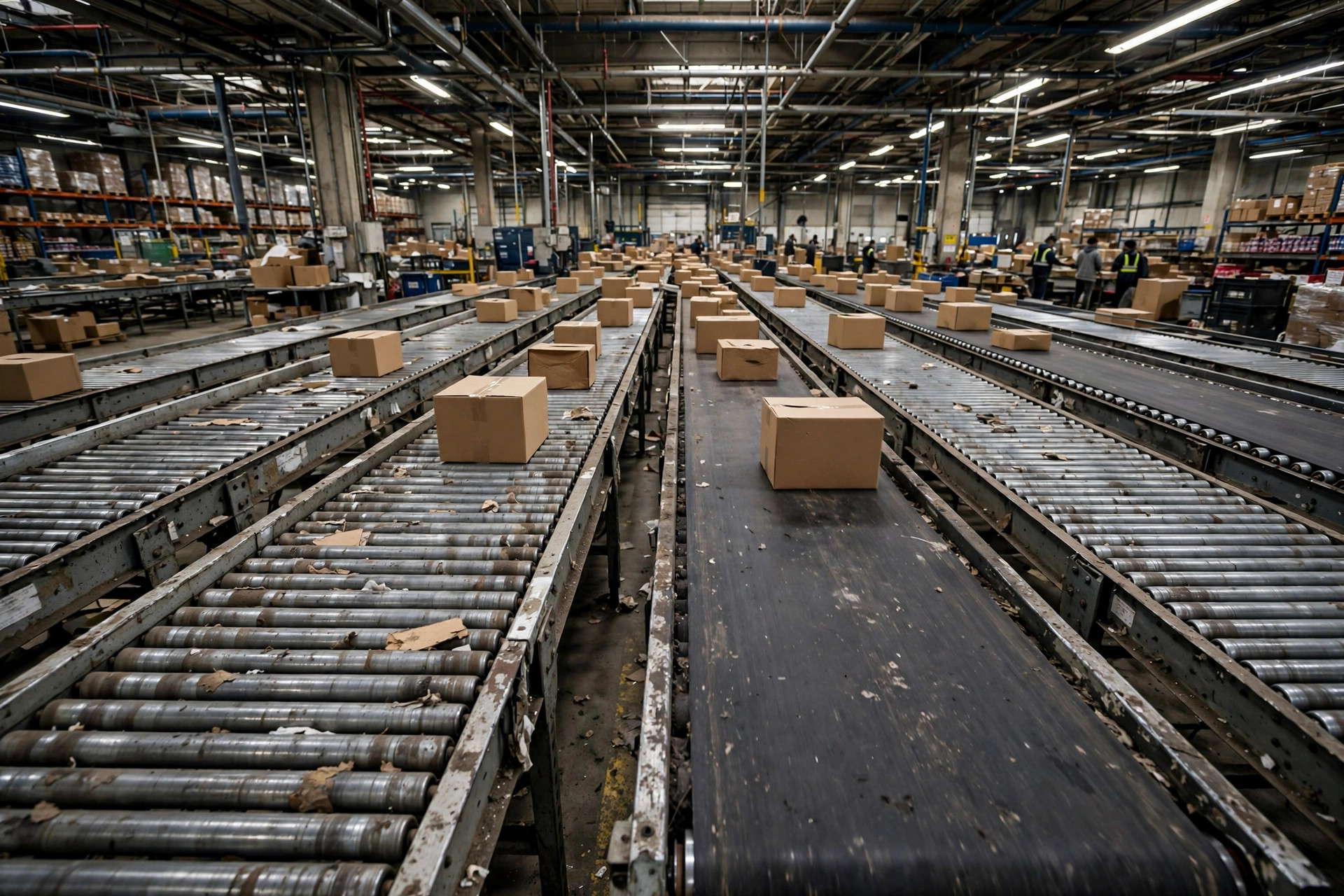
Think of a conveyor as a highway you build once: after the concrete is poured, traffic flows one way on a fixed route. The upside is metronomic takt — a roller conveyor running at 1 m/s covers 80 meters in 80 seconds, every single time. The downside: change the route and you are rebuilding the highway.
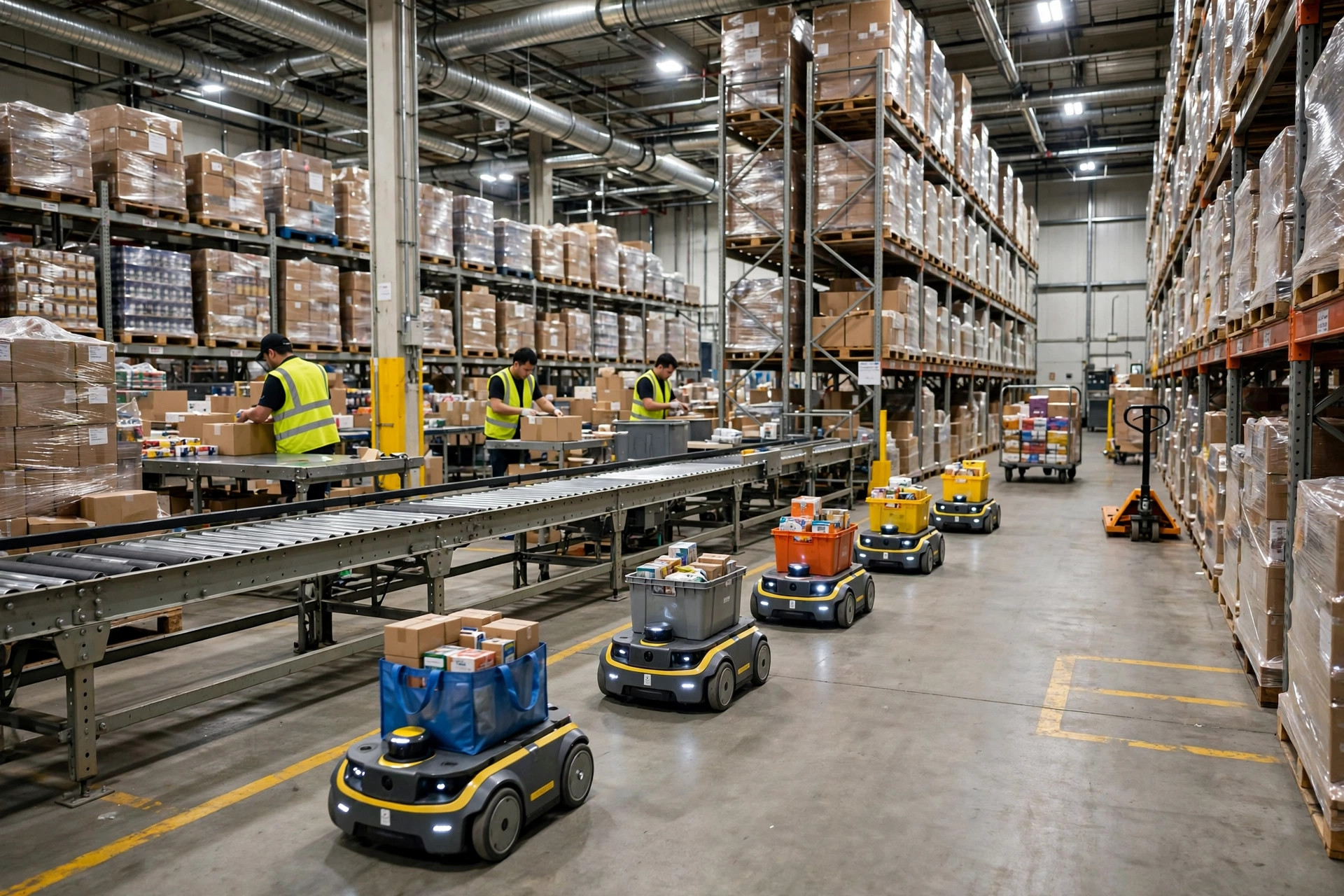
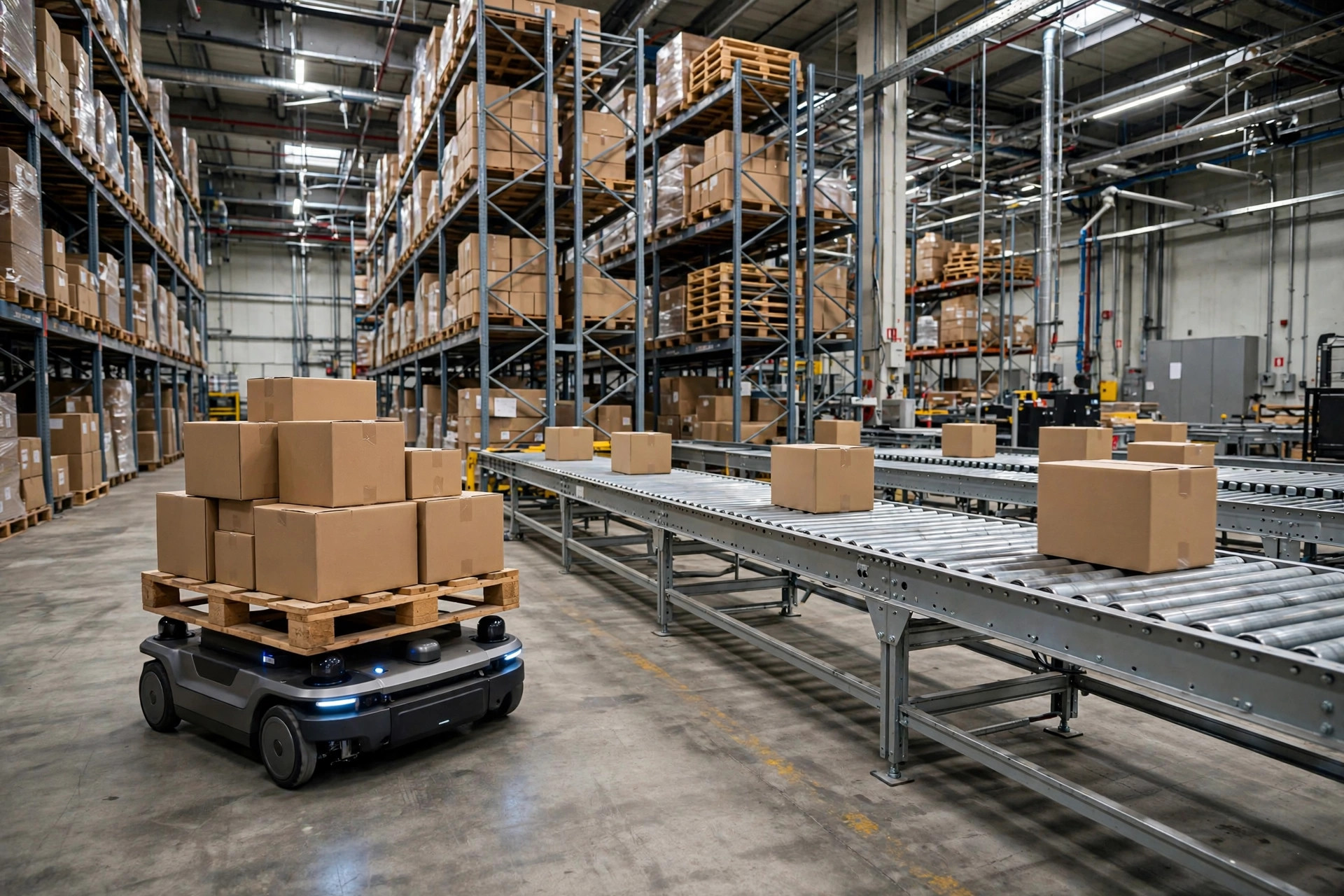
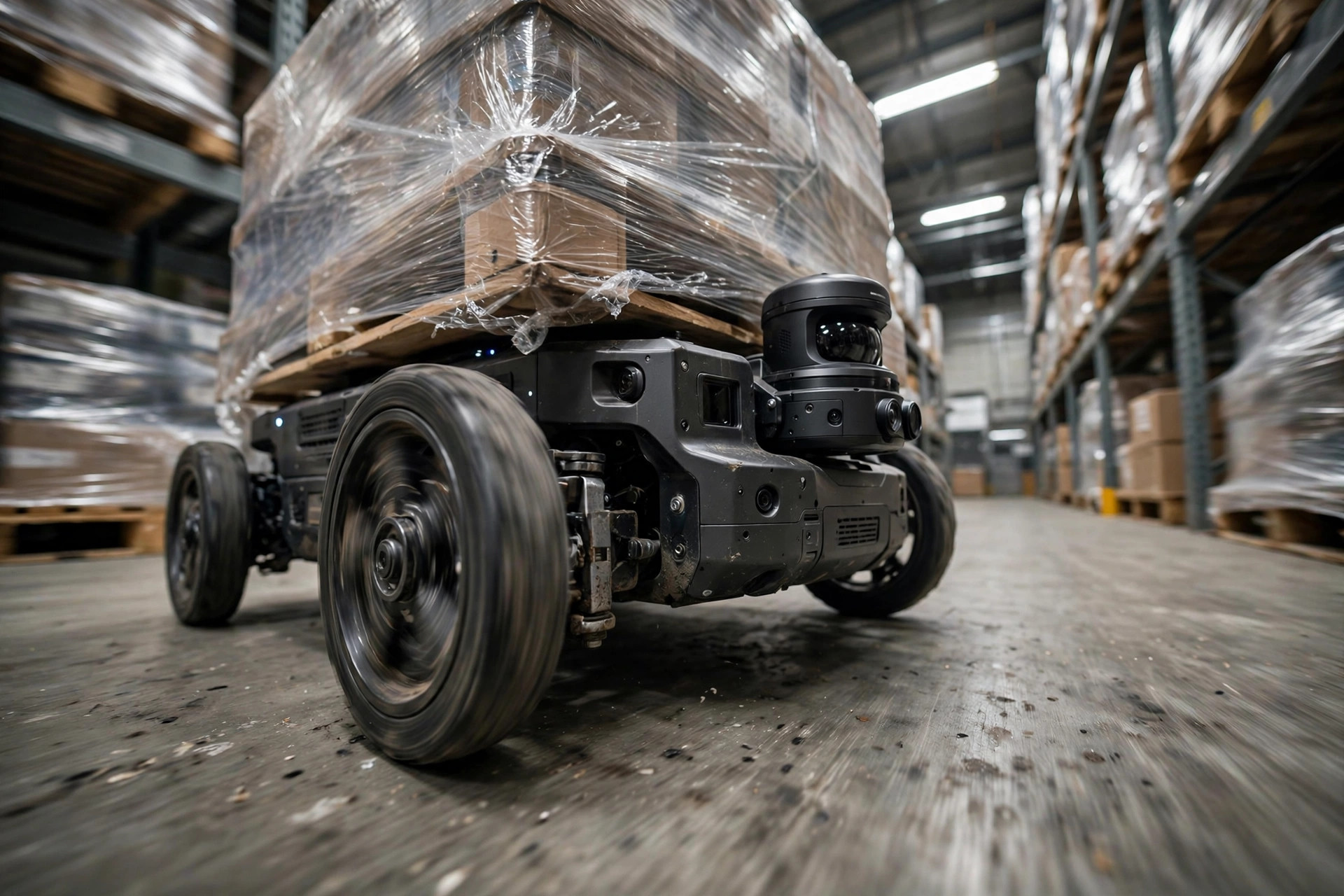
An AMR fleet is more like a taxi company: every vehicle navigates on its own, dispatch lives in software, and routes change with a few clicks. A single unit runs 1.5–2 m/s, but do not let that number fool you — moving one pallet means driving empty to pickup, lifting, aligning, transporting, setting down, and driving back empty. On an 80-meter run, a full cycle realistically takes 4–6 minutes. So you never size a fleet on speed; you size it on cycle time.
Do the math: 400 pallets over 8 hours is one pallet every 72 seconds. A single conveyor line eats that for breakfast. For AMRs at a 5-minute cycle, one vehicle moves 12 pallets an hour, so you need 5 units running flat out, plus 1 spare — 6 vehicles. That is where every honest engineering comparison starts: cycle time first, fleet size second, money talk third.
5-Year TCO, Line by Line: the AMR vs Conveyor Cost Comparison Table
The figures below are an illustrative model — order of magnitude, informed by North American integrator projects from 2023–2025. Treat them as a method, not a quote; get fresh numbers from your integrator.
| Cost line | Conveyor | AMR fleet (6 units) |
|---|---|---|
| Equipment | Line, motors, controls — mid six figures | 6 vehicles + chargers, low-to-mid six figures per unit |
| Installation / civil works | Foundations, floor leveling, cable trays — 20–30% on top of equipment | Near zero: floor markings and a charge zone |
| Software licenses | Controls software, mostly one-time | Fleet manager annual fee + per-vehicle license, compounding over 5 years |
| Energy | Motors run continuously, roughly 10+ kW sustained for 80 m | Charging electricity, but lower peak draw |
| Maintenance labor | Simple mechanics; a part-time electrician covers it | Needs a dedicated tech or a vendor service plan; response SLAs cost extra |
| Spares | Rollers, belts, motors — cheap, generic | LiDAR, drive wheels, batteries — expensive and proprietary |
| Downtime exposure | One failure stops the line, but failure modes are predictable | One dead vehicle degrades gracefully; a fleet-wide software bug floors everyone |
Here is the counterintuitive part: in the AMR column, the six vehicles are only about a third of the five-year bill. The fleet-manager subscription, the service contract, and one battery replacement cycle usually add up to more than the vehicles themselves. In the conveyor column, equipment is more than half of the total, and the cost curve stays flat in later years.
Two real cases. In 2023, a large e-commerce DC in Southern California ran almost exactly this exercise — 120 meters, 600 pallets a day — and picked conveyor. Not because it won on paper, but because their route would not change for five years: pave the road once, done. The same year, a 3PL outside Memphis picked AMRs: they re-slot the building every quarter, and one conveyor teardown-and-rebuild cost nearly half a vehicle. Flexibility converted straight into dollars.
The Dividing Line: Three Questions That Settle the AMR vs Conveyor Debate
Ignore the vendor storytelling. Answer three questions:
- How many times will the route change in five years? Zero — conveyor. Every year — AMR.
- Is flow steady or spiky? A flat 50 pallets an hour — conveyor. Triple at peak season, half in February — AMRs scale up and down; sizing a conveyor for the peak is money burned eleven months a year.
- One lane or a network? A single A-to-B lane — conveyor. Many origins, many destinations — AMR.
You can think of it as buying versus renting a house: staying put for five years, buying (conveyor) wins on total cost. If the job moves every year, renting (AMR) — the flexibility itself is the value.
"Maintenance-Free AMRs": the Myth I Love to Kill
Any salesperson who tells you AMRs are maintenance-free can show themselves the door. LiDAR is optics — in a dusty warehouse, expect noticeable degradation in 2–3 years. Drive wheels are consumables; under heavy duty, yearly replacement is normal. Batteries run on charge cycles: after roughly 3 years, capacity drops below 80% and you are swapping packs at thousands of dollars each. When a vendor quotes MTBF of 20,000 hours, ask the only question that matters: MTBF in our dust, on our floor, at our load? Nine out of ten cannot answer it.
Do not romanticize conveyors either: roller bearings, belt tracking, burned-out motors are daily life. But their failure modes have not changed in 50 years — any plant electrician can fix them blindfolded, and spares are commodities. When an AMR's LiDAR dies, you are waiting on the OEM.
The Maintenance Traps: Three Clauses Your Contract Must Have
- Lock spare-parts pricing: write a 5-year cap on core spares into the contract, or a LiDAR that costs 40% more in year three will teach you a painful lesson.
- Cap the software fee: fleet-manager pricing is per vehicle, so doubling the fleet doubles the fee — negotiate tiered caps now.
- Response SLA plus a spare unit: get the 4-hour on-site promise in writing, with penalties for misses, and negotiate at least one standby vehicle — a rental model works fine.
Back to our task: 80 meters, 400 pallets a day, route essentially fixed. My call is conveyor, winning the 5-year TCO by roughly 20–30%. Add one condition — "we might extend to Zone C next year" — and the verdict flips instantly. So is the money well spent? Watch this one number: multiply your expected route changes over five years by the cost of a single re-route, and compare it against the TCO gap between the two options. Bigger — go AMR. Smaller — pour the concrete and lay the conveyor.
By Da Liu, Automation Engineer