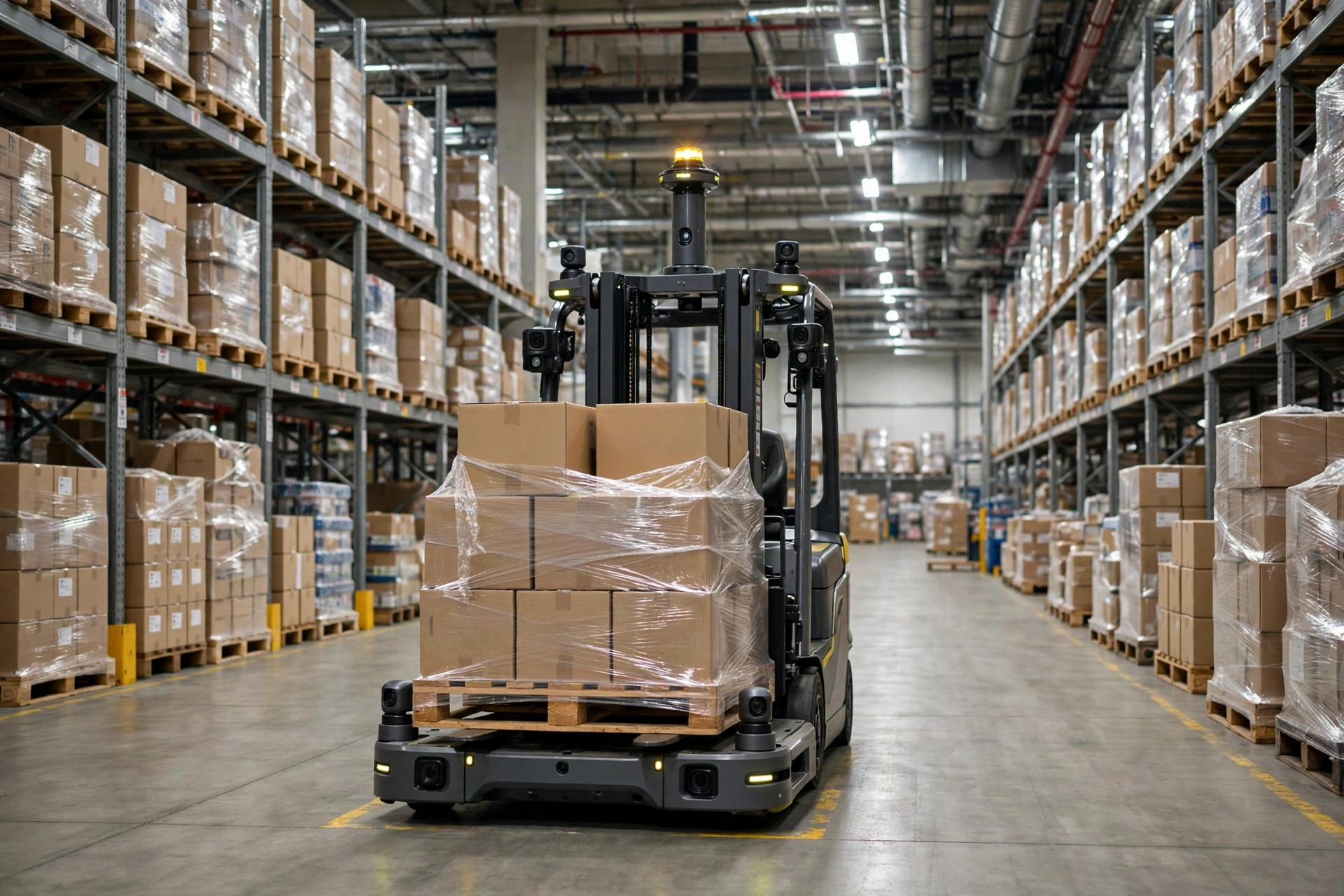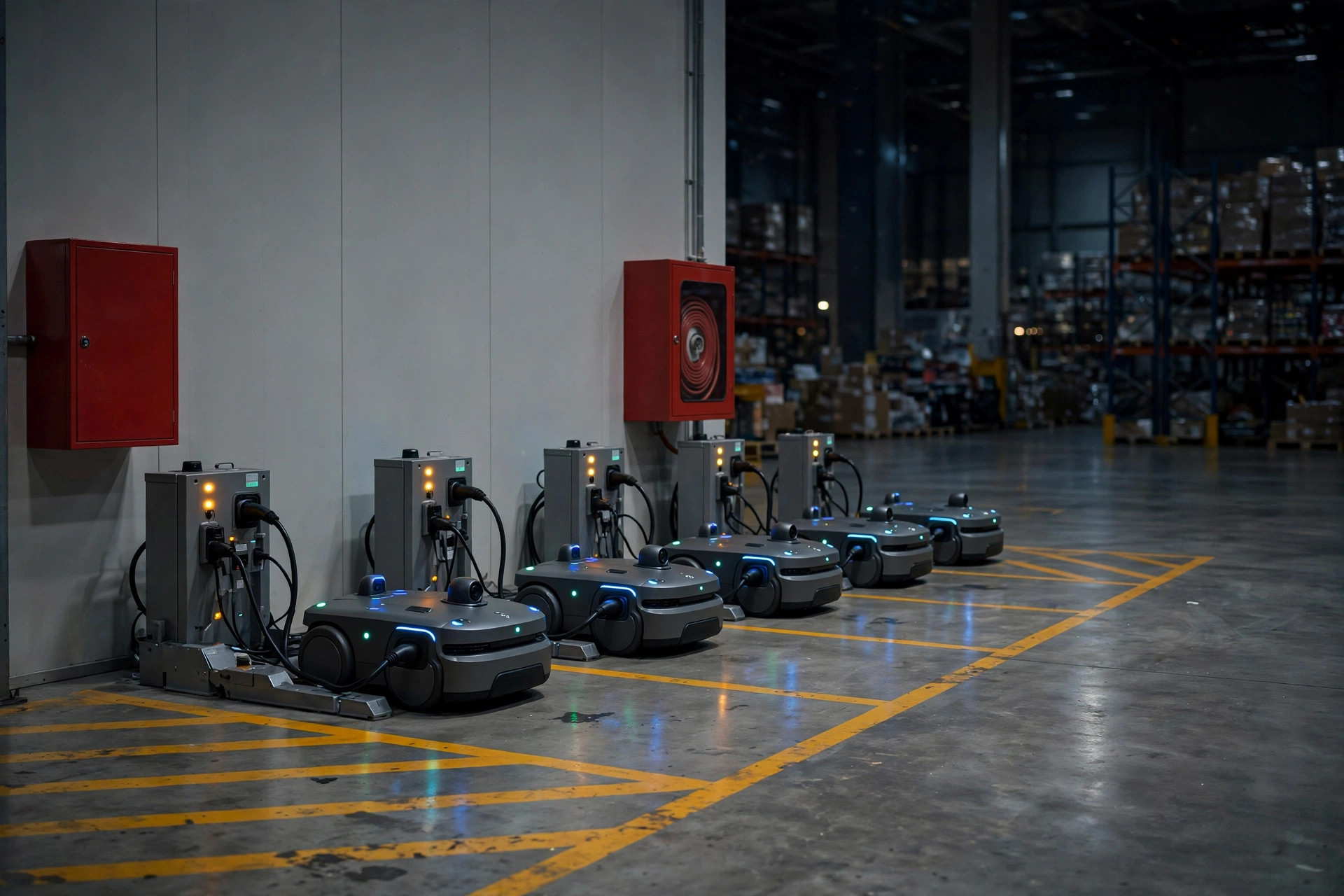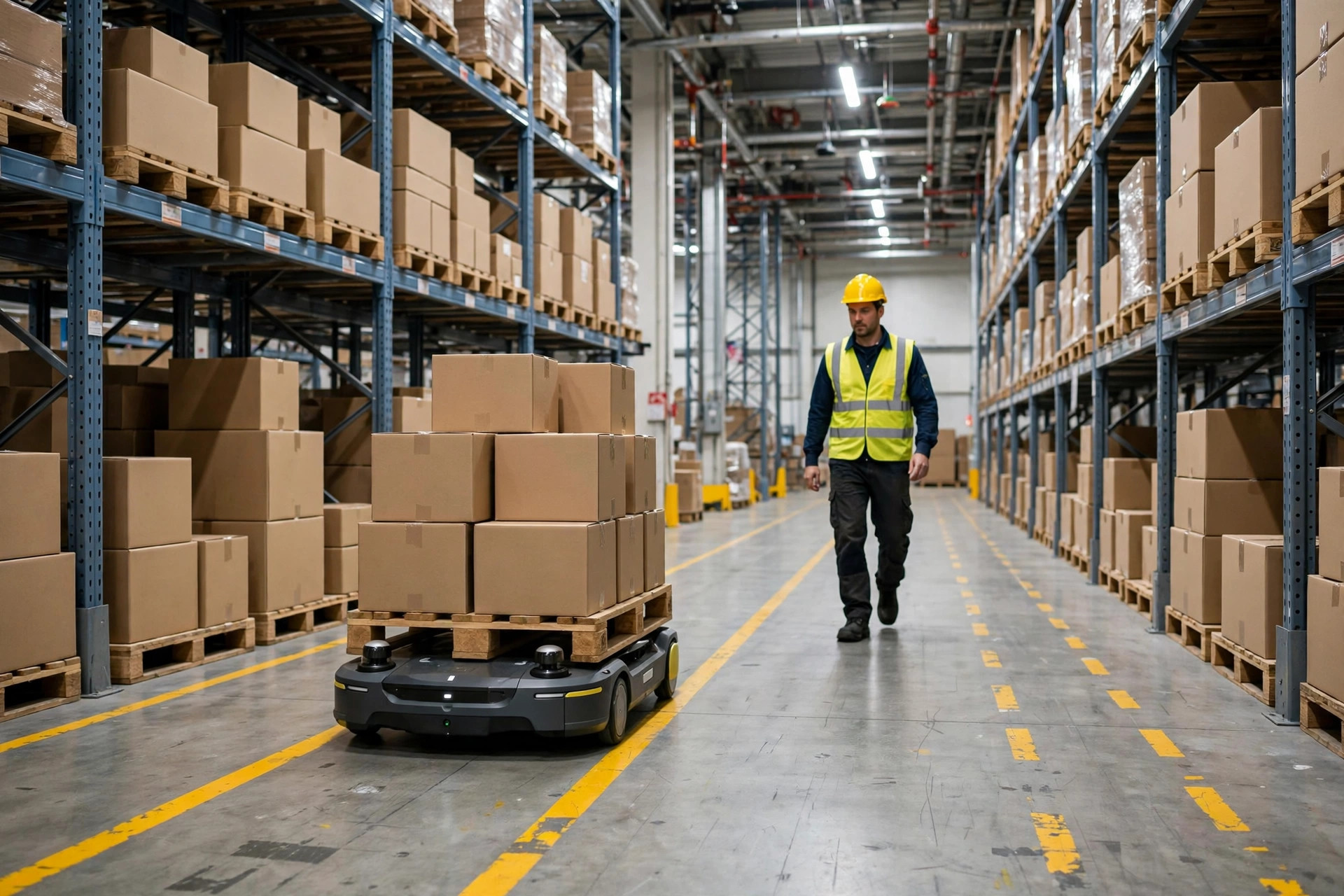
Here's my verdict up front: when an AMR hurts someone in a mixed-traffic aisle, eight times out of ten the root cause isn't a blind robot — it's wrong safety parameters. Think of them as an electronic fence around the vehicle. Draw it too wide and the robot stops at every person, throughput collapses, and your people learn to ignore it. Draw it too narrow and the one time it matters, the brakes can't save anyone. This is about how to draw that fence.
How an AMR Actually "Sees" a Person in Mixed Traffic
Principle first. An AMR doesn't avoid people by recognizing "that's a human." It doesn't care whether the obstacle is a person or a box. Its safety logic has exactly two layers:
- Warning field: object enters, the vehicle slows. Think of it as your car's following-distance alert.
- Protective field: object gets closer, the vehicle emergency-stops. No negotiation. It stays put until the zone clears.
The hardware is the 2D safety laser scanner front and rear. It sweeps a flat plane at a fixed height, 270 degrees. Something pops up in the plane, the controller computes distance, and whichever field trips dictates the response. Fancier robots add 3D cameras, but the 2D plane remains the backbone of safety certification — the hard currency standards like ISO 3691-4 recognize.
But the 2D plane has a built-in blind spot: anything outside the plane is invisible. A crouching person, a low obstacle below scan height, an area blocked by a pallet — none of it exists in the robot's world. Like driving on the rearview mirror alone. Empty mirror doesn't mean empty road.
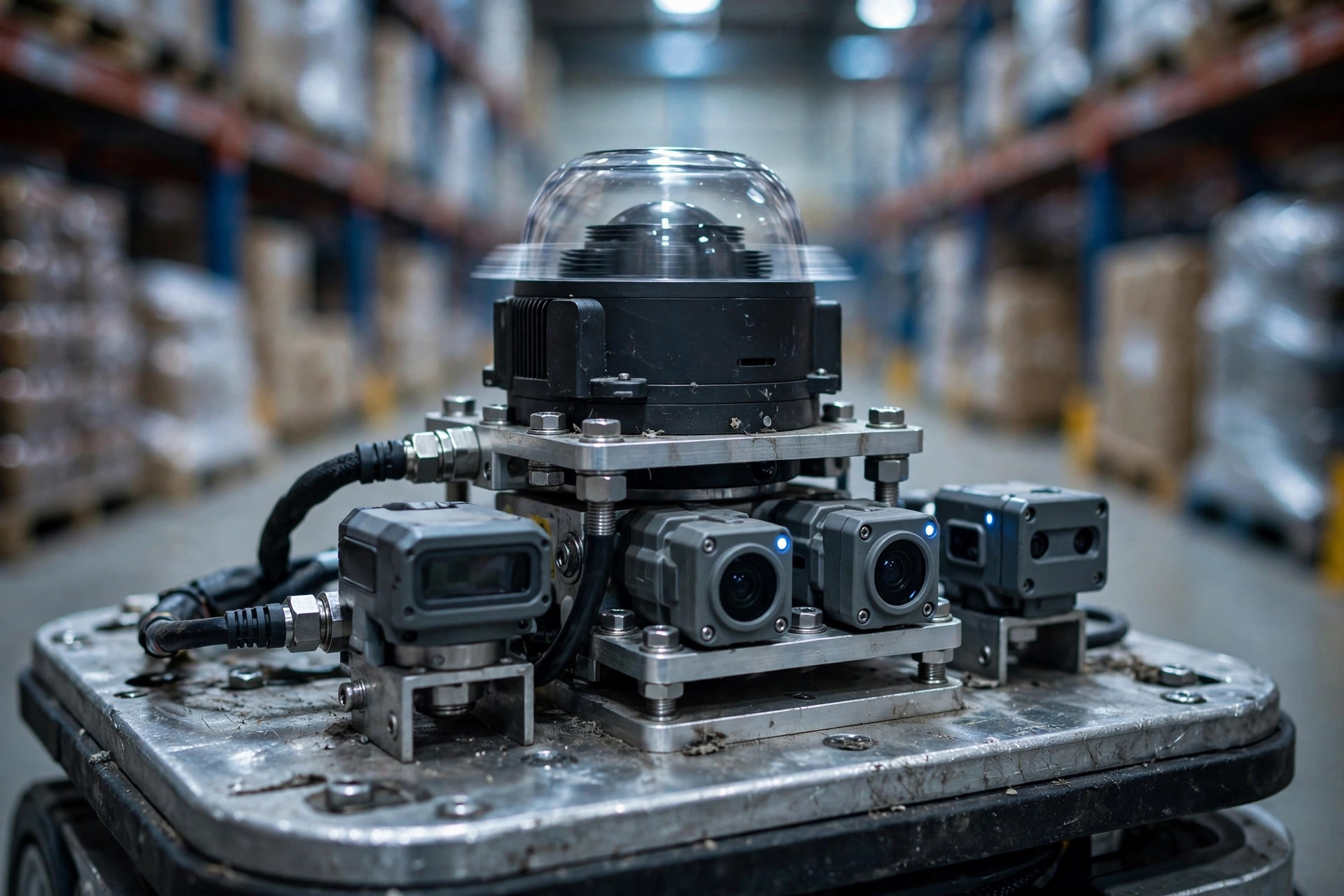
Safety distance isn't a guess. The physics is fixed: stopping distance is roughly velocity squared over twice the deceleration, plus response delay. Plain language: double the speed, quadruple the braking distance. Field experience: a loaded AMR at 1.5 m/s needs 1.5 to 2 meters from trigger to full stop. Set the protective field smaller than that and the stop command fires while the vehicle is still sliding — that meter of "momentum" is what hits someone.
The Three Most Dangerous Mixed-Traffic Scenarios
Principle covered. Now the scenarios. Nearly every mixed-traffic incident I've seen falls into one of three buckets:
First, the blind corner. October 2025, an e-commerce 3PL near Ontario, California. Temp workers were in ahead of peak, and pallets of inbound freight were staged at a cross-aisle intersection. A picker cut the corner from behind the pallets — right as a shelf-carrying AMR came around the bend at 1.2 m/s. The 2D scanner's plane was fully blocked by those pallets. In the robot's world, the aisle was empty. The picker heard the drive motors and jumped clear; the robot stopped less than a meter behind him. Nobody was hurt, but the building stood down half a day to investigate. Root cause wasn't a bad robot — it was temp staging creating a radar blind spot the safety configuration never covered.
Second, the cross-intersection standoff. The person is on a phone, the robot is on its route, each assuming the other yields. The AMR's logic is "stop first." Humans have no such logic. Intersections get their own speed zone — hard rule.
Third, behind the pick face. A picker has their back to the aisle, bent over a bottom slot, while an AMR passes behind. The robot stopped correctly — the protective field fired — but the person never knew a half-ton machine was waiting behind them. The startle itself causes injuries. I've seen a picker flinch and launch a scanner into the racking. That counted as a workplace injury.
Safety Distances and Speed Zones: One Classification Table
Now the decision framework. Split the warehouse into four zones by probability of human-vehicle contact, each with its own speed limit and protective field. The table below is field experience — not any vendor's official numbers. Re-run it against your own braking curve before using it:
| Zone | Typical scene | Speed limit (field experience) | Protective field (field experience) |
|---|---|---|---|
| Vehicle-only lane | Enclosed conveyor aisles, cross-building trunk routes | 1.5–2.0 m/s | 2–3 m |
| Mixed main aisle | Wide aisles shared by people and robots | 0.8–1.0 m/s | 1.5–2 m |
| Dense work area | Pick faces, in front of pack stations | 0.3–0.5 m/s | 1–1.5 m |
| Blind intersections | Rack corners, cross-aisle junctions | 0.3 m/s + audio-visual alert | Tightened per blind-spot survey |
Three things people get wrong:
- The protective field must exceed "stopping distance plus margin." Use fully-loaded braking data — not empty. A loaded robot can stop 30–50% longer than empty.
- The warning field sets efficiency; the protective field sets safety. Oversize the warning field and the robot slows from far away, killing takt. Undersize it and it slams to a stop in someone's face, chewing through brakes. Warning field is typically 2–3x the protective field; tune on site.
- Don't forget the side fields. Most people only tune the front. In a pick aisle, workers walk tight along the robot's flank — no side protection means the robot pulls away and clips someone. Give the sides 0.5–0.8 meters.
Counterintuitive Truth: In Mixed Traffic, a Bigger Protective Field Is More Dangerous
Time to pick a fight. Plenty of buyers run on "bigger protective field, safer robot." Plainly: that's a fake requirement, and it's flat wrong.
2024, a 3PL in Dallas, Texas, brought 12 AMRs online. The integrator took the easy way out and set every protective field to 4 meters — "maximum safety." Problem: the pick aisle itself was only 3.5 meters wide. Every robot emergency-stopped at every picker. Each vehicle logged 40–60 false stops a day, each costing 8–15 seconds from standstill to recovery. Do the math: 50 stops × 10 seconds is nearly 10 minutes of pure waste per robot per day — 2 vehicle-hours across the fleet. Fleet effective uptime sagged into the low 70s. The owner paid for 12 robots and got 8 robots' worth of output.
Worse was what happened to the humans. When the robot cries wolf all day, pickers go numb within two weeks. They walk tight along the chassis, cut across the nose, and I've watched people push carts at a robot just to make it stop. That's the "boy who cried wolf" effect — the more frequent the alarms, the lower the vigilance, and the one time it's real, nobody moves. The biggest enemy of a safety system isn't technology. It's people trained into numbness by technology.
Second counterintuitive point: slower does not mean safer. Crush the mixed-zone speed limit to 0.3 m/s and single-vehicle takt drops 40–60%. To hold capacity you add robots — 8 becomes 12 — and total human-vehicle encounters rise, so absolute safety events can increase. The right move is the opposite: fix the people flow first. Pickers walk here, robots drive there, separated with guardrails and floor markings; only stretches you truly can't separate get a mixed-traffic zone. Managing foot traffic is an order of magnitude cheaper than fiddling with robot parameters.
The Maintenance Trap: Safety Parameters Expire
Last section — the part integrators least like to mention: safety configurations go stale.
Peak-season temp staging, a big slotting reshuffle, a pick face moving aisles — the moment the floor changes, the blind spots change, and your tuned protective fields are worthless. I've seen at least three near-misses right after peak staging created new blind intersections nobody re-surveyed. The rule is simple: re-verify safety parameters after every major layout change and before every peak season. Half a day walking the floor beats one accident, every time.
And don't overdo alarms. A buzzer plus a beacon is standard, but some sites add voice announcements to every robot — a few hundred a day, and by day three nobody looks up. Tier them: warning-field trigger lights the beacon only; protective-field trigger gets the buzzer. Keep people scared of the buzzer. Don't burn that fear on routine traffic.
Mixed-traffic AMR safety is an engineering problem, not a mystery. At acceptance, don't listen to the vendor recite specs. Watch one number: unplanned downtime minutes per vehicle per day caused by pedestrian proximity.
If that number sits above 15–20 minutes long-term, don't blame the robot — check whether your zones are drawn right and whether your foot traffic makes sense. No tuning can save a floor where people and robots fight for the same aisle. Get that number down, and your electronic fence is in the right place. Whether the money was well spent comes down to that one number.
By Da Liu, Automation Engineer