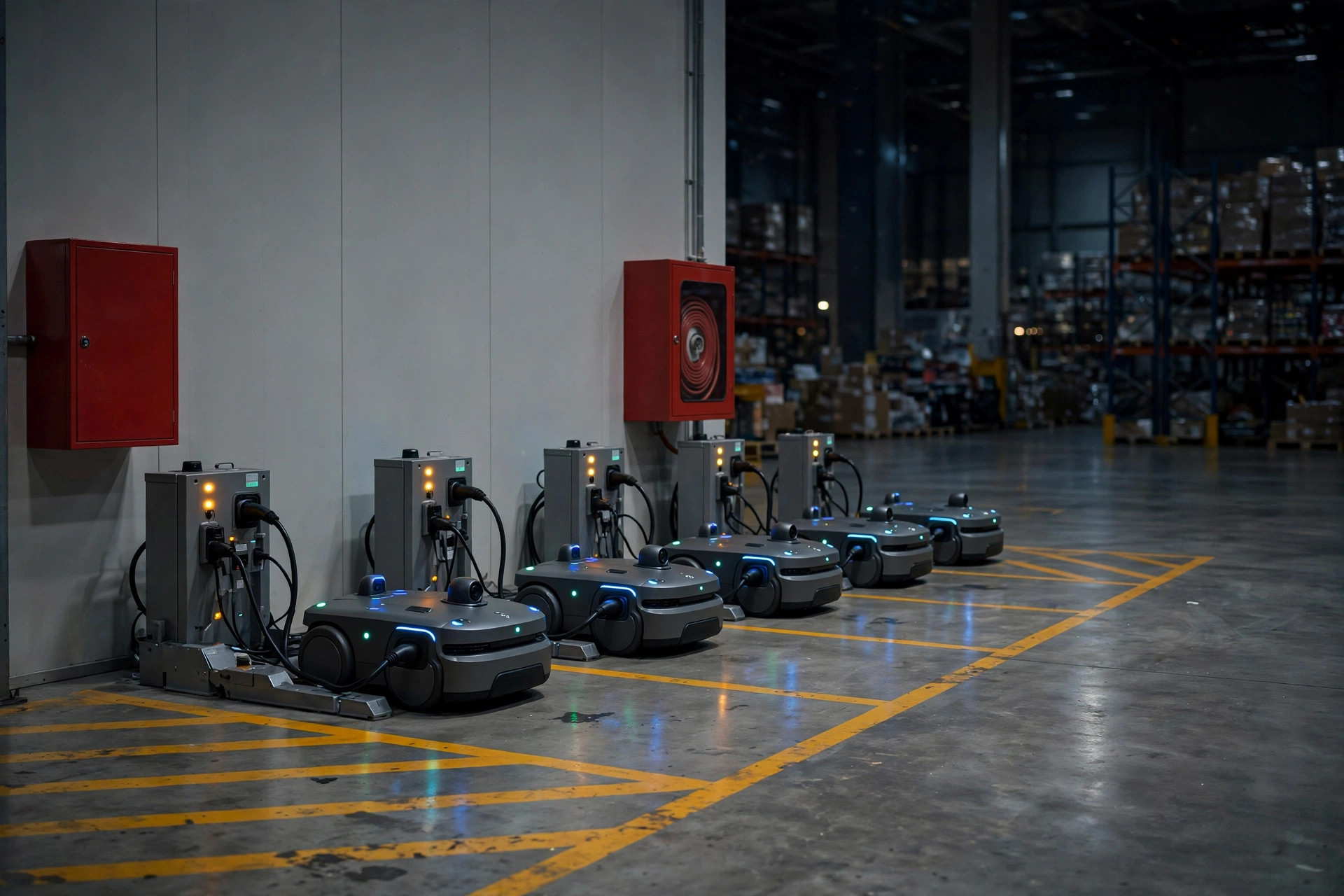
"Two-seventeen in the morning. Night shift lead Zhang's voice came over the radio: 'Anybody else smell something weird over by the charging zone?'"
I was staring at the outbound manifest when I heard the word "weird." My stomach dropped. Guys, after all these years running warehouses, there is one thing about AMR lithium battery fire safety that keeps me up at night — the charging zone on the night shift. Nobody's watching. And when something goes wrong there, it goes really wrong.
This was July 2025, at a big 3PL in the Inland Empire outside Los Angeles — 120,000 square feet, 40 AMRs running pick and transport. My team had taken over operations barely two months earlier. The charging docks stood in a row against the wall, less than 15 feet from the nearest rack. Zhang walked over with the infrared thermometer and found one robot with a battery pack visibly swollen, hot to the touch like a sheet pan out of the oven. Worse, the BMS had been flashing a temperature alarm on the tablet for almost half an hour. Eleven people on the night shift, all buried in outbound work. Nobody saw it.
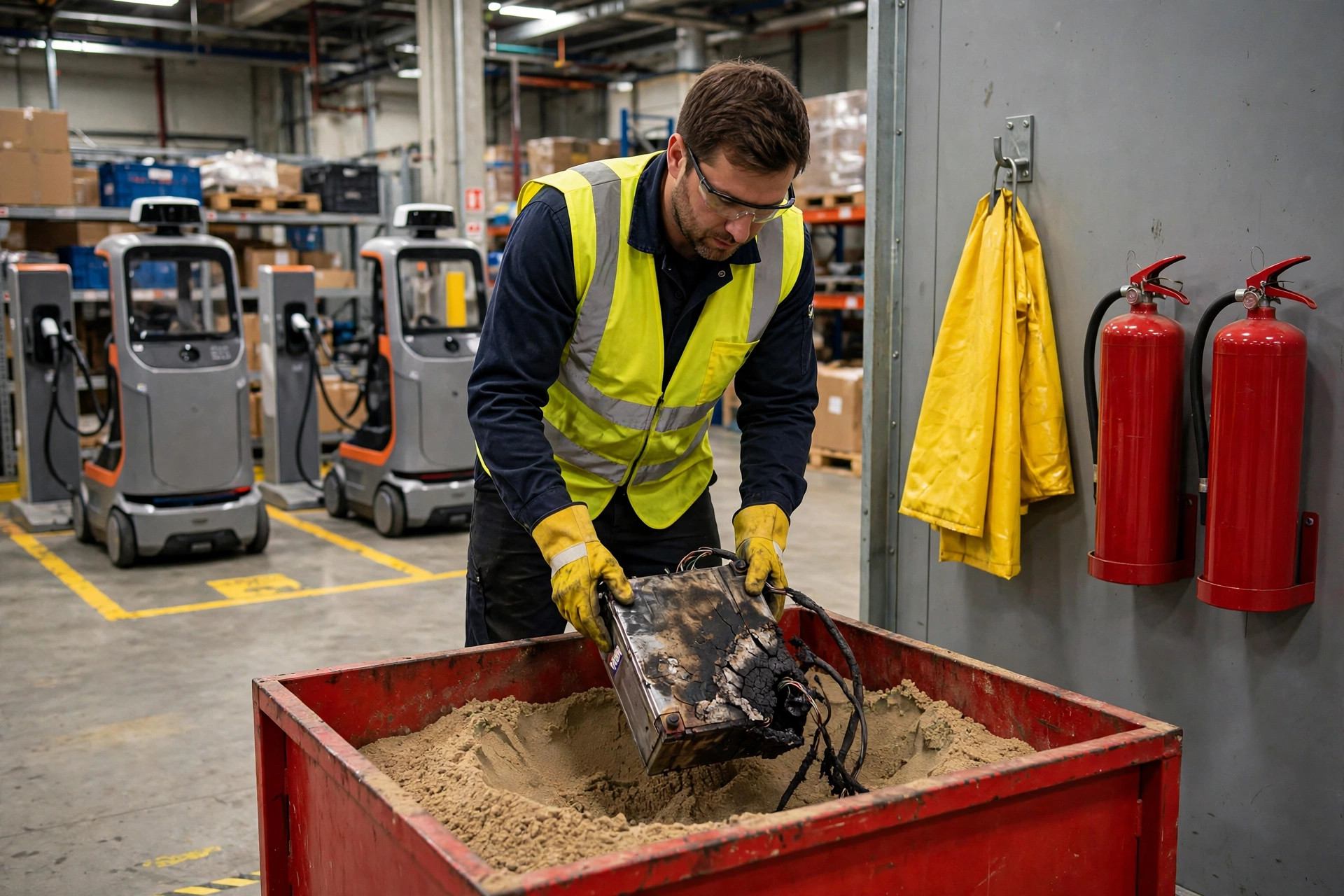
We didn't waste a second. Killed power to the whole row of chargers, pushed that robot out onto open concrete, roped off the area. Then we grabbed a steel drum, filled it halfway with sand, pulled the battery pack, and buried it. Called the fire department to report it — no fire yet, but that's the procedure. The firefighter who showed up walked the area and said something I'll never forget: "You did the right thing. That's the early stage of thermal runaway. Two or three more hours and this would have been a very different call."
False alarm. But the next morning I kept everyone after the shift meeting and asked one question: how did this even happen?
That Night: A Strange Smell in the Charging Zone
Turns out that robot had been draining abnormally fast for three days — two full charges just to survive one shift. A driver on day shift had mentioned it to the shift lead: "Something's off with this one, it's eating battery." The lead was juggling peak-season schedules with three call-outs out of twelve people, and brushed it off with a "we'll look at it tomorrow." Tomorrow never came.
Here's the honest truth about the floor: forty robots, eleven people on nights. Who has time to babysit a battery pack? An alarm blinking on a tablet while everyone's running between racks — that's not a warning system, that's decoration. The problem was never "we didn't know." It was "nobody treated it like it mattered."
Why AMR Battery Fires Are Different: Dry Chemical Kills Flames, Not Thermal Runaway
Our first round of fixes looked great on paper. We moved the chargers away from the racks into their own zone, painted yellow lines on the floor, hung two ABC dry chemical extinguishers on the wall. I was proud of it. Done deal, I thought.
Three months later, a peer warehouse in the Inland Empire had an incident that hit us like a punch. One of their AMR battery packs went into thermal runaway and started smoking around midnight. The guy on duty emptied a dry chemical extinguisher on it. Flames went down. Ten minutes later, they came back. Dry chemical can knock down the visible flame, but it does nothing about the chain reaction still cooking inside the cells — if the temperature doesn't come down, reignition is just a matter of minutes. In the end the fire department showed up, hooked up the hose line, and drowned the thing. The bill: two robots written off, a whole row of chargers replaced, half a day of dead outbound shipments.
Their manager told me something I'm passing straight to you: a lithium battery fire needs cooling, not just extinguishing.
This is the part that goes against everyone's gut. Your instinct says you never put water on an electrical fire. But thermal runaway is a different animal — what it needs is water, lots of it, to bring the temperature down. Dry chemical or CO2 will suppress the flame, yet the cells inside keep generating their own heat and even their own oxygen. Temperature stays high, and you're back to square one. The fire protection logic in NFPA 855 — the U.S. standard for stationary energy storage installations — is built around exactly this: detection, separation, cooling. The specific spacing and configuration numbers depend on which edition your local fire marshal has adopted, so check with your AHJ rather than copying numbers off the internet. FM Global also publishes lithium battery fire guidance, and your insurer will absolutely ask about it.
And four warning signs every single person in your building should know by heart: swelling, heat, hissing, leaking. See any one of them, pull the pack from service immediately. No debate.
Our AMR Charging-Zone Fire Setup: What We Actually Run Today
After getting burned — almost literally — we tore down the charging-zone fire setup and rebuilt it. If our whole AMR lithium battery fire safety program boils down to one sentence, it's this: detect early, separate fast, cool it down. Here's what we run now, in a checklist you can steal:
Location. The charging zone stands alone, well clear of racks and anything combustible. Hardened floor, nothing stored inside. Ventilated walls, plus exhaust fans in summer.
Detection. Smoke detectors, heat detectors, and combustible gas detectors — all three. Leaking electrolyte has a smell, and gas detection catches it before smoke ever shows. Alarms go straight to the night shift lead's phone now. No more blinking tablets nobody watches.
Suppression. ABC dry chemical extinguishers (for visible flame) plus a fire hose line (for cooling). You need both. Remember: a charging zone with extinguishers but no water is a charging zone with no real protection. A fire blanket hangs on the wall too.
Damaged-pack handling. A steel drum and sand live right next to the charging zone, permanently. A swollen or hot pack gets pulled and buried in sand for isolation, then goes out through a proper battery recycling channel the next day. Never the trash bin.
Night patrols. Every two hours, someone walks the charging zone and spot-checks pack temperatures with the infrared gun. Any BMS alarm must get eyes on it within 15 minutes — we wrote that into the shift-lead handover sheet, with a signature.
Electrical. Factory chargers only, no daisy-chained power strips. Every row of chargers has its own disconnect switch. Per OSHA guidance, we keep charging ambient temperature above freezing and below about 40°C (104°F) — in our summers that means the exhaust fans earn their keep.
Drills and training. Fire drills every quarter, with a dedicated "smoking battery" scenario. A new hire's first safety lesson is learning what a swollen pack looks like — a veteran walks them through it, pointing at the real thing.
When we first moved the charging zone, the loudest complaint was "it's farther from the pick area now, the robots waste travel time." I ran the math: forty robots, the extra daily travel converted into electricity and lost throughput — we're talking tens of dollars a day. Now stack that against one fire: two robots, a row of chargers, half a day of dead outbound, and a fatter insurance bill. Which one's cheaper? The fire marshal put it even better: you're buying time with that distance. When it burns, distance is life. On this one, convenience yields to safety. No negotiation.
We also had a robot that had clipped a pallet — the pack housing was slightly deformed. The crew figured "it still charges, it's fine" and kept it running. Three nights later the BMS flagged a temperature anomaly, and thank goodness the two-hour patrol caught it early. Our rule now: any robot that's taken an impact gets its pack pulled for inspection. A deformed housing means retirement, no "good enough." That "good enough" is a down payment on your next incident.
One Reminder for Fellow Operators: Go Smell Your Charging Zone Tonight
Guys, an AMR is only as safe as its battery — it's the heart of the machine and its biggest risk. Don't tell yourself "we're a small warehouse, we don't have that many robots" — one pack in thermal runaway can take half your building with it.
The charging zone doesn't cost much: yellow lines, a sand drum, an infrared gun, a patrol every two hours. The hard part isn't the money. It's the discipline. AMR lithium battery fire safety comes down to human habits in the end, not hardware. Here's something you can do tonight: walk your charging zone, sniff around, feel the packs, look for swelling or heat. If you find one, don't let it charge tonight. Tomorrow morning, forward this to your safety lead.
By Chen Feng, Warehouse Operations Manager