Here is my conclusion up front: in any AGV selection warehouse project, the vehicle is only half the decision. The other half is your floor and your racking. I have seen too many warehouses spend the whole budget on the vehicles, pick a navigation method almost as an afterthought, and then blame the vehicles when they spend their days alarming, stopping, and wandering off course. The vehicles were fine. The selection was wrong; nobody had seriously looked at the floor.
In 2019 I was helping an auto-parts warehouse in Ontario, California, with an AGV project. They chose magnetic tape: four vehicles running a fixed loop from receiving to storage. On paper it was the obvious pick. Tape was the cheapest option, the route never changed, and the vehicles were more than capable. Three months after go-live, the trouble started. Forklifts drove over the tape all day. It went pale, curled at the edges, and the vehicles started drifting off the line, alarming a dozen times a day. The crew patched the tape every week, and a few days later it was chewed up again. Worse, when the warehouse needed a new route, the tape had to be relaid and the floor shut down for two days, and operations refused. The system lasted two years before it was pulled out. The vehicles still worked. The navigation was finished, because the routes could no longer change.
Magnetic Tape, Laser, or QR: AGV Selection Starts With the Floor
Magnetic tape is not a bad technology. It is the cheapest of the four navigation families, it is steady, and it is accurate enough for most warehouse work, with published accuracy around plus or minus 10 millimeters. The catch is that it welds your routes to the floor. If your layout will not change for three years, your material flow is fixed, and forklifts do not grind over the same strip all day, tape is the best value you will find. But if your layout changes often, forklift traffic is heavy, or the floor sees water and oil, tape becomes a standing maintenance bill. Before you pick it, answer one question honestly: will this route still exist in three years? If you cannot answer that, do not take the discount.
Laser navigation takes the reference off the floor entirely. A rotating laser head scans reflectors mounted on walls and columns and triangulates its position, typically to a published accuracy of around plus or minus 5 millimeters. Docking is precise, and changing a route means changing software, not the floor. It sounds like the all-rounder. The price is the reflectors. They have to be surveyed into position, and a single one hidden behind a rack, a pallet, or a temporary stack can cost the vehicle its fix. In 2023 I watched this in an e-commerce warehouse in Texas: peak-season overflow stock blocked a row of reflectors, three laser AGVs stopped dead at the same junction, and outbound shipping ran two hours late while someone moved pallets by hand. Laser navigation is not afraid of technology. It is afraid of a warehouse that cannot keep its floor discipline.
QR code navigation works off a grid of codes on the floor. A downward-facing camera reads them one by one, fixing position and heading at each code, with published accuracy around plus or minus 5 millimeters, and route changes are easy: add codes, update the map. Cost sits in the middle, more than tape, less than laser. Its weak point is the floor itself. A code that is dirty, scuffed, or soaked stops being readable. A damaged, oily floor with forklift tires grinding over it all day will eat QR codes almost as fast as tape. QR also hates glare: a waxed or wet floor can blind the camera. Before choosing QR, get down and look at your floor. Clean, flat, and mostly dry is the precondition, not a nice-to-have.
Natural navigation, or laser SLAM, builds its own map from walls, columns, and fixed machinery. No codes, no reflectors. It is the freest option and the most expensive, and it is sensitive to change: move a rack, stack pallets along a wall, and the map needs updating. In a warehouse where the environment shifts constantly, map maintenance becomes a job in itself. My view: natural navigation belongs in warehouses with changing layouts, a real budget, and disciplined floors. Small warehouses and tight budgets should leave it alone. Freedom has a price, billed every time the layout moves.
| Navigation | Reference | Published accuracy | Route change | What breaks it | Best for | | Magnetic tape | Tape strip on the floor | Around ±10 mm | Relay tape, floor shutdown | Forklift wear, curling, peeling | Fixed routes, tight budget | | QR code | Printed codes on the floor | Around ±5 mm | Add codes, update map | Dirty, scuffed, or wet codes; glare | Clean flat floors, occasional route changes | | Laser with reflectors | Reflectors on walls and columns | Around ±5 mm | Software change only | Blocked or moved reflectors | Stable layout, disciplined floor | | Natural navigation (SLAM) | Walls, columns, fixed features | Varies by scene | Map update, most flexible | Big environment changes, stale maps | Changing layouts, strong budget |
One warning about the accuracy column: those figures are published numbers from ideal conditions, not measurements from your warehouse. At acceptance, do not trust the brochure. Run your own product, on your own floor, at your own peak, and measure docking error a hundred times. Look at the worst runs, not the average. The easiest way to get burned in an AGV selection warehouse project is to treat an ideal number as a field number.
AGV or AMR: Where the Line Actually Sits
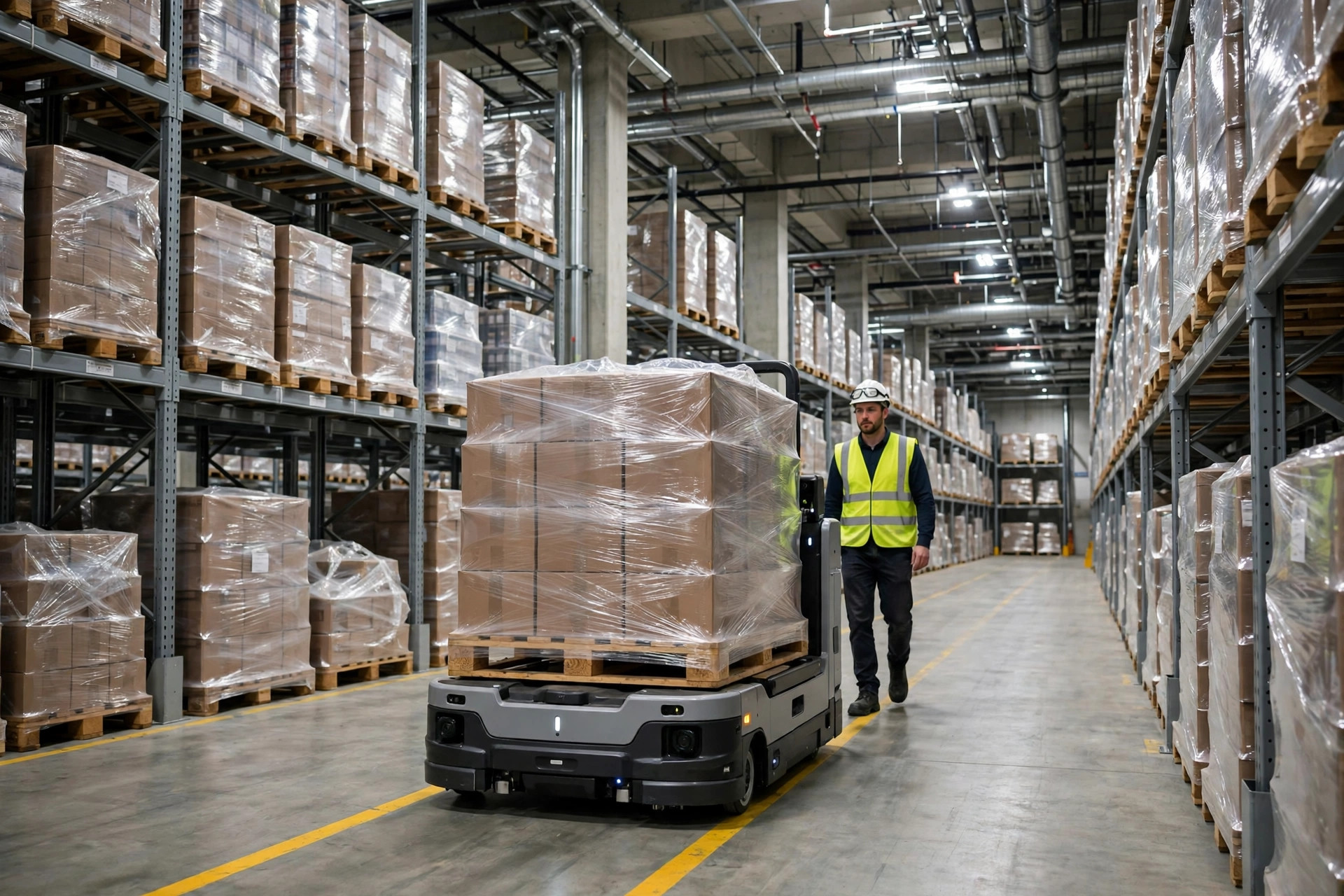
Once navigation is settled, the next question in any AGV selection warehouse project is AGV versus AMR. An AGV is like a train: fixed route, steady, cheap, predictable. An AMR is like a car that finds its own way: flexible, expensive, demanding on software and floor discipline. If your material flow is one fixed loop, the same point-to-point moves every day, an AGV is enough. Paying AMR money is waste. If your task points move daily and routes need to dodge obstacles on the fly, then talk AMR. A second dividing line gets less attention: mixed traffic. Forklifts, people, and AGVs sharing one aisle is manageable, because everyone knows where the AGV goes next. An AMR that reroutes itself is harder for people to predict, and that has to be designed for in the safety plan.
Then there is total cost of ownership, and it has to be calculated honestly. Worked example, clearly hypothetical: a tape-guided AGV at $40,000 per vehicle, tape installation and surveying at about $8,000 once, and tape maintenance around $3,000 a year comes to roughly $63,000 over five years. A laser-guided vehicle at $55,000, reflectors and surveying at $12,000, and maintenance around $1,500 a year comes to roughly $74,500 over five years. Tape looks $11,500 cheaper over five years, but only if the route never changes. One route change, with relaying plus the cost of the shutdown, eats that $11,500 without trying. Cost the route changes at the most likely number, not the most optimistic one. Batteries, tires, chargers, and WMS integration all belong in the table too. The vehicle price is one row, not the whole table.
There is one more pitfall I have seen more than once: charging. An AGV running two shifts has to give charging time back out of the schedule, and chargers have to sit near the routes. Put them far away and the vehicles burn their day driving to charge, which is the same as buying one fewer vehicle. Before you buy, write charging into the shift plan and check that enough vehicles are online at peak. When there are not enough vehicles out, the problem is not always that you bought too few.
So before you select anything, take a sheet of paper and write four lines: will the routes change in three years, is the floor clean, is there somewhere to mount reflectors, and how much money is set aside for route changes. Once those four lines are honest, the choice between tape, laser, QR, and natural navigation mostly makes itself. The vehicle is the last thing you pick. Navigation and the floor come first.
Before you buy a vehicle, go look at your warehouse floor. It is more honest than any sales brochure.
By Lao Mi, Supply Chain Veteran (20 yrs)