Here's my verdict up front: as of 2026, laser SLAM is the right default for any fleet over ten robots, magnetic tape is perfect for routes that will never change, and visual SLAM is a cheap-but-picky contender that isn't a laser replacement yet. The expensive mistakes I see aren't about bad technology — they're about good technology deployed in the wrong building. I've watched operators pay laser-SLAM money for a magnetic-tape system, then pay double three years later to rip it out.
Every AMR lives or dies on one question: "where am I?" There's no GPS indoors, so the robot has to figure it out on its own. Three mainstream approaches dominate the market, built on completely different principles, with completely different failure modes. Let's draw the lines.
Laser SLAM: Navigating by Walls — the Safest Bet, With Kryptonite
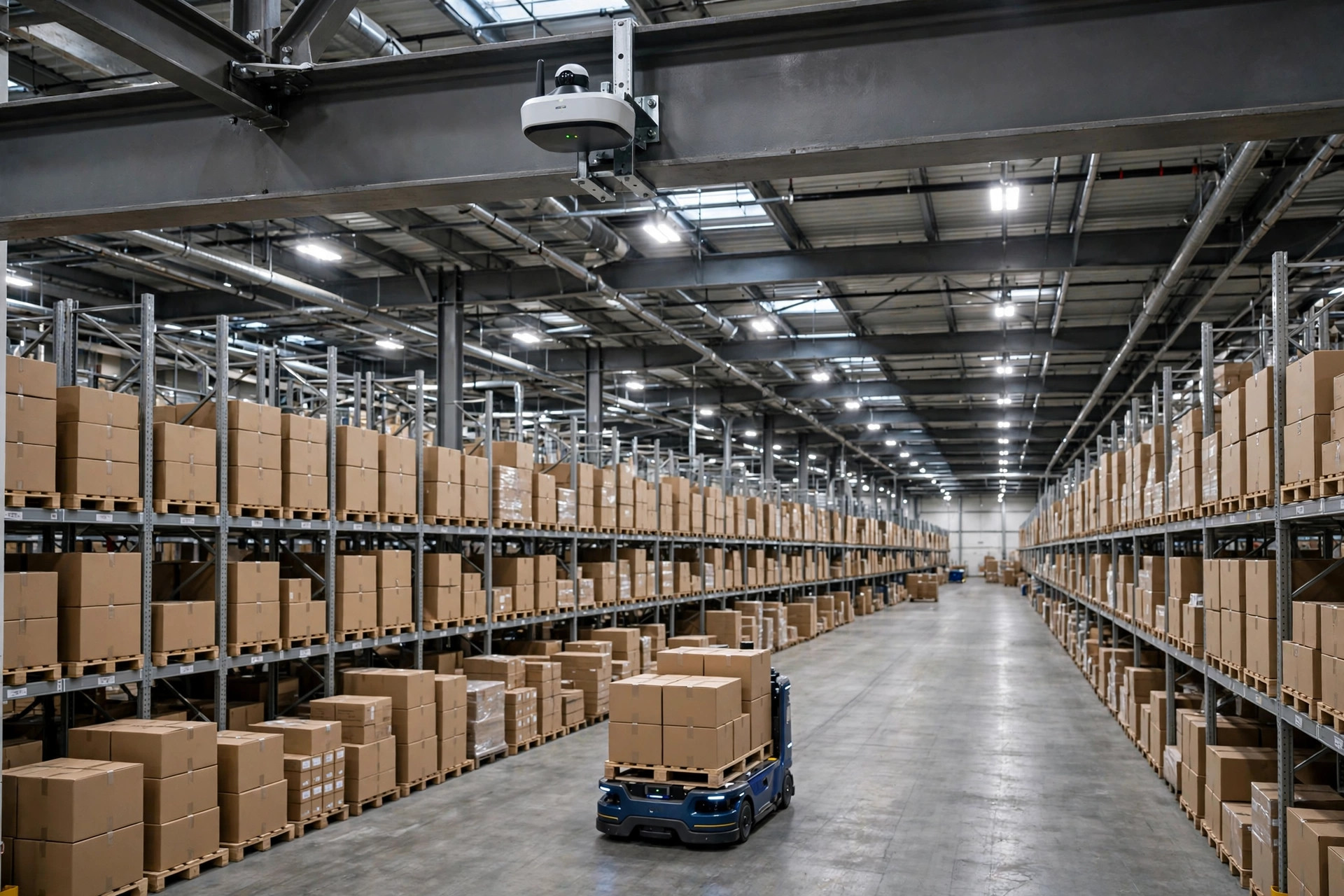
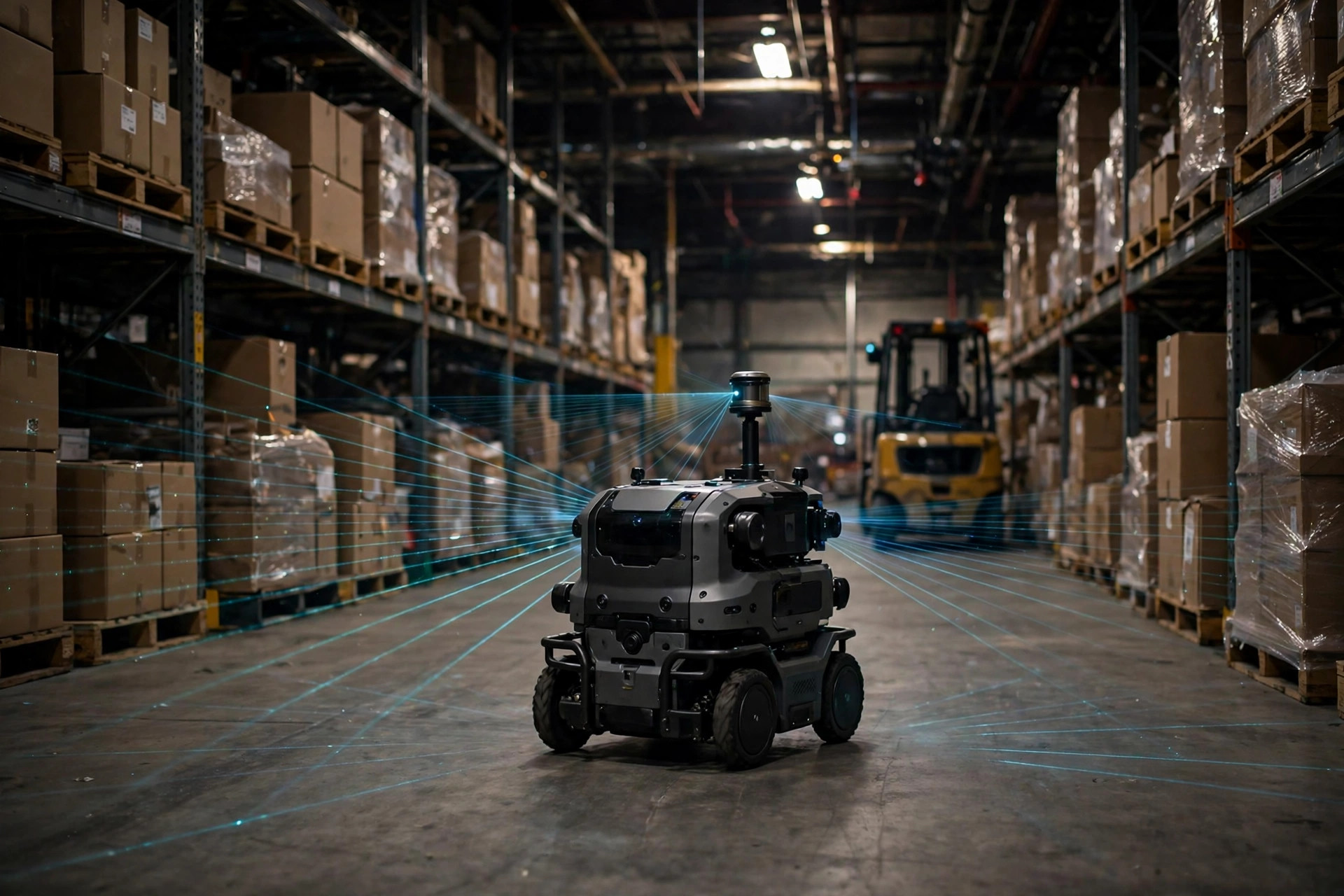
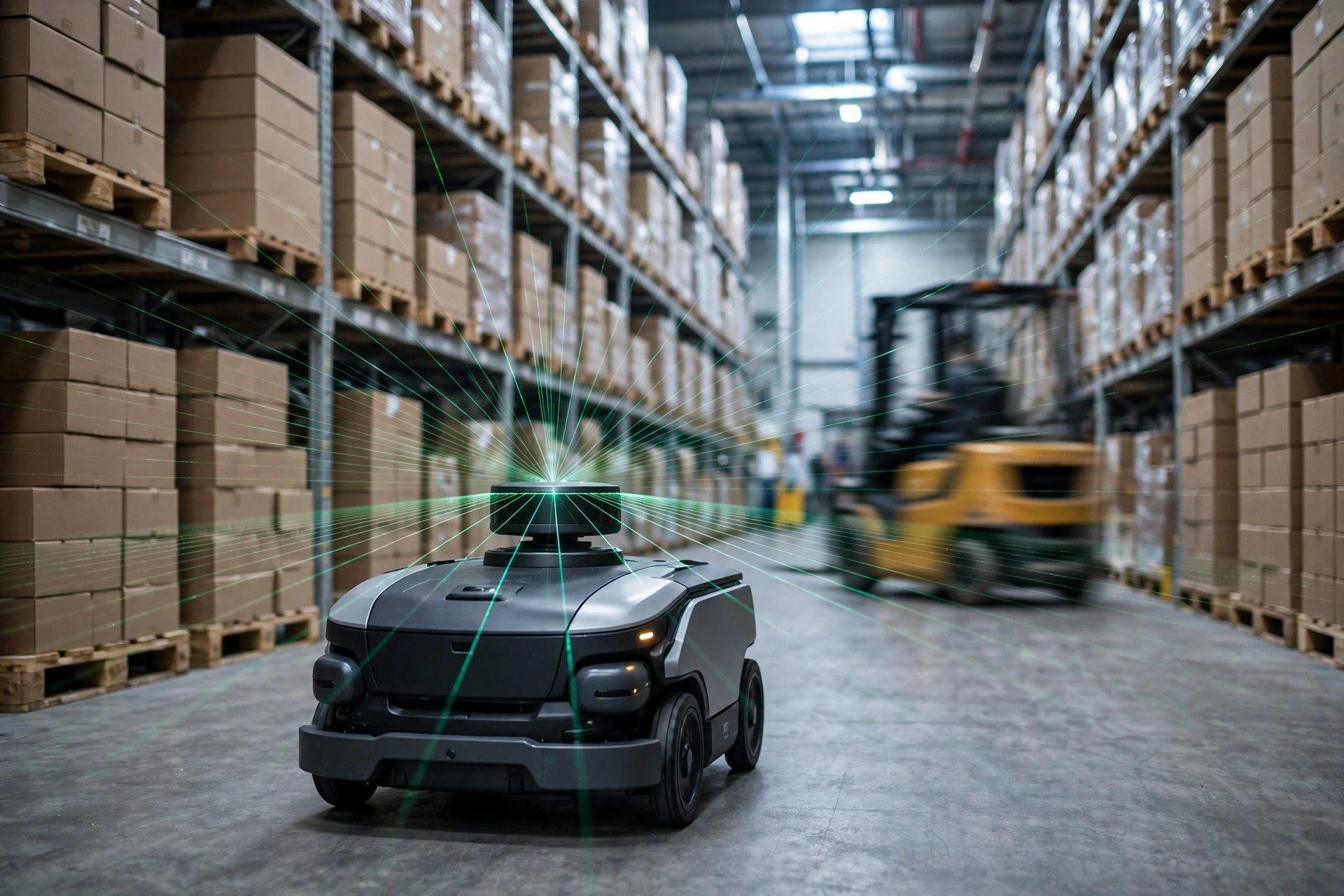
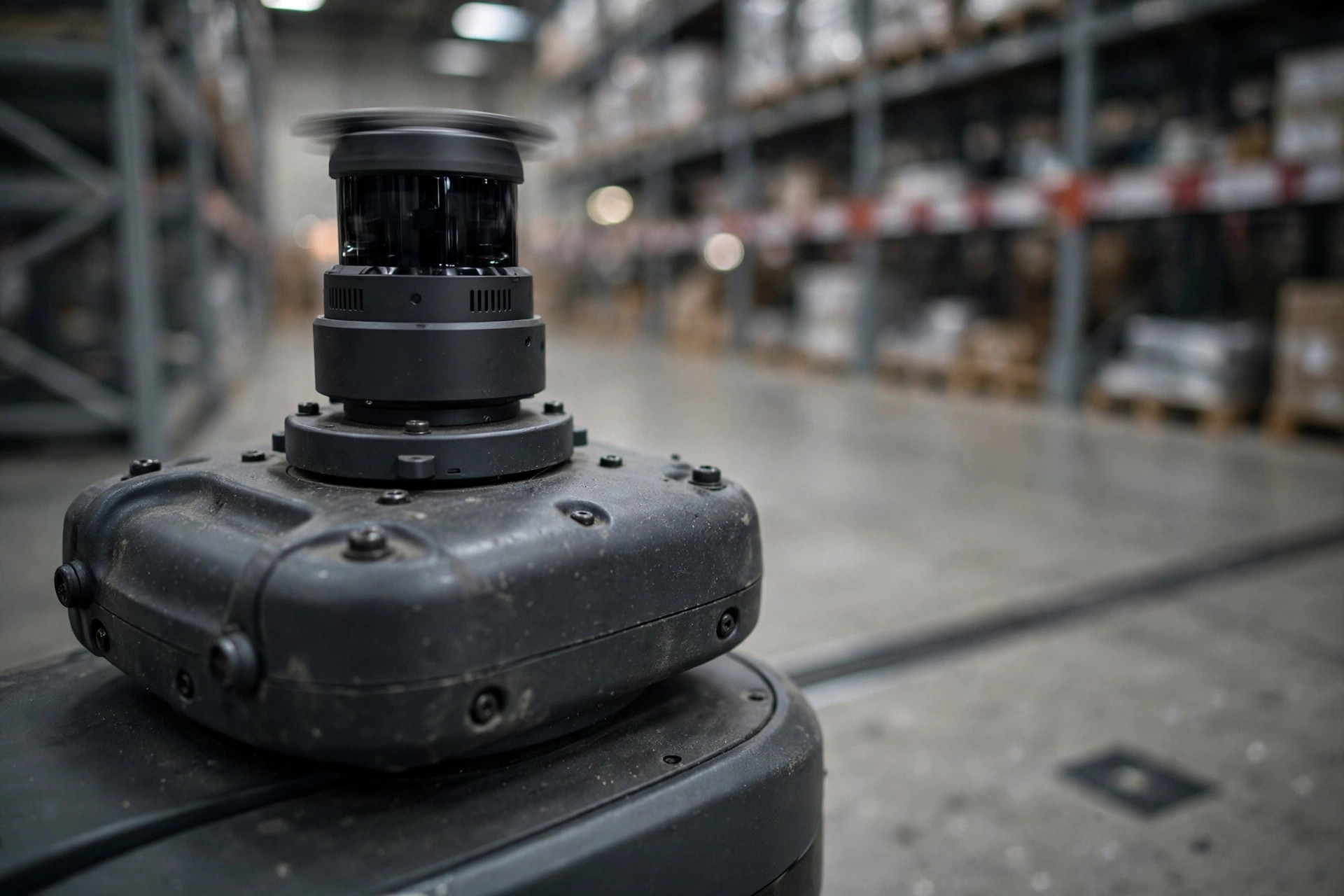
Laser SLAM ships more units than anything else right now. The principle is beautifully simple: a LiDAR unit on the robot's roof spins a dozen or so times per second, firing lasers and timing the echoes to sketch a contour map of the surroundings. As the robot moves, it matches live scans against that map — essentially checking, "do these walls and columns line up with what I remember?" When they do, the robot knows where it is.
Accuracy is the best of the three — vendors routinely claim centimeter-level positioning. Deployment is painless too: no floor modifications, no stickers, no tape. You drive a robot around the building once to build the map, push it to the whole fleet, and start working. Adding robots or rerouting lanes is mostly a software job. That's why most greenfield builds and retrofits have converged on it over the last few years.
But it has kryptonite, and the nasty kind — the kind that works fine at noon and fails at 2 a.m. First, it hates open space. In a cavernous staging area with nothing within dozens of meters, the laser echoes come back too weak. The robot is like a driver in fog: localization drifts. Second, it hates reflective surfaces — glass partitions, stainless rack uprights, shrink-wrapped pallets scatter the beams and plant "ghost" features in the map. Third, it hates big environmental change. SLAM recognizes static contours. When peak season hits and you stack temp pallets along the main aisle, the contours change, the robot gets lost, and somebody has to rebuild the map.
I toured a 100,000-square-foot 3PL in the Inland Empire in 2024 running a laser-SLAM fleet. Smooth operation eleven months a year — until peak, when outbound staging pallets got stacked high along the main travel lane and several robots started circling the same intersection. The fix wasn't new technology; it was operational discipline. They geofenced that stretch and banned staging above a set line. Right tech, wrong habits, still equals downtime.
Visual SLAM: Recognizing Faces Instead of Walls — Cheap, but Picky
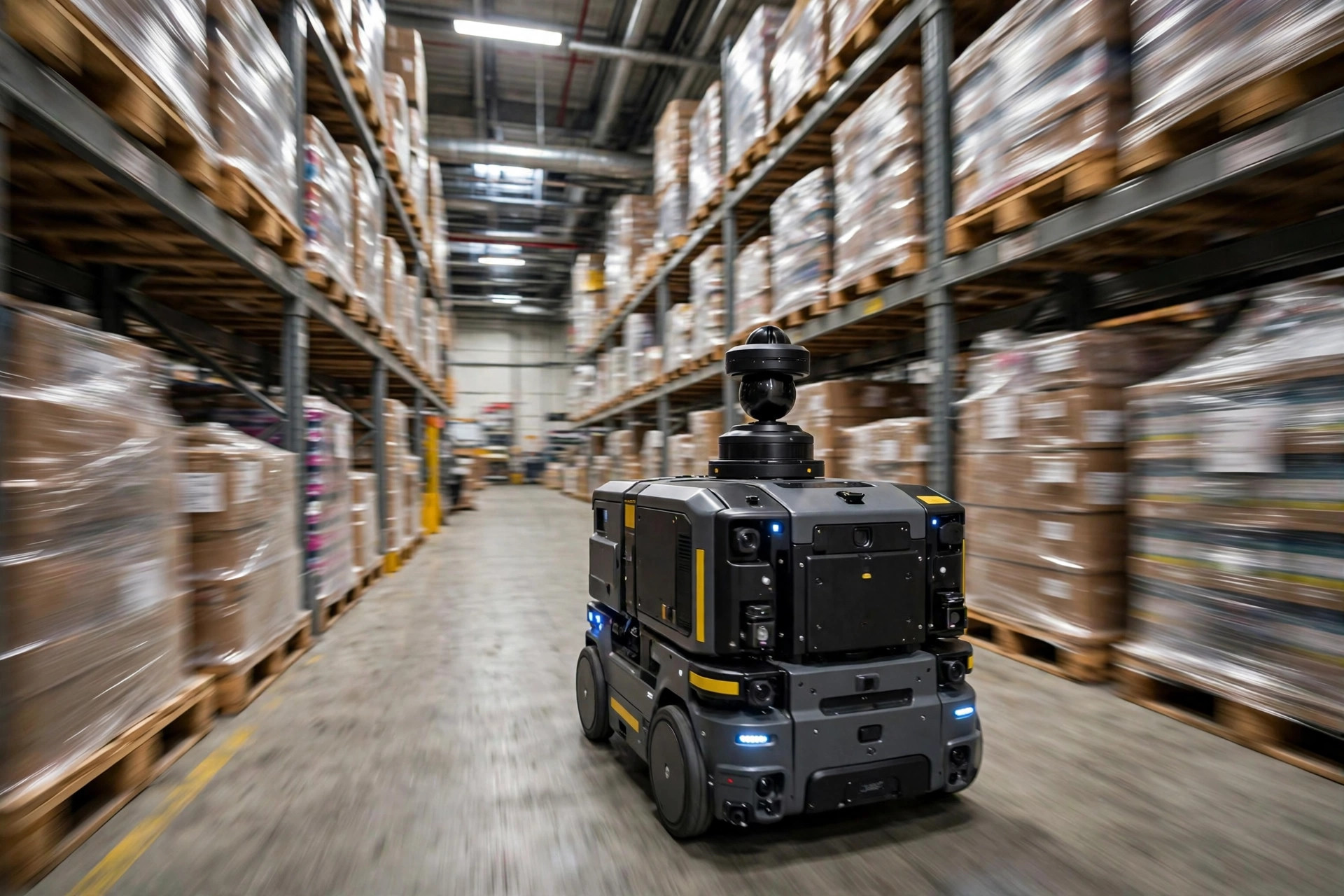
Visual SLAM ditches the laser for cameras. Fisheye or depth cameras watch floor texture, ceiling light strips, rack features, and the algorithms triangulate position from the images. The selling point is cost: cameras run an order of magnitude cheaper than LiDAR, so the bill of materials drops meaningfully. Some vendors even double-dip — the same cameras do cycle counting and read location labels on the way past.
The catch: this approach is picky about everything. First, it's picky about light. Kill the lights, or let afternoon sun rake through clerestory windows and throw hard glare across the floor, and the image features scramble. A lights-out 24/7 facility? Dead on arrival. Second, it's picky about floors. A polished epoxy slab or a featureless concrete expanse gives the cameras nothing to lock onto — it's like counting your steps with your eyes closed, drifting a little further with every meter. Third, it's hungry for compute. Vision algorithms eat processing power, and the onboard computer's cost and power draw claw back part of the sensor savings.
So here's where I land: visual SLAM fits small fleets doing point-to-point material runs in stable lighting with textured floors — think a couple of tuggers in a plant. If your building runs around the clock, has dark shifts, or waxes its floors to a mirror shine like half the e-commerce DCs I know, don't touch it. The tech is improving, but in 2026 it is not a laser-SLAM substitute.
Magnetic Tape and Floor Codes: Navigation by Roadwork — Rock Solid, and Rigid
The oldest school, inherited straight from the AGV era. Magnetic-tape navigation buries or sticks magnetic strips into the floor; a sensor under the vehicle follows the field and corrects drift. Floor-code navigation pastes a grid of QR-style markers on the concrete; a downward camera reads them, and each code encodes coordinates. Amazon's 2012 acquisition of Kiva Systems for $775 million put this approach on the map — Kiva's bots rode a floor grid of machine-readable codes.
The upside is boring reliability: immune to lighting, immune to open space, immune to reflections, centimeter-level accuracy, and the lowest per-robot cost of the three. The downside is one word: rigidity. Routes are physical infrastructure. Reroute a lane and you're re-taping or re-sticking the floor — downtime, labor, recommissioning, all billed by the hour. Tape wears under daily forklift traffic and needs patching every few years. Worst of all is the flexibility tax: when the business changes and slotting gets reworked, you're rebuilding roads.
So the dividing line is crisp: routes that won't change for a decade — fixed point-to-point material delivery in a plant, that kind of thing — magnetic tape or floor codes are cheap and bulletproof. E-commerce and 3PL buildings where slotting changes constantly and peak season rewrites the floor plan, stay away. What you save on the robots, you'll pay back with interest on the third reroute.
The Three-Way Comparison
| Laser SLAM | Visual SLAM | Magnetic tape / floor codes | |
|---|---|---|---|
| How it localizes | LiDAR scans environment contours, matches against a map | Cameras track floor/ceiling visual features to estimate position | Follows magnetic strips, or reads floor codes for coordinates |
| Accuracy | Centimeter-level (per vendor specs) | Centimeter-level, drifts when lighting is poor | Centimeter-level, extremely stable |
| Cost | Mid-range per robot, near-zero facility modifications | Cheapest per robot, but onboard compute eats back some savings | Cheapest per robot; floor work and reroutes are the real cost |
| Biggest fear | Open space, reflective surfaces, big environment changes | Lighting changes, featureless floors, lights-out operation | Route changes (physical rework), tape wear |
| Best for | Most new builds and retrofits, fleets of 10+ | Small fleets, stable light, budget-sensitive | Fixed routes that won't change for years |
The Hybrid Trap: 1 + 1 Is Often Less Than 2
Lately vendors have been pitching "laser + visual" fusion SLAM, and on paper it's seductive: vision covers the open spaces laser hates; laser covers the dark hours vision can't handle. Let me pour cold water on it: fusion complexity is exponential. Calibrating two sensor suites, synchronizing their clocks, building arbitration logic for when one feed goes bad — each one is a project by itself. I've seen a deployment spend four months tuning a fusion stack, then switch vision off and run laser-only. It got more stable overnight.
My advice: unless you have your own algorithms team to own the integration, pick one mainstream approach and run it to its limit. Sensor fusion is for vendors showing off at trade shows, not for ordinary warehouses paying tuition.
The One-Line Rule and a Reminder
Four lines, that's the whole playbook: routes change — laser; light is stable — visual is worth a look; routes frozen for a decade — tape; fusion — not yet.
And one reminder before you sign anything: don't buy off a demo video. Make the vendor bring robots to your building, run your messiest aisle, during your worst-lit shift, for a full shift. SLAM's failures never happen in the lab — they happen on your floor. And get this into the contract before you sign: who rebuilds the map after a major layout change, and how fast. That one clause will save you half your future arguments.
Lao Mi has spent 20 years in U.S. warehouse operations — selecting systems, deploying them, and living with the consequences. Got a specific AMR question? Come ask Lao Mi.