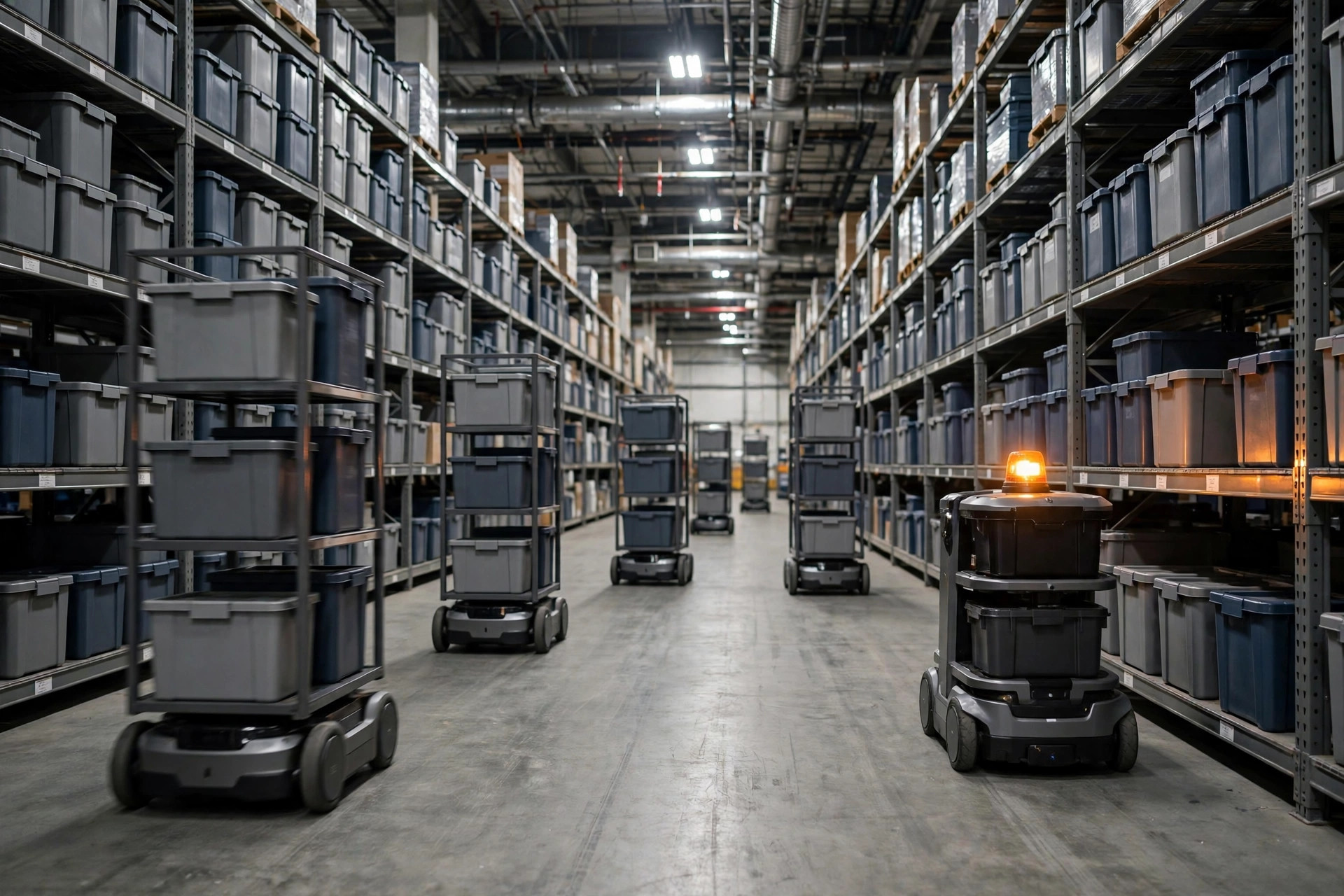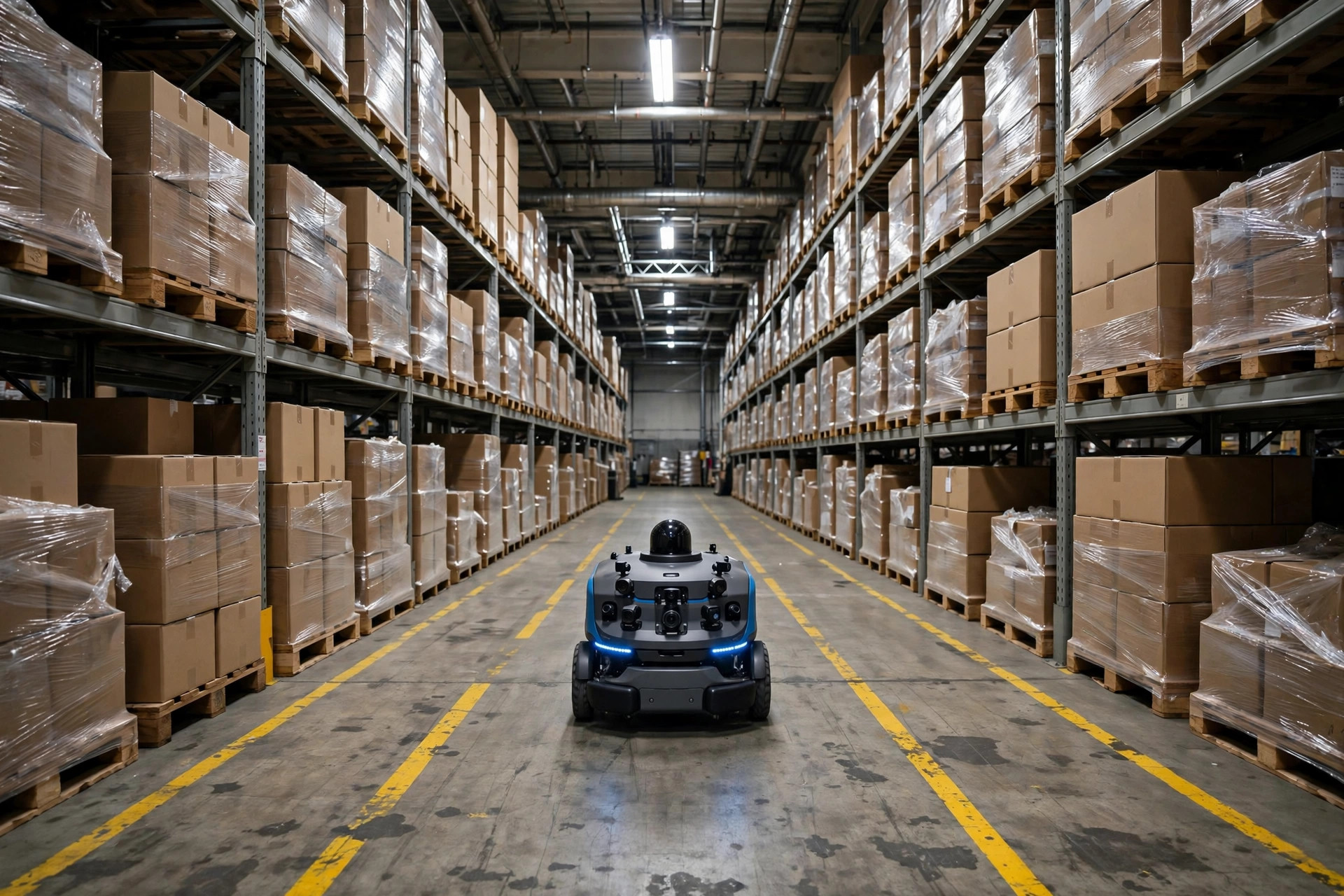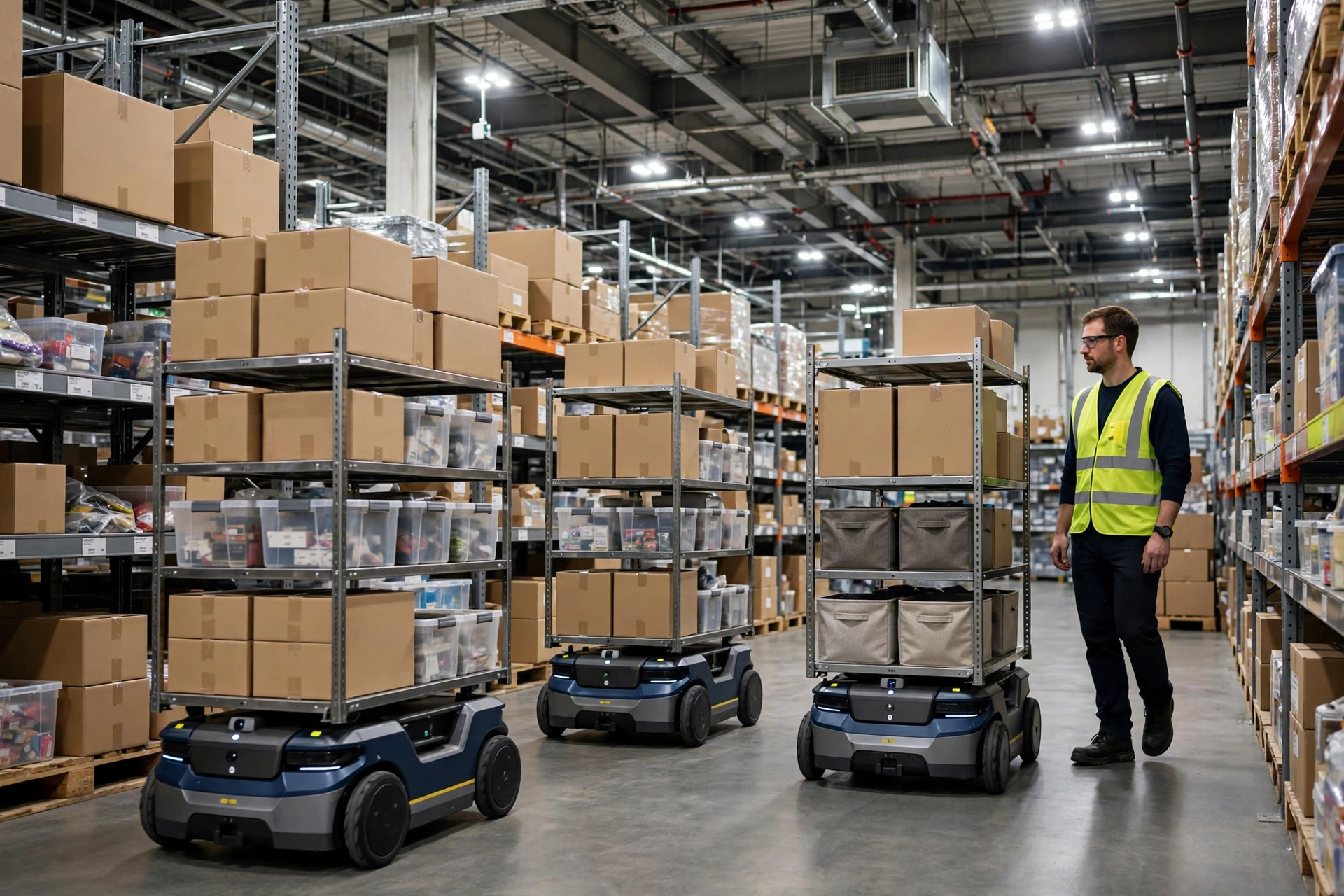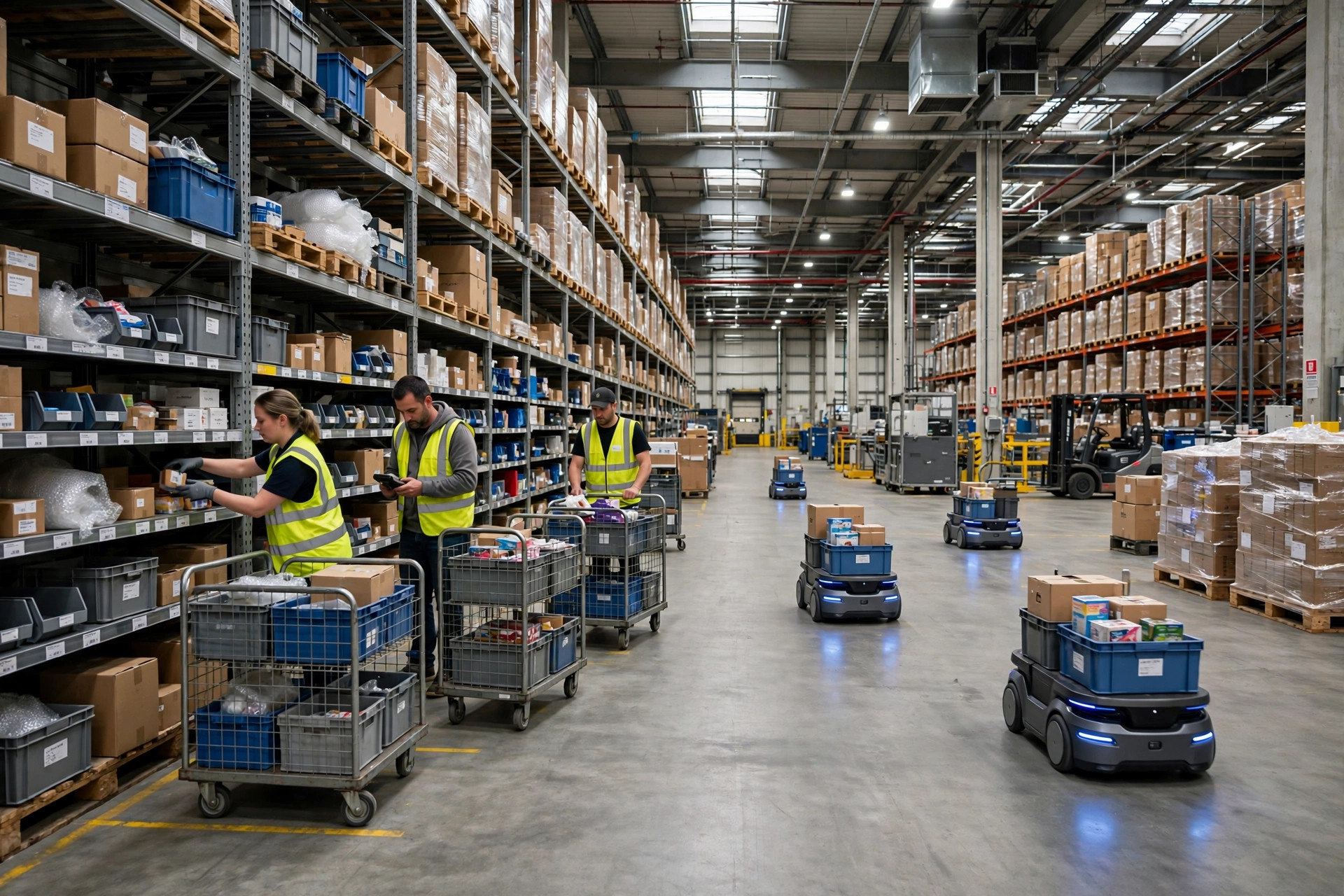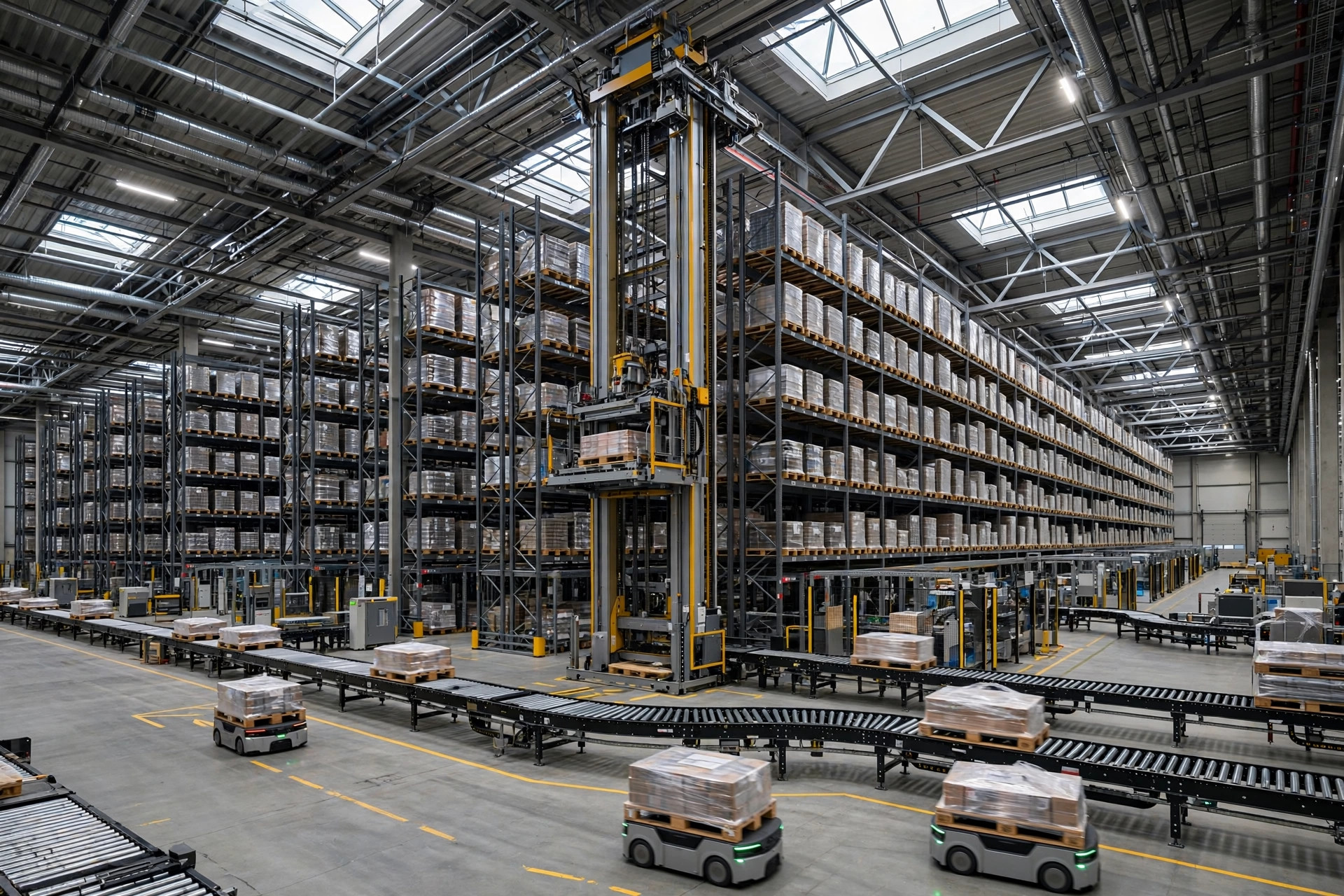
In February 2018, GEODIS dropped 30 little robots into an apparel warehouse in Indianapolis: 139,000 square feet, more than 30,000 SKUs. Picking productivity doubled. New-hire training went from hours in a classroom to a few minutes shadowing a bot on the floor. Every day, 80% of units were picked straight onto the robots.
That is what collaborative picking robots do — the "follow-me" AMRs from companies like Locus and 6 River. They don't pick for you. They walk for you.
This article skips the hype and does the math: whether these robots are worth it, and which warehouses will make money on them versus which ones will pay tuition.
How Collaborative Picking Robots Actually Work
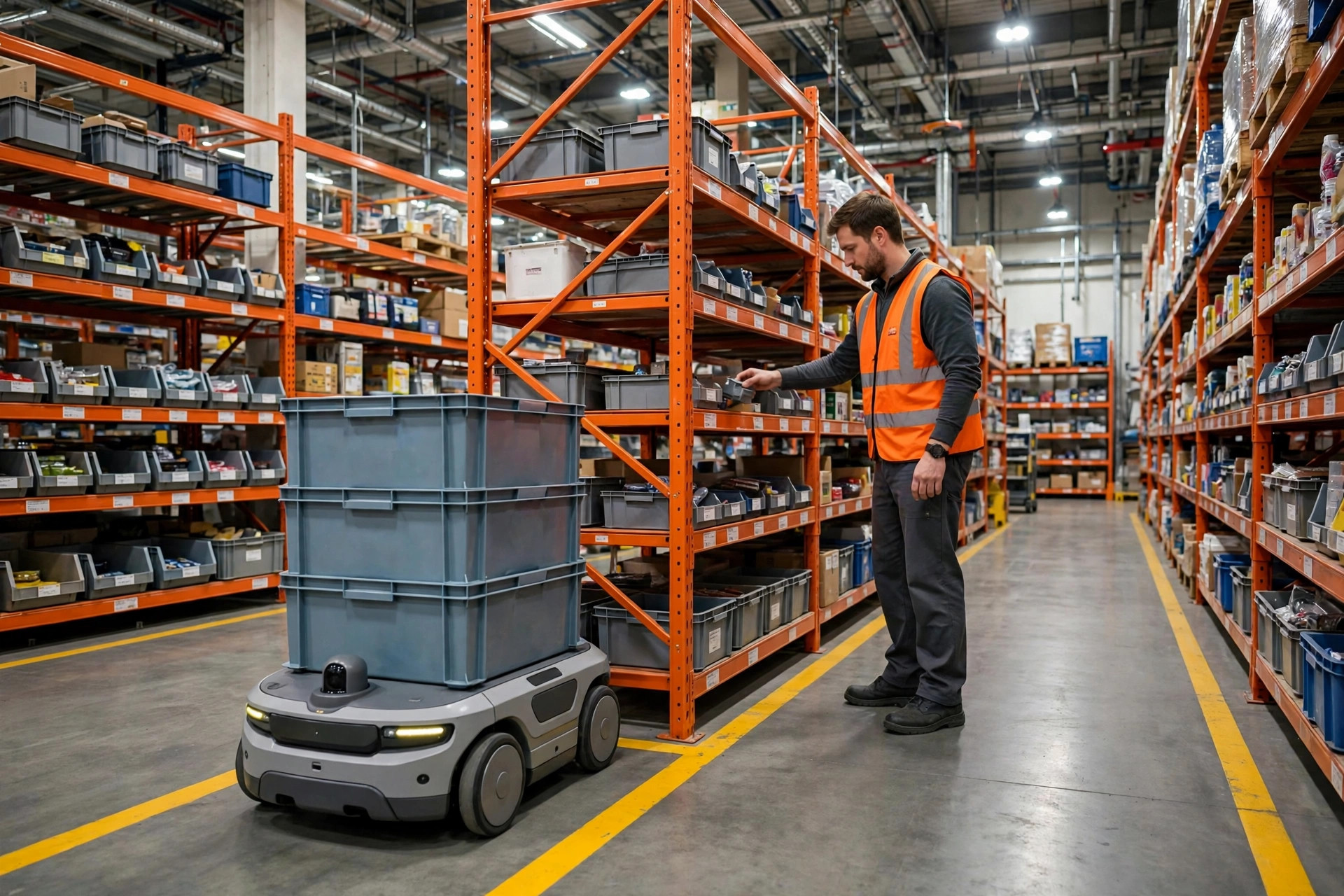
Think of it this way: a picker used to be a person pushing a shopping cart through a supermarket, walking three steps for every item picked — spending more time walking than picking. Now the cart has grown legs and its own navigation. The human just reaches out a hand.
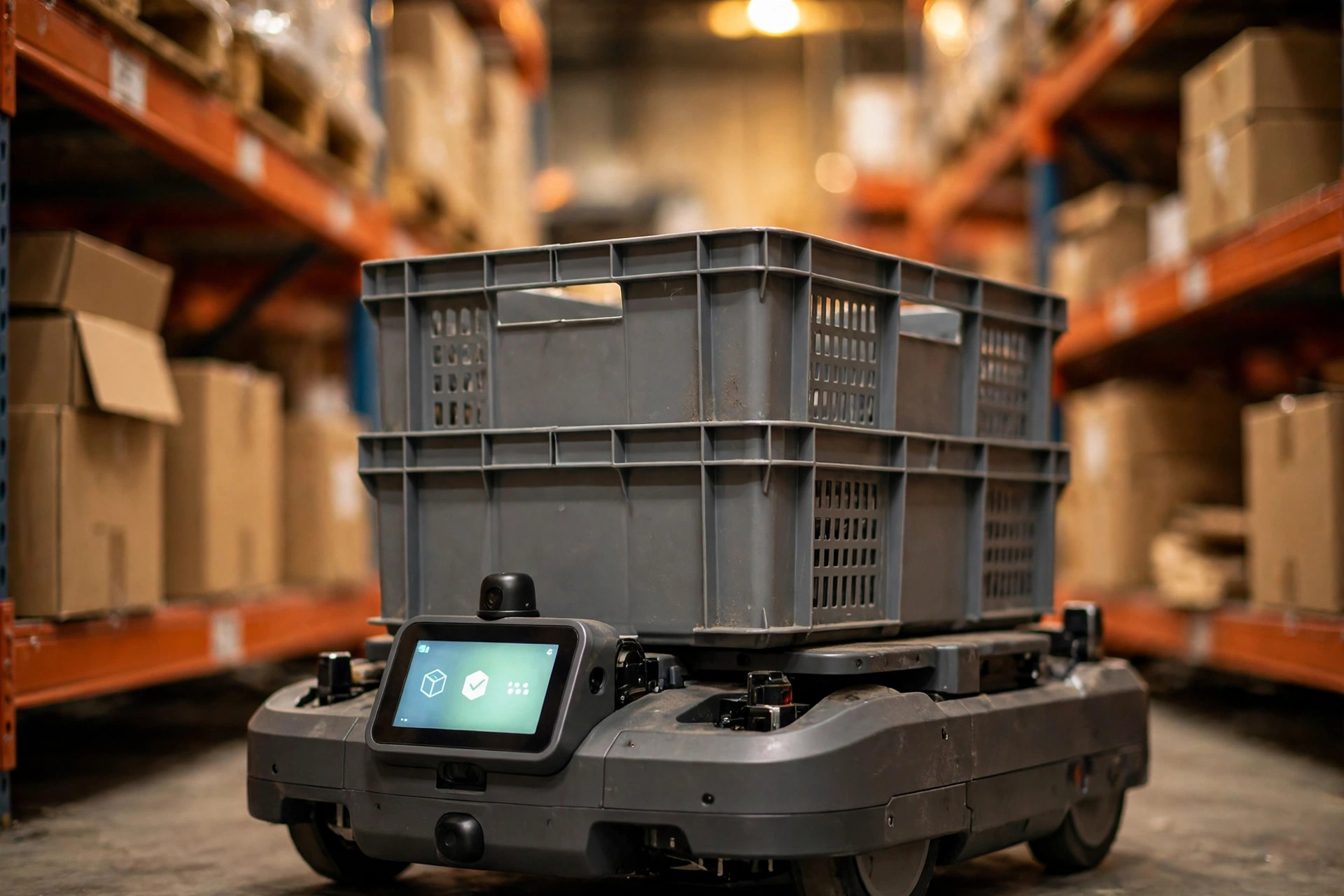
Here's the actual workflow: an associate badges into a robot, the screen shows the next pick location with a product image, the person walks to the slot, picks, scans to confirm, drops the item into the tote on the robot. Then that robot drives itself to the next pick location — or off to the pack-out area — while another empty robot is already waiting in front of the picker. Humans and robots work in relay, not in fixed pairs.
Here's the part most people get backwards: the value of a collaborative picking robot is not in the vehicle. It's in the brain in the cloud. 6 River calls it CFS, the Collaborative Fulfillment System — a cloud server that dispatches dozens of robots in real time: batching orders into optimal pick waves, sequencing routes to minimize walking, syncing the pace of humans and machines. The vehicle is a commodity; the always-on scheduling algorithm is the product.
The data backs this up. 6 River compared 34 days of real order data from a global 3PL (a 94,000-square-foot site with 38 long aisles): its picking algorithm sent carts down 20% fewer aisles per trip and picked 18% more order lines per aisle trip than a leading WMS's algorithm. Same warehouse, same orders, zero extra robots. When you buy these robots, you're buying a system that makes people walk less.
Two Real Cases: Let the Numbers Talk
Case one: GEODIS, Indianapolis, 2018. The apparel site from the opening. Before the pilot it was conventional manual picking; after 30 Locus bots went live, associate productivity doubled and training time was cut at least in half. GEODIS later deployed at Kutztown, Pennsylvania: from 100 units per hour with traditional picking to 175–200 with the robots — a 1.8x lift, deployed in six weeks.
Case two: a U.S. 3PL running 6 River's Chuck. Baseline was 61 units per hour. One week after setup, the site hit 151 units per hour — 2.5x. Accuracy reached 99.9%, and a single mispick cost the site an average of $22 to correct. Doubling throughput saves labor; the accuracy lift saves customer service and returns — most ROI spreadsheets forget the second part.
One more public data point: in 2018, XPO Logistics deployed 40 Chucks for 25 pickers and went from 60 to 120 units per hour per picker. Note that ratio, 40 robots to 25 people — you always buy more robots than you have pickers, because while one robot runs errands, another must already be waiting.
The ROI Math: Three Options Side by Side
Collaborative picking AMRs sit between pure manual picking and full goods-to-person systems:
| Dimension | Pure manual | Collaborative picking AMR | Goods-to-person |
|---|---|---|---|
| Go-live timeline | — | 4–6 weeks | 6–12 months |
| Facility retrofit | None | Minimal (WiFi + floor leveling) | Major (racking, rails, power) |
| Throughput lift (public cases) | Baseline | 1.8x–2.5x | Higher, at a totally different investment level |
| Peak-season elasticity | Hire temps (good luck) | Add robots (rent if needed) | Essentially fixed |
| Best order profile | Anything | Multi-line orders, spread-out SKUs | Ultra-high-density, massive SKU counts |
6 River's own business-case document makes an eye-catching claim: versus goods-to-person, collaborative robots deliver "67% of the value at 20% of the cost in 36% of the time." That's a vendor number, so take it with salt — but the direction is right. The pitch was never "highest throughput." It's "best payback, fastest result."
So how do you actually compute payback? Here's a back-of-the-envelope formula:
Payback ≈ total robot investment ÷ (peak-season temp labor avoided + mispick cost avoided + overtime avoided)
Walk through it with the case magnitudes above: a 20-person picking team averaging 70 units per hour goes to 150 with robots. To hold 1,400 units per hour of capacity you used to need 20 people; now 10 people plus a robot fleet does it. The 10 temps you would have begged staffing agencies for in peak season — slow to train, quick to mispick — you simply don't hire. For many 3PL operators, that alone justifies the check.
The Counterintuitive Part: ROI Lives in Dispatch, Not Navigation
Most people assume the technical moat of these robots is LiDAR navigation and obstacle avoidance. Wrong. Navigation is a commodity now — your vacuum cleaner does it. The real moat is the central dispatch I described above: dozens of robots, dozens of people, thousands of order lines, computed in real time — who goes where, which robot waits for whom — without collisions and without humans standing around waiting for robots.
That leads to a counterintuitive conclusion: the same fleet of robots, dropped into a warehouse with good wave management, performs twice as well as in one where orders are picked first-come-first-served with no batching. Robots amplify your existing process; they don't replace it. A messy process with robots is just "messy, faster."
Research backs the boundary too. A 2018 Auburn University paper on robotic picking found the gains are largest when the ratio of average distance between pick locations to average distance to the depot is high — and the benefits dilute fast in large facilities with small pick lists. In plain English: the more spread out your SKUs and the more walking your operation involves, the more these robots pay.
Who Should NOT Buy: I'll Say It Straight
Three situations where buying these robots is paying tuition:
- Low volume, low walking. If your daily order lines are in the low thousands and pickers spend under 30% of their time walking, there's nothing to save. Do ABC slotting and golden-zone placement first — that's free.
- One order per cart, unchanged. Some warehouses still run one order, one trip, one cart. Under that process a robot is just an expensive shopping cart. You must switch to multi-order batch picking first, or the value never unlocks.
- Hoping robots fix accuracy. 90% of mispicks are process problems — no barcode scan, no verification step — not leg problems. Fixing your verification process first gets you the same result for free.
The Maintenance Traps: Read Before You Buy
- Charging. Don't trust the "10-hour runtime" spec sheet — that's empty, straight-line driving. Loaded, with constant stop-and-go, derate it by about 30%. Ask whether it's opportunity charging or battery swap, and whether peak-season schedules need charging windows.
- WiFi. These robots are cloud-dispatched. A WiFi dead zone means a strike. Do a full-site roaming survey before go-live — high-bay racking, cold storage doors, and metal roller shutters are the usual dead spots.
- Floors. The wheels are more delicate than you'd think. Expansion joints, cracks, and uneven epoxy all force robots to slow down or fault out. Level old floors before the fleet arrives.
- Tote standardization. Robots only accept standard totes. Figure out oversized and odd-shaped items upfront — XPO's deployment added larger Chuck+ units specifically for pillows and blenders that don't fit standard totes.
- Software updates. Cloud systems push updates overnight as a matter of routine. Confirm you control the update window — you don't want a "system maintenance" banner on Black Friday.
Worth It or Not? Look at This One Number
Forget the vendor slide decks. Measure one number: how much of your pickers' day is spent walking.
Shadow someone for a morning with a stopwatch. If walking — pushing carts, waiting for elevators, hunting for slots — is over 50%, the money is almost certainly well spent; the 2x productivity in the cases above is not a fantasy. If it's under 30%, spend the money on slotting and wave management first, and revisit robots later.
At the end of the day, a collaborative picking robot isn't really a robot purchase. It's a purchase of "freeing humans from walking" as a scheduling capability. The more your warehouse walks, the more it's worth. That simple.
By Da Liu, Automation Engineer