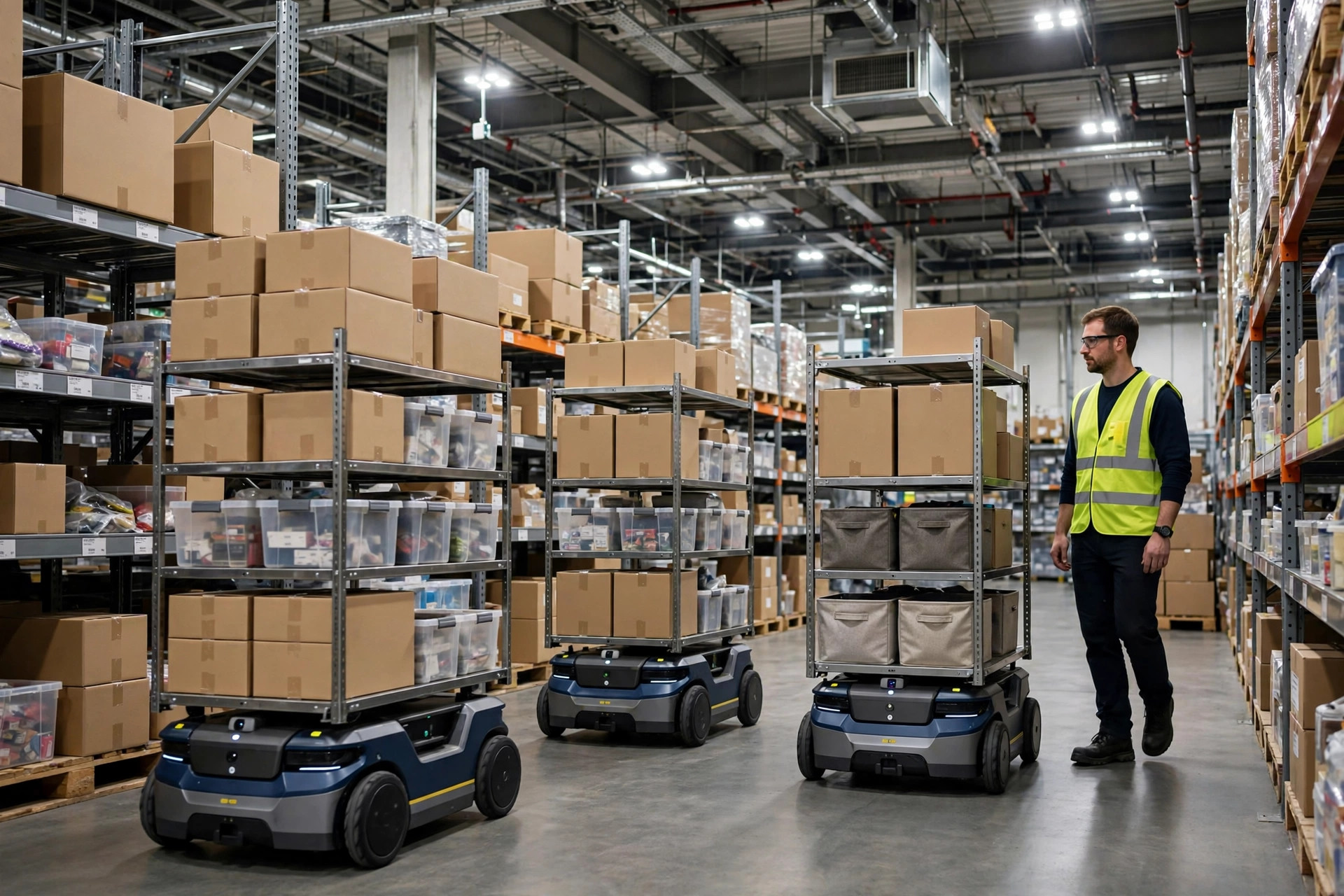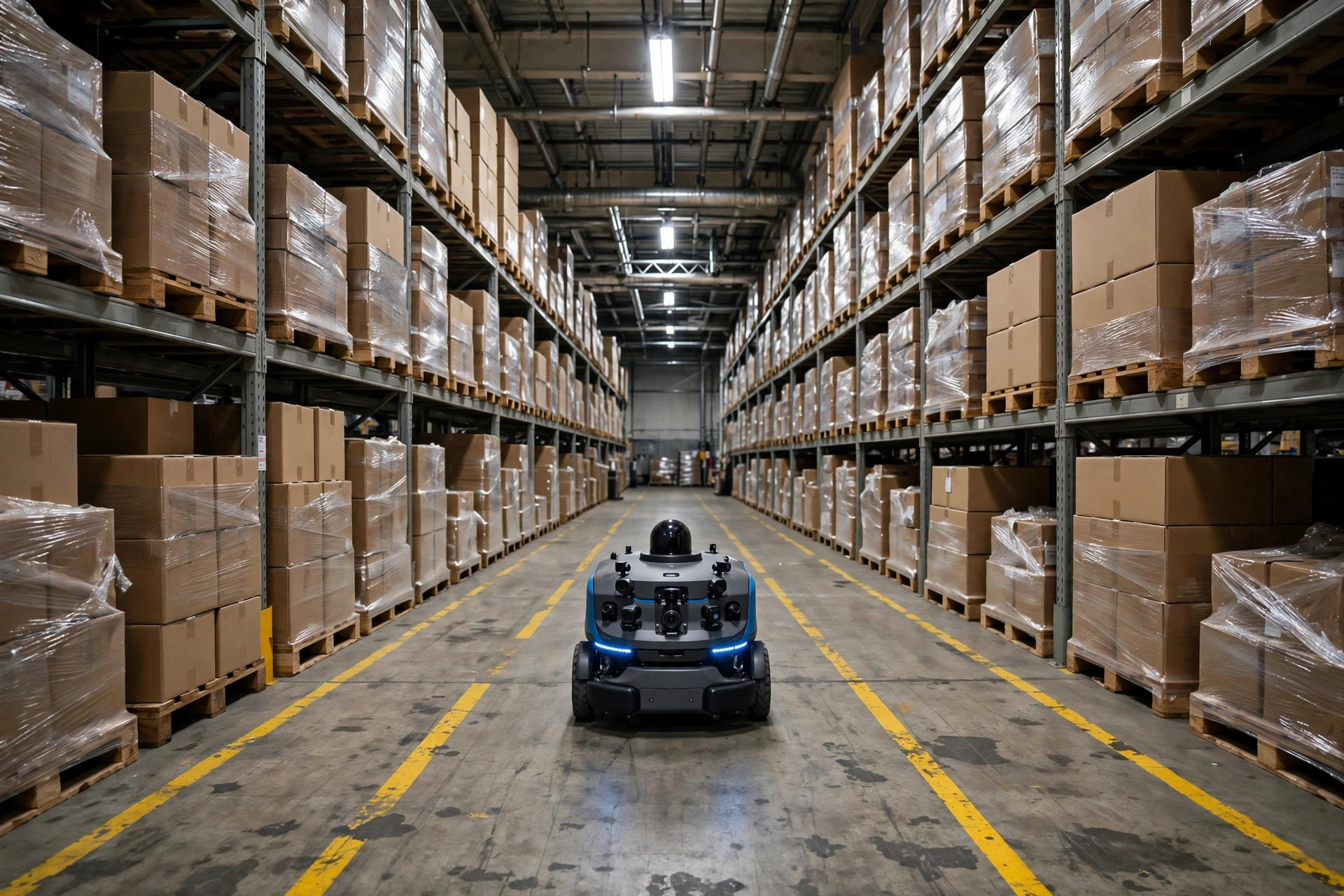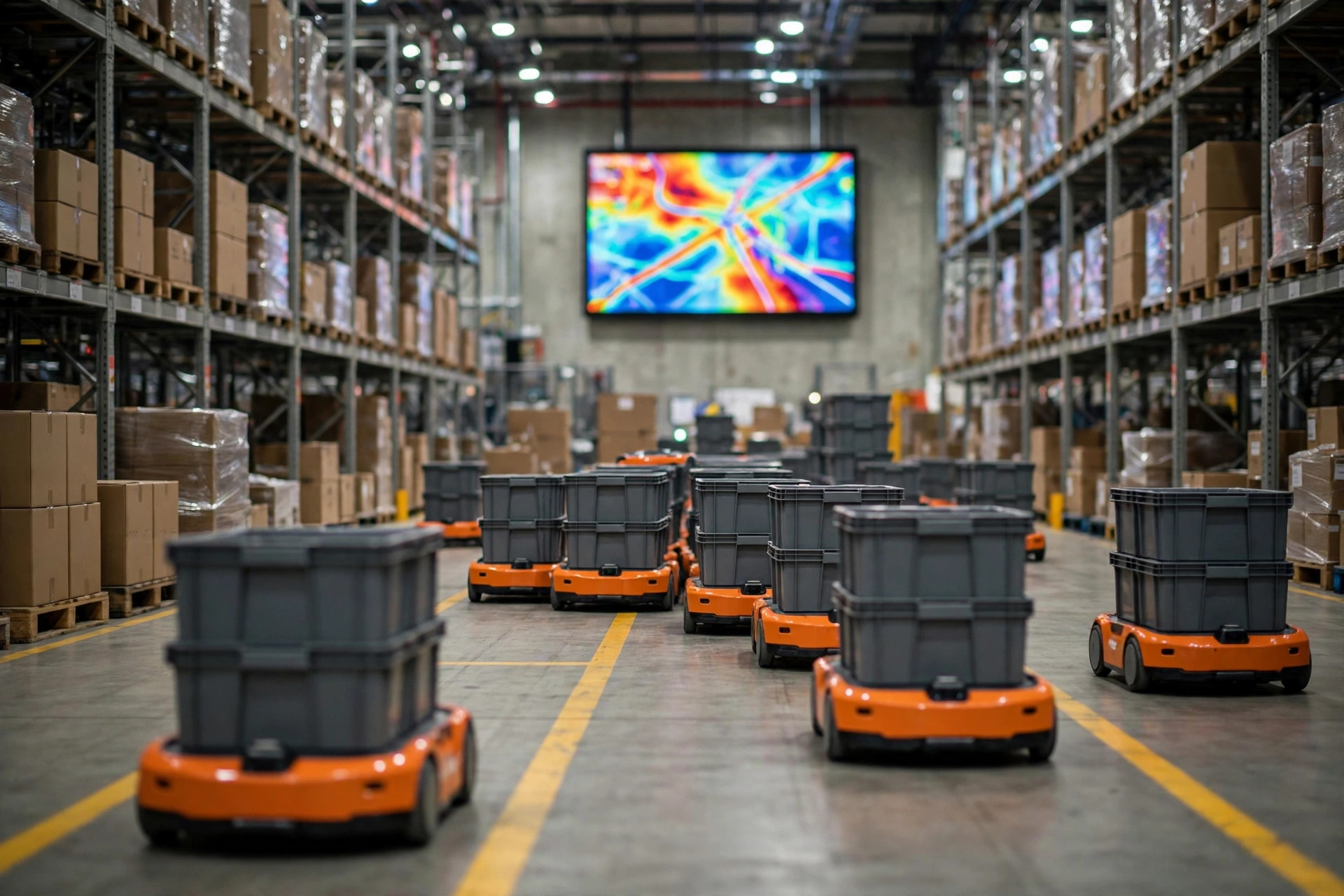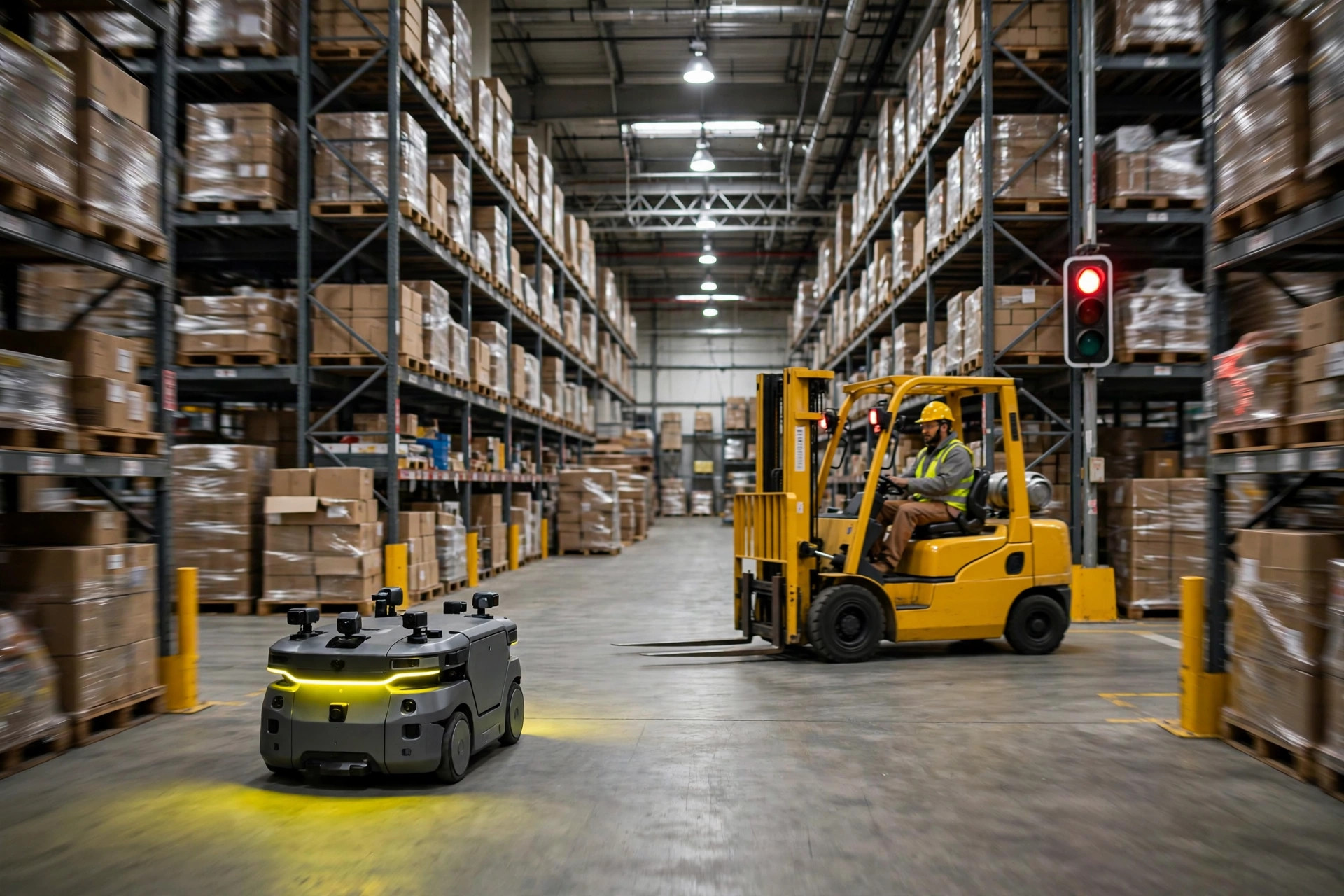
May 2023, a 12,000-square-meter home-furnishing warehouse in Foshan: six AMRs, four forklifts, one main-aisle intersection. An AMR's LiDAR triggered an emergency stop at 0.4 meters; the forklift driver slammed the brakes, and the forks stopped less than 30 centimeters from the robot's roof. Three seconds of silence across the floor. No contact — but the warehouse manager turned to me and said: "Da Liu, we have to do something about this intersection." Here's the thing about intersections: the question is never whether something happens. It's how many times.
First, the physics: an intersection is a critical section
Think of it like two threads racing for the same block of memory — the intersection is a critical section shared by AMRs and forklifts, and somebody has to decide who goes first. That's mutual exclusion, and there are exactly three ways to implement it:
- Time-slicing: traffic lights. You get your green window, I wait out my red.
- Space-slicing: physical separation or one-way loops. Delete the shared zone so there's nothing to fight over.
- Negotiation: zone reservation in the AMR fleet manager. You can think of it as a distributed lock — whoever grabs the token first goes through.
The forklift's problem is the human behind the wheel. Indoor forklifts typically run around 10 km/h — call it 2.8 meters per second — and a loaded truck needs well over 2 meters to stop, plus driver reaction time. From "I see it" to "we're stopped" easily exceeds 4 meters. But rack ends and pallets staged along the aisle routinely squeeze sight lines under 3 meters. By the time the driver sees the AMR, it's already too late.
The AMR's weakness is the mirror image: it can see, but it can't be seen. A typical AMR runs 1.0–2.0 m/s loaded; its LiDAR spots an obstacle, slows, then e-stops — logically sound. But when the driver is looking down at the forks or the pick list, the robot is sitting right in the blind spot.
Do you need traffic lights at the intersection? Three hard rules
Short answer: not every intersection deserves one. Slapping signals on every crossing in the building is a textbook pseudo-requirement — you spend the money and slow the operation down. Three hard rules; if an intersection meets any one of them, light it up:
1. Sight distance is short. Stand at the center and look down all four approaches. If visibility is under braking distance plus reaction distance (rule of thumb: 5 meters), install. A signal on a wide-open intersection is decoration for the boss's tour.
2. Conflicts are frequent. Count near-misses — e-stops, hard braking, manual interventions — for a week. More than 3 a day on average: install. Below that, try the cheap fixes first.
3. Outsiders use it. If the intersection connects to the dock area, a visitor route, or anywhere temps walk through, install. Your AMRs and your regular drivers develop an understanding over time. Strangers don't.
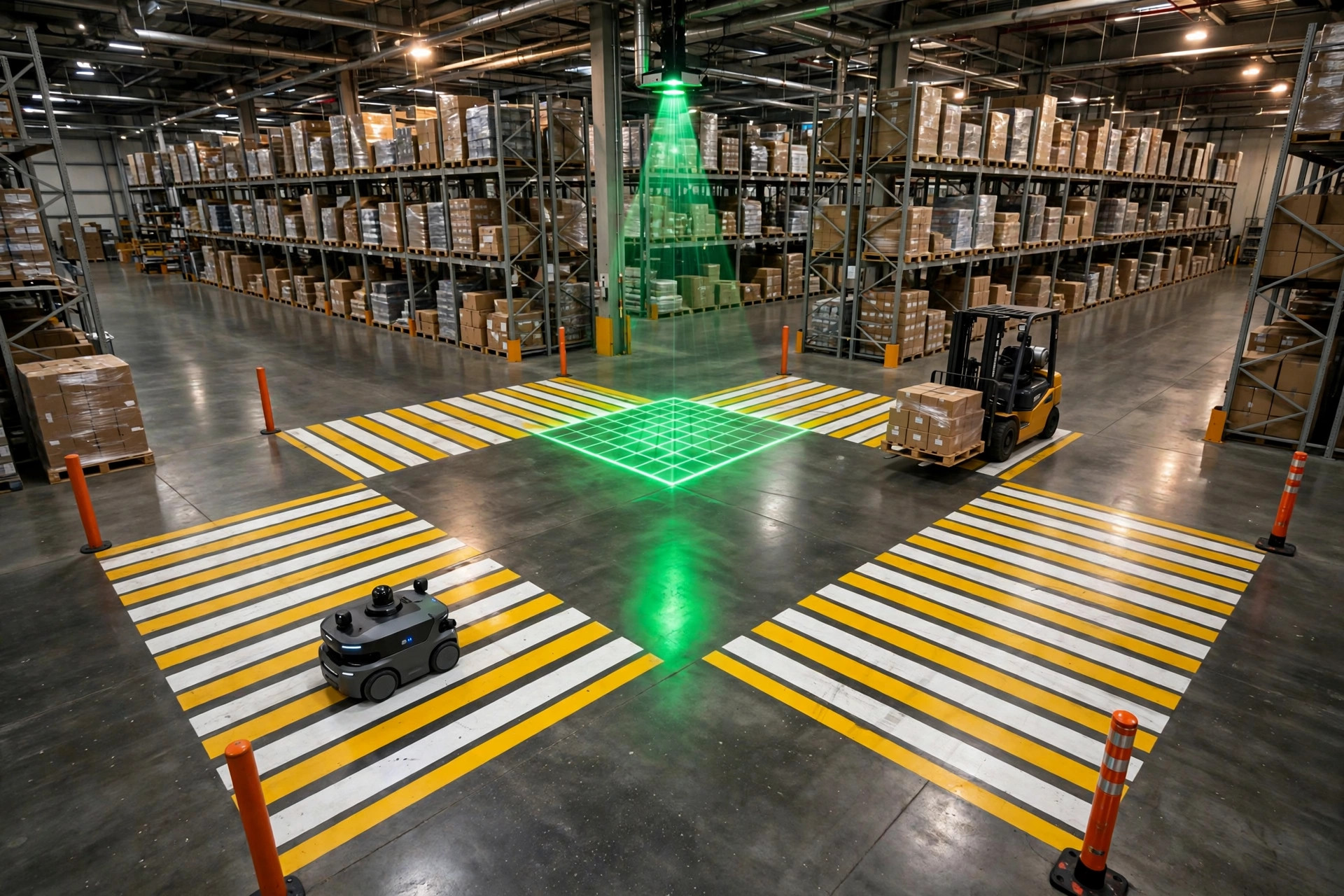
Tying traffic lights into AMR dispatch: remember, the lights are for humans
This is where most projects go wrong. AMRs don't need to see the light — the fleet manager already knows every vehicle's position and route. The traffic light is for the forklift driver.
The right architecture is "one signal, two outputs": an inductive loop or radar detects a vehicle entering the approach zone, and the controller does two things at once — turns the other approaches red, and fires an "intersection occupied" event to the fleet manager so queued AMRs slow down and wait behind the stop line instead of e-stopping in the middle of the crossing.
It works the other way too: the fleet manager can reserve the intersection. Ten meters out, an AMR requests a slot; the controller flashes the forklift approach yellow for 3 seconds, then red. Think of it as airport slots — a call-number system for the intersection, traffic-light edition.
A light that isn't integrated is an expensive ornament. In March 2024, a finished-goods warehouse at an electronics plant in Dongguan installed four signal sets across two main-aisle intersections — over RMB 30,000 — but never tied them into dispatch. AMRs would stop mid-intersection per their own zone reservation while drivers, seeing green, rolled straight through. Two scrapes in one month. Near-misses dropped from 2.1 a day to 1.8 — barely a dent. Classic case of "we installed lights but skipped the integration," money mostly wasted.
When the budget says no: do the free stuff first
Lights aren't the only answer — they're not even the cheapest one. Three moves that cost almost nothing and work immediately:
- Stop lines + convex mirrors. Paint stop lines on all four approaches and mount convex mirrors on the blind corners. Forcing the driver to "stop, look once" kills most near-misses outright.
- One-way loops. Convert the main aisle to one-way traffic and the intersection degrades from a cross into a T — or disappears entirely. This is traffic-design basics; half the intersections I see never needed to exist.
- Virtual slow zones on the AMR side. Draw a virtual speed bump around the risky intersection in the fleet manager: AMRs drop to 0.5 m/s starting 5 meters out. It's a config change — zero hardware cost.
That's exactly what the Foshan site did: sensor-actuated lights on the single worst-sight-line intersection, stop lines plus a one-way loop for the other three. Three months later, site-wide intersection near-misses fell from 11 a day to under 1.
The maintenance trap: installation day is the easy part
Signal systems don't fail because they were installed wrong. They fail because nobody noticed they broke. Real failures from my projects:
- A forklift clipped the signal pole. Don't laugh — it's the number-one "failure mode." Put poles behind bollards, or hang the heads from the ceiling.
- A pallet parked on the sensor. Someone staged pallets permanently over the inductive loop; the system thought the intersection was always occupied, the light stayed red all day, and drivers started running it — more dangerous than no light at all.
- Power-loss default. On controller failure or power loss, the default must be all-red (fail-safe), never all-green. First item on the acceptance test: pull the plug and look at the lights.
- Inspection routine. Monthly: test sensor sensitivity, check pole alignment, review the controller log for abnormal switching events. Hold it to 99.5%+ uptime — judge a signal like safety equipment, not like a light fixture.
The math: signal lights vs. one accident
A sensor-actuated signal for a four-way intersection — pole, controller, loop or radar — typically quotes around RMB 10,000–20,000. Four intersections, under RMB 80,000 installed, plus a few thousand a year in maintenance.
On the other side: OSHA estimates roughly 85 fatal forklift accidents and 34,900 serious injuries a year in the US. For a single site, one injury accident — medical bills, shutdown for investigation, insurance hikes, possible fines — runs into six figures in RMB without breaking a sweat; a serious injury or fatality starts at seven figures, before you count line stoppages and customer claims.
| Traffic lights (4 intersections) | One accident | |
|---|---|---|
| Upfront | ~RMB 40k–80k | 0 (but that's gambling) |
| Annual upkeep | A few thousand RMB | Insurance hikes, every year |
| Cost per incident | — | Six figures RMB for a minor injury; seven for serious |
| Efficiency hit | ~5–10 s wait per crossing | Minimum half-day shutdown for investigation |
And here's the counterintuitive part: the more lights you install, the slower the warehouse gets. A signal converts "conflict" into "queue" — 5 to 10 seconds of waiting per intersection, four signals on a main aisle, half a minute added to every trip. Five hundred trips a day, and you've evaporated four hours of capacity. Signals are a safety tax, not a free lunch: pay it only at intersections that are actually dangerous, not across the whole building.
So is the money worth it? It comes down to one number — daily near-misses at the intersection. Count for a week before the lights go in, count for a week after. If it drops below one a day, the RMB 80,000 was well spent. If it doesn't, the problem was never the lights — it's the traffic design, and the money belongs in a one-way loop instead.
By Da Liu, Automation Engineer