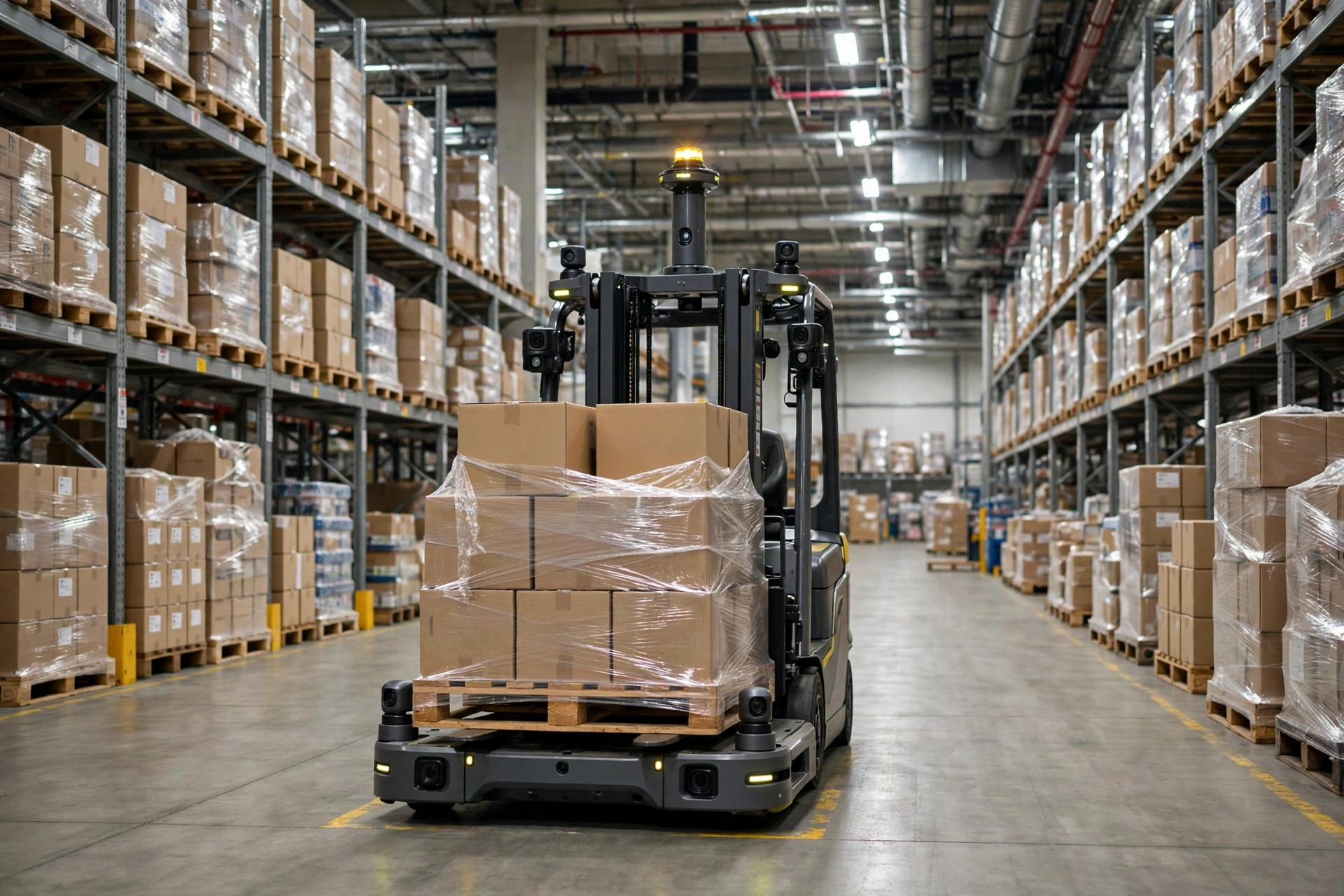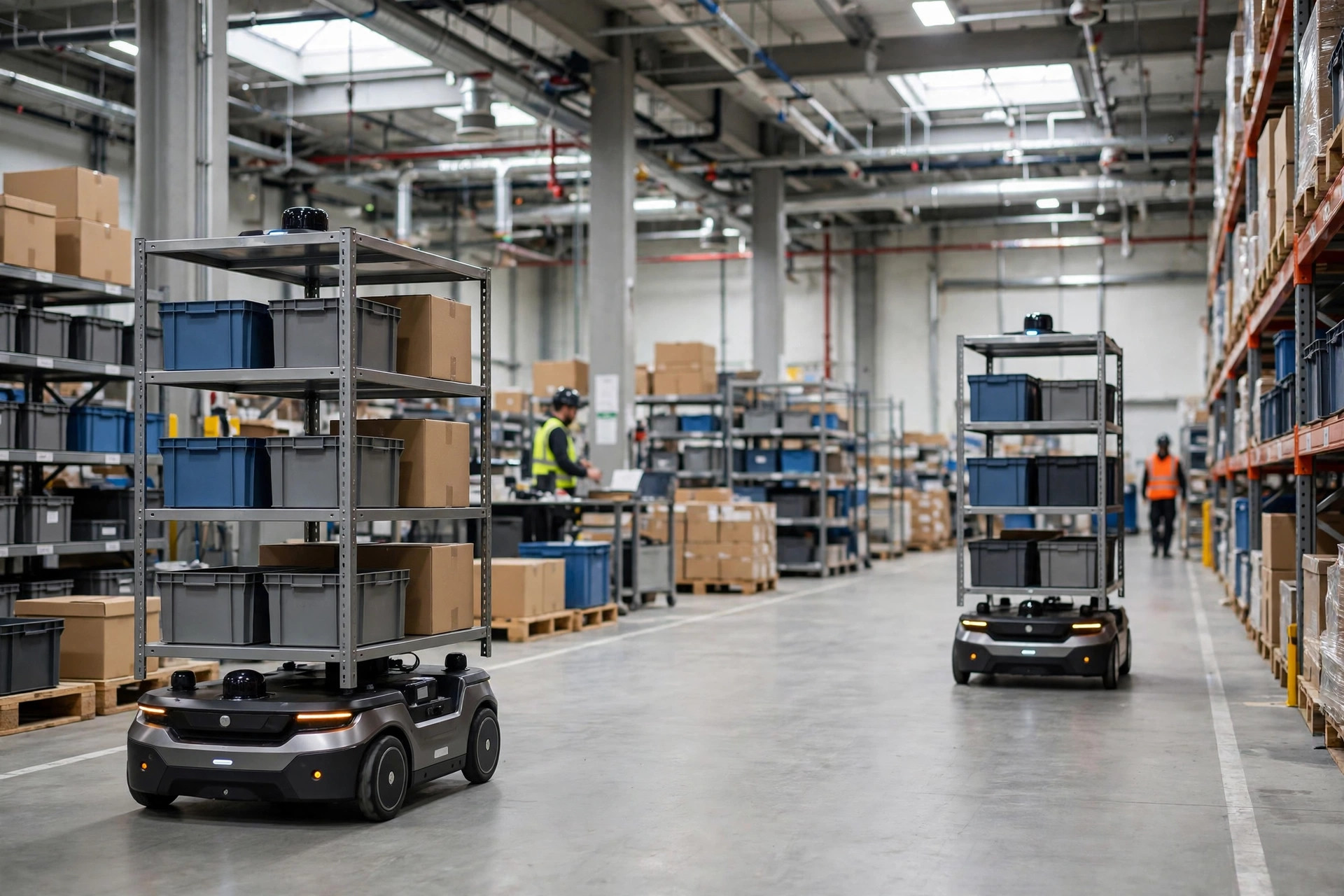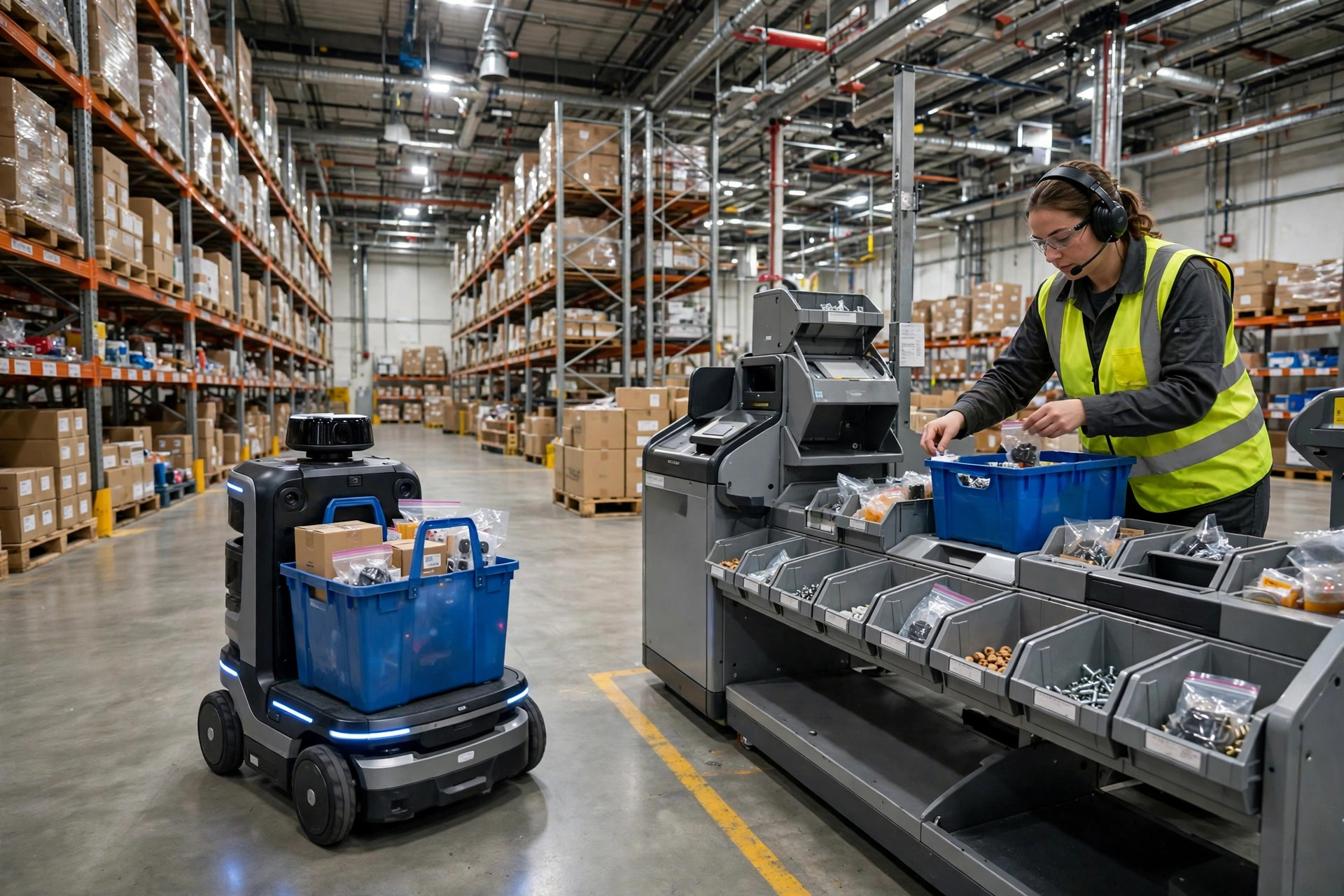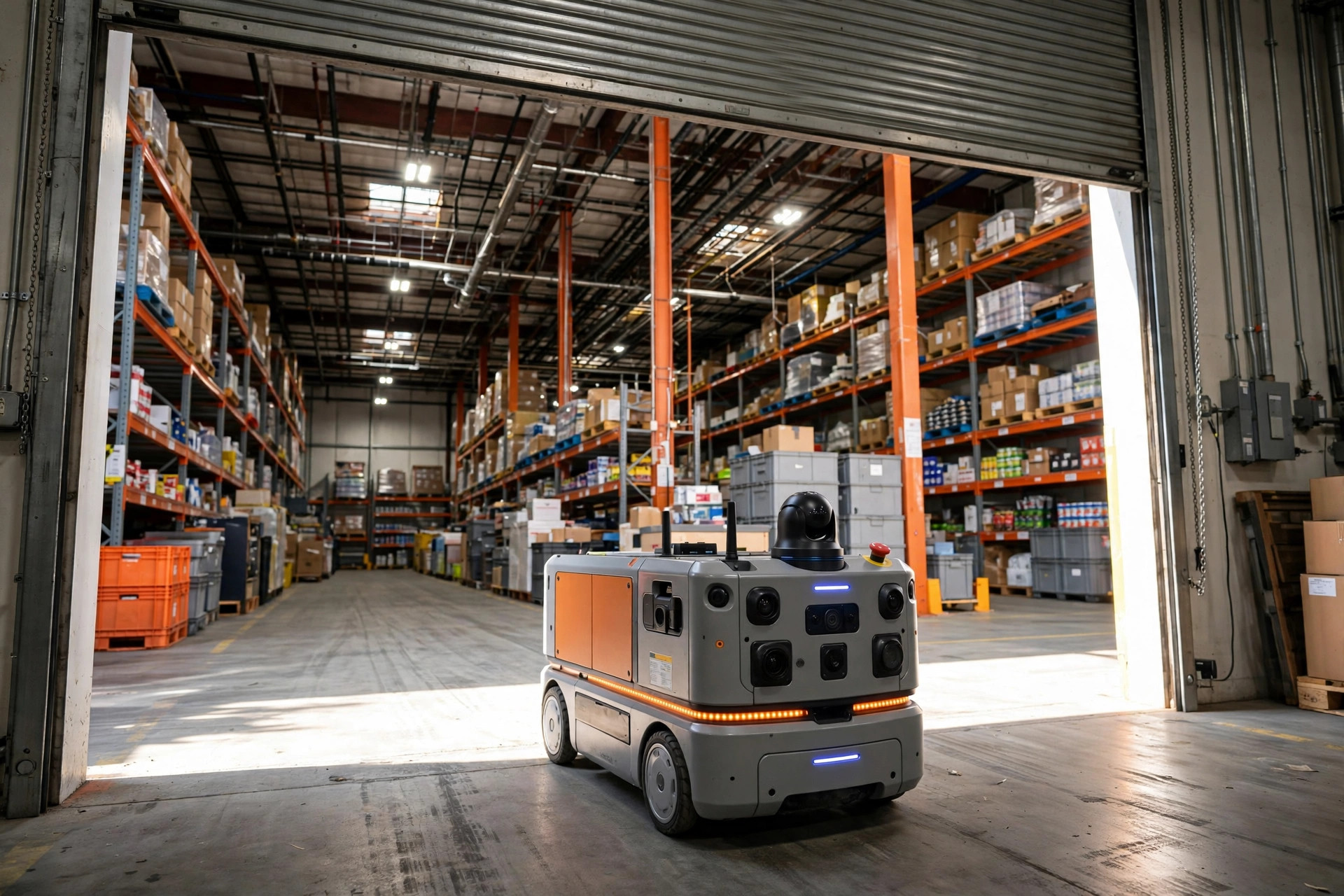
Open with the ledger. A New Jersey 3PL spent roughly $380,000 on 12 AMRs in 2024 to run a picking and replenishment loop across two fire compartments. The acceptance report said "40% automation uplift." Three months later I ran the numbers: those 12 robots were spending about 45 minutes a day waiting at doors—three fire-rated rolling shutters, each one needing a human to push the open button. The two shifts combined added up to roughly 0.4 full-time equivalents doing nothing but opening doors for robots. Fleet utilization fell from a designed 82% to 63%. Half the labor savings were eaten by a doorman.
Door and elevator integration exists for one reason: to let the AMR talk to the building itself. Here is where the money actually goes, and which parts of it are wasted.
1. The Cost Breakdown: Integration Is Four Line Items
| Cost item | Typical range (USD) | Notes |
|---|---|---|
| Dry-contact IO hardware | $800–$2,000 per door | Relay + fully-open limit switch + IO module |
| Safety interlock hardware | $500–$1,500 per door | Safety light curtain or anti-crush radar |
| Elevator robot-access module | $3,000–$8,000 per elevator | Usually a licensed module from the elevator OEM |
| Systems integration labor | $2,000–$5,000 per project | Includes commissioning and joint testing |
| Landlord/fire-authority approval + downtime | Varies | Process cost, almost always forgotten |
A single rolling shutter retrofitted with hardware runs about $1,500–$3,500. The moment an elevator is involved, that figure doubles. Note the last row: landlord approval, fire-alarm paperwork, and production losses during construction rarely appear in the project manager's budget—and they explain about 90% of overruns.
2. AMR × Rolling Doors: Dry-Contact IO vs. Protocol Integration
There are exactly two architectures. Option one: the AMR's onboard IO board drives a dry contact; the door controller opens on that signal; when the door reaches the top it trips a "fully open" limit switch that sends a signal back. The interlock logic is one sentence: if the door is not fully open, the robot does not move. Option two: protocol integration (Modbus, OPC UA), where the fleet manager and the door controller exchange messages. It looks more "digital."
| Dry-contact IO | Protocol integration | |
|---|---|---|
| Hardware cost per door | $1,500–$3,500 | $4,000–$8,000 (incl. gateway dev) |
| Commissioning time | 0.5–1 day per door | 3–7 days per door |
| Failure points | Relay + switch, field-replaceable | Protocol stack + network, OEM-dependent |
| Fire-alarm compatibility | Native (alarm cuts door power directly) | Custom linkage logic required |
Here is the counterintuitive verdict: protocol integration is the biggest waste in this budget. A door integration needs exactly two bits of information—"open" and "confirmed open." Sending that over a protocol is hiring a truck to deliver a letter. Dry-contact IO is not only less than half the cost; it also passes fire inspection the easy way, because the fire alarm panel can cut door-controller power and force the shutter closed. With protocol integration, that linkage has to be developed and tested separately—and every extra question from the fire marshal costs you two weeks. Given the choice, I always take dry contacts.
Safety interlocking needs two layers: the door's fully-open signal plus the robot's lidar confirming the doorway is clear. Both conditions must be true before the wheels turn. In the New Jersey project, the first build used a single signal; one day a limit switch fouled with dust reported a false positive, and an AMR drove straight into a half-open curtain—about $2,700 in repairs. Since then I put the second confirmation on every project: roughly $300 of radar logic that prevents one accident.
3. AMR Elevator Rides: Queueing Strategy Decides Throughput
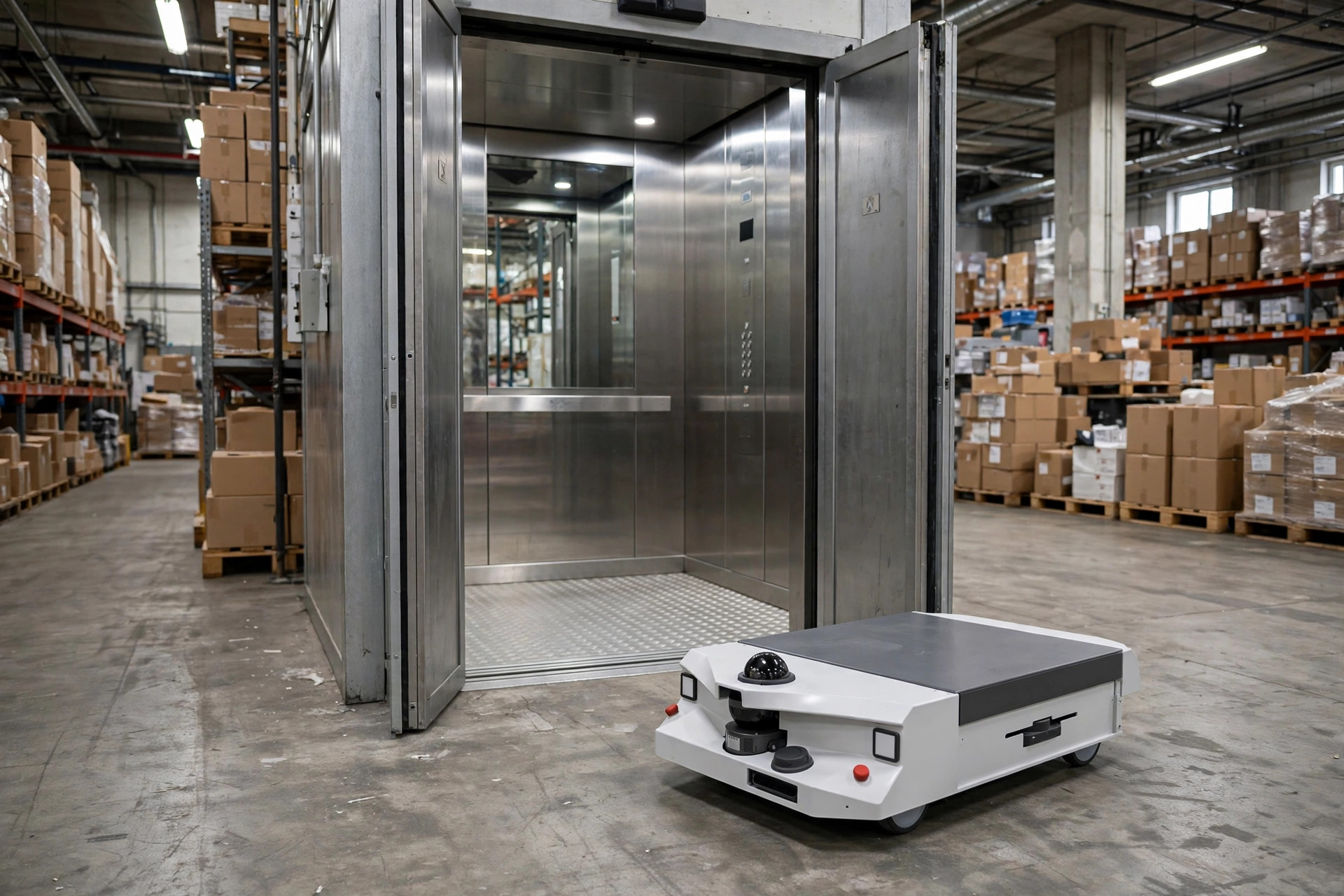
In 2023, an auto-parts distribution center in China ran 8 AMRs across two floors sharing a single freight elevator. The elevator OEM quoted its robot-access module at about ¥28,000 (roughly $3,900). The owner wanted to cut it. Before cutting, I asked him to look at this table—a measured single elevator cycle:
| Phase | Time |
|---|---|
| AMR calls elevator + response | 8–15 s |
| Door opens + AMR enters + door closes | 20–30 s |
| One-floor travel | 15–25 s |
| Door opens + AMR exits | 15–20 s |
| Total | ~60–90 s |
At 75 seconds a cycle, one elevator moves at most 48 robot-trips per hour. With 8 robots wanting cross-floor moves at the same time, a queue is guaranteed. This is where the real money goes: the queueing strategy.
Three strategies, three different bills:
- First-come-first-served. Simplest, but at peak hours low-priority tasks block high-priority ones—$3,900 of hardware buying you a "fair but inefficient" elevator.
- Priority + batching. The dispatcher groups 2–3 same-direction robots into one trip. Elevator utilization rises about 30%—the equivalent of getting 0.3 elevators for free.
- Off-peak scheduling. Push cross-floor replenishment into idle windows. Zero hardware cost, done with scheduling rules.
The DC went with options 2 and 3 combined: they bought the access module (unavoidable—without it the elevator won't even take your call), but batching and off-peak scheduling killed the idea of adding a second elevator, which would have started at $150,000 with shaft work. The real lever in elevator integration is the queueing algorithm, not hardware negotiation. That is where most people look the wrong way: everyone haggles 10% off the module quote while nobody prices the 30% throughput that queueing strategy is worth.
One fire-safety red line: on fire alarm, the elevator goes to recall mode, and AMRs must automatically leave the elevator queue and clear the elevator lobby. Write it into the acceptance criteria—the landlord and the fire authority will both check it. Paint a yellow no-parking zone in front of the elevator and keep waiting robots 1.5 meters back. A robot "waiting for the elevator" in a fire egress path buys you a fine and a correction notice on the same day.
4. The Compliance Gate: Landlords and Fire Authorities
Fire-rated rolling shutters are fire-protection equipment. Touch them only after clearing two gates:
- Written landlord/owner approval. Scope of work, construction hours, restoration liability—in writing. Many industrial parks restrict construction to 22:00–06:00, when labor rates run about 50% higher. Budget for it up front.
- Fire-authority filing/notification. After the linkage is modified, a fire signal must close the shutter unconditionally. At acceptance, the fire authority will test it live: simulate an alarm, and the door must be fully closed within about 60 seconds while every AMR clears the doorway.
My iron rule: start the compliance process at least 2 months early. Waiting until the equipment arrives to chase a landlord's stamp means 3–6 weeks of delay as standard, and every idle day of an AMR fleet is silent depreciation.
5. Three Levers That Actually Save Money
- IO wherever possible, never protocols. Save $2,500–$4,500 per door; across 10 doors that is $25,000–$45,000—the single biggest saving in this entire article.
- Do elevator queueing in software first. Batching plus off-peak scheduling costs nothing in hardware, lifts throughput ~30%, and can eliminate a $150,000-class second-elevator investment.
- Convert manual door-opening into dollars to force the business case. A high-traffic door opened manually 60 times a day at ~45 seconds each is 45 minutes a day. At roughly $22/hour for a US warehouse operator, that is about $6,000 per door per year. Three doors run ~$18,000 a year—against ~$10,000 total for an IO retrofit. Payback in 7 months. Put that number in front of the owner and the project approves itself.
The Calculable Conclusion
The go/no-go formula for door integration is one line:
Total integration cost < annual manual door-opening cost × 3 years → do it. Otherwise, defer.
Annual manual door-opening cost = daily openings per door × time per opening (hours) × operator hourly wage × 300 days.
With the numbers above, a high-traffic door breaks even in 7–10 months. Low-traffic doors (fewer than 15 openings a day) can wait—do the busy doors first. The elevator module at $3,000–$8,000 looks expensive, but it is a ticket, not a choice: without it, cross-floor dispatch is fiction. The queueing strategy is where the negotiation happens.
One last line: when AMR projects overrun, 70% of the overrun is not in the robots—it is in the handshake between the robot and the building. Doors, elevators, fire systems: those belong to the building, not the robot vendor. They never appear on the vendor's quote. They must appear on your ledger.
By Lao Zhou, Logistics Cost Analyst