Last fall I walked into an e-commerce warehouse in Ohio for an acceptance test. Twenty-eight AMRs on the floor, a claimed utilization rate of 82%, and six robots sitting in a queue outside the charging area, waiting for a free charger. The fleet supervisor told me they lost more than two hours of capacity a day during peak season, just waiting for power. The robots were fine. The scheduler was fine. The AMR charging strategy they had picked on day one was the problem, and nobody had ever run the numbers on it.
Think of it this way: a charging strategy is the refueling rule for your fleet. Battery swap is like a pit stop — a depleted pack comes out, a full one goes in, and the robot is back to work in minutes. Automatic charging is like a phone on a wireless pad — the robot drives itself to a charger, tops up when it has a spare moment, and goes back to work without anyone touching it. Both approaches work. The question is which one matches the way your warehouse actually runs.
How AMR Charging Gets Power Into the Robot
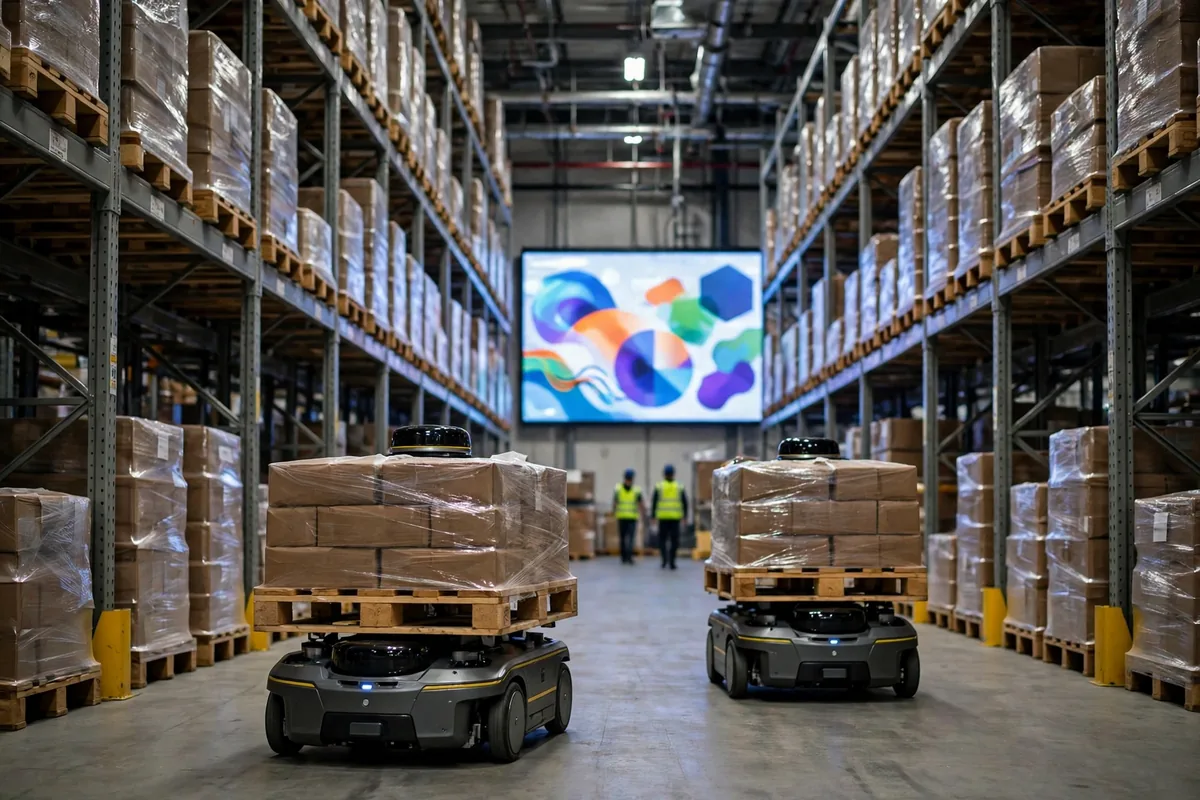
With battery swap, the battery is a self-contained pack that comes out of the robot as one unit. The robot drives into a swap station, a mechanism or a technician pulls the depleted pack out and slots a full one in, and the whole exchange usually takes three to five minutes. The depleted packs charge slowly in the background, waiting for the next robot. The robots and the batteries are two separate pools of assets, and you can own more batteries than robots.
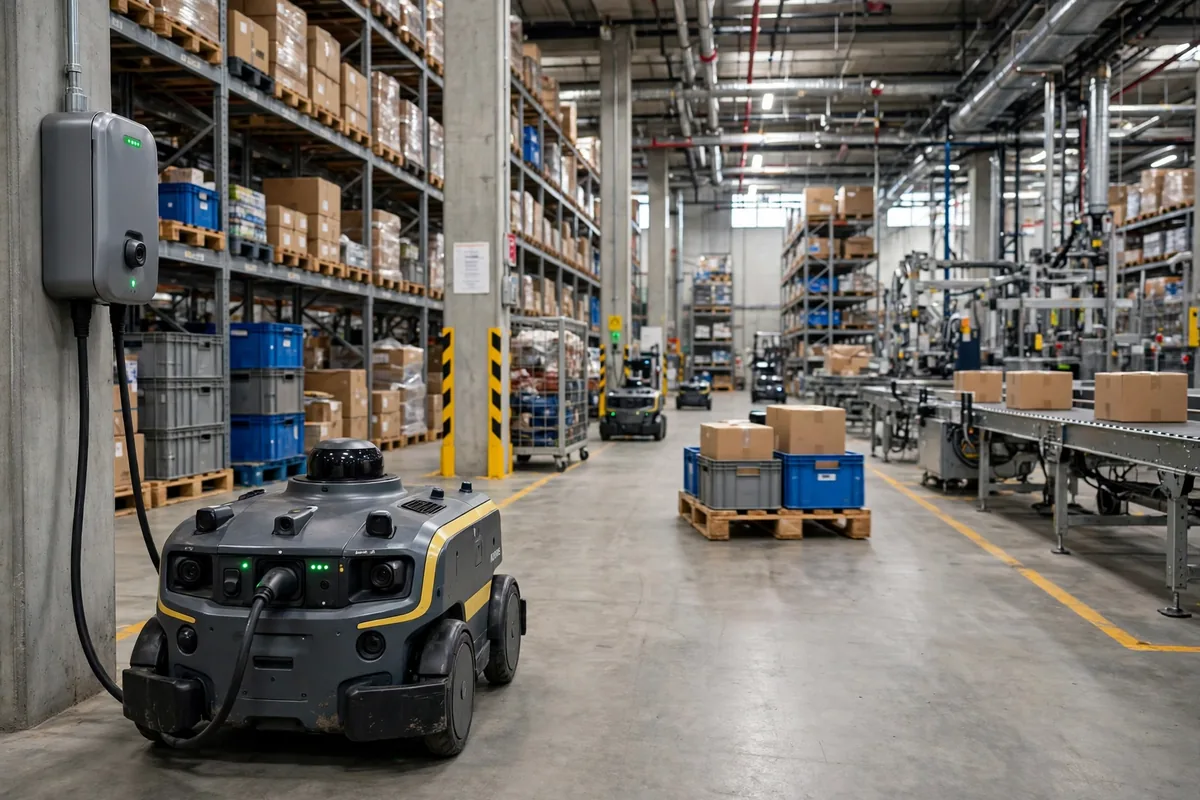
Automatic charging comes in two flavors. Opportunity charging lets the robot drive to a charger during gaps between tasks, sit for fifteen to thirty minutes, and grab enough charge to keep going. Overnight slow charging runs the fleet during the day and fills every battery up while the building is quiet. Neither needs a human to touch a battery.
The Ohio Warehouse: Twenty-Eight Robots Queuing for Power
Let me go back to that Ohio site. Twenty-eight robots, two shifts, twenty hours of operation a day. The original design had six automatic chargers and opportunity charging. On paper it was enough. In practice, every afternoon around three o'clock, the order wave peaked and a dozen robots dropped below 30% charge at the same time, all heading for the charging area at once. Six chargers, a queue of six robots, and a forty-minute wait. One unlucky robot hit its low-battery protection threshold and stopped dead in the middle of an aisle, waiting for someone to push it back.
We measured for a week. The fleet lost an average of 52 minutes per robot per day to charging waits, and the worst robot lost an hour and forty minutes in a single day. When peak-season volume rose, the waiting time rose with it. There were two fixes on the table: add chargers, or switch to battery swap.
Adding chargers was simple arithmetic. Each charger with installation cost a little over ten thousand dollars, so four more meant more than forty thousand, plus electrical work. Battery swap was a different bill: a swap station plus spare batteries cost considerably more up front, but the robots would never wait, because batteries rotate through the station in the background while the fleet keeps running. Utilization could climb back above 90%.
The customer picked a hybrid. They kept automatic charging, added two chargers, and gave battery swap to the eight robots running the highest-frequency waves. Three months later we measured again: average daily charging wait had fallen to nine minutes. What I took away from that job is that the choice is rarely either-or. Plenty of warehouses end up running both.
Now the opposite case. Early in 2025, a 3PL warehouse in California ran twelve AMRs on a single ten-hour shift, with nobody in the building overnight. The sales team had proposed battery swap, and the swap station plus six spare batteries made up nearly a fifth of the total quote. I walked the floor, looked at the operation, and told the customer the money was wasted. Twelve robots, ten hours a day, fourteen quiet hours overnight — more than enough to slow-charge the whole fleet. They ended up with four chargers, overnight slow charging, and almost no daytime charging at all. The money they saved paid for an extra robot.
Put those two warehouses side by side and the dividing line is obvious. A small fleet, short shifts, and empty nights point to automatic charging. A large fleet, two or three shifts, and sharp peaks point to battery swap.
Three Lines That Decide Your AMR Charging Strategy
The first line is fleet size and shifts. My rule of thumb from the field runs like this: under fifteen robots on a single shift, automatic charging is usually enough. Above twenty robots on two shifts, start seriously considering swap. Above thirty robots running around the clock, swap is close to mandatory. That is not a standard, it is a line I have measured on real floors. If your peaks are especially sharp, the line moves earlier.
The second line is task continuity. In a warehouse where picking waves run back to back with no natural gaps, opportunity charging cannot keep up, and robots run until the low-battery alarm forces them to stop. In a warehouse with a natural rhythm — inbound in the morning, outbound in the afternoon, a quiet half hour in between — automatic charging uses those gaps and barely costs any capacity.
The third line is floor space and labor. Battery swap needs a dedicated station, plus someone to manage the batteries or an automated swap machine. A tight warehouse may not have room for the station without blocking a travel lane. Automatic charging only needs a few charger positions along a wall. Labor matters too: if swap depends on a person changing packs by hand, it stalls on a night shift with nobody around.
| Factor | Battery Swap | Automatic Charging |
|---|---|---|
| Time per top-up | 3–5 minutes | 15–30 minutes (opportunity) or overnight slow charge |
| Effect on uptime | Almost no downtime | Queuing possible during peaks |
| Upfront cost | High, station plus spare batteries | Low, a few chargers |
| Labor needed | Battery handling or an automated swap unit | Almost none |
| Best fit | 20+ robots, two shifts or more | Under 15 robots, single shift |
The maintenance traps hide behind the battery. Most buyers price the equipment and forget the cost of keeping batteries alive. In a swap setup, batteries are consumables. After enough charge cycles, capacity fades, range shrinks, and robots come back early with low-battery warnings. I have seen a warehouse run swap for six months, watch utilization slide again, and find two spare batteries already down below 70% of their rated capacity, still in rotation.
Automatic charging has its own trap. Opportunity charging is hard on batteries: frequent shallow charge cycles wear a pack out faster than a full overnight slow charge. Charger docking contacts are consumables too. A robot docks dozens of times a day, the contacts wear, the connection gets flaky, and the system thinks the robot is charging when it is not. The robot drives off and discovers the charge never happened.
The easiest trap to miss is winter. Lithium batteries charge more slowly and lose range in cold conditions. Some warehouses lose more than a tenth of their fleet range in the coldest month. Size the system using your coldest month, not your mildest.
Here is the counterintuitive part: a bigger battery is not always better. Some customers ask for the largest pack available, assuming longer range means fewer headaches. In practice the bigger pack is heavier, the robot burns more energy carrying it, and handling efficiency drops. Enough range for one shift plus a margin is plenty. The extra capacity is dead weight.
Whether the Money Is Worth It Comes Down to One Number
Here is the check I run on site. Measure for one week and calculate one number: the fleet's total daily capacity lost to charging, divided by the fleet's total daily operating time. If the ratio is above 5%, the charging strategy needs attention. Above 10%, stop debating — add chargers, switch to swap, or both.
The Ohio warehouse measured 8.7% before the change and 1.5% after. The California warehouse with twelve robots measured 0.8% all along, which is why the swap investment would have been money thrown away.
There is no standard answer for AMR charging strategy, only the answer that fits your shifts, your peaks, and your floor. Before you sign the contract, run one week of real operating data through that single number, and then decide where the money goes.
By Da Liu, Automation Engineer