At 3:30 a.m., the night supervisor called me about allergen segregation on a line change. Client A's peanut line had just come down, and Client B's oat line was supposed to go up with only an hour of changeover in between. The crew stood between the two lines asking how far the cleaning had to go. I told them to stop the line. Do not rush it. Output pushed out at night can turn into returns and complaints by morning, and a supervisor has to carry that line in his head.
A shared warehouse is not a single-brand plant, where one product family runs all day. A shared warehouse switches clients several times a day, and the last client's residue becomes the next client's risk. The crew is not lazy. The schedule squeezes changeover time until there is nothing left. Day shift finishes late, and night shift's cleaning window gets eaten alive. A supervisor sees trucks waiting and wants to rinse the belt and start running. That moment is the test of whoever runs the floor: do you dare to stop a whole line for cleaning.
A few peak seasons back, I watched this play out in a California warehouse serving several food brands. The site handled nut products and bakery products side by side, and at peak it changed over several times a day. One night, the outgoing product contained peanut, and the incoming line was a bakery product sold as peanut-free. The crew rinsed the visible belt surface but never broke down the corners, and crumbs stayed in the dead spots. The next day the client ran its own check, found residue, and sealed the whole batch. The client then paused orders for the rest of that month. Let me be straight with you: what we lost was not that batch. It was the client's trust, and crew morale sank with it.
Another case hurt more because it felt unfair. Last autumn, a third-party warehouse in New Jersey took on a new client whose ingredient sheet never mentioned sesame, and the contract said nothing about it either. The crew cleaned to the old checklist, so the sesame paste tanks and pipes never entered the cleaning scope. A downstream customer complained, and the trail led back to the undisclosed ingredient. The warehouse crew felt wronged, and in a sense they were. But goods leave from your building, so when something goes wrong, you are the first one asked. That is the deal in shared warehousing.
Allergen segregation fails not on dirt, but on the last client's residue
Many people think this work is just about keeping the warehouse clean. It is not. A floor can shine while conveyor seams, hopper corners, and filler heads still hold residue, and that counts as nothing done. The shared-warehouse problem is switching: the same line and the same equipment serve one client in the morning and another in the afternoon. Residue does not label itself. It hides wherever a part cannot be taken apart.
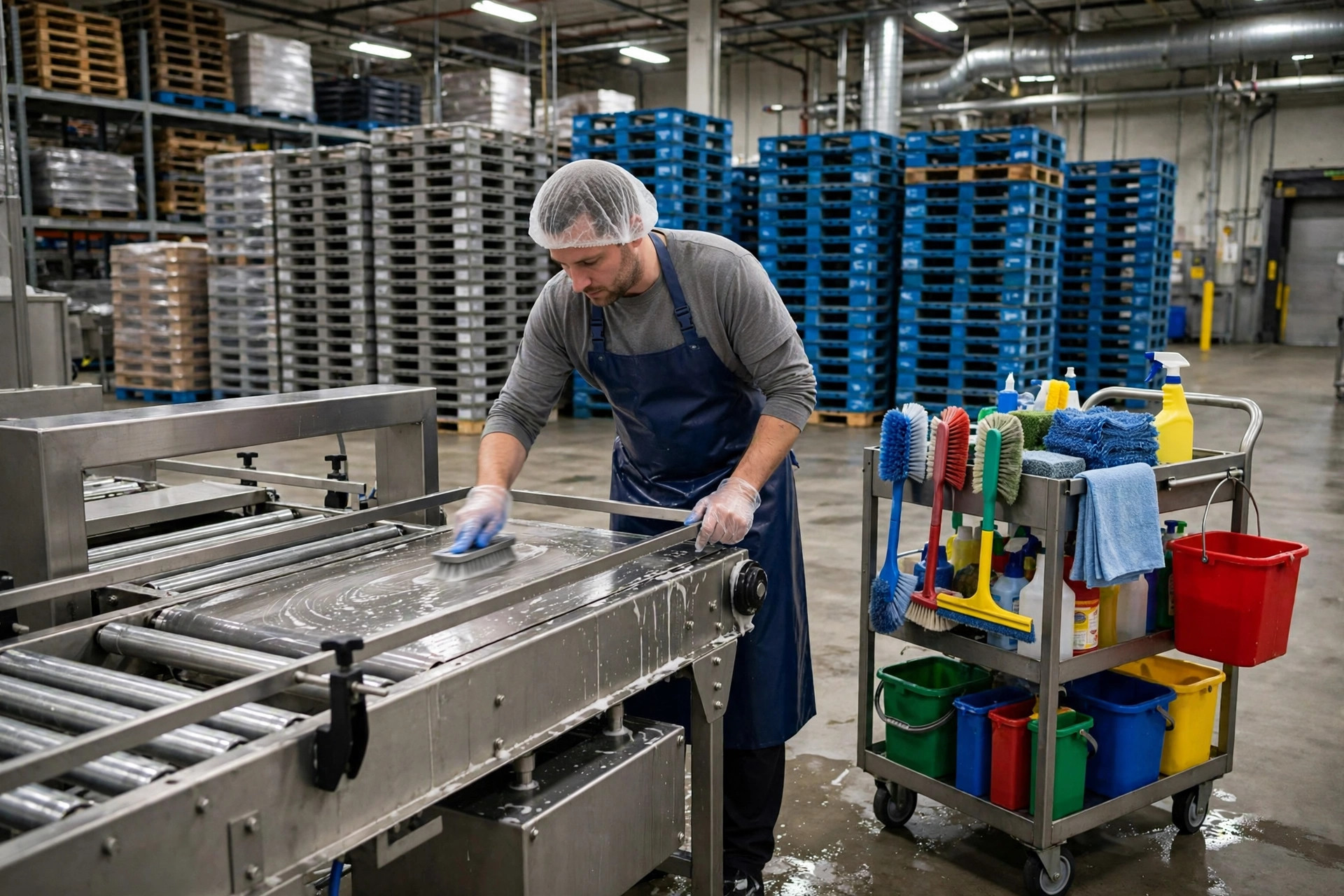
I later set one hard rule for my crews: changeover cleaning means strip first, then wash. If it was not stripped, it was not washed. Every part that can come off comes off. Parts that cannot come off get photographed and signed off by the supervisor before the line restarts. It sounds slow, and it saves time. One rework, one sealed batch, costs far more than an extra half shift of cleaning. A supervisor's scorecard has to count first-pass changeover success next to output. Count output alone, and crews will cut corners every time.
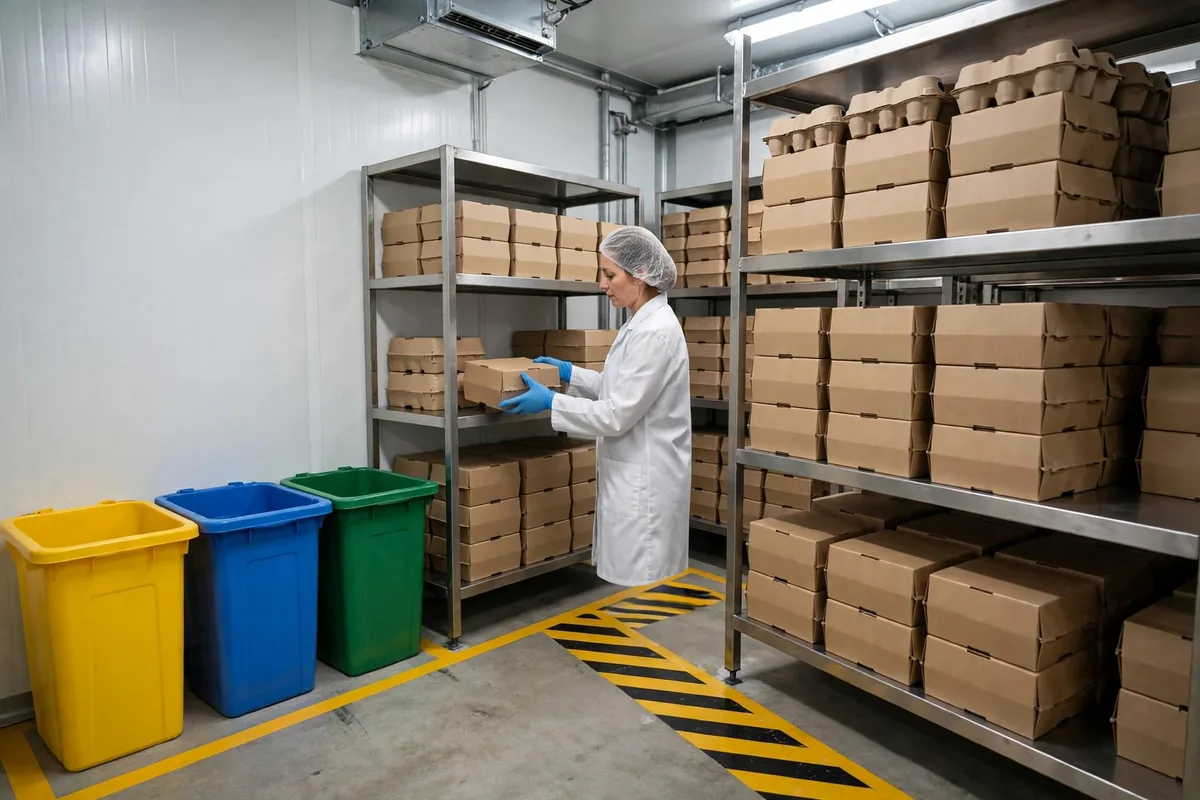
Tools need separation too. Lines at different allergen levels get their own scoops, brushes, and cloths, color-coded and hung on separate racks, returned to their own spot after use. Shared tools are the easiest way to cross over: one brush used on a peanut line and then on an oat line undoes everything before it. Color management looks crude, but at 3 a.m., when a worker can barely keep his eyes open, color beats written labels. New hires learn the colors on day one, and nobody works a line alone until they can name them all.
The allergen segregation changeover checklist: people first, equipment second
Managing people is harder than managing equipment. Changeover time has to sit on the roster as its own block, not squeezed inside production time. My current practice is this: the changeover crew arrives early, and handover covers exactly three things — what allergen the last client ran, what the incoming client cannot tolerate, and which spot holds residue most easily. Then the worker repeats it back. If the repeat is wrong, we say it again. Do not call that nagging. Most night-shift trouble traces back to a handover where those few minutes were skipped.
Cleaning order matters as well. Start with the hardest spot while the crew is freshest, and do the dirtiest work with the most energy. After washing, inspect by eye, then shine a flashlight into the seams, then let the supervisor spot-check. Spot-checking is not a walk-through. The supervisor names a random part and checks that part. Crews work differently when they know the check is real. Then comes a signature, and the person who signs owns that line. When responsibility lands on a named person, cleaning quality holds steady.
I wrote up the general approach before — see allergen segregation basics — and this piece covers only the extra trouble a shared site adds. The general approach answers how one warehouse does the job. A shared warehouse has to answer one more question: how do you cut cleanly between clients, and who owns the gap. Put the cleaning standard, the verification method, and the mis-declaration liability in the contract. A verbal promise counts for nothing on the day something goes wrong.
| Changeover method | When it fits | Risk | Cost |
|---|---|---|---|
| Surface rinse | Same client, same product family, continuous run | Residue hides in dead spots; the next client's check may fail | Fastest, but only for conflict-free switches |
| Dry clean plus visual check | Clients at similar allergen levels | Seams and inner walls may still hold residue | Medium time, needs supervisor spot-check and sign-off |
| Full strip-down plus verification | Clients at different allergen levels | Lowest, but still depends on how thoroughly parts were stripped | Slowest, needs its own changeover shift |
I pin that table on the changeover room wall. A new supervisor reads it and understands at once: the fast method is not forbidden, it is only for switches with no conflict. Once two clients conflict on allergens, only the slowest tier applies. If you want to save time, fix the schedule instead: group similar clients together and cut the number of conflict switches. When the scheduler does not understand allergens, the crew spends every night cleaning up after the schedule.
When a client mis-declares: seal first, argue later
Mis-declaration has a fixed order, and the order matters. The moment you suspect it, seal the affected batches and stop shipping. Do not let goods keep moving out. Next, keep samples and photographs to fix the scene as it stood. Only then sit down with the client and work through the declaration clause in the contract. Get the order wrong, and chasing shipped goods is a losing game. A shift lead has to remember: sealing stock is not an insult to the client. It protects the client, and it protects you.
For every new client, I now insist on one step before onboarding: check the ingredient sheet against the real product, and open one batch to look at it. If the sheet and the product do not match, onboarding waits. Sales sometimes pushes back and says the client is waiting to launch. I have pushed back a few times, and sales learned to ask for the full ingredient list before signing. One extra question at the source beats sealing a whole warehouse after the fact.
Here is the counter-intuitive part, and it may sound wrong at first: the cheapest control in a shared warehouse is turning away one conflicting client. Take on two clients whose allergens fully conflict when your cleaning verification cannot truly handle it, and you earn one month of storage fees while risking the reputation of the whole site. Turn away one unsuitable client, and the crew skips several overnight shifts while the supervisor skips several 3 a.m. phone calls. Count that over the long run, not over one month's intake numbers.
Before the next changeover, a supervisor should answer three questions: what did the last client run, has this line been stripped open, and is the signer present on the floor. If all three have answers, start the line. If any one does not, let the truck wait. A truck waiting is a cost. A recall is a disaster.
By Chen Feng, Warehouse Operations Manager