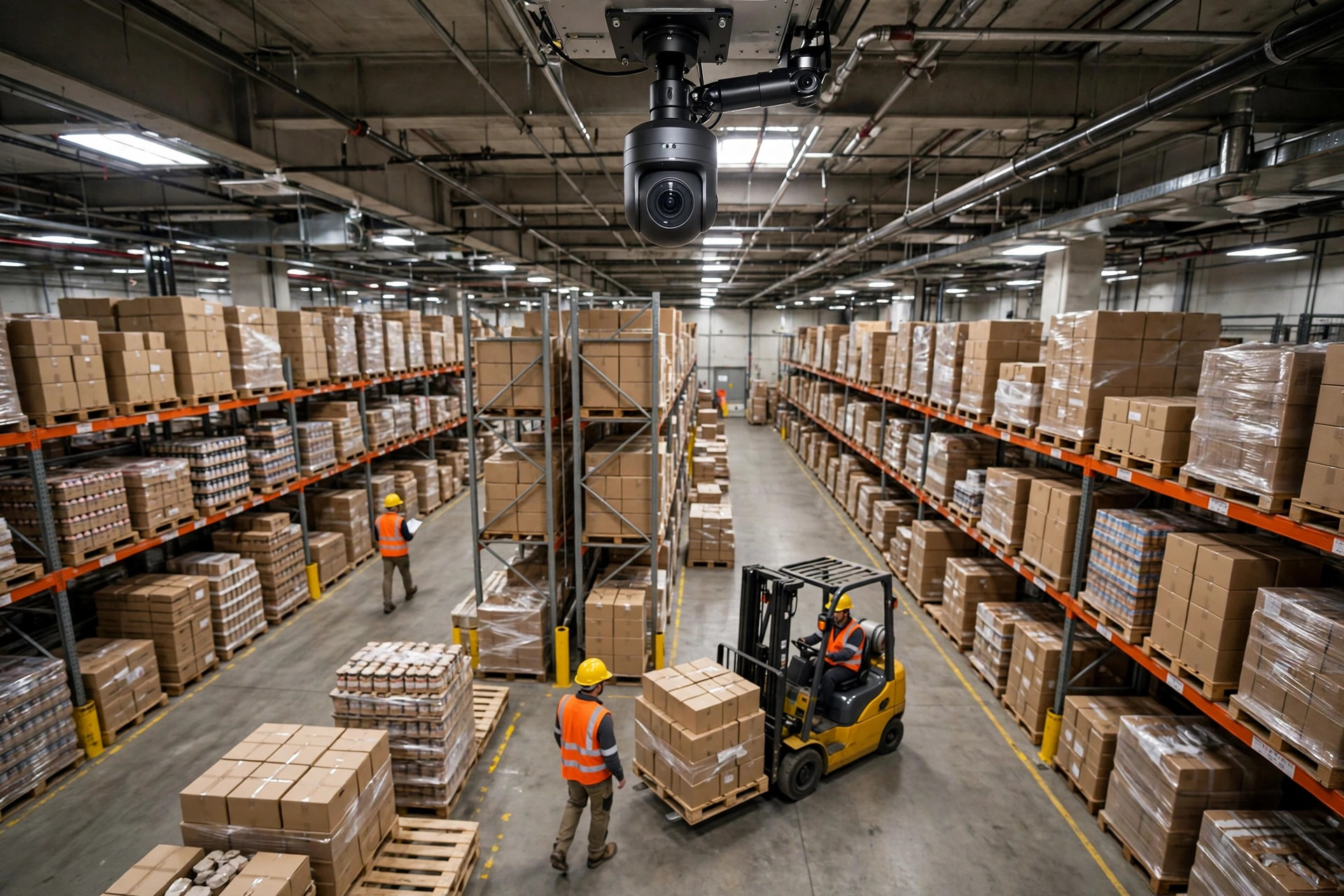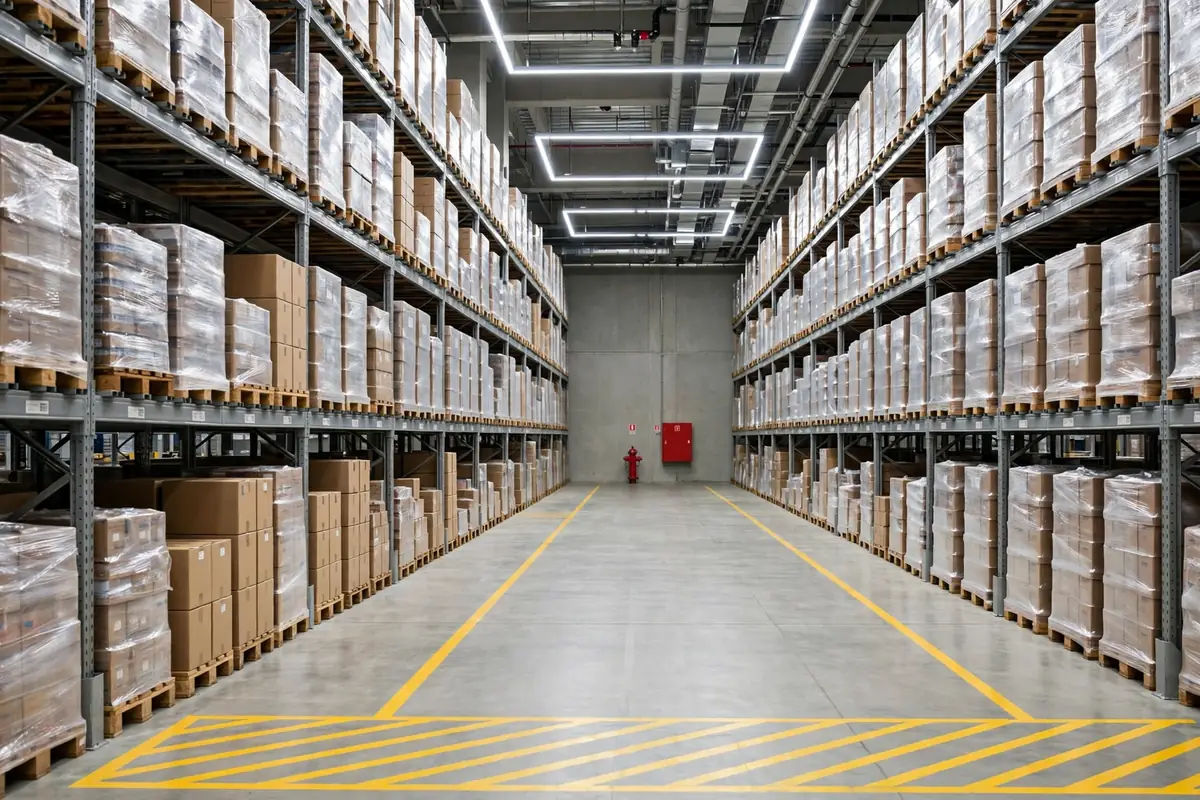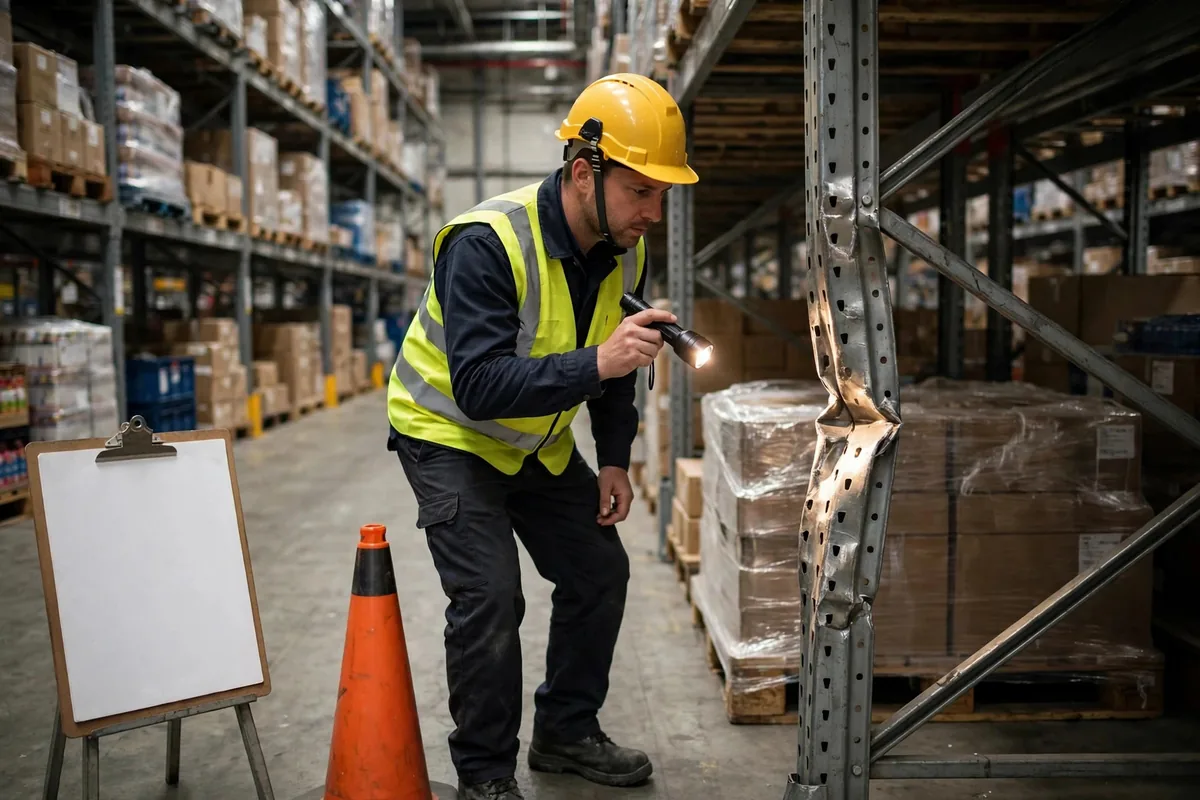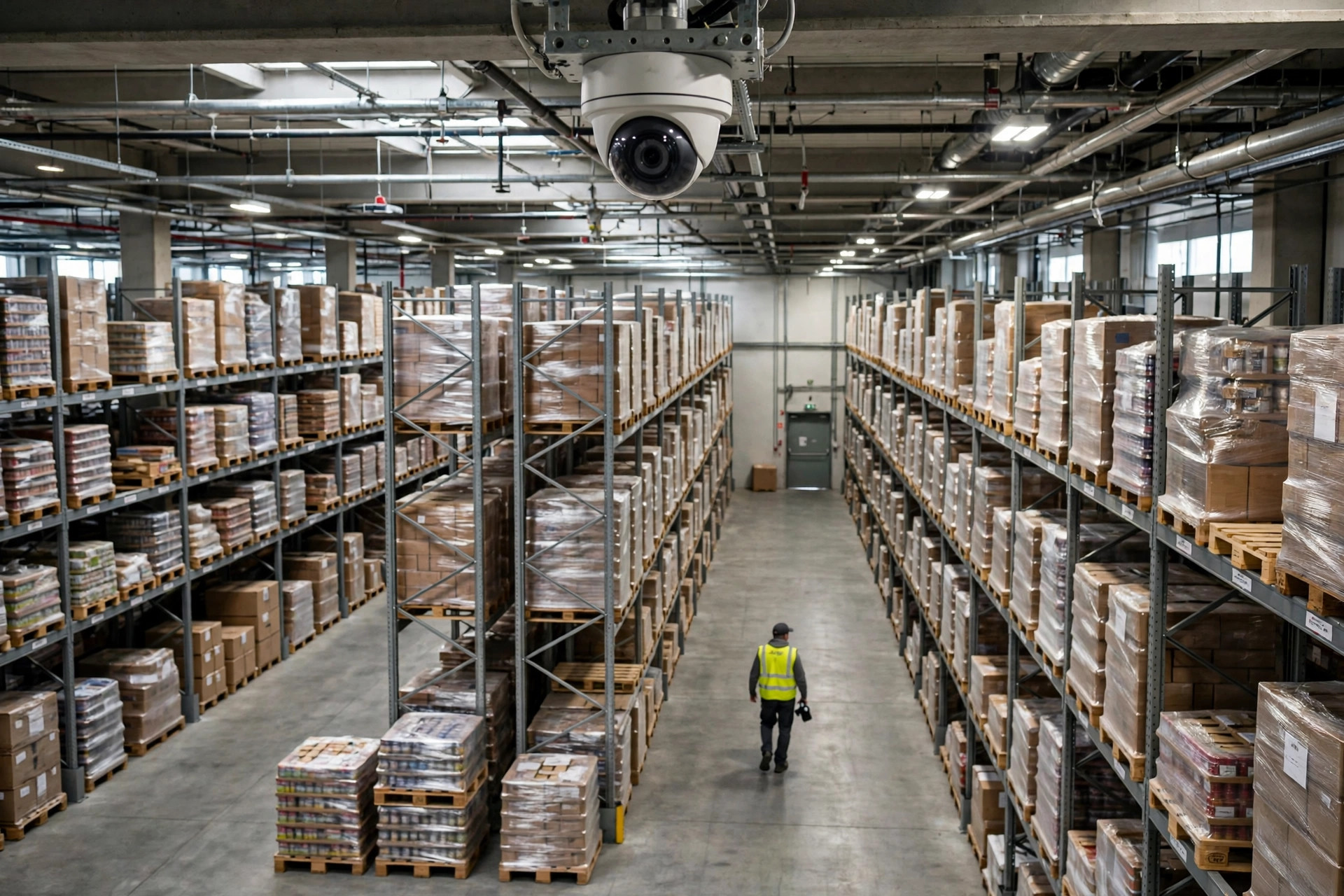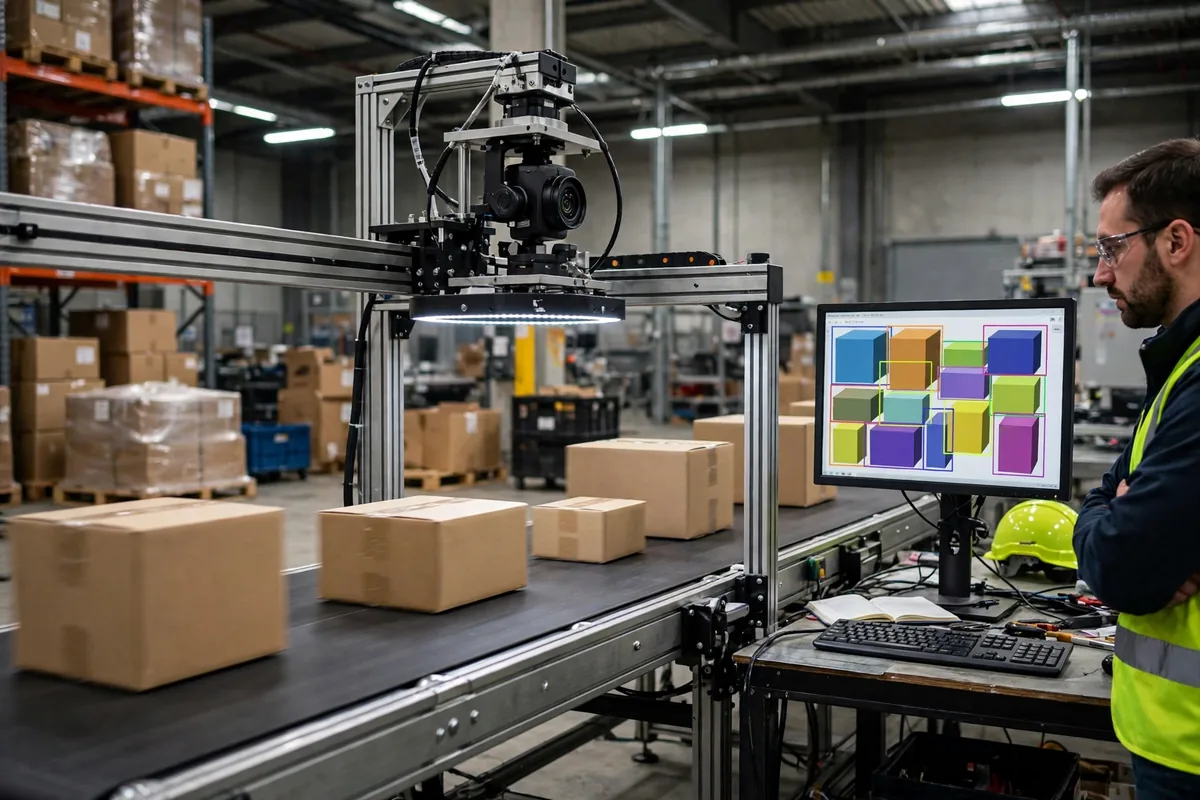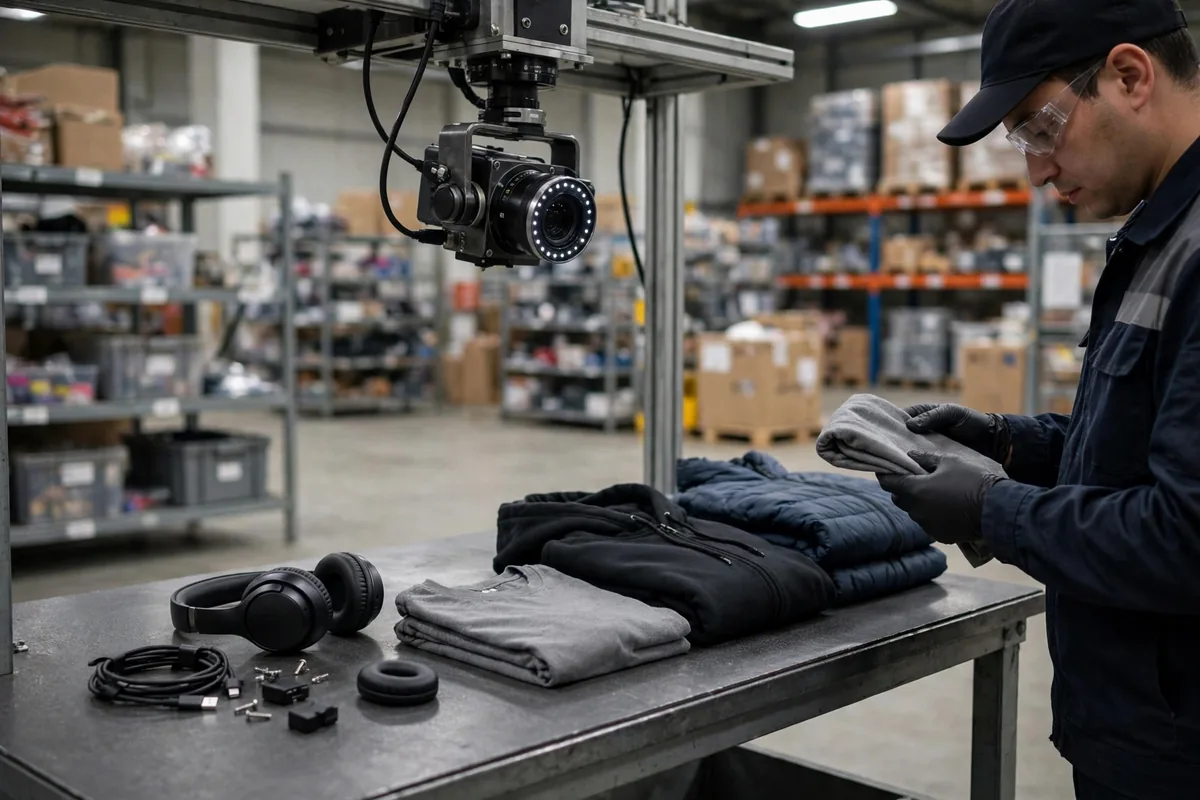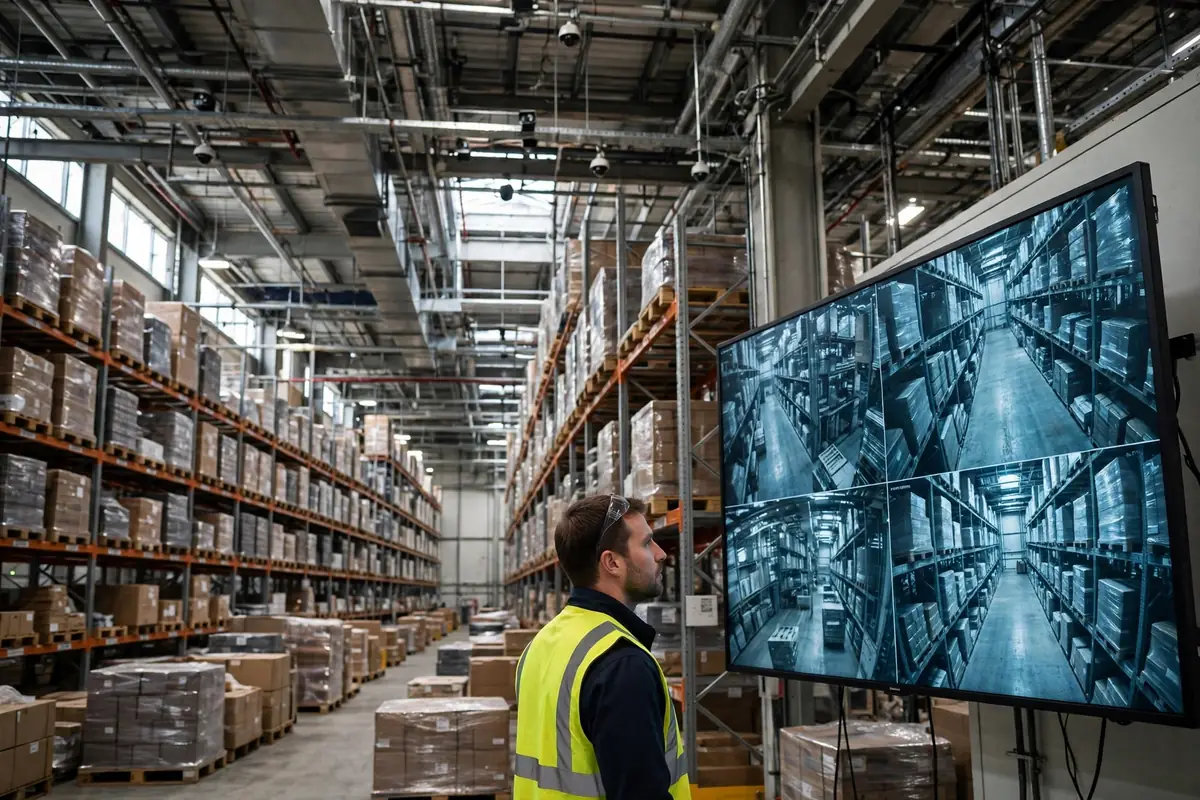
Two autumns ago, I visited a third-party warehouse in eastern China. The site manager pointed at a high-bay rack and told me the upright at its base had a slight bend — a night-shift forklift had clipped it three months earlier, and nobody had reported it. That is where the conversation about AI warehouse camera inspection really starts: racks do not collapse overnight. They bend, tilt, and loosen for a long time before they fall. The problem is that the patrol never walked past, never noticed, or noticed and decided it was not worth mentioning.
Publicly reported industry incident records point to a pattern: in a meaningful share of rack-collapse cases, there were observable warning signs beforehand — a bent upright, a dislodged beam connector, a badly leaning pallet, water pooling on the floor. These signs share one feature: they are visible. And if something is visible, in principle a camera can watch for it. The real questions are whether the camera watches accurately, who takes responsibility after it flags something, and whether the investment is worth it.
What AI Warehouse Camera Inspection Actually Watches
Let me set the boundary first. What AI warehouse camera inspection can reliably do today clusters around five kinds of visual signals.
The first is rack deformation. Algorithms compare the outlines of uprights and beams; a bent upright beyond a set threshold, a fallen beam connector, or a sagging deck gets flagged. The advantage is not that the camera sees better than a person, but that it sees every time. A human patrol might come once a week; a camera can sweep every hour. The gap between a deformation appearing and being noticed shrinks from days to hours.
The second is blocked aisles. Main aisles, fire lanes, and emergency exits temporarily occupied by pallets, empty cartons, or goods awaiting processing are the most common — and most easily rationalized — violations in a warehouse. Cameras judge occupancy against marked floor zones and raise an alert when the occupation exceeds a set duration. The earlier these are caught, the cheaper the fix; waiting until a fire inspection to clear them changes the cost entirely.
The third is leaning pallets and overloaded bays. Pallets sticking out past the rack edge, goods stacked above the beam height, heavy cartons sitting on light ones — these are the preconditions of a collapse. Vision models are relatively sensitive to geometric anomalies of this kind, and their false-alarm rate here is lower than for semantic judgments.
The fourth is water and liquid on the floor. In cold storage, chemical warehouses, and receiving docks during the rainy season, pooled water is both a slip risk and a product-damage risk. Cameras detect it through floor-reflection features. Sensitivity is modest, but the system is online around the clock.
The fifth is people and equipment crossing boundaries — a worker entering a high-bay forklift zone, a pedestrian walking into a vehicle lane. Technically mature, but the most contested in practice, because it touches directly on how employees feel about being watched. More on that below.
AI Warehouse Camera Inspection: Getting Past the False-Alarm Problem
Any discussion of AI warehouse camera inspection that skips false alarms is avoiding the core issue. My view is that false alarms are not a technical defect; they are tuition this kind of system must pay. The question is who pays it, and for how long.
I have followed an e-commerce warehouse in northern China that, in its first month after going live with vision inspection, received more than 40 alerts a day, of which fewer than 5 genuinely needed action. The rest were light changes, forklifts parked briefly, shadows cast by pallets. The site manager put it bluntly: if this keeps up, the shift leads will stop looking at the alerts altogether. That sentence captures the real cost of false alarms — not the few minutes spent verifying each one, but the moment the alerts themselves lose credibility.
The industry has converged on several workable responses. First, tier the alerts: a bent rack upright is a first-tier alarm that must be handled the same day; a 10-minute temporary aisle occupation is a third-tier note, logged but not pushed. Second, add a verification step: alerts go to a control-room operator who glances at the snapshot before deciding whether to dispatch someone, rather than going straight to the floor supervisor. Third, budget at least a month for tuning: thresholds, sensitivity, and detection zones must be recalibrated for the site's own lighting, traffic flow, and product mix. The vendor's factory defaults are only a starting point.
Here is the counterintuitive part: when the false-alarm rate will not come down, the problem is often not the algorithm but the warehouse itself. In a site where aisles are blocked every day and pallets are always leaning, even accurate alerts look like false alarms — because they are reporting violations everyone has grown used to. In that sense, AI warehouse camera inspection acts as a mirror: it quantifies, one item at a time, the non-compliance the warehouse had learned to live with.
Does the Math Work?
Before talking ROI, one premise needs stating: much of the benefit of inspection is measured in things that did not happen — a rack that did not fall, a fire lane that was not blocked, a worker who did not slip. Those benefits never appear in a report, which is also why the site manager sleeps at night. So this calculation can only be done in terms of avoided loss, and avoided loss is inherently hypothetical.
The figures below are a hypothetical worked example, offered only to show the method — they do not represent the cost level of any real warehouse. Take a high-bay facility of roughly 20,000 square meters. Assume 60 inspection cameras plus a vision-analysis platform, with a one-time hardware and implementation cost of about 400,000 yuan, and annual maintenance and model tuning of about 80,000 yuan. Suppose manual inspection previously required two full-time patrol staff at 120,000 yuan per person per year, and after the system goes live, staffing drops to one part-time reviewer at about 60,000 yuan a year. Under these assumptions, the first-year outlay is roughly 480,000 yuan, then about 140,000 yuan a year; the labor saving is about 180,000 yuan a year. On labor savings alone, the payback period runs past two years. Not an exciting number.
But labor is not the whole account. The calculation only starts to work when three kinds of avoided loss are included. The first is a rack-collapse incident: a mid-size collapse — product damage, rack rebuild, downtime — runs on the order of 1,000,000 yuan in this hypothetical example. Avoiding even one in five years covers the entire investment. The second is fire and compliance penalties: fines and shutdown orders for blocked exits vary by jurisdiction, so check local regulations for actual figures. The third is insurance: some insurers have begun offering premium discounts to warehouses with vision inspection installed — confirm the actual quote with your insurer.
My conclusion is therefore layered. Judged purely on labor savings, the ROI of AI warehouse camera inspection is not compelling. But once risk cost enters the calculation, it deserves serious evaluation for warehouses with tall racks, mixed SKUs, and heavy forklift traffic. For a low-rack, simple-flow small warehouse, it is most likely over-investment. The decision can be reduced to three questions: how tall are your racks, how easily do your aisles get blocked, and has your warehouse had any "almost an accident" moments in the past three years? If two of the three answers are yes, then talk procurement. Otherwise, make the human patrol checklist solid first — it may deliver more.
Finally, what AI cannot do. A camera cannot see a cracked weld inside a rack, cannot tell whether a bolt has worked half a turn loose, cannot judge metal fatigue in a beam connector. It cannot decide whether a pallet was stacked sensibly, only whether it is leaning. And it cannot handle the checks that require a person on the spot to smell, touch, and ask: the faint odor of a chemical leak, the burnt smell of an overheating motor, a worker mentioning in passing that a column "made a noise twice this week." None of that is within a vision model's range.
The sensible place for AI warehouse camera inspection is to give human patrols a pair of eyes that never tires — not to replace the patrol. Cameras handle the high-frequency, repetitive, visible checks; people handle the low-frequency, judgment-based checks that require being there in person. When the division of labor is clear, the system earns its keep. Expect the camera to do everything, and you end up with a pile of alerts nobody reads.
In your warehouse, who is doing that work today — and what is being missed?
By Dr. Chen, Supply Chain Researcher