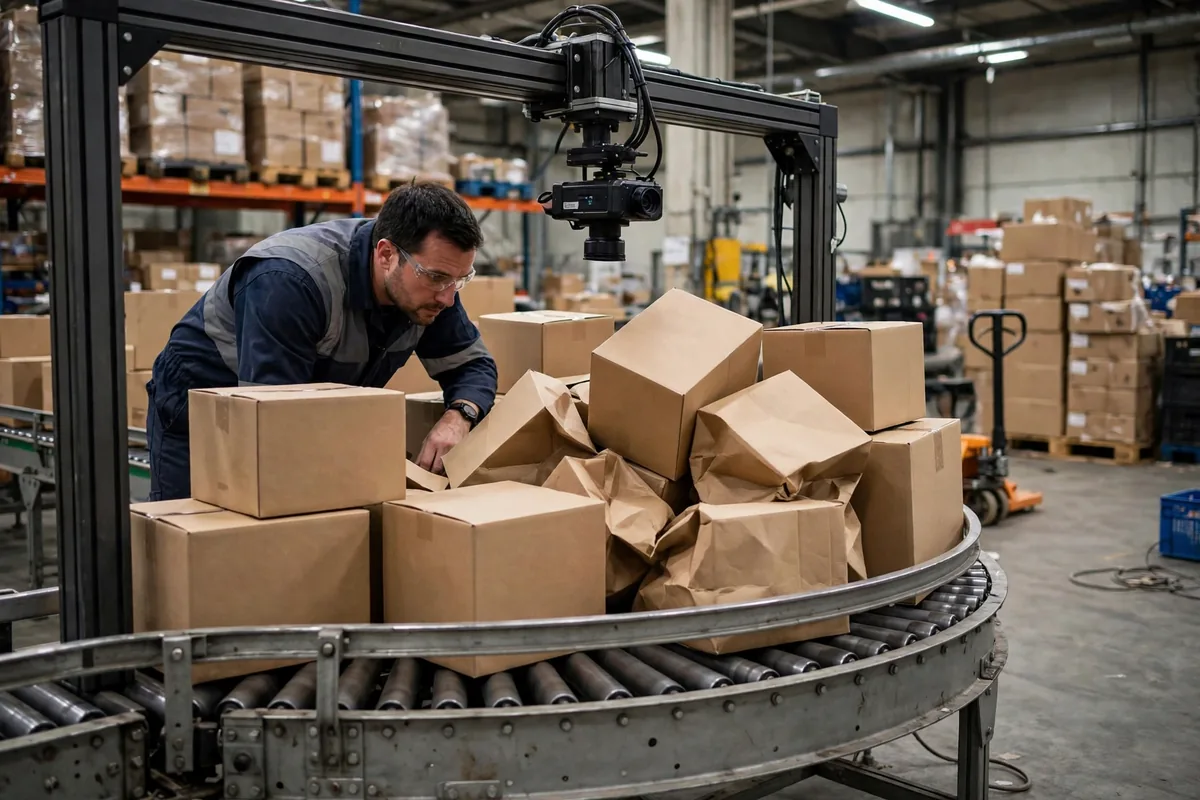
At 8:40 on a November evening last year, our 28-metre conveyor stopped. One oversized carton came into the merge point sideways, the cartons behind it piled up three layers deep, and nobody noticed until the line was already choked. Forty-seven minutes of downtime, more than 180 orders stranded, and customer service phones ringing past midnight. This AI vision conveyor jam detection warehouse story starts there: a small warehouse that cannot afford that kind of money, or that kind of stoppage.
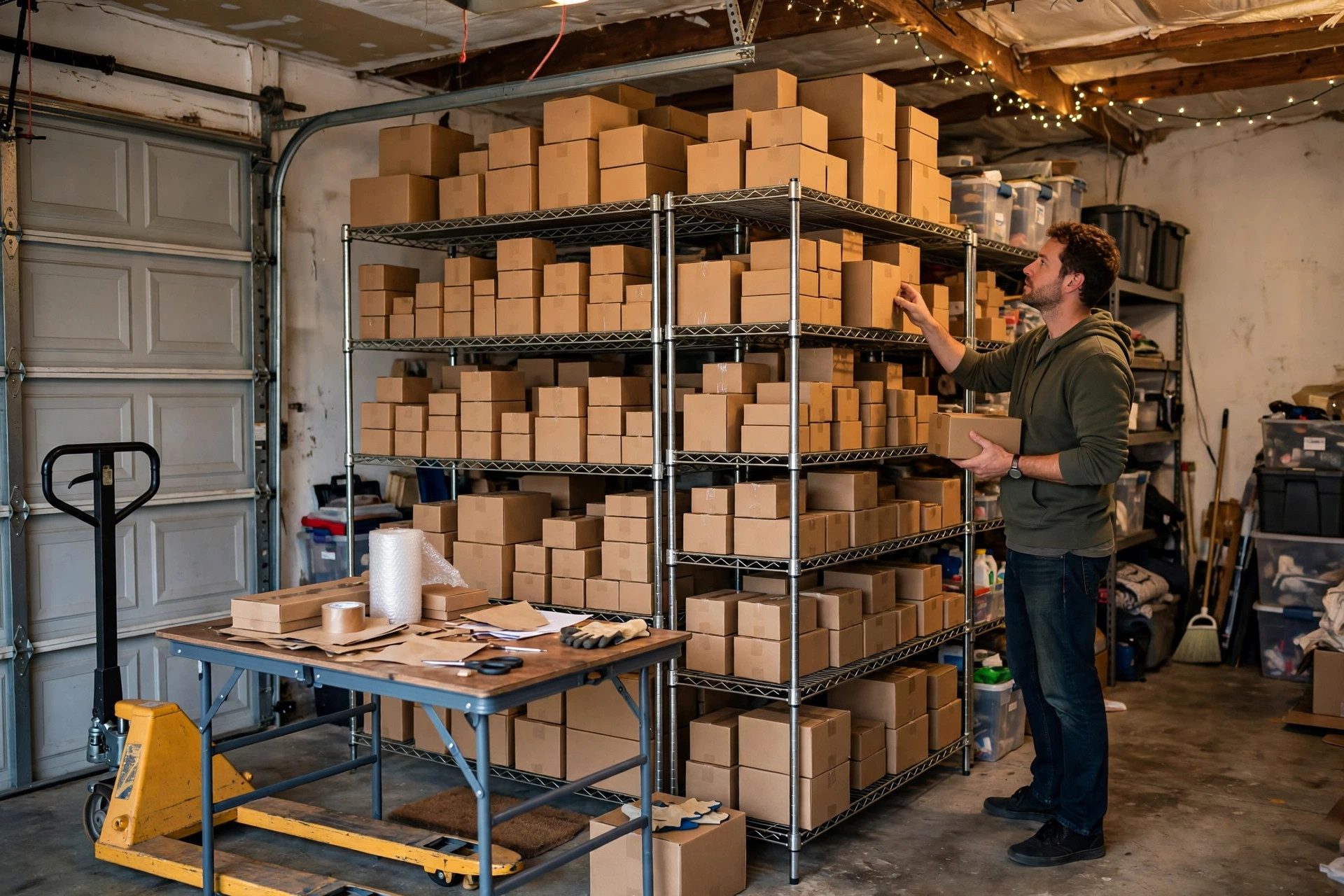
We run a 3,000-square-metre warehouse with fourteen people across picking and packing, one main conveyor and two feeders. For years our jam defence was human eyes and photo eyes. Here is what I finally understood about photo eyes: they can only tell you "this spot is already blocked." They cannot tell you how bad it is, or where exactly it started. By the time they sound, cartons are already stacked. AI vision conveyor jam detection works the other way round. It watches whether cartons are skewed, crowded, or simply not moving, and it can shout before a jam has fully formed. That difference sounds small. In peak season, it saves the day.
AI Vision Conveyor Jam Detection Starts at the Merge Point
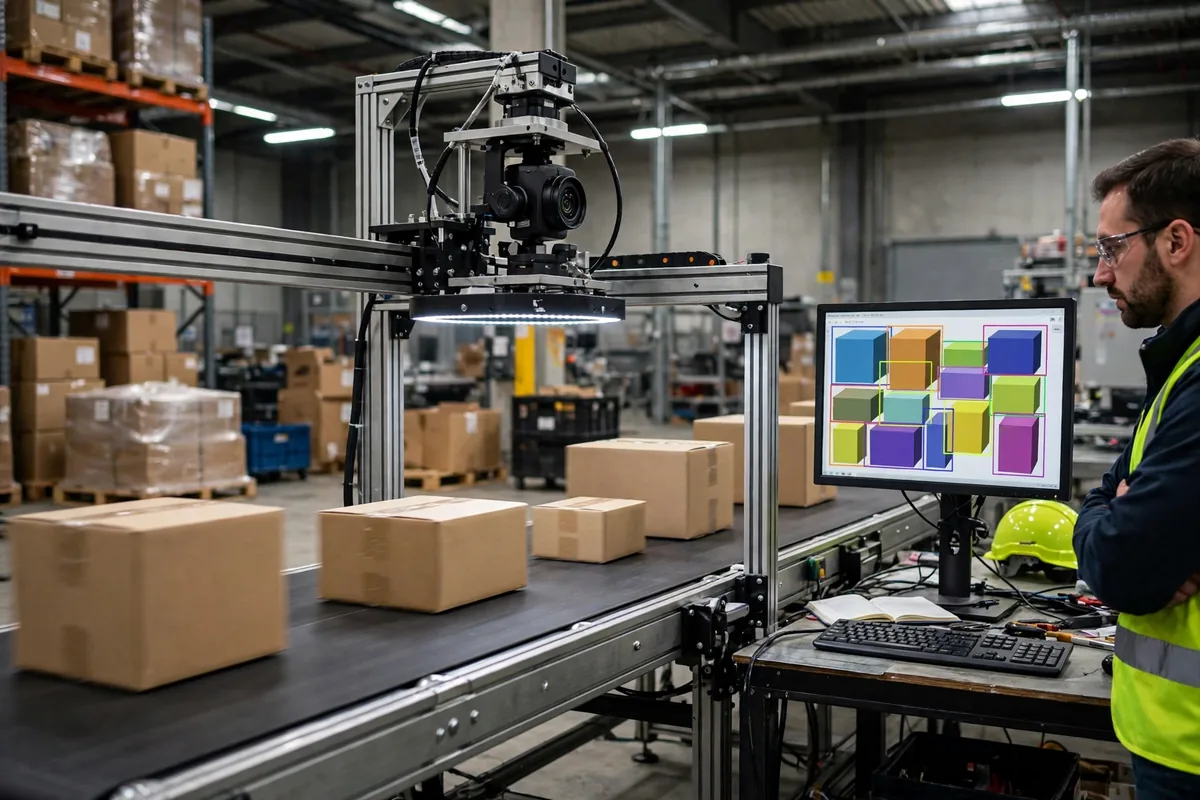
I did not dare spend big on the first step. Covering the whole line with cameras and models is a big-warehouse game. We put cameras only where jams love to happen: the merge point where the main line meets a feeder, and the bend just before the sortation exit. Three cameras in total. Two were spares left over from our security system, and we bought one new. The model does not try to recognise everything. It watches for three things only: a carton is skewed, cartons are stacked, or a carton has not moved for several seconds. Keeping the list that short cut our false alarms a lot.
The first week of the trial still blew up in our face. Afternoon sun came through the west windows and threw long shadows across the belt. The system read a shadow as a carton lying sideways and raised the alarm nine times in one afternoon. The crew ran over, found nothing, and by the third trip they were cursing. I talked it through with the vendor's engineer, and we changed the rule to "alarm only after several consecutive frames look wrong," plus a separate setting for the brightest hour of the day. False alarms fell to about one a day. That lesson stuck with me: in a small warehouse, fix false alarms before you brag about detection rates. If the crew stops believing the system, the cleverest model in the world is just decoration.
There was a second story that made me a believer. One Tuesday morning in December, a soft polybag got squeezed at the bend, half of it hanging off the side of the belt. The photo eye said nothing, because it only watches one line of sight. The camera saw it: the bag had not moved for five seconds, and its shape was stretching longer. The alarm went off, the line stopped, a worker walked over and straightened the bag. Under two minutes, start to finish. If we had waited for a full jam, that would have been another half hour gone. After that morning, I stopped calling this a gimmick.
The Money, Worked Out as a Hypothetical Example
Let me be clear about the table below. It is a hypothetical worked example built on our warehouse's size, not an industry price list and not anyone's quotation. The arithmetic is real. Plug in your own numbers and the method still holds.
| Item | Hypothetical example |
|---|---|
| Cameras and installation | 3 points, roughly 20,000 yuan in total |
| Model and software, annual | Roughly 15,000 yuan a year |
| One serious jam | About 40 minutes, about 150 orders affected |
| Serious jams per month | About 6 in peak season, about 2 in quiet months |
| Labour and rush cost per jam | Roughly 800 yuan |
Roughly worked through: in peak season, avoiding three jams a month saves about two hours of stoppage, and the labour and rush-order cost saved covers most of a month of software fees. In quiet months you save less, but the system sits there and eats nobody's lunch. That is the whole point of an AI vision conveyor jam detection warehouse project at our scale. Here is the contrarian point: when a small warehouse buys AI vision, it is not buying a detection percentage. It is buying fewer stoppages. Pushing detection from ninety percent to ninety-five percent means little at our scale. Two fewer stoppages a month means a lot. When a vendor shows you an accuracy figure, your next question should always be: how many false alarms a day, and who deals with them?
Published research gives a useful reference point. Amazon's research team has publicly reported a single-camera system that, in a live sortation facility, counted throughput at 98.05% accuracy against 513 hand-counted packages, with 96.0% precision on detecting side-by-side doubles. Those are their site and their data. I quote them only to make one point: this approach has been run in a real warehouse, not just in a lab demo. Your lighting, carton mix, and belt speed are different, so copying their accuracy figure onto your warehouse would be fooling yourself.
Where to Point the Camera for AI Vision Conveyor Jam Detection
We learned another lesson on selection. Someone first recommended a depth-sensing setup. I shook my head when I saw the quote. It was good kit, but our cartons are a mixed bag anyway — soft bags, cardboard boxes, odd shapes all running together — and depth data cannot rescue a big carton that comes into the merge sideways. Our rule became: watch flow first, shape second. Flow means whether cartons are moving and how fast. Shape means whether they are skewed or stacked. An ordinary camera and an ordinary model can do both. No need for the most expensive option.
Maintenance bit us too. One camera sat right above the sortation exit, and dust filmed the lens within two months. The picture went hazy and false alarms jumped. Now wiping the lens is on our weekly equipment checklist, same day as conveyor lubrication, a ten-minute job. Night shifts brought another wrinkle: half the lights are off at night, one stretch of belt runs dim, and the model kept hesitating there. We did not add lights or change models. We just loosened the threshold on that stretch, preferring to miss one slight skew rather than wake people up at 3 a.m. Trade-offs work like that. Sensitive by day, quiet by night. One model cannot have it both ways.
My advice to other small warehouses is one sentence: do not start by talking about intelligence, start by talking about the three places your line jams most. Find those spots, point the cameras there, teach the model to recognise only the few failures that actually hurt, and the money lands where it matters. Get the spots wrong, install a row of cameras, teach the model a dozen things, and the alarms will annoy people more than the jams do. The crew will switch it off, and every yuan you spent goes down the drain. Small warehouses have their own way of surviving. Big warehouses talk about full-line intelligence. We talk about holding down the one spot that hurts most. One conveyor, three cameras, two points. And two weeks with a notebook first — time, place, and carton type for every jam — before you decide where anything goes. That notebook is worth more than any vendor's proposal.
By Xiao Ma, Small Warehouse Owner