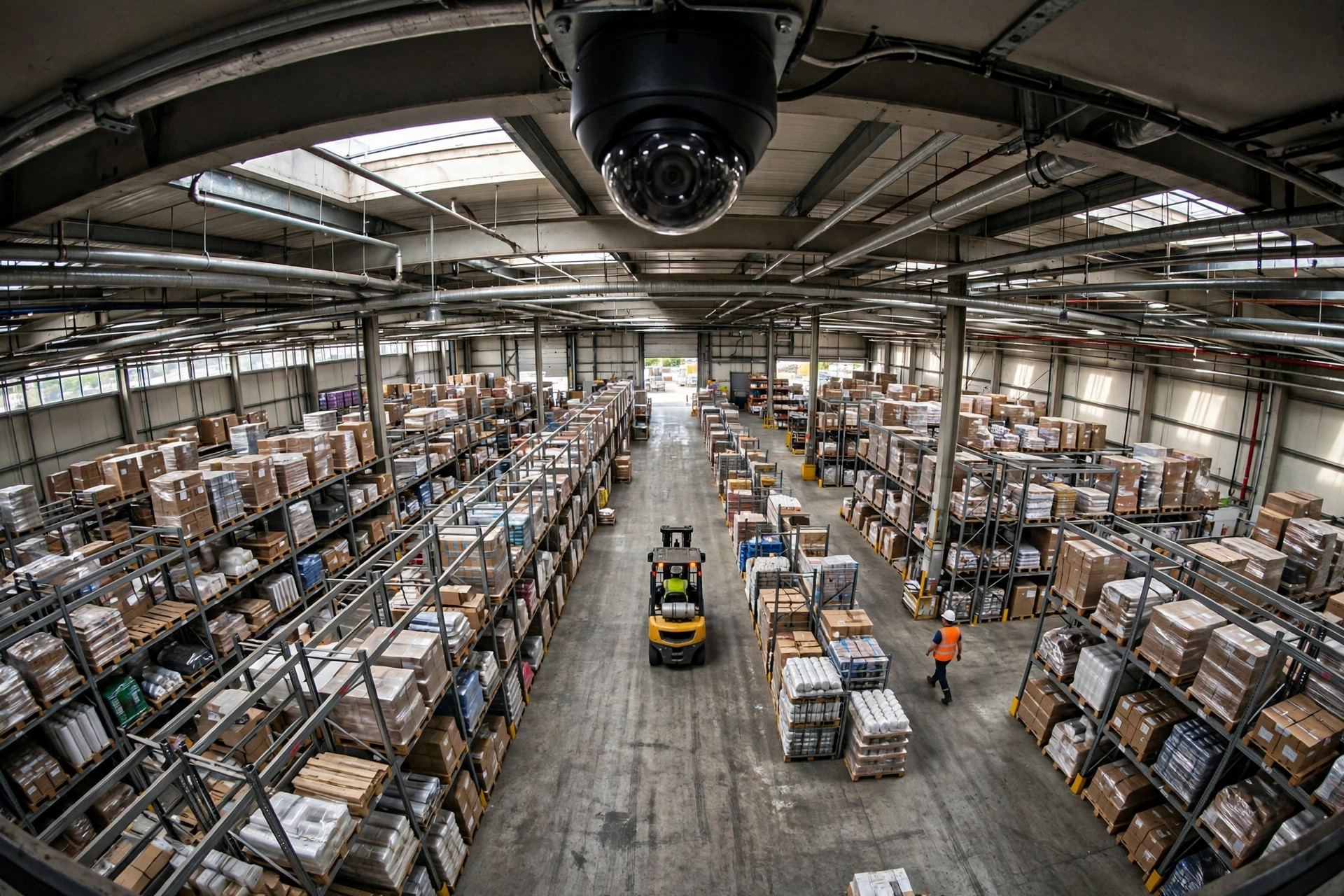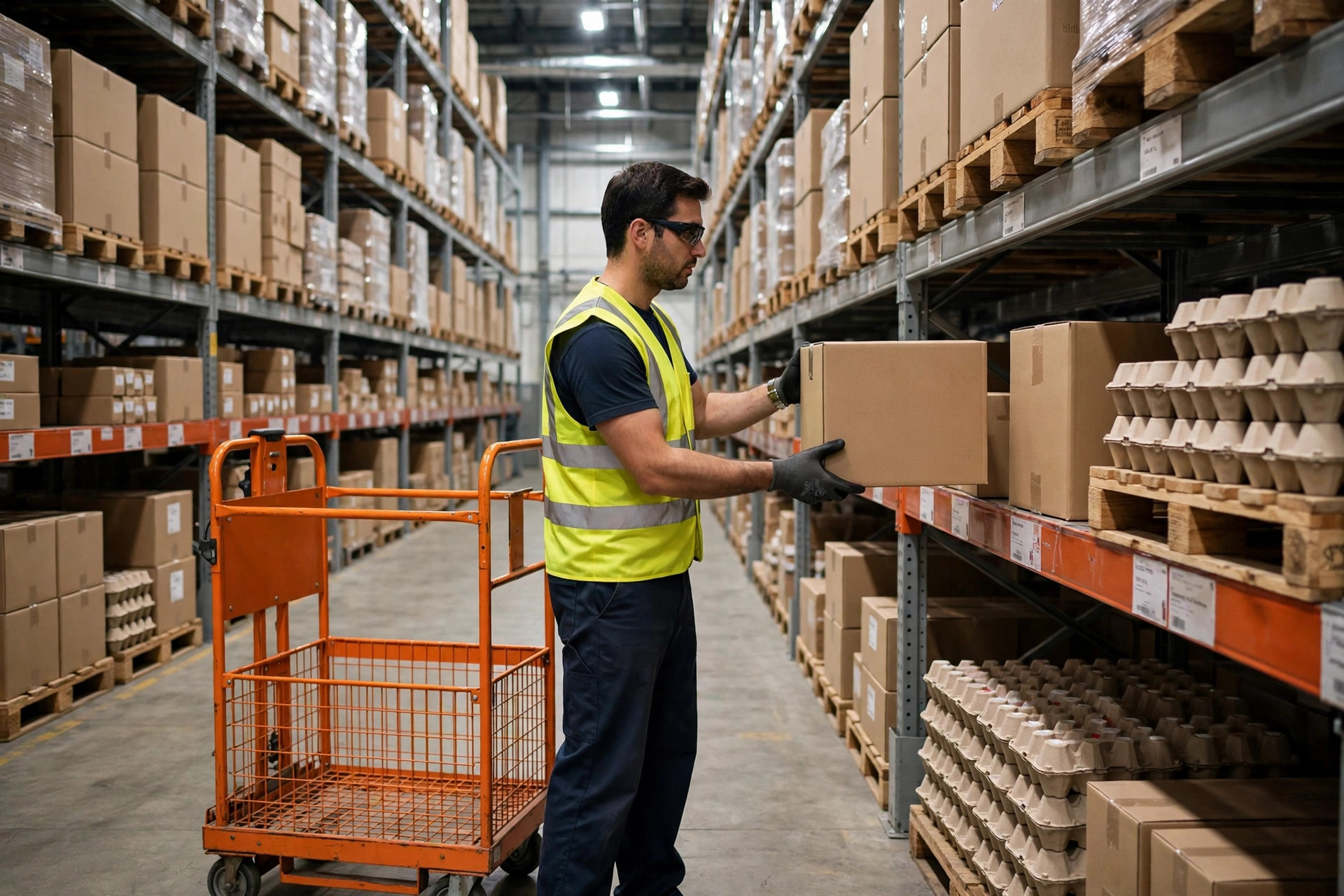
AI slotting optimization in the warehouse is quietly moving one of the industry's oldest judgments — where each SKU belongs — from veteran brains into algorithmic models. Every warehouse I have studied has one such veteran: a supervisor who can glance at a new product and name its aisle and level by instinct. As a researcher, what interests me is not the technology itself, but what this migration reveals about the industry's underlying constraints.
The Phenomenon: Slotting Optimization Moves From Brains Into Models
Based on publicly disclosed vendor case studies and industry reports, AI-powered slotting optimization typically ingests three kinds of data: historical order-line data (which SKUs tend to appear on the same order), SKU master data (dimensions, weight, velocity, ABC class), and the physical layout of the facility (aisle lengths, pick-face heights, equipment positions). The output is a set of slotting recommendations: which SKUs deserve the golden pick zone, which ones should sit next to each other, and which slow movers should be relocated outward.
I have tracked two cases with enough public detail to be instructive. The first involves a mid-sized American 3PL that ran a pilot in 2024 at an e-commerce fulfillment center of roughly 20,000 square meters in California. They fed twelve months of order-line history into a slotting model, which recommended relocating about 15 percent of SKUs — mostly pulling frequently co-ordered items into adjacent aisles. Within three months of implementation, the facility reported a meaningful, double-digit-magnitude reduction in picker travel distance, along with shorter search time at the verification step. The second case comes from a European automotive parts distribution center, where the problem was not travel distance but misplacement: heavy components kept getting suggested for upper rack levels, forcing pickers to climb on and off forklifts repeatedly. Once weight and ergonomic constraints were added to the model's objective function, these "technically optimal, operationally awkward" recommendations dropped sharply. Both cases point to the same insight: the value of the algorithm is not that it computes faster, but that it can jointly optimize across constraints — velocity, affinity, weight, ergonomics — that a human mind can only juggle two or three of at a time.
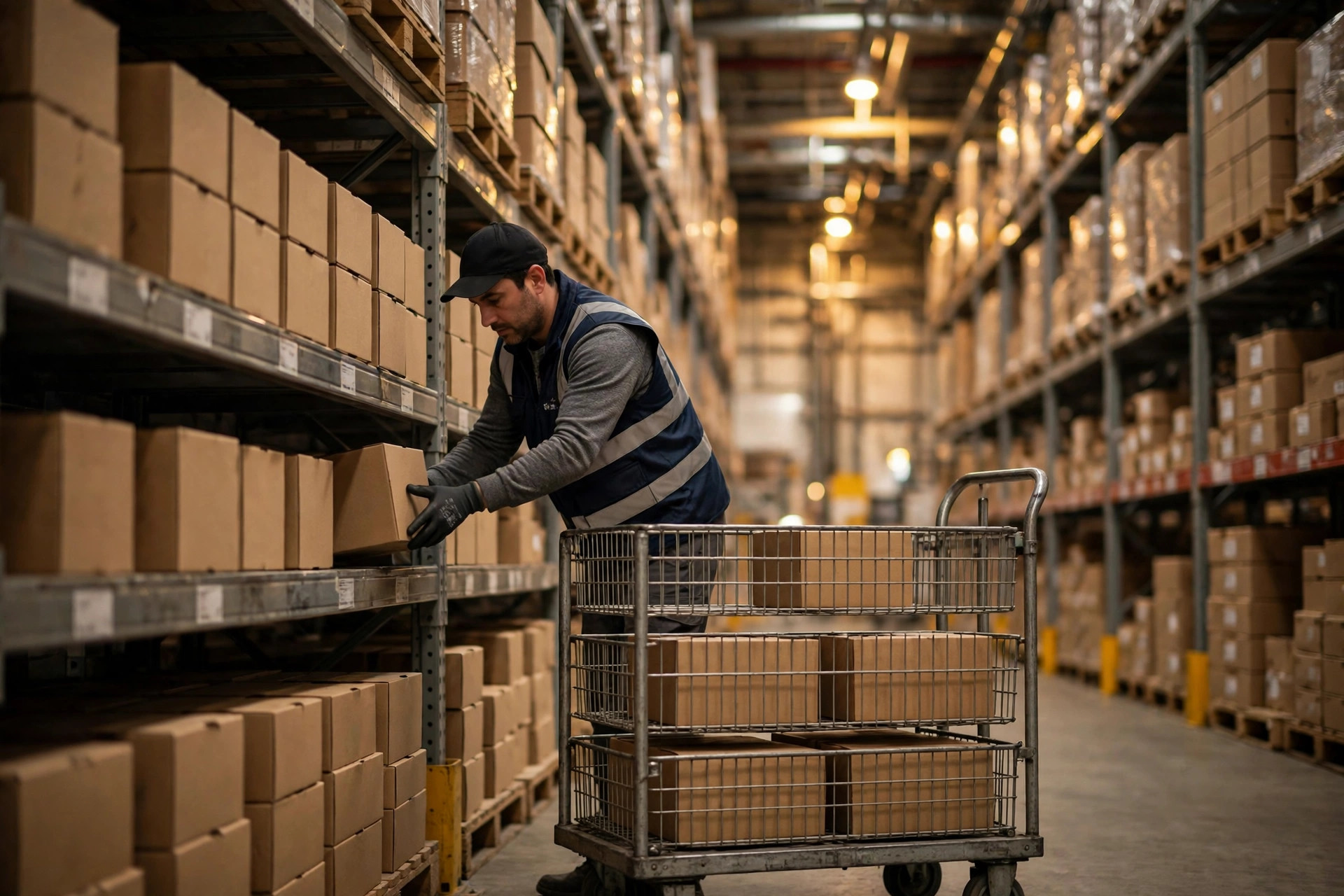
The Data: The Performance Ceiling Is Set by Data Quality, Not by the Algorithm
Vendor marketing materials love to quote impressive efficiency gains, and my advice is to discount every such number before taking it seriously. From the publicly documented cases I have reviewed, the picking-efficiency improvement generally falls in the low tens of percent — treat that as an order of magnitude, not a promise. More illuminating than any single number is a comparison of how the three generations of slotting logic actually differ in practice:
| Dimension | Veteran intuition | Rules engine (ABC / velocity) | AI algorithmic recommendations |
|---|---|---|---|
| Decision basis | Personal memory and gut feel | One or a few static metrics | Joint optimization across many constraints |
| SKU scale handled | Hundreds — beyond that, coverage breaks down | Tens of thousands, but rules are static | Hundreds of thousands, recalculated dynamically |
| Response to demand shifts | Detected by humans, lagging by weeks | Fixed cycle (e.g., quarterly) re-slotting | Rolling recommendations, weekly or even daily |
| Handling of exceptions | Strong — experience covers the gaps | Fails where rules don't reach | Depends on data; dirty data produces bad advice |
| Hidden cost | Knowledge walks out the door with turnover | Rigid rules break down in peak season | Data governance and model maintenance overhead |
The last row is the one that matters. In my observation, fewer than a third of AI slotting project failures trace back to the algorithm itself; more than two-thirds die on data. Missing dimensions and weights in SKU masters, returns and transfers polluting order history, location masters that no longer match physical reality — the model eats dirty data and emits recommendations nobody trusts, and once floor staff lose faith in the suggestions, the project is effectively dead. The practical upshot for anyone evaluating AI slotting optimization is to audit the data first and demo the model second — because what determines success here is precisely the foundational work that was never done in the decade before AI arrived.
The Attribution: Why Now? Three Conditions Matured at Once
The mathematics of slotting optimization is not new — operations research has studied it for decades. So why is AI-powered slotting landing only in the last couple of years? I see three newly matured conditions. First, the cost of compute and algorithm engineering has fallen enough that jointly optimizing a hundred thousand SKUs went from "unaffordable" to "runs overnight." Second, WMS data has accumulated past a critical threshold — many warehouses now hold three to five continuous years of order-line history, the minimum fuel for training co-occurrence relationships and seasonal patterns. Third, and most easily overlooked, the labor structure has changed: veteran supervisors are retiring, turnover is rising, and tribal knowledge is evaporating on its own. Companies are being forced to move knowledge from brains into systems. Remove any one of these three conditions, and AI slotting remains a slide-deck concept.
The Trend Judgment: A Counterintuitive Take on AI Slotting Optimization, and a Three-Year Timeline
Here is the counterintuitive judgment: in the near term, the warehouses that gain the most from AI slotting optimization are not the ones with the best veteran supervisors, but mid-sized facilities with the cleanest data and the most standardized processes. The reasoning rests on two points. First, the algorithm's edge is joint optimization across many constraints, while the veteran's edge is intuitive handling of exceptions — in warehouses with stable SKU structures and predictable order patterns, the former wins decisively; in facilities with constant SKU churn and promotion-driven chaos, the latter remains irreplaceable for now. Second, large flagship DCs already harvested most of the low-hanging fruit with home-grown rules engines years ago, so AI's marginal gain there is modest; the mid-sized warehouses that have always slotted by hand, yet sit on decent data, see the largest first-time improvement.
On that basis, here is how I read the next three years. From 2026 to 2027, the mainstream form will be hybrid: rules plus machine learning, with the algorithm proposing and humans confirming — human-in-the-loop as the standard operating mode. From 2027 to 2028, as warehouse digital twins become common, slotting will move from static recommendations to simulated validation: run the proposed layout through a virtual facility first, check travel distance and congestion, then execute. After 2028, genuine online learning may mature — locations adjusting themselves continuously as demand shifts. But every milestone on this timeline hangs from the same rope: data governance. If a warehouse's SKU master accuracy cannot even clear eighty percent, then every stage described above is, for that facility, a castle in the air.
Which leaves me with an open question rather than a conclusion: as algorithms systematically take over decisions like where goods should live, what becomes the core competence of a warehouse manager? Is it understanding algorithms better — or understanding how to feed them clean data and how to judge whether a recommendation is actually executable? My observation is that the latter is becoming a new kind of scarce capability: it writes no code, yet it determines whether the code's output has any value. And cultivating that capability may prove slower, and harder, than deploying any AI model.
By Dr. Chen, Supply Chain Researcher