Every year before peak season, warehouse managers ask the same question about AI dynamic slotting: is one pre-peak reslotting run for warehouse location optimization worth it? According to public industry reports, the order mix changes far more sharply during peak than in an ordinary month, so a layout that runs smoothly in the quiet season is not guaranteed to run smoothly when volumes spike, and the question returns each year rather than being settled once and forgotten.
A third-party logistics warehouse in eastern China faced this exact situation before last year's peak. In ordinary months it served dozens of brands, orders were spread fairly evenly, and locations had been arranged by category and historical sales, so pickers knew their routes by heart. When peak arrived, orders for a handful of leading brands roughly doubled, the same products kept appearing in order after order, and pickers spent much of their day walking long detours to fetch the same goods, while queues formed at the packing benches. The problem was not a shortage of hands. The layout still reflected quiet-season logic, with the hottest products buried deep in the warehouse and travel distances stretched well beyond what the order profile now justified.
According to public industry reports, rising order concentration during peak is a recurring pattern: the share of total orders taken by the top products climbs noticeably during promotional periods, while long-tail products keep selling at roughly their usual pace. That shape matters, because it means the payoff from warehouse location optimization comes mostly from moving a small number of high-frequency products, not from turning the whole building upside down. Once that is understood, the scope of a pre-peak run, the effort it deserves, and how to judge whether it paid off all become easier to set.
What AI dynamic slotting actually moves
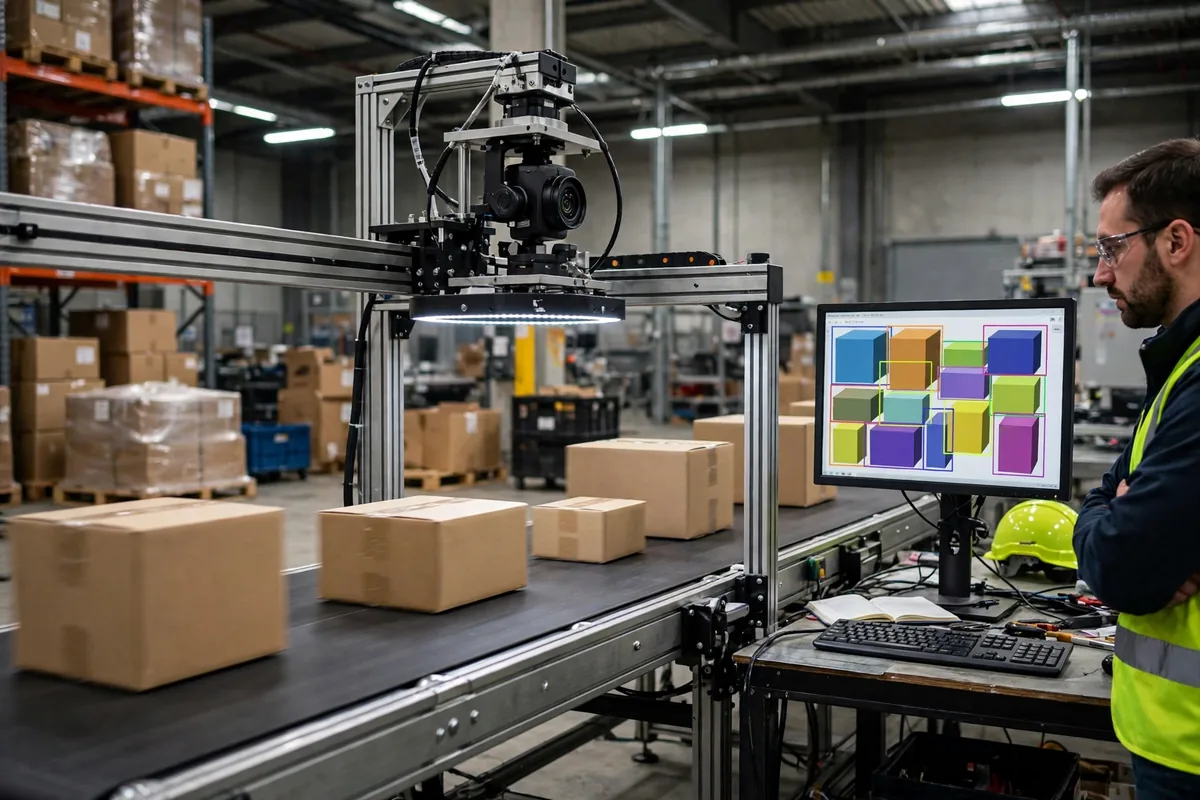
AI dynamic slotting sounds new, but the work behind it breaks down into steps that are not mysterious at all. It starts with demand data: how often each product shipped over a recent period, how often it appeared in orders, and which products tended to appear together in the same wave, to judge which items are likely to be ordered together at peak. Then comes ABC stratification, sorting products that ship frequently and steadily into one group and products that ship rarely and erratically into another, based on real shipping records rather than category instinct. The next step is location heat: overlaying pick frequency, walking distance, and congestion for every location to see which spots are crossed again and again and which sit idle for weeks. Only then does the picking path get reworked, pulling high-frequency products toward the picking start and the packing area and placing products often ordered together near each other, so pickers make fewer U-turns and cross fewer crowded aisles.
What AI actually does in this chain needs to be stated plainly. It is not a magic box that prints an optimal location map. It is rules plus a model: the rules guard hard constraints, such as heavy goods on lower levels, crushable goods never at the bottom of a stack, hazardous goods stored apart, and chilled goods confined to the cold area, while the model works inside those constraints, using demand forecasts and past order combinations to propose moves and rank their expected benefit. The model offers suggestions, not orders, and the site manager still makes the final call, weighing rack load limits, aisle widths, and shift rosters. Treating AI as a faster adviser is closer to its real position in the warehouse than treating it as a system that decides on behalf of people.
The pre-peak maths of warehouse location optimization
The cost of a pre-peak run is visible and immediate. Moving stock takes labour and forklifts, it has to be squeezed into gaps between normal outbound work, some locations are locked while they are being moved, and pickers need time to relearn where things live, so the first days after a move tend to bring wrong picks and extra checks. Those costs land within a few days, while the benefit is spread across every day of peak, so the calculation has to spread the benefit over the length of the season rather than judging it on the day of the move. The longer the peak lasts and the higher the volume, the more days there are to absorb the cost of moving; when peak lasts only a few days, the moving cost may still be unpaid by the time the rush is over.
| Item | What a pre-peak run costs | What peak may pay back |
|---|---|---|
| Labour and equipment | Moving labour, forklift time, locations locked during the move | Shorter picker travel, lower picking time per order |
| Learning cost | Pickers relearning locations, more wrong picks at first | Fewer mispicks and less rework once routes settle |
| Opportunity cost | Outbound rhythm interrupted during the move | No queues at packing caused by congested travel routes |
A beauty-products warehouse in northern China illustrates the trade-off. Before the peak two years ago it moved nearly half of all its locations in one effort, aiming to get the layout right in one pass, and the move itself took far longer than planned, so pickers were still learning new locations during the first days of peak and errors and rework went up rather than down. The following year the same warehouse moved only the small number of areas holding high-frequency products and left the rest untouched, finishing the move within two days, and the picking rhythm through peak held steadier. The counterintuitive lesson is that more movement is not better movement: as the scope grows, the cost of shifting stock and of relearning rises faster than the extra benefit, and the marginal gain fades quickly, so the most economical pre-peak run is often the one that touches only the hottest slice of the range.
Whether a run was worth it should be judged on before-and-after measures, not on impressions. The measures worth tracking are picking time per order, walking distance per picker, mispicks and rework, the labour hours the move itself consumed, and overtime hours through peak. Record the baseline for each measure before the move and compare week by week until peak ends. Judging by the first day alone easily mistakes the confusion of the learning period for a failed move, or mistakes a natural fall in order volume for a successful one.
Which warehouses should run slotting — and which should leave it alone
The warehouses that gain most from a pre-peak run share several traits: a wide product range, an order mix that changes clearly at peak, high concentration in a small set of fast sellers, picking that is mainly manual or people working with machines, and a peak season long enough to repay the move. In such a warehouse, moving a few products affects a large share of orders, so the benefit has room to multiply. By contrast, a warehouse with very few products and a stable order mix all year has little left to rearrange; a highly automated warehouse must change equipment logic and scheduling rules to move locations, at higher cost and higher risk than a manual move; and a warehouse whose peak is short and whose volume swings can be handled by adding temporary staff will struggle to recover the cost of moving and relearning at all.
According to public industry reports, dynamic slotting is shifting from a special project run by a few large warehouses into a routine pre-peak consideration for more mid-sized sites, driven by more demand data already sitting in warehouse management systems, falling computing costs, and higher order concentration at peak. Over the next two to three years, the more likely pattern is divergence rather than uniform adoption: high-frequency warehouses with long peaks will turn the pre-peak run into a fixed annual routine, while low-frequency warehouses with short peaks will keep fixed locations and cope with temporary top-up stock, and AI will gradually shift from proposing a full reslotting plan toward offering small continuous suggestions through the year, with one larger review concentrated before peak.
So is one pre-peak reslotting run worth it? There is no answer that holds for every warehouse. It depends on how much the order mix will change, how long peak will last, how much stock has to move, and whether managers will spend several weeks after the move comparing measures properly. When those questions can be answered before any stock is touched, the run is worth doing carefully; when they cannot be answered, the more useful first step may not be moving stock at all, but recording demand data and picking measures clearly enough that the decision can be made on evidence next time.
By Dr. Chen, Supply Chain Researcher