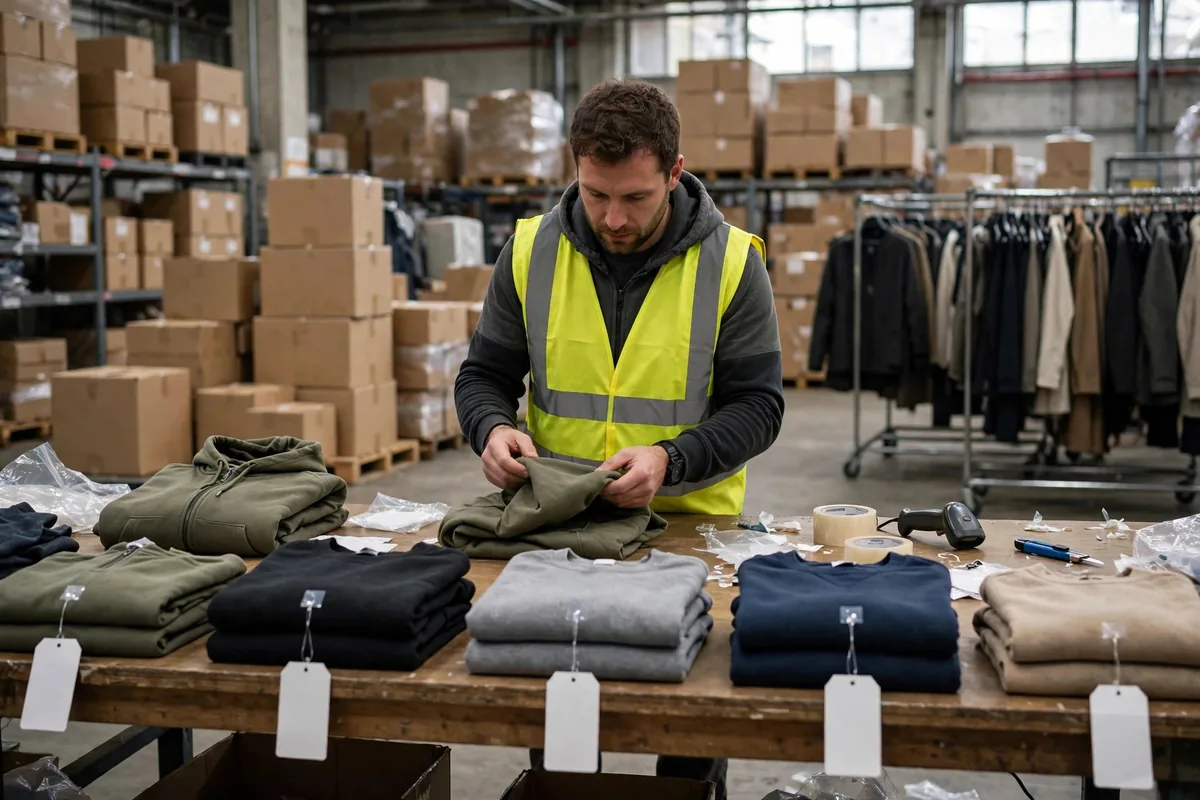
We have a client who runs a fulfillment warehouse in Ontario, California, shipping small home appliances for half a dozen brands. A week before peak season last November, he called me with a hoarse voice and one question: can AI anomaly detection actually catch picking errors in real time, or is it another line item that sounds good in a sales deck? His best-selling air fryer came in black and white, one letter apart on the pick list, and his pickers had shipped the wrong color for three straight days — more than 400 orders. Returns, replacements, apologetic emails, marketplace penalties. He put the direct damage near $90,000 before counting the two big accounts he lost that month. The client paying the bill asked him a question I still remember: you keep telling me you have AI, so why can't it tell black from white?
What AI Anomaly Detection Actually Catches
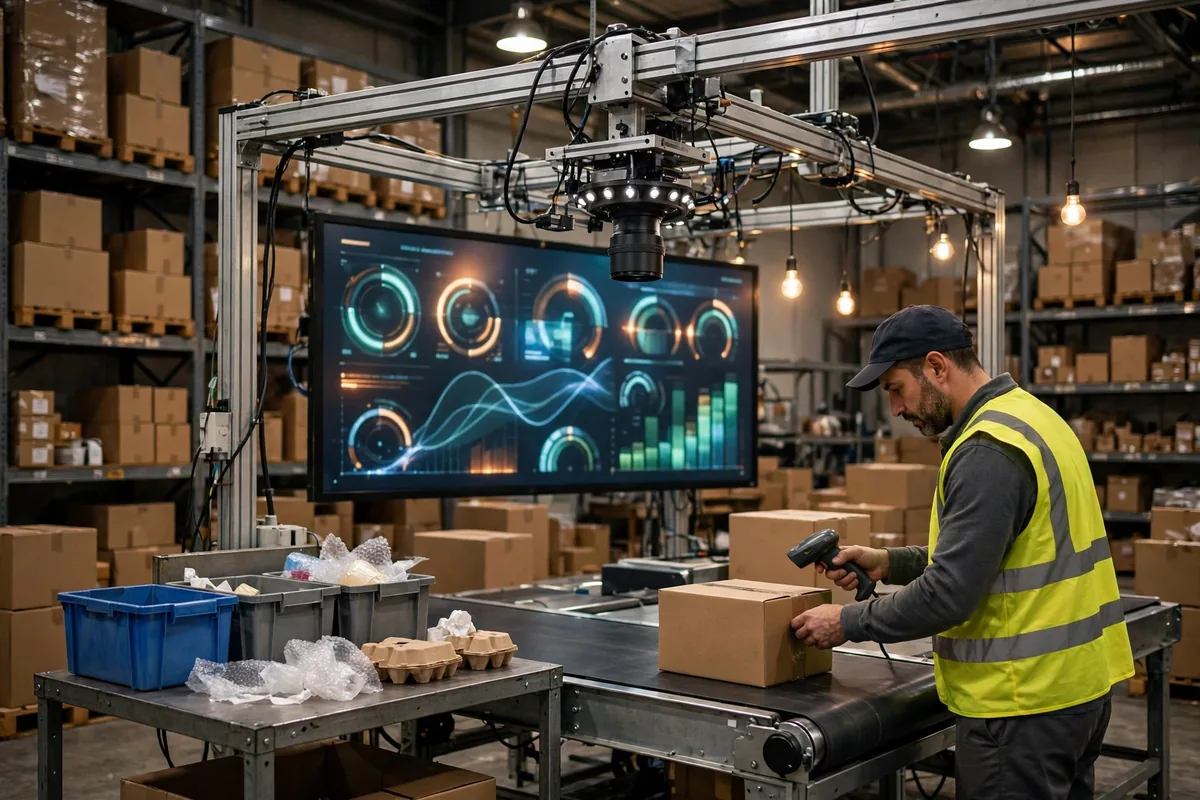
Let me be blunt about what this technology does. It does not pick for you. It watches the moment a picker puts an item in the carton and stops the mistake before the box leaves. A camera above the packing bench photographs every item, compares it against the order — color, size, quantity, barcode — and if something does not match, a light flashes, a buzzer sounds, and that order does not move on. It catches the wrong variant, the wrong color, one item too many, one item short, and the classic disaster of putting Client A's product in Client B's box. It does not catch a wrong bin location, a wrong inventory count in the system, or damaged packaging on the right product. The camera only sees what is in front of it. It cannot see what is wrong inside your system.
After the November disaster, that Ontario client put vision checks on two pick lines in December. Between December 18 and 31, the system flagged 217 orders. Of those, 190 were genuine mistakes and 27 were false alarms, most of them caused by glossy packaging catching the light and looking like a different color to the camera. The pickers hated it in week one — they felt the machine was second-guessing them — and started trusting it in week two. When peak ended, the client gave me his honest verdict: it did not let him hire fewer people, but it stopped a lot of expensive bleeding. The 190 genuine catches, at his average cost of about $18 to fix a shipped mistake, saved a little over $3,400. That is not a big number. But that was two weeks, two lines, and it says nothing about the accounts he kept.
A second client in Dallas, Texas, ships cosmetics, and took a different route in March 2026. Lipstick in twelve shades sitting side by side is a human-eye trap, so they did not put cameras everywhere. They put detection only on the forty-odd SKUs that were high value and easy to confuse. Between March 10 and April 10, the system stopped 96 orders, including one where a serum worth more than $200 was about to go out in place of a $40 lookalike sample. The price gap on that one order covered half a month of the detection service. Their operations director told me the lesson plainly: the money is in watching the few places where mistakes are most likely, not in blanketing the whole warehouse.
Is Real-Time Catching Worth Paying For? Do the Math First
Do not let the vendor do this math for you. Their formula always works out in their favor: error rate times order volume times average loss per error, minus the service fee, always positive. The insider detail — the part vendors never volunteer — is that the error rate itself is the shakiest number in the whole equation. Most warehouses do not actually know their picking error rate. They work backward from customer complaints, and a 1% complaint rate can hide a true error rate of 3% or 0.5%. Get the base number wrong and everything after it is fiction. Before you sign anything, spend two weeks checking manually: pull 200 random orders a day, re-check them by hand, and record the real error rate, the type of each error, and the average cost of each type. Nobody will do this homework for you. The vendor certainly will not offer, because once the numbers are clear, their quote gets harder to defend.
Here is the comparison I use with clients when we sit down with a calculator:
| Factor | Manual re-check | AI anomaly detection, real-time |
|---|---|---|
| When the error is found | After shipping, when the customer complains | At the packing bench, before the box leaves |
| Cost to fix one error | About $15–$25, including returns and support | About $1–$3, a re-pick on the spot |
| Best fit | Any product range, but slow | High-similarity, high-value, easily confused goods |
| Biggest weakness | People get tired; re-checks collapse at peak | False alarms slow the line; reflective and odd-shaped packaging is hardest |
| Right scale | Under 500 orders a day | Over 1,000 orders a day, or where one mistake is expensive |
Here is the counterintuitive part: the biggest saving is usually not the refunds you avoid. It is the re-check team you no longer need. A warehouse shipping 3,000 orders a day needs six to eight people for full manual re-checking. With AI flagging orders and humans handling only the flagged ones, that team drops to two. The labor saving dwarfs the refund saving. And the same logic cuts the other way: if your warehouse ships 300 orders a day and your error rate is already low, this system is a gift to the vendor. Without the volume, no technology pays for itself.
There is one more trade-off almost nobody budgets for: the stricter the catching, the slower the picking. Every extra point of false-alarm rate means dozens of extra stops per picker per day, and at peak that becomes a queue. A good contract should not only promise a catch rate. It should cap the false-alarm rate and set a response time. If false alarms pass the agreed limit, the fee gets discounted. If the system goes down beyond the agreed window, that month's fee gets waived. Vendors will not offer those clauses. You have to ask.
Three Ways Vendors Oversell Anomaly Detection to the Client
The first is accuracy. The number in the demo was measured in the vendor's lab, on products they chose, under their lighting. In your warehouse the light, the packaging, and the angle are all different, and the number drops. Do not put the vendor's accuracy in the contract. Put your own acceptance test in it: take your fifty hardest SKUs, run them for a week under your lights, and set the catch rate and false-alarm rate that count as a pass. If it fails, you can extend the trial, cut the price, or send it back. All three need to be written down.
The second is pricing. Per-order pricing sounds fair until peak season doubles your bill. Monthly pricing sounds expensive until you realize you are paying it in the slow months too. My rule of thumb: if your volume swings, negotiate a monthly cap with a per-order rate above it. If your volume is steady, negotiate an annual package. The worst deal is per-order pricing with no cap, where the peak-season invoice costs more than the mistakes you avoided.
The third is data. The cameras take tens of thousands of pictures a day. Whose pictures are they? Can the vendor use them to train models for your competitors? If the contract does not say, the default answer is that they can. How your products are packed and shelved is operating knowledge. Add one sentence to the negotiation: all image data belongs to the client and may not be used for model training or shared with third parties without written consent. Skip that sentence and you will argue about it later, when it is too late.
Next time you negotiate a contract, ask these three questions. Will acceptance be tested on my products, under my lights, and what happens if it misses? If false alarms run high or the system goes down, how does the fee come down? Who owns my data, and can it be used to train somebody else's model? Ask those three and the vendor will know you have bought AI before. AI anomaly detection can catch a picking error before the box leaves the building. What it cannot catch is a bad deal. Do the math first, then sign, and the technology works for you. Sign first and do the math later, and it is just another cost.
By Susan, 3PL Sales Director