Let me say this up front: the AGV US safety certification pitfalls that cost real money rarely sit inside the vehicle. The vehicle runs fine. The battery is charged, the navigation works, and then the customer's safety audit stops the whole fleet cold. I have watched it happen more than once, and every time the story is the same — the machine was ready, the site and the paperwork were not.
In the spring of 2024, a 3PL warehouse outside Ontario, California took delivery of twelve AGVs. On day three, the customer's safety auditor walked the floor, looked at the mixed traffic of people and machines, looked at the safety scanner configuration, and shut the deployment down on the spot. Three weeks. That is how long the fleet sat idle while peak-season orders were picked by hand. The scanners were not broken. They were configured for a different floor layout than the one they were actually running on.
Where AGV Safety Certification in the US Gets Stuck
Here is the principle, and you can think of it like getting a car on the road. Passing the vehicle inspection does not mean you can drive — you also need the road, the license, and the insurance. AGV safety certification works the same way, in three parts: the vehicle has to comply, the site has to comply, and the documentation has to comply. Miss one, and the audit fails.
The vehicle part is what most vendors talk about: the emergency stop circuit, the audible and visual alarms, the safety scanners. The site part is what gets ignored: floor markings, pedestrian routes, isolation around the charging area. The documentation part is what gets left to the last minute: the risk assessment, the test records, the operator training logs. Vendors obsess over the vehicle and leave the site and the paperwork to the customer — and those are exactly the two parts that stop a deployment.
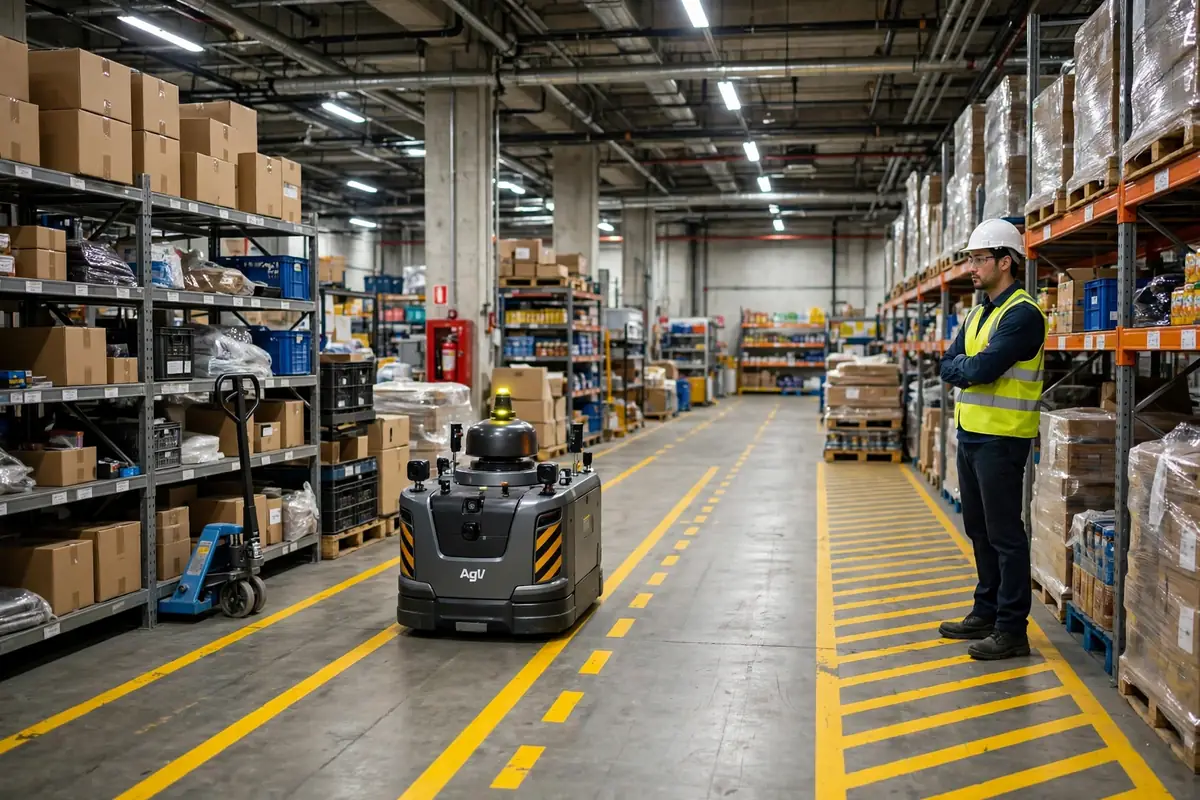
The site is trickier than most people expect. A polished concrete floor reflects the scanner beam and triggers false emergency stops. A pedestrian aisle drawn in the wrong place puts forklifts and AGVs in the same intersection, and one look at that is enough for an auditor to call a halt. A charging area with no isolation, workers carrying coffee past the charging docks — every one of those is a line item on an audit checklist. None of it is the vehicle's fault, but the bill lands on the project all the same.
In the US, the conversation usually turns to UL standards and the ANSI/ITSDF safety requirements for guided industrial vehicles. I am not going to recite standard numbers at you here, because which ones apply depends on your vehicle type, your load, and your operating scenario. Check the current requirements with your certification body and your customer's audit checklist before you spend a dollar. A test report from another country is not a passport. In front of a US customer's safety team, on its own, it is worth very little.
AGV Safety Certification: Where the Money Really Goes
Here is a counterintuitive judgment: the most expensive part of AGV safety certification in the US is almost never the certification fee. It is the cost of the time you lose when you buy the vehicles first and certify later. Idle machines, manual cover for missed orders, late delivery penalties — add those up and they usually dwarf the certification bill itself.
The table below is an illustrative estimate per vehicle. The figures are order-of-magnitude only; get real numbers from your vendor and your certification body.
| Where the money goes | Certify up front | Fix it later |
|---|---|---|
| Certification testing and assessment | One payment, sized to the job | The same payment, plus rush fees |
| Site work (markings, routes, isolation) | Done during planning, almost free | Done during a shutdown, labor doubled |
| Documentation (risk assessment, training records) | Built as the project runs | Thrown together at the last minute, most likely to fail review |
| Downtime losses | None | Charged by the day, worst in peak season |
See the pattern? Doing it up front and fixing it later are not in the same league, and the difference sits in the downtime row. There is also a cost the table cannot show: the chain reaction of rework. Scanner parameters have to be retuned, floor markings redrawn, operator training reorganized, re-signed, and re-filed. Each item looks small on its own. Together they add up to the better part of half a year, because when one step gets sent back, every step behind it has to wait. That is what makes fixing it later truly expensive. In 2023 I followed a project where a domestic manufacturer shipped its first batch into the US carrying a test report from home. The customer's safety team reviewed it and sent back a list: the emergency stop circuit had to be rebuilt as dual-channel, audible and visual alarms had to be added, the reflective floor markings had to be redrawn, and the operator training records had to be built from zero. The full rework took the better part of half a year, and the first delivery slipped with it. The manufacturer told me later that if they had known, they would have put the cost and the time into the contract. But at contract time, nobody was thinking about certification.
Some "Certification" Is a Pseudo-Requirement — Don't Pay for It
This might offend some people, but it needs saying. There are plenty of middlemen out there who wave a list of standard numbers you have never heard of and sell you a "complete certification package." My test is simple: ask the customer for the audit checklist first. If an item is not on the list, do not buy it yet. That is one of the AGV US safety certification pitfalls nobody warns you about — paying for paperwork your customer never asked for. If it is on the list, work through it item by item. The checklist is your construction drawing. Starting work without one means spending money and still ending up short.
The other pseudo-requirement is the obsession with doing everything at once. A small pilot run in a closed zone with good separation between people and machines is a completely different certification problem from a fully open mixed-traffic floor. Get the smallest compliant setup running first, get it stable, and then expand. That beats buying the full top-tier package on day one. The reverse is equally true: in an open mixed-traffic scenario, do not save a single cent on safety. Every cent you save there will come back with interest in an incident.
One more thing: a certificate is not the same as being safe. A certificate proves you passed one assessment at one point in time. Once the vehicles are running, routes change, volumes grow, new operators arrive, and the safety picture drifts. Treating certification as a finish line is itself the biggest safety hazard.
Three Questions Before You Spend a Dollar
First: will your vehicles run in mixed-traffic areas? If yes, certify now. If no, start with the minimum set for a closed scenario.
Second: does your customer have a written safety audit checklist? If yes, that list is your construction drawing. If no, get the list before you move — do not spend money on a guess.
Third: what does one day of downtime cost you? Work that number out, then look at what up-front certification costs. Whichever number is bigger is your answer.
So whether the money is worth it comes down to one number: what does one day of downtime cost you? Once you have that number, you will know for yourself whether certification is a cost or an insurance policy.
By Da Liu, Automation Engineer