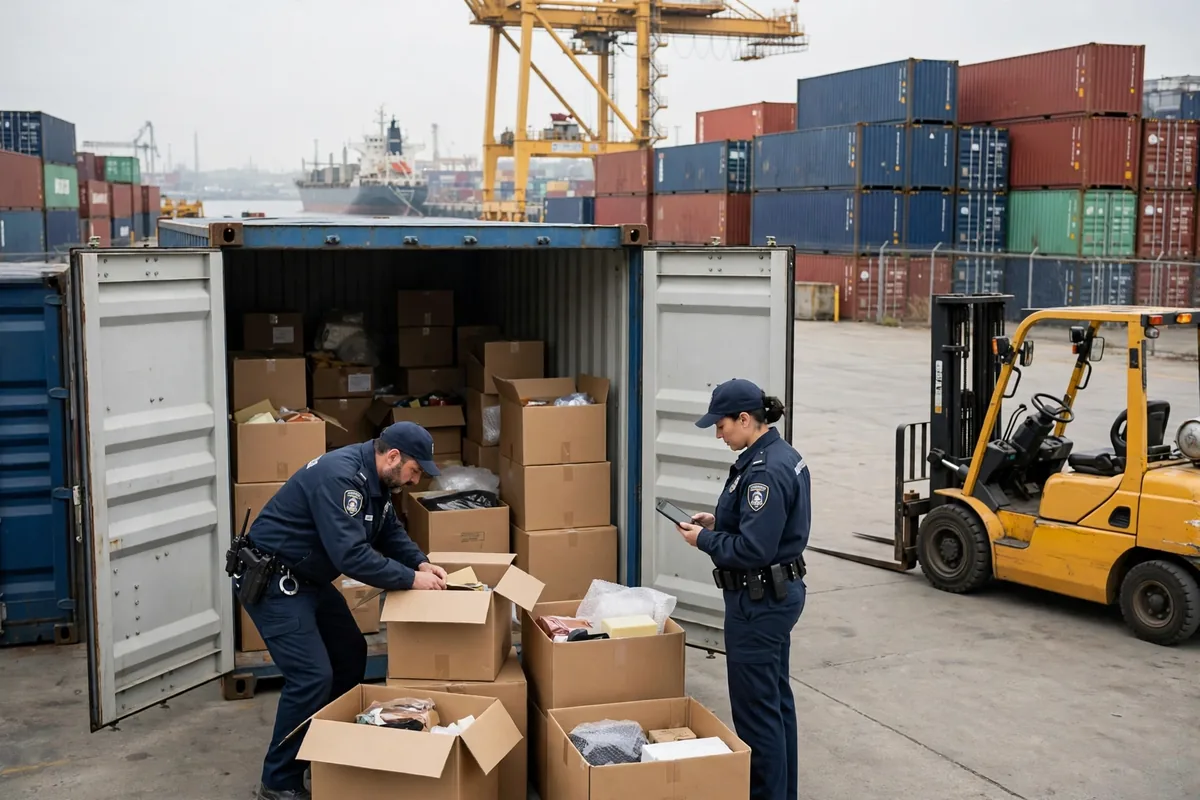
Start with the bill for a single shipment — the starting point for the whole AEO calculation. Below is what one customs inspection actually costs — an illustrative example, not any one company's real books, but every line is a charge that really happens:
| Cost item | Amount (illustrative) | Notes |
|---|---|---|
| Inspection service fee | About 800–1,500 yuan | Unpacking, handling, and repacking labor and equipment |
| Container detention and storage | About 300–600 yuan per day | Two or three extra days in the queue is common |
| Missed sailing and late delivery | Hard to quantify | Miss the next vessel and the customer claims start |
| Staff follow-up | About half a day to a full day | Broker on site, extra documents, waiting for notice |
| Total | About 3,000–6,000 yuan per shipment | Excludes customer claims and lost orders |
At 3,000 to 6,000 yuan per inspection, twenty inspections a year burns 60,000 to 120,000 yuan. What the status saves is not face, it is this kind of money leaking out one shipment at a time.
What AEO Actually Buys You
AEO — Authorized Economic Operator — is the World Customs Organization's trusted-trader program. In China it is called Advanced Certified Enterprise. Under General Administration of Customs Order No. 282, effective April 1, 2026, the credit rating system expanded from three tiers to five, and both the Advanced Certified Enterprises and the new lower-tier Certified Enterprises now hold the status. Smaller companies that could never reach the top tier can now start with the lower one.
The benefits come in five items, ranked by how much money they are worth. First, a lower inspection rate. Tianjin Customs published hard numbers in an October 2026 reply: 373 certified companies in the Tianjin area handled 328.98 billion yuan of trade last year — 45.1% of the city's total — with an average inspection rate just 18.5% of ordinary companies. The policy benchmark for Advanced Certified Enterprises is an inspection rate below 20% of ordinary companies, and some certified companies report actual rates around 0.3%. Practically speaking, that means almost never inspected.
Second, priority treatment even when you are inspected. Advanced Certified Enterprises get priority document review, priority inspection, and appointment-based clearance — the queue disappears. Shanghai Customs data shows certified companies clearing airfreight imports in under six hours on average, roughly 60% faster than ordinary companies.
Third, mutual recognition works abroad too. As of September 2026, China Customs had signed mutual recognition arrangements with 34 economies covering 60 countries and regions, 53 of them already in force. When your goods land in the EU, Japan, South Korea, or Singapore, the local customs grants the same conveniences. One certificate, savings at both ends.
Fourth, guarantees can be waived. Advanced Certified Enterprises may apply for exemption from customs guarantees, so working capital stops sitting in deposits. For high-volume importers this is often the single biggest saving.
Fifth, a dedicated coordinator and joint incentives. Local customs assigns AEO companies a contact officer — when something goes wrong, someone picks up the phone. Commerce and finance departments add their own incentives: one company in Hubei, certified in July 2026, saved nearly 150,000 yuan a year on foreign exchange settlement and transaction fees. Check the General Administration of Customs' latest announcements for current policy details.
What AEO Costs to Get and Keep
The cost has three parts. The first is the remediation work: the certification standard scores four areas — internal controls, financial status, legal compliance, and trade security — and you need 95 points or more with no single failing item. Policy documents, ledgers, warehouse security, and staff training all have to be brought up to standard; for a mid-sized company that typically runs into tens of thousands to over a hundred thousand yuan. The second is time: six months to a year from kickoff to approval, including an on-site audit, is normal. The third is maintenance: the certificate is not forever. Advanced certification is reviewed every five years, and companies rated excellent can skip the on-site re-check under a simplified review, but a failed review means downgrade or cancellation — so compliance staffing is a permanent cost.
Now the return, using an illustrative example: suppose a company handles 200 import and export shipments a year worth 50 million yuan, with a pre-certification inspection rate of 10% — twenty inspections a year at 4,000 yuan each, or 80,000 yuan burned. After certification the rate falls to a fifth of that, about four inspections, saving 64,000 yuan a year. Add the interest saved on released guarantees and the losses avoided from fewer delays, and the payback period usually lands inside two years. The bigger the volume, the faster the payback; the smaller the volume, the uglier the math.
| Item | Before certification (illustrative) | After certification (illustrative) |
|---|---|---|
| Inspections per year | About 20 | About 4 |
| Direct inspection cost | About 80,000 yuan | About 16,000 yuan |
| Guarantee deposits | Paid in full | Exemption can be applied for |
| Clearance time | Waiting in line | Priority handling, appointment clearance |
| Maintenance cost | Zero | Annual compliance staffing and review preparation |
Here is the counterintuitive part: the most valuable thing about the status is not the low inspection rate, it is priority treatment when you are inspected and having someone to call when things go wrong. The low rate saves small money; priority inspection and a dedicated coordinator save sailings, customers, and orders. Anyone who values the certificate by the inspection rate alone is undervaluing it by half.
Who Should Not Bother
Three kinds of companies should hold off. The first is anyone handling fewer than 20 import or export shipments a year — the inspection fees saved won't cover the compliance staffing, and that money would be wasted. Build volume first. The second is companies with customs penalties or high declaration error rates in the past three years — clean up the record before applying, or the on-site audit will fail and the remediation money burns for nothing. The third is companies with no import or export business at all — the certificate would be worth exactly zero.
How should the benefit be split between warehouse and shipper? My advice: the shipper gets certified, the warehouse rides along. A warehouse can apply as an operator, but most mid-sized warehouses don't have the trade volume to justify the math. The smarter play is for the warehouse to get its documentation, ledgers, and security up to standard so the shipper's application goes through smoothly — then use "serving certified clients" as a selling point to win orders. The certificate sits in the shipper's hands; the orders land in the warehouse's pocket. That is the right way for a warehouse to share in the benefit.
The conclusion can be calculated: a company with more than 100 import and export shipments a year, annual inspection costs above 50,000 yuan, and a clean compliance record will very likely recover the cost within two years — worth applying for. If you don't meet those numbers, start with the lower-tier Certified Enterprise status, or simply wait. It is a good certificate, but the math has to be your own.
By Lao Zhou, Logistics Cost Analyst