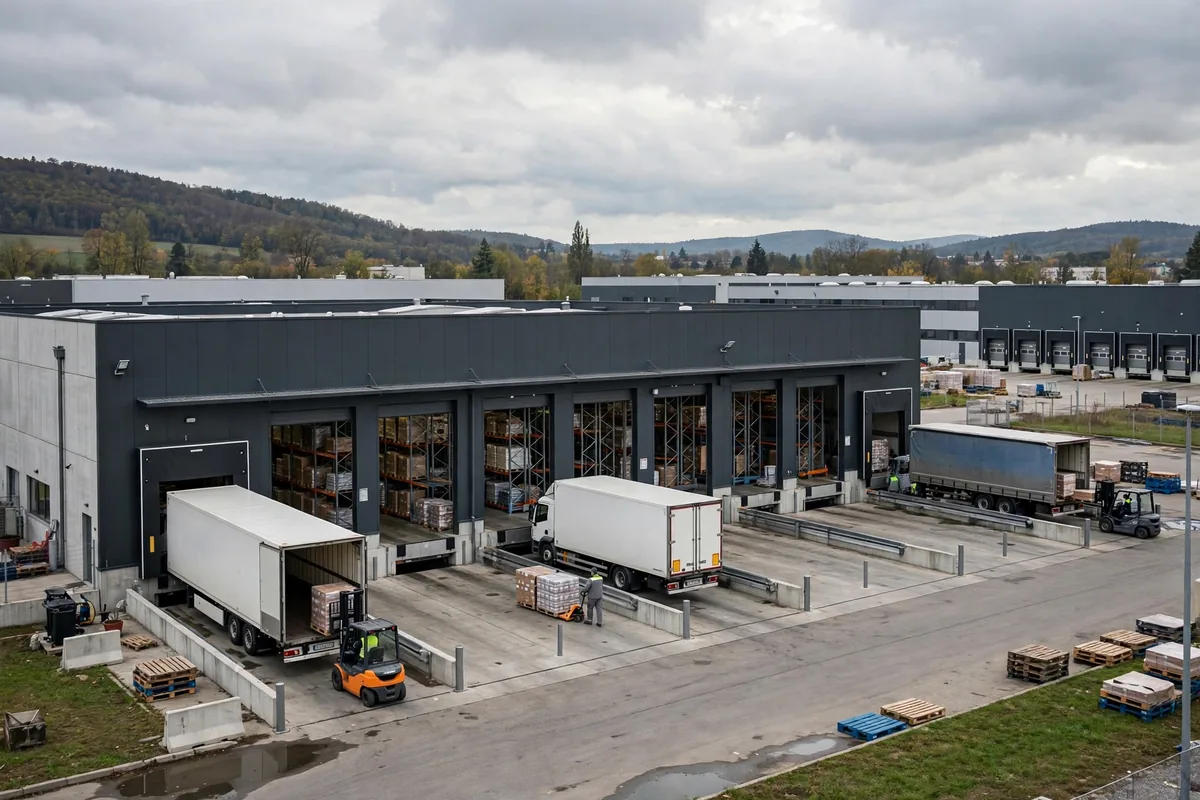
Any serious discussion of zagreb croatia warehouse logistics has to resist a tempting shortcut, namely treating Zagreb as a smaller Vienna or Budapest simply because it sits where Central Europe meets the Balkans on the map, because a node earns its role not from geographic centrality alone but from stable inbound channels, institutional continuity on its outbound routes, and a local supply structure that can absorb outside demand without excessive organisational cost, and in Zagreb those three conditions form an asymmetric pattern that should shape every warehousing decision made there.
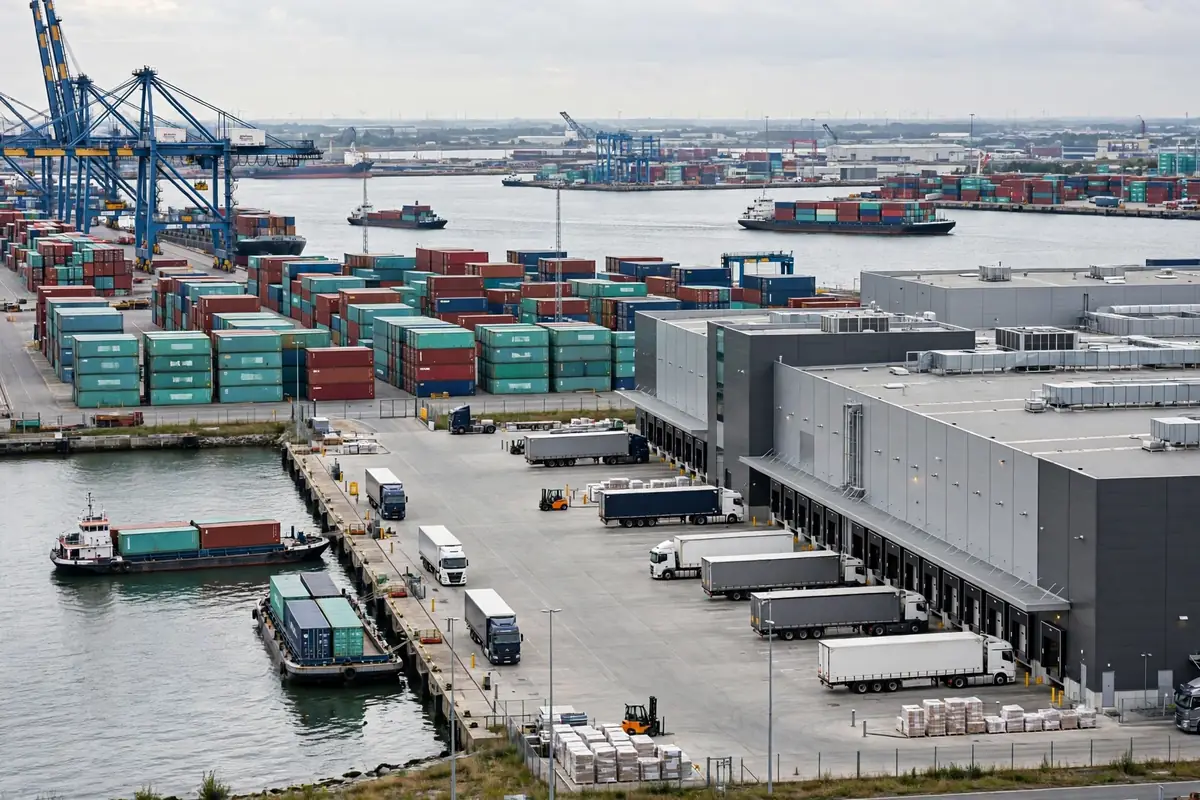
The first element is the division of labour between coast and inland. Seaborne imports enter mainly through Rijeka on the northern Adriatic, while Zagreb performs inland consolidation and distribution, the two linked by road and rail corridors. According to public port and corridor material, Rijeka's role is structural rather than the product of one strong year, although precise volumes should be taken from the latest official releases. A Zagreb warehouse therefore does not mark the start of the supply chain, which starts with arrival, clearance and inland transfer from Rijeka, and if that leg is budgeted as ordinary domestic transport, later inventory calculations will be too optimistic.
zagreb warehouse inbound: why Rijeka sets the tempo
The Rijeka channel offers value and constraint in equal measure. Its value lies in providing an Adriatic entry point that avoids routing goods through northern European ports and back south, which makes directional sense for cargo shipped from Asia and consumed in Croatia and neighbouring markets. Its constraint lies in scale and scheduling. Port capacity and inland corridor arrangements transmit a comparatively fixed rhythm into arrival windows at a Zagreb warehouse, which suits planned replenishment far better than high-frequency, small-batch replenishment built around aggressive delivery promises. Choosing this channel is a choice to trade flexibility for directional certainty, not a choice of a channel that can simply be accelerated whenever sales spike.
A hypothetical illustration makes the mechanism clearer. Suppose a consumer goods seller receives two planned inbound batches per month through Rijeka, rents a mid-sized warehouse near Zagreb, and distributes onward to Slovenia, Hungary and Bosnia and Herzegovina. If replenishment is tightly aligned with vessel and inland transfer schedules, warehouse waves remain even and handling costs stay predictable. If the sales side generates frequent urgent orders and expects ad hoc transfers in response, the mismatch between inbound and outbound rhythm quickly forces safety stock upward. The extra cost does not come from rent but from inventory held to hedge a rigid channel. The figures in this illustration are deliberately illustrative; the structural relationship is the point, namely that the more rigid the channel, the more the inventory strategy must be decided in advance.
croatia logistics after Schengen and the euro: a fan, not a circle
If the port determines physical rhythm, institutions determine the shape of cross-border friction, and this is where zagreb croatia warehouse logistics is most often oversimplified into a headline about Croatia joining the euro area and the Schengen area. The two changes operate on different layers. Euro adoption mainly simplified settlement and pricing for trade already denominated largely in euros, reducing conversion and quotation friction. Schengen membership mainly improved the predictability of movement toward fellow members such as Slovenia and Hungary. Together, they made distribution northward and westward from Zagreb institutionally more continuous than before.
The boundary of that benefit is equally clear, because Bosnia and Herzegovina sits outside the same framework. Movements in that direction still involve customs and border procedures, and documentation, lead times and delivery promises cannot be extrapolated from Schengen-internal experience. Zagreb's effective service area is therefore not a circle in which equal distance means equal lead time, but a fan in which institutional friction differs sharply by direction. It extends relatively smoothly toward Slovenia and Hungary, while the Bosnian direction requires its own compliance and lead-time budget. Companies that manage all three directions under one promise and one cost model tend to discover the difference later, as complaints, returns handling and expediting costs.
A second scenario shows how this fan shape affects location decisions. Consider a distributor of household goods that previously served Croatia from Hungary and, after Croatia's institutional integration, reassesses moving stock for Croatia, Slovenia and Bosnia into Zagreb. What changes is not a single road freight quote but the possibility of consolidating separate frictions, currency settlement, border waiting and fragmented reconciliation, into a more unified model, with steadier planning for vehicles and finance. Yet the Bosnian lane remains separately budgeted, with local partners handling clearance and final delivery. Institutional integration lowers systemic friction; it does not abolish directional differences.
warehouse logistics supply reality: a market of smaller warehouses
On the supply side, the Zagreb market is characterised by stock in which small and mid-sized warehouses account for a substantial share, while the choice of very large, high-specification facilities for a single tenant on a long lease is comparatively limited. Precise figures for stock composition, vacancy and rent levels should be taken from the latest local market reports; the argument here concerns orders of magnitude and structure rather than any specific figure. That structure cuts both ways. For mid-volume distribution of relatively concentrated consumer goods, it allows a phased entry, testing the model before committing to larger space, and flexibility is a genuine advantage. For operations requiring extensive automation, very large single-floor plates and deep systems integration, adaptation costs rise quickly, and management effort on site selection, retrofit and multi-site coordination can consume much of the benefit the location appears to offer.
This leads to a counterintuitive judgement about zagreb croatia warehouse logistics, which is that Zagreb's main weakness is not its location but the limited depth of scalable supply. Location assessments often ask first about rent and then about transport links, and only later about whether the local market can provide the building type and expansion path the operating model requires. If building fit is poor, losses in daily efficiency persist for the life of the lease and cannot be compensated by negotiating a lower rent. Rent is the visible cost; building fit determines the floor under the invisible costs, and over a long contract that floor is systematically underestimated.
The following framework summarises the matching logic rather than offering a universal verdict.
| Dimension | Better suited to Zagreb | Poorly suited to Zagreb |
|---|---|---|
| Product profile | Consumer goods for Central European and Balkan distribution, such as household goods, small appliances, apparel and personal care, with plannable turnover | Highly time-critical ranges dependent on frequent rolling replenishment |
| Distribution direction | Croatia plus Slovenia and Hungary as core, Bosnia as a separately budgeted extension | Operations centred on non-Schengen directions but promised at Schengen-internal lead times |
| Replenishment model | Planned replenishment aligned with Rijeka arrivals and inland transfers | Ad hoc replenishment expecting the channel to accelerate on demand |
| Operating model | Mid-volume, phased expansion, manual and semi-automated distribution | Very large single-site, highly automated operations needing immediate scale |
| Settlement | Euro-denominated regional business seeking consolidated reconciliation | Volumes so small that standalone warehousing costs exceed direct shipping or third-party options |
The trade-off is that Zagreb offers certainty on channel direction and institutional continuity, at the price of constraints on supply elasticity and scale. What a company obtains is not the lowest cost on any single line, but a balanced total cost structure for a specific combination of products and directions. When the mix falls on the suitable side, that balance has real value; on the other side, the same conditions reappear as friction to be hedged at every step. The node itself is neither right nor wrong; the matching relationship is what succeeds or fails.
Zagreb's node value is undergoing a slow reappraisal driven not by a single event but by corridor investment, gradual institutional integration, and regionalisation of consumer goods distribution across Southeast and Central Europe. On that timeline, the more defensible judgement is that Zagreb will strengthen its role as a regional distribution point at the southern edge of Central Europe and the northern edge of the Balkans, rather than evolving into a hub handling all-European volumes, for which depth of supply, channel redundancy and freight density are not yet sufficient. That positioning of zagreb croatia warehouse logistics may sound less exciting than the language of emerging hubs, but it has the advantage of being testable against inventory, contracts and delivery performance.
Whether that judgement survives will depend on two open variables: whether smaller warehouses can upgrade at a pace matching changing demand, and whether coordination between Rijeka and the inland corridor can preserve the reliability planned replenishment requires as volumes grow.
By Dr. Chen, Supply Chain Researcher