
Let me tell you something: I learned about yard safety the hard way, with a cold sweat.
A couple of autumns back, I delivered to a warehouse out in the Inland Empire. Truck parked, I hopped down and walked toward the office with my paperwork. I had just stepped around the nose of a trailer parked next to me when a forklift came flying out from behind it, pallet loaded high, horn blaring, brakes squealing. I jumped back. It stopped two or three steps away. The driver stuck his head out, completely unbothered: 'I drive this route every day.'
I stood there with wobbly knees. That's exactly the problem. Drive this route every day, and every day you almost hit somebody.
I've been running roads for years. Here's the pattern: inside the warehouse, everything is managed — racks, slots, systems watching. Out in the yard? Trucks, forklifts, and people on foot share one slab of concrete, everybody running on luck. And luck runs out. Yard safety isn't fixed by posting two more guys out there to shout. It's fixed when a YMS separates people, vehicles, time, and routes first, then makes the rules stick.
Yard Safety Is Not Luck — It's Staggering Arrivals
The yard gets dangerous when everybody shows up at once. Monday afternoon, pre-holiday stocking, peak-season outbound — a dozen trucks pile into one yard, only so many dock doors, and drivers who can't find their door start circling. A circling truck makes forklifts yield, makes pedestrians dodge, turns the yard into a parking lot. Chaos is the warm-up act for an accident.
The first thing a YMS does for yard safety is spread arrivals out. Appointments aren't there to hassle drivers. They exist so trucks come one at a time, not all at once. The system tells the driver ahead of time: arrival window, route in, staging area, door. No circling, no fighting over doors. Fewer trucks means clearer roads, and clearer roads mean far fewer accidents.
One warehouse changed exactly this and nothing else. Every Monday around noon, ten-plus trucks jammed the yard, horns going off, drivers glaring at each other. Then they spread the appointment windows out. Same doors, same crew — just fewer trucks in the yard at any one moment. For the first time, the yard looked like a road system, not a flea market. That tells you something: a lot of yard accidents aren't caused by bad drivers, but by a schedule that squeezes everybody into the same hour.
Yard Safety Means Three Separate Roads for Trucks, Forklifts, and People
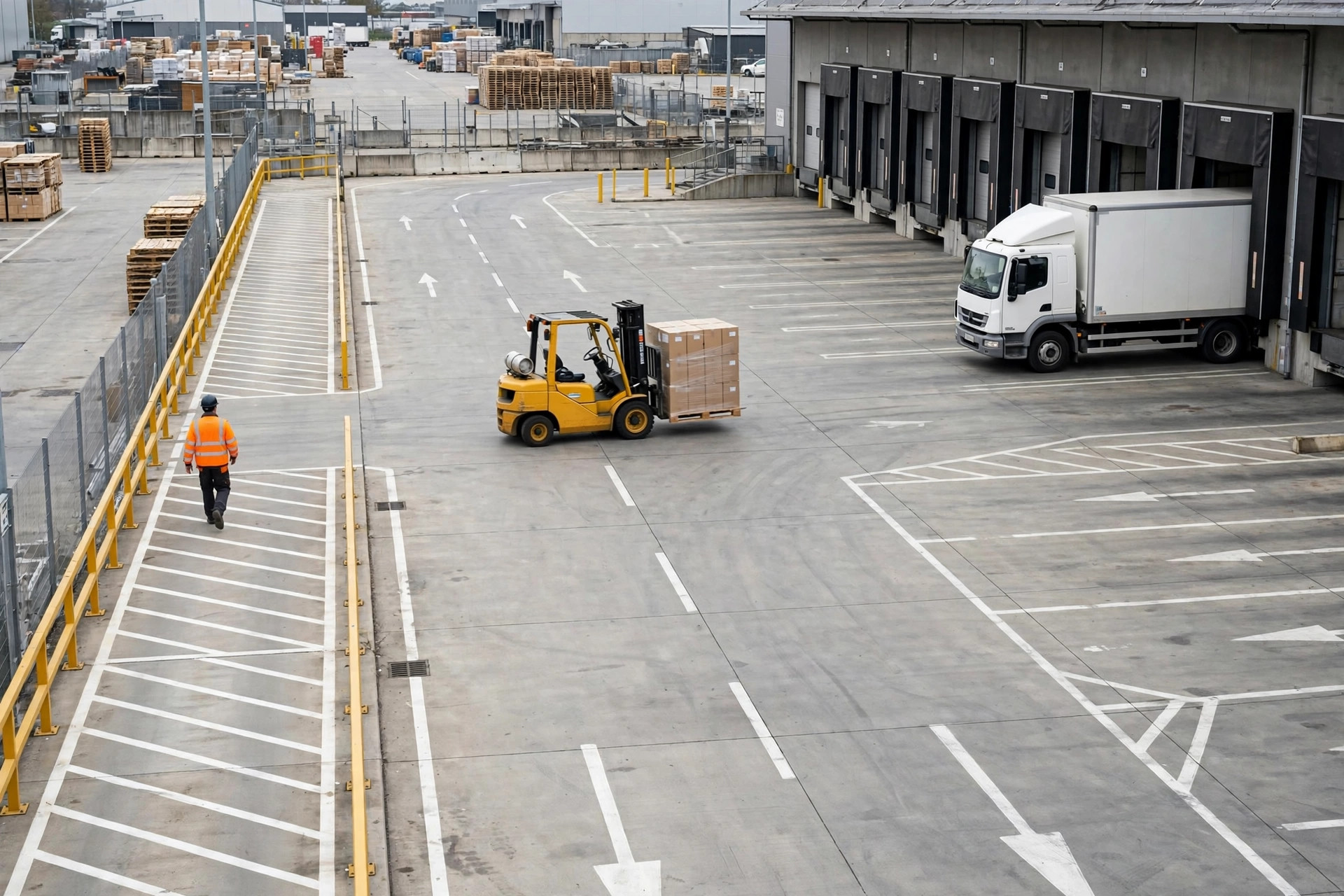
Timing handled, you still have to separate the traffic. There are really only three kinds of traffic in a yard: trucks, forklifts, and people on foot. Different speeds, sight lines, stopping distances. Mix them in one lane and sooner or later somebody gets hurt. A serious yard gives each of them its own road.
Trucks get truck lanes: one way in, one way out, no U-turns mid-yard, no backing across open concrete. Forklifts crossing the yard get their own work zones and speed zones — and don't be fooled by open space: a loaded forklift at speed won't stop when you want it to. A National Safety Council bulletin suggests no more than 3.5 miles per hour for forklifts in congested areas — not to slow drivers down for fun, but to leave everybody a stopping distance. Pedestrians get a real walkway, with guardrails or bollards separating it from vehicle traffic — not just a painted line. Paint disappears under truck tires. A guardrail is real.
A rule a lot of people don't know: under OSHA's rules, forklifts must yield to pedestrians, and aisles and passageways have to be clearly marked and kept clear. If a load blocks the driver's forward view, the driver is supposed to travel with the load trailing, not push forward blind. These aren't fancy best practices — they're basic requirements in 29 CFR 1910.178 and 1910.176(a). And here's the illusion that gets pedestrians hurt — they assume the driver sees them. A forklift has blind spots behind it, and a tall load creates one in front. You can stand in a blind spot waving, and the driver genuinely may not see you. Separate roads mean pedestrians never have to bet their lives on a driver's eyesight.
Here's the counterintuitive part: the most dangerous time in a yard isn't when it's crowded — it's when it's empty and wide open. When it's crowded, everybody slows down and watches each other. When it's empty, people relax: the forklift speeds up, the pedestrian cuts a corner, the truck driver backs into a dock in one swing. That's why separated routes and speed zones have to hold every single day, busy or not.
At the Dock Door: The Riskiest Sixty Seconds
The riskiest spot in a yard isn't the big intersection. It's the sixty seconds when a truck backs into a dock door. The driver's mirrors are full of blind spots, and the closer the trailer gets to the door, the less he can see of anyone near it. If somebody walks out of that door with paperwork, or a forklift rolls out to meet the truck, neither sees the other coming.
I saw it happen once. A driver was backing into a dock, and a young warehouse guy walked out with a clipboard, trying to hand the driver his papers. The driver never saw him. An old-timer on the dock yelled, the driver hit the brakes, and the kid's clipboard hit the ground. After that, the warehouse made a hard rule: no truck backs into a dock without a spotter standing where the driver can see him, and the backing zone cleared — no forklifts, no pedestrians — until the truck is set. No spotter, no move. Clumsy, but that door hasn't had another close call since.
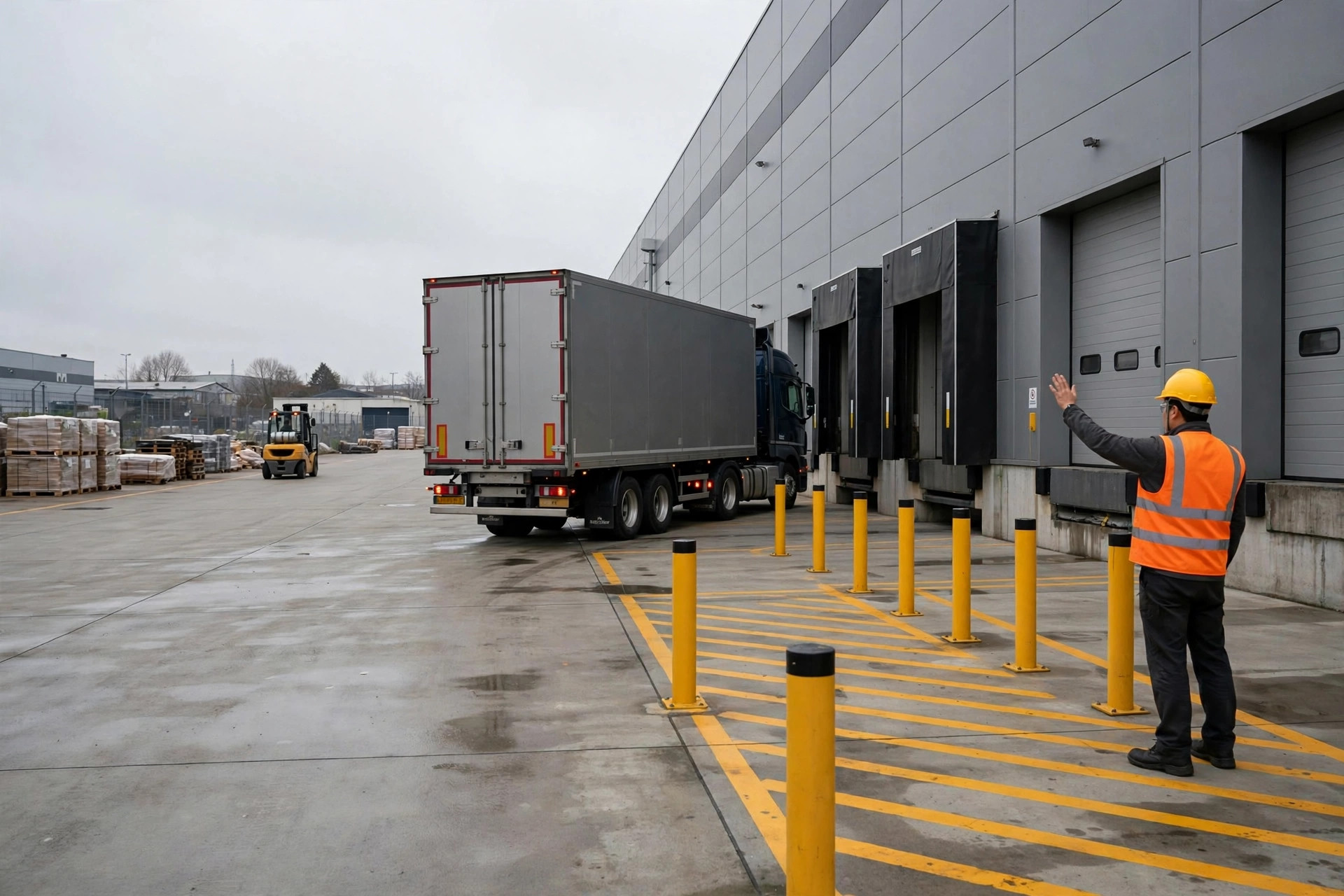
This is where a YMS earns its keep. The system sets it up in advance: this truck, this door, this time, this zone cleared, this spotter. Backing and forklift loading get scheduled apart, so they don't collide in the same minute. The driver doesn't have to guess — the system tells him his door, his route, his spotter. Turning 'we rely on each other paying attention' into 'we rely on the plan' locks down those sixty seconds.
Don't Just Argue After an Incident — Write It Down
When something small happens in a yard — a scraped fender, a near miss — most people's first move is to argue. The driver blames the forklift, the forklift blames the pedestrian, the pedestrian blames the warehouse. Everybody walks away, and next week it happens in the same spot. Arguing is the most useless response. The useful one is writing it down.
Log every incident and near miss in the YMS: time, door, truck, route, truck count in the yard. After a few months, the pattern shows itself — one door, one time of day, one forklift route that keeps crossing the walkway. Once you can see the pattern, the fixes have a target: change the route, the time, the speed zone, add a guardrail. Without records, every improvement is a guess.
| Approach | What it controls | What it can't control |
|---|---|---|
| Shouting | One risky move, right now | Nothing after people walk away; nothing at peak hours |
| Signs | Reminds everyone rules exist | Habits — a sign seen a hundred times becomes invisible |
| YMS plus rules | Staggered times, separated routes, cleared backing zones, incident reviews | Needs people who stick with it |
That's my summary after all these years. Shouting and signs aren't useless — they're just backup. What keeps a yard safe is tying time, routes, dock doors, and records together in one system, so the rules stay the same every day.
My advice for shippers and warehouses — you can start tomorrow: draw a yard traffic map. Put truck routes, forklift work zones, the walkway, dock backing zones, and blind corners on one sheet, and post it in the drivers' break room and at the dock doors. Then ask three questions against that map: does the walkway have real barriers? Where do forklift routes cross pedestrian routes? When a truck backs in, where exactly does the spotter stand? If you can't answer those three, the yard isn't managed yet. Once the map exists, use the YMS to lay appointment times, routes, and door assignments on top of it. One step at a time.
There's an old saying among drivers: better three minutes late than one second early. That minute you save by rushing in the yard isn't worth a fraction of one accident. Trucks a little slower, people waiting a little longer, roads kept clean and separate — that's a safe yard.
By Shifu Zhao, Trucking Veteran (15 yrs)




