Let me tell you something. After 15 years behind the wheel, what scares me isn't traffic jams or midnight deliveries. It's rolling into a yard with a hazmat load on board, watching a parking lot full of trucks in chaos, and realizing nobody has any plan for where my truck should park. How a YMS — a yard management system — handles segregated parking for hazardous-material vehicles isn't some fancy technology — it's basic common sense: separate them, keep escape routes open, don't bunch them together. But every yard I've seen get burned was burned because of exactly this.
The Scene at the Gate That Made My Blood Run Cold
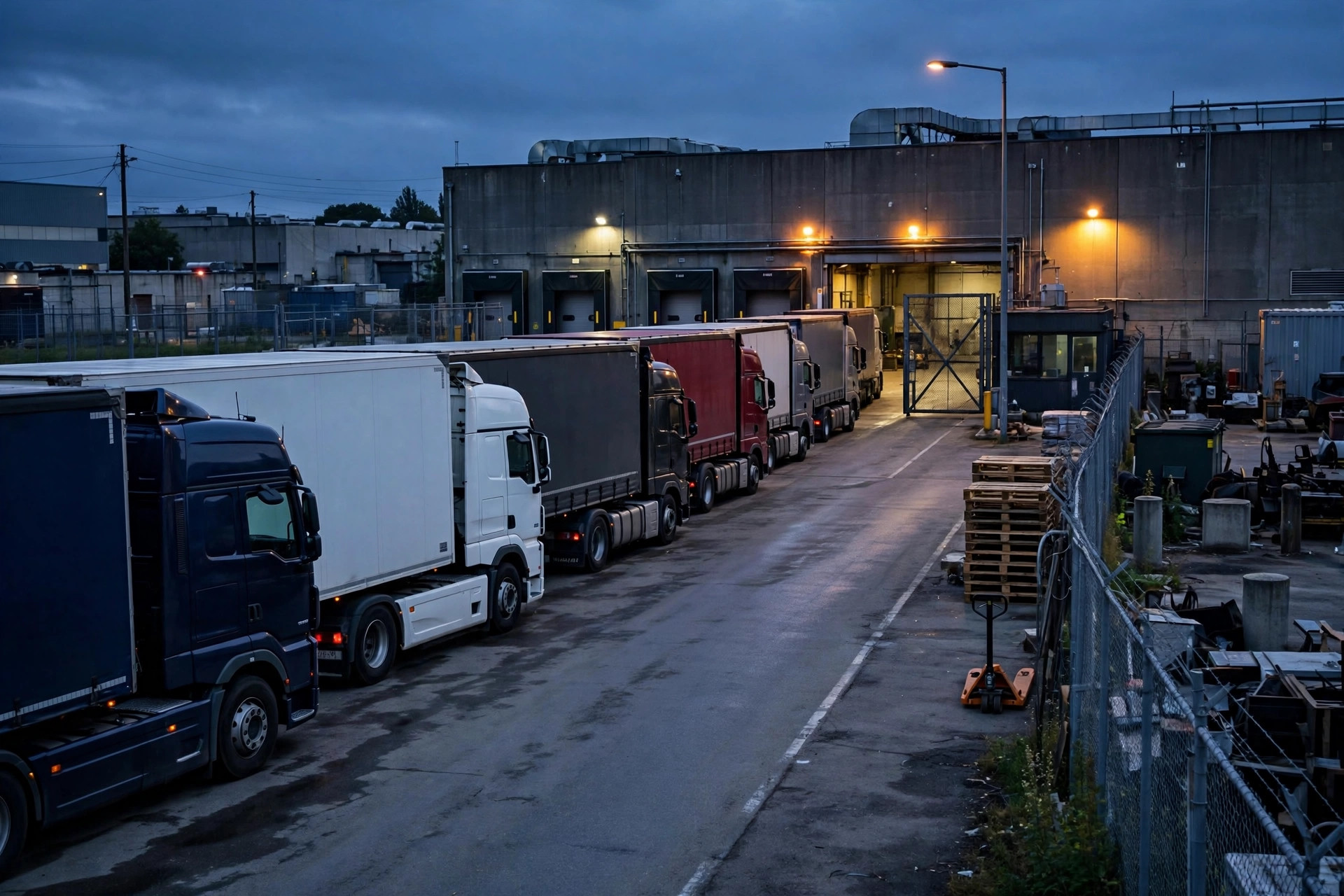
September 2024, Zibo, Shandong Province — a chemical logistics park. Around 3 PM, peak arrival hour. I'm in my cab in the entry queue, and ahead of me is a box truck hauling paint thinner, red flammable diamond placard on the side, lined up with a bunch of regular box trucks hauling furniture. The gate guy glances at a paper manifest, waves it through. Where does it park once inside? Nobody tells the driver. He just finds an empty spot himself.
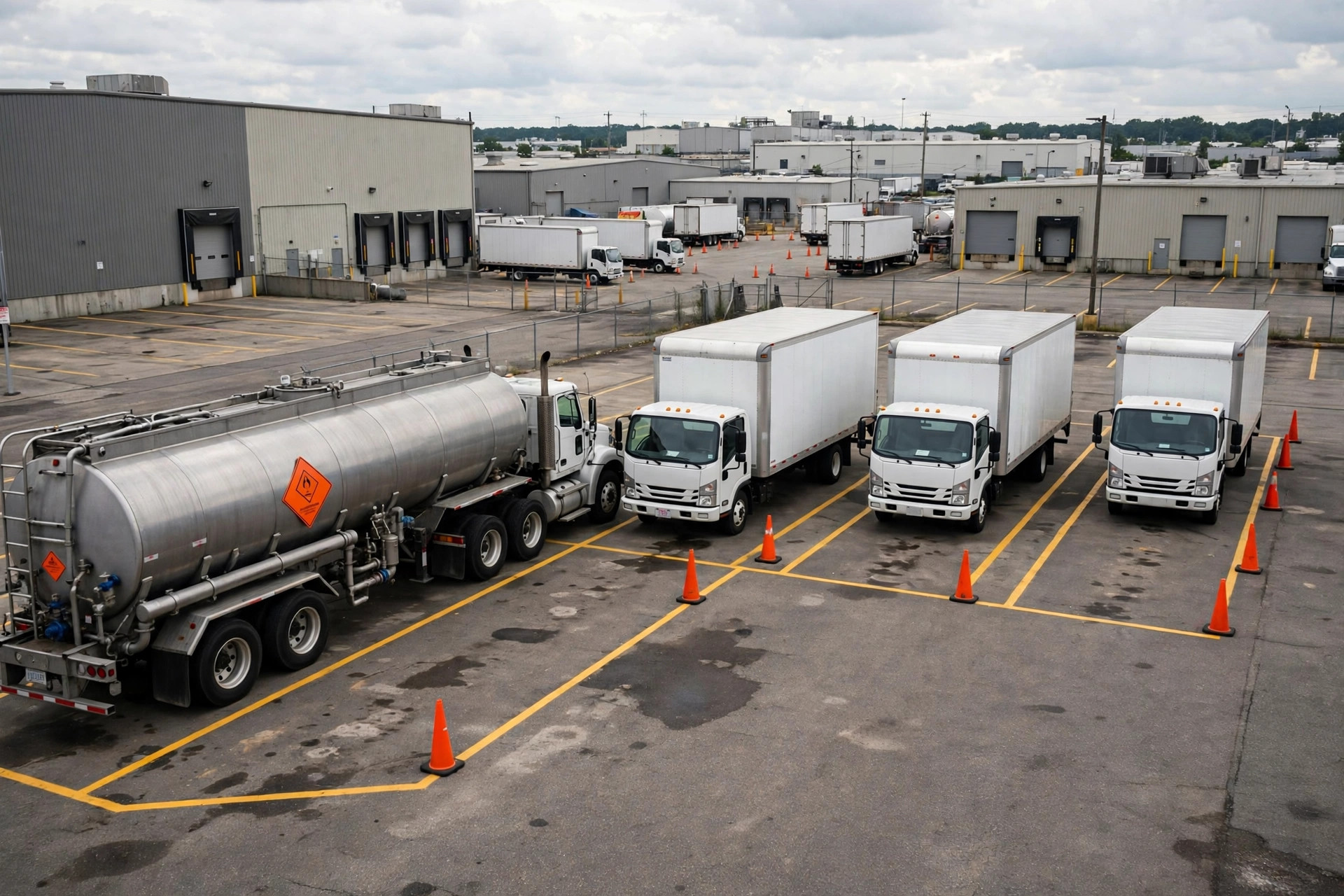
That day I watched: the thinner truck parked at the west end of the yard, maybe two or three meters from a tanker hauling hydrogen peroxide. Two loaded trucks — one flammable liquid, one oxidizer — parked almost bumper to bumper. If anything went wrong with one, the other wouldn't even have time to move. I sat in my cab and my back went cold.
Nothing happened that day. Pure luck. But think about it — what if it had? Luck is the worst safety program.
The Ones That Actually Blew Up Blamed It on "Saving Trouble"
Summer 2023, Langfang, Hebei — a warehousing park. The park stored plenty of chemical raw materials, and the good stuff and the dangerous stuff were managed as one big mixed pile. One day around noon, at the worst heat of the day, a box truck hauling butanol — another flammable liquid — parked right in the middle of the yard. It was the breeziest spot, so the driver figured it was cooler there. Less than ten meters away: the park's e-bike charging shed. A few meters beyond that: stacks of empty pallets and an AC compressor unit.
At 12:30, smoke started coming off the side of a tire. Luckily someone was there, hit it with an extinguisher, the tire never caught, the cargo was fine. The park got fined tens of thousands by the fire department and shut down for a week of remediation. The shipper's goods sat locked inside the whole week, losses on top of losses.
The post-mortem: when that truck entered the park, the gate never knew it was hauling hazmat. The manifest said "chemical raw materials," and nobody thought twice. In the YMS, that truck was treated exactly like an ordinary one — same registration, same release, same parking. The shipper told me later that one shipment cost him a fortune in fines, delays, and claims — all of it "saved" by cutting corners.
Fifteen years on the road taught me this: for a hazmat truck, the most dangerous part of the trip was never the highway. It's the last few hundred meters — from the gate to the parking spot. You can drive perfectly for a thousand kilometers, and if nobody manages those last few hundred, it all counts for nothing.
Segregated Parking for Hazmat Vehicles: Separate Them — Don't Just Push Them Far Away
When I've talked to yard managers about this, the first thing most of them say is: "Hazmat parking? Just stick it in the farthest corner, far from the warehouse, problem solved."
Let me tell you — that's a trap, and a counterintuitive one. The farthest corner usually has three problems: no cameras watching it, so nobody sees trouble early; fire trucks can't reach it quickly, so a real incident means the fire engine circles half the park; and nobody patrols it at night, so a driver smoking in his cab or a slow leak goes unnoticed. Far away doesn't mean safe.
The well-run yards I've been through do it more or less the same way. Four rules:
Separate by chemistry. Flammables with flammables, oxidizers and acids in their own zones. The park should post a simple incompatibility chart at the gate — drivers can't read chemical names, but they can read "these two must never park next to each other."
Separate from regular trucks. Hazmat trucks need their own marked zone — painted lines, signs, cameras — off-limits to ordinary vehicles. That zone should be reasonably close to the loading area (drivers wait for loading), but set well apart from offices, dormitories, and charging sheds. Exact separation distances vary by local fire code — follow your local fire and emergency-management requirements.
Reserve emergency access in advance. When you paint the parking lines, paint the fire lanes first — entry and exit in both directions, not a single pallet allowed in the lane. The classic failure: the lane is marked on paper but gets blocked by staged freight and parked forklifts. That lane belongs to the fire department, not to anyone's convenience.
Driver stays with the truck, or at least stays reachable. While a hazmat vehicle is parked, the driver should stay with the rig or in the designated rest area, phone on. The park posts emergency numbers and evacuation routes.
What a YMS Should Actually Do About Hazmat Vehicles
Somebody always asks at this point: all this sounds right, but when dozens of trucks show up, who remembers which truck is carrying what?
Nobody can remember. A system can. Here's what a yard management system can do about hazmat trucks, step by step:
Split traffic at the appointment stage. When the driver books the entry slot in the YMS, he declares the cargo category. Hazmat declarations automatically get a hazmat time slot and a hazmat parking bay — never mixed in with regular traffic. No declaration means manual inspection at the gate and an extra half hour — once the time cost is real, drivers start declaring in advance.
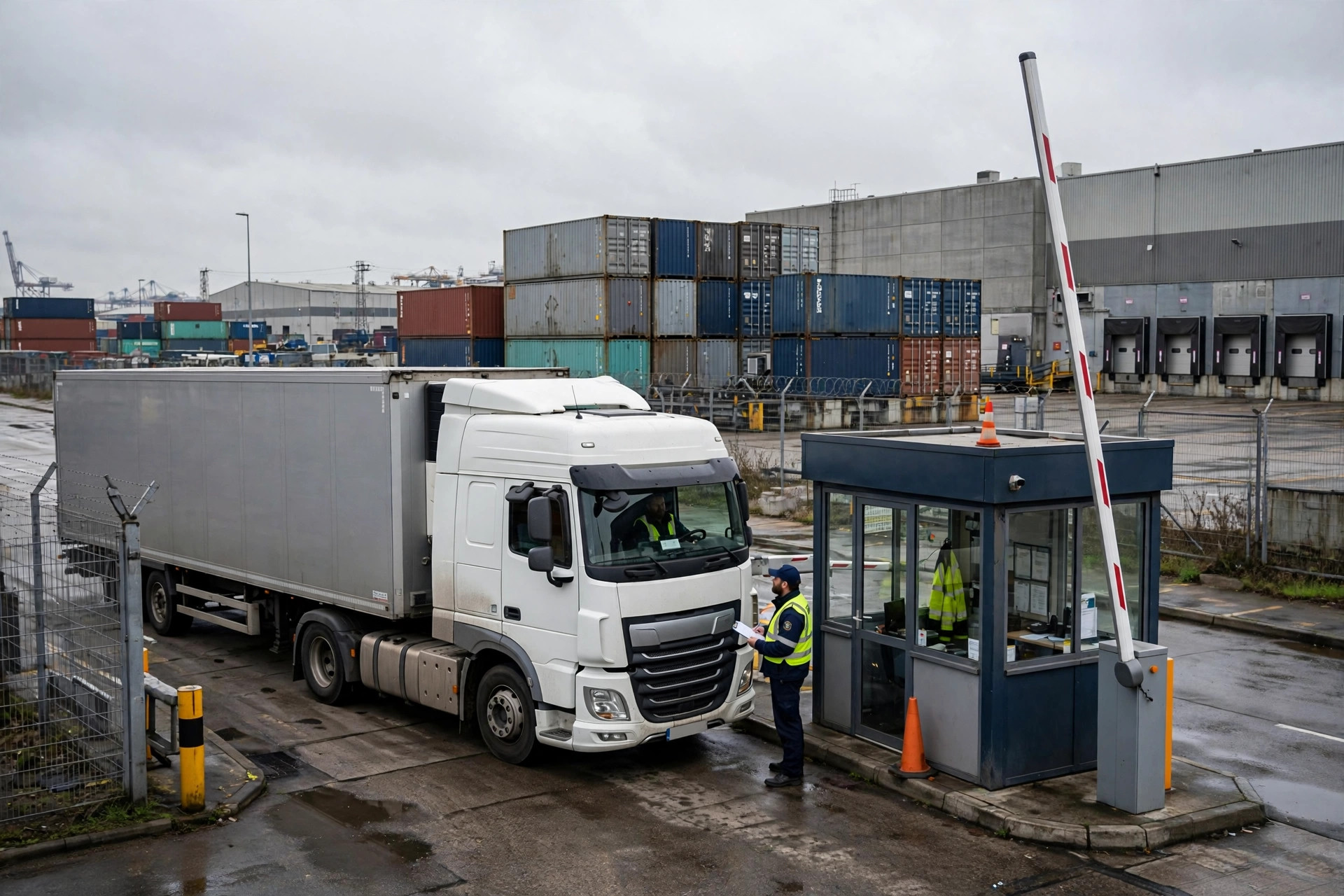
Intercept at the gate. The YMS pushes vehicle info to the gatehouse: plate number, cargo category, assigned zone. The gate officer doesn't have to remember anything — one look at the screen tells him where this truck goes. No appointment, no permit, cargo doesn't match the paperwork? Turned away. The gate is the sluice of the whole chain. A loose gate makes everything downstream pointless.
Auto-assign the parking bay. Based on cargo type, quantity, and an incompatibility matrix, the system assigns each truck a bay. The driver gets the bay number on his phone and follows the yard signage. A misparked truck triggers an alert. That's far more reliable than a human flagger, who loses track the moment things get busy.
Timeout and exception alarms. If a hazmat vehicle overstays its slot or leaves its assigned zone, the YMS alarms the yard supervisor automatically. And if something really happens, the system can pull up in seconds: what the truck is carrying, how much, exactly where it's parked. When the fire crew arrives, those facts save lives.
Now do the math: a yard painting ten dedicated hazmat bays — lines, signs, cameras — is a one-time spend in the low tens of thousands of yuan. Adding a hazmat module to the YMS is modest development work. Now flip it: one small incident — the fine, the shutdown, the shipper's claim, the insurance hike — adds up to hundreds of thousands, easily. Anybody can do this arithmetic.
For shippers and warehouse operators, my advice is three things, all of them learned the hard way over 15 years:
First, when you're picking a yard to work with, ask how they manage hazmat trucks before you ask about the rent. A yard that manages them sloppily is a trap no matter how cheap — one incident and everything you saved goes back with interest.
Second, transport classification and warehouse classification are two different things. "Flammable liquid" on the truck and "Class A goods" in the warehouse come from different standards. The YMS segregation logic and the warehouse zoning logic have to match up — don't let one side do it right and the other side mix it all up again.
Third, walk your fire lanes and check your extinguishers yourself, every quarter. Don't wait for the fire inspector to find a blocked lane and an expired extinguisher. Half a day of checking saves you from real trouble.
There's an old saying where I come from: careful driving gets you home every time. Segregated parking for hazmat trucks isn't something to fear being fussy about — it's something to fear being lazy about. One honest hassle today beats betting on luck tomorrow. Fifteen years on the road — that's my word to everyone who works with hazmat.
By Shifu Zhao, Trucking Veteran (15 yrs)