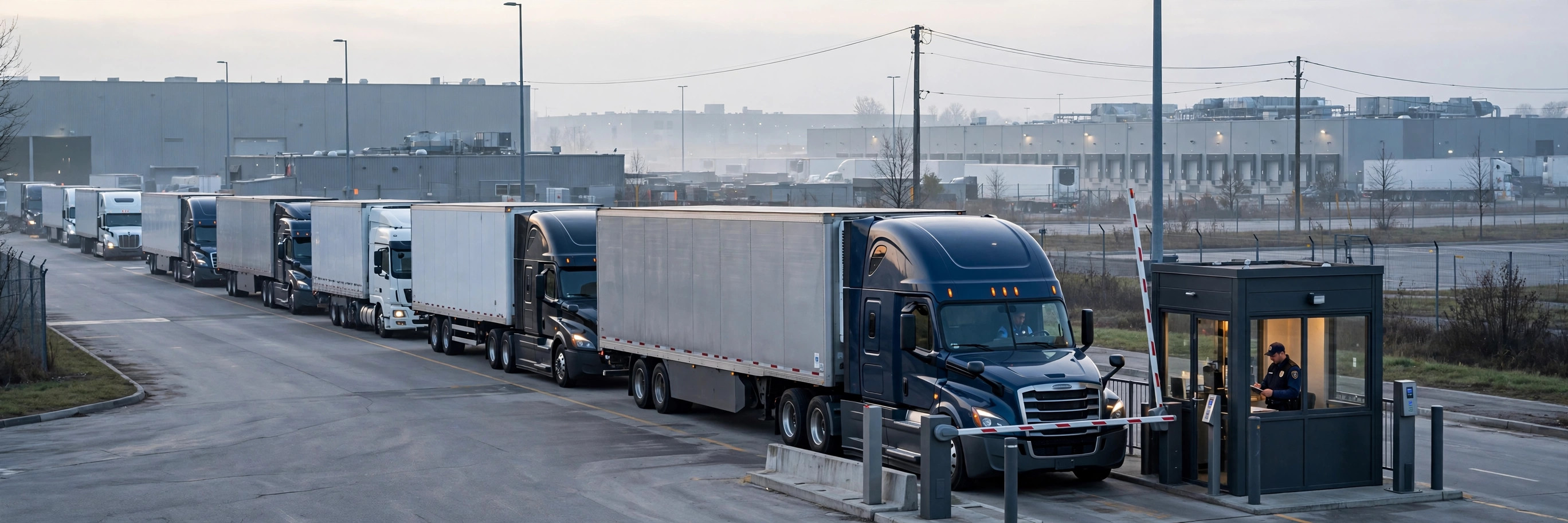
I don't run yards for a living. I read P&Ls. So when the CFO of a 3PL in Ontario, California asked whether cutting his YMS appointment windows from one hour to 15 minutes would save money, I didn't give him an operations opinion. I gave him a spreadsheet question: show me where the money actually goes.
His numbers told the story first. Twenty-four doors, about 110 trucks a day, one-hour appointment windows. Last year they paid $470,000 in detention. Real money, out the door, sitting in accounts payable.
His logic was simple: tighter windows, trucks arrive on time, detention drops. Before answering, I asked for three numbers — average driver wait time over the last quarter, the appointment no-show rate, and how many hours his planners spend rescheduling every day. When the math came back, the 15-minute window would have cost him roughly $50,000 more per year. That's money down the drain. So let's do the math before anyone touches that setting.
I'm a cost analyst by training, not a yard guy. But an appointment window isn't really an operations decision. On paper it's a YMS parameter — 15 minutes, 30 minutes, or an hour, a few clicks. On a P&L, it's a switch that controls several costs at once.
An appointment window is a cost switch, not an IT setting
First, detention actually paid. The most visible line. In the US, detention runs $75 to $125 an hour; I'll use $90 as the midpoint. Coarser windows mean looser dock schedules and longer average driver waits, so this line climbs fastest. One caveat: not every waiting truck turns into money — two hours of free waiting time is industry standard, and fewer than one in five waiting trucks ever becomes a paid invoice.
Second, planner labor. The finer the window, the more fragile the schedule — one truck 20 minutes late and the whole afternoon needs reworking, which means someone calling drivers and rebooking slots all morning. A full-time planner in the US costs about $67,000 a year, fully loaded. One-hour windows need one planner. Fifteen-minute windows need three, and sometimes that still isn't enough.
Third, no-show handling. A no-show truck doesn't vanish. Most get rebooked for the next day, but the dangerous 20 to 30 percent come roaring back the same afternoon — the gate squeezes them in, crews work overtime, someone argues with the carrier. Blended across all no-shows, each one costs about $60 in extra handling. It hides across half a dozen GL accounts, but it's real cash.
Fourth, idle-door opportunity cost. I'll discount this one upfront: it only counts if your doors are the constraint — if freight can't get in because doors are full. If you have spare doors anyway, the opportunity cost of an empty one is close to zero. So the table below totals only the first three. I'd rather be honest than impressive.
These costs fight each other: squeeze the first by tightening windows, and the second and third jump immediately. The finance way to decide is simple: add them up, smallest total wins.
The table: what each appointment window size actually costs per year
I modeled a 28-door distribution center running 96 trucks a day, 260 operating days a year, across the three window sizes. The inputs are industry-typical; plug in your own numbers and the direction of the answer won't change much.
| Annual cost | 1-hour window | 30-min window | 15-min window |
|---|---|---|---|
| Realized door utilization | 62% | 73% | 78% |
| Average driver wait | 55 min | 30 min | 22 min |
| Appointment no-show rate | 8% | 11% | 19% |
| Detention paid | $413K | $225K | $165K |
| Planner labor | $67K | $133K | $200K |
| No-show handling | $120K | $165K | $285K |
| Three-cost total | $600K | $523K | $650K |
Look at it closely. The finest 15-minute window has the lowest detention bill — and labor plus no-show handling eat every dollar of it, then another $50K on top. The coarsest one-hour window bleeds on detention alone. The cheapest is the middle: the 30-minute window at $523K a year, $77K less than one hour, $127K less than 15 minutes.
Here's the counterintuitive part: finer is not always better. The detention you save with a 15-minute window is paid for with more expensive labor and a higher no-show rate. Granularity is never free — it just moves money from 'paid to carriers' to 'paid to your own staff.'
The cautionary tale: a Chicago food DC burned a year on 15-minute windows
Early last year, a food distribution center outside Chicago — 18 doors — let IT cut appointment windows from 30 minutes to 15. The pitch: door utilization would hit 80%.
Utilization did reach 78%. Then everything else broke. Drivers couldn't hit 15-minute windows — one jam on the interstate and they're late — and the no-show rate climbed from 9% to 19%. Two planners spent every morning from 9 to noon doing nothing but rebooking, chasing trucks, and arguing with drivers. The no-shows flooded back in the afternoon, the gate crew worked overtime, and overtime ran $9,000 extra a month.
Year-end math: detention fell by a bit over $60K, but the extra planner headcount, overtime, and emergency handling added $140K. This March they switched back to 30 minutes. IT's own words: 'The system setting was fine. The math was wrong.'
Underneath sits a rigid rule: no-show rate is a function of window size. The finer the window, the harder it is for drivers to hit, and no amount of fines or blacklists fixes it — drivers don't want to be late, but the road has variance. Cut your window finer than the variance of the road, and no-shows are guaranteed.
The money-saving lever: calculate first, then cut
So how should you set it? One rule: don't go by feel. Pull three numbers and run the formula.
Monthly total cost = detention paid + planner rescheduling hours x 32 + no-show trucks x 60
Where to get them: detention paid is in your AP ledger; have a planner log rescheduling hours for one week; no-shows and wait times come straight from YMS reports. One afternoon of work tells you what your current window size really costs per year. If doors are your constraint, add one more term: idle door-hours x 45.
Then the decision becomes a simple question: if you tighten one notch — say, one hour to 30 minutes — does the detention saved cover the extra labor and no-show cost? If not, don't touch it. And if you're on 15-minute windows with a no-show rate above 15%, switching back to 30 minutes will almost certainly save money — every percentage point off the no-show rate saves over a thousand dollars a month in handling.
The calculable bottom line: for facilities running 50-plus trucks a day, the 30-minute window is most likely the total-cost minimum. Under 30 trucks a day, the one-hour window wins — there isn't enough detention to save to justify the extra headcount. Anyone running 15-minute windows below that line is paying for precision they can't afford.
By Lao Zhou, Logistics Cost Analyst