Here is the thing about Xian China Europe Railway Express warehouse work: the trains keep getting more frequent, and if your warehouse still works at the old pace, you will fall behind sooner or later.
In 2023, Xi'an ran 5,351 China-Europe freight trains, up 15.3 percent year on year. Since services began in 2013, the cumulative total has passed 21,400 trains. There are 17 trunk lines reaching 45 countries and regions across Eurasia. In the first seven months of 2024, Xi'an ran another 2,998 trains, up 28.6 percent, carrying 3.27 million tonnes. That kind of frequency would have sounded impossible a few years ago. But the warehouse side? Plenty of consolidation warehouses still work the old way: sort when the goods arrive, pick when the order shows up, load whenever someone gets around to it. Honestly, that is not warehouse operations. That is gambling.
I have sold cross-border e-commerce for five years, and I have moved a lot of cargo on the Xi'an route. Frequent trains are great news: space is easier to get and transit times are stable. But only if your goods reach the warehouse on time and board the train on time. If your cargo arrives a day late, the train will not wait for you.
The Train Timetable Is the Xi'an China-Europe Railway Express Warehouse Production Plan
The Xi'an to Budapest scheduled train X8159 departs every Saturday at 23:00 and takes 10 days and 23 hours door to door. The Xi'an to Poti route in Georgia runs 7,829 kilometers in about 15 days. See the pattern? The trains run on their own clock, and the warehouse needs its own clock, and the two clocks have to match.
My method is plain, but it works: take the departure time and work backwards into a warehouse production plan. A Saturday 23:00 departure means loading, paperwork, and yard entry all get scheduled backwards from there. As for getting goods to the warehouse, my practical advice, based on experience rather than any official rule, is to arrive 3 to 4 days early. Do not show up right at the cut-off. If the road jams or the warehouse gets busy, your shipment is in trouble.
Sellers underestimate cut-off time all the time. They think the cut-off is 5 p.m., so arriving at 4:59 p.m. is fine. Nice try. Queuing, inspection, labeling, and loading all take time. If you arrive at the last minute, the warehouse will push your cargo behind the early arrivals. You think you made it, but your goods are actually sitting there waiting for the next train.
The more frequent the trains, the harder the warehouse has to work. When there was one train a week, the warehouse could take its time. Now there are several departures a week, and the warehouse has to run like a production line. Today's train is not loaded yet, and tomorrow's cargo is already arriving. Without a board in the warehouse showing which train each job belongs to, workers cannot tell what to do first.
Splitting Across Lines: Do Not Put Everything on One Train
The Xi'an China-Europe Railway Express runs north, central, and south routes, with 17 trunk lines reaching 45 countries and regions across Eurasia. Having many routes is a good thing, and also a trap. The good part is choice: if one route jams, you can switch. The trap is laziness: sellers stick to one familiar route, and when that route has a problem, everything falls apart.
I learned this the hard way. One shipment went on my usual route, the border crossing got congested, the train was delayed for days, customers kept asking where their goods were, and I spent my days on the phone with the forwarder. After that, I changed my approach: a main route plus a backup route, written into my own shipping checklist. The main route runs normally, and the backup route's space and transit time are checked in advance, so I can switch immediately when something goes wrong.
Splitting routes also needs the warehouse to play along. Cargo for different routes should be stacked separately and labeled separately from the moment it enters the warehouse, not mixed together. Mix them up, and loading day turns into a treasure hunt, with all the time wasted finding goods. My plain method: zone the warehouse by route, and put the route and train number on the label so workers can find it at a glance. That small thing can save half a day in peak season.
Here is a counterintuitive call: the more frequent the trains, the less you should chase the fastest one. Everyone wants the fastest train, so space is tight, the cut-off is early, and the risk of being rolled is higher. Sometimes the second-fastest train, with steadier space and a more forgiving cut-off, actually arrives more reliably. Sellers cannot only count transit days. They have to count the chance of being rolled and the cost of arriving late. On time beats one day faster.
Rolled Cargo: The Warehouse Can Prevent Half of It
Every seller knows that feeling when cargo gets rolled: your goods are already in the warehouse, the train is full, and your container gets left behind. Customers ask where the goods are, and all you can say is that they are still in Xi'an. It is a miserable feeling.
There are many reasons cargo gets rolled: space, paperwork, inspection. But the warehouse can control two of them: getting the full shipment ready on time, and getting the paperwork right. If the goods are incomplete, the warehouse cannot load. If one character on the documents is wrong, customs clearance stalls, the train leaves, and your container sits in the yard.
My rule now: check the documents myself before shipping, matching the product name, piece count, and weight, and do not ship if the three do not line up. If the warehouse finds a problem during inspection, fix it immediately instead of waiting until the cut-off. And if goods arrive at the warehouse in separate batches, tell the warehouse in advance which batches belong to one shipment, so they do not split your cargo across two loads and waste time taking it apart again.
The table below is my own shipping checklist. The figures are an illustrative example, but the logic is what cuts the risk of rolled cargo:
| Check | My method | What happens if you are late |
|---|---|---|
| Goods arrival time | Practical advice: 3 to 4 days early | Arrive at the cut-off and queue for loading |
| Three document figures | Product name, piece count, and weight checked first | One wrong character blocks customs clearance |
| Route zoning | Stack by route and train from intake | Mixed stacks waste half a day in searching |
| Backup route | Main route plus one backup, space checked in advance | Main route jams and you can only wait |
| Cut-off confirmation | Confirm full readiness half a day before cut-off | Discover incomplete cargo at the cut-off |
See the point? Warehouse operations here need no fancy technology, just lead time and a checklist. The train schedule is fixed, the warehouse work is flexible, and flexibility has to follow the fixed schedule. Lead time is your lifeline.
An Inland Port Xi'an China-Europe Railway Express Warehouse Competes on Rhythm, Not Size
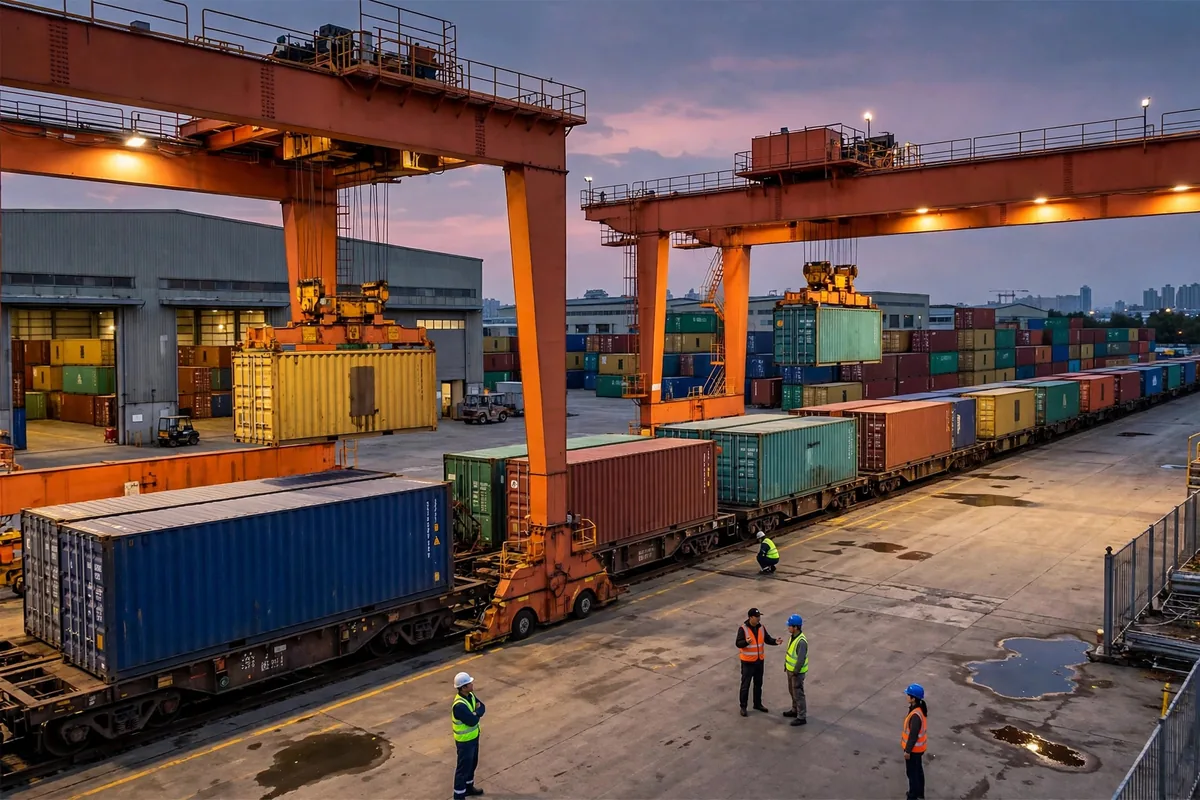
Xi'an International Port Station, at Chanba, is the originating station. For an inland port warehouse, the contest is not about floor area, it is about rhythm. A huge warehouse with no rhythm still gets jammed. A smaller one where every train's cargo is ready and loaded on time runs far more smoothly.
My advice to fellow sellers comes down to three points. First, pin the train timetable on the warehouse wall and plan production backwards from departure time. Second, give goods lead time at the warehouse, my practical advice is 3 to 4 days, and never cut it close to the cut-off. Third, keep a main route plus a backup, zone cargo by route at intake, and guard against rolled cargo in advance.
Frequent trains are a real advantage, but the advantage only goes to people who keep up with the rhythm. If the warehouse cannot keep up, it does not matter how many trains run. In the end, the Xian China Europe Railway Express warehouse bill comes down to one question: when the train departs, are your goods sitting steadily on board?
This trick worked for me, first hand.
By Ah K, E-commerce Seller (5 yrs)