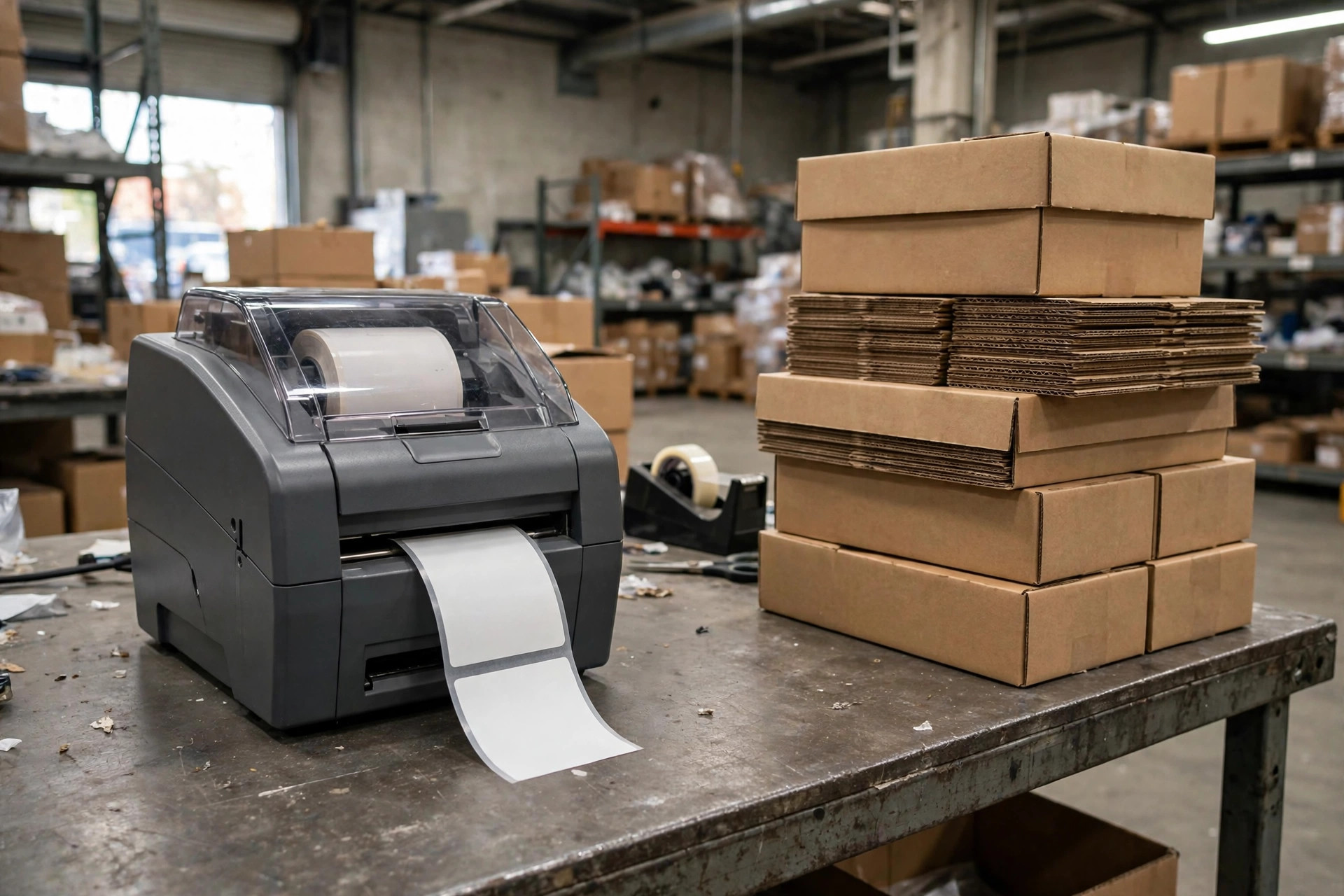
Here is the verdict up front: when tracking numbers go missing between your WMS and the carrier label system (a classic wms tracking number sync failure), 90% of the time it is not the label system's fault. Your WMS is dropping them. I have seen this exact pit three times across 30-plus WMS go-lives. During the 2024 peak season, a 3PL warehouse in Los Angeles shipping roughly 3,000 orders a day hit a 2% tracking-number loss rate. Customer service was drowning. The label system was perfectly healthy. All three leaks were on the WMS side, at the same three breakpoints every time: the label printed but the number never came back; the number came back but got attached to the wrong order; the number was correct in the WMS but never reached downstream systems. This article walks through how to find and fix each breakpoint, and closes with a go-live-night checklist you can copy verbatim.
Breakpoint 1: The Label Prints, the Tracking Number Never Comes Back
Whenever the loss is intermittent, look first at whether the label callback and the WMS write-back are asynchronous. Nine times out of ten, that is your answer.
At that 3PL warehouse, losses clustered between 2 PM and 4 PM every day — gone during quiet hours, back during the rush. The logs told the story: the label system returned the label PDF first, and the tracking number arrived later through a separate asynchronous callback with a 5-second timeout. During peak hours the label system slowed down, the callback arrived late, and the WMS had already recorded "label created." Labels printed fine, parcels shipped fine, and those orders sat in the WMS as "pending shipment" forever while customer service had no tracking number to give.
The fix has three steps, and none is optional. First, confirm label creation and number write-back separately: the label PDF arriving means "label created," but only a row in the shipment table with a tracking number means "number received." Store those as two separate status fields, never one. Second, make callbacks idempotent with retries: the label side will re-fire a callback when its network hiccups, so the WMS must recognize duplicates; and when a callback never arrives, the WMS must go fetch the number itself instead of waiting. Third, add a safety-net polling job: every 15 minutes, sweep all orders that have labels but no tracking numbers and look each one up against the label system. That polling job is a lifesaver — more on it below.
Breakpoint 2: The Number Comes Back but Lands on the Wrong Order
This breakpoint specializes in multi-parcel orders. The label system returns an array of tracking numbers at the parcel level — one order split across two parcels means two tracking numbers. But many WMS shipment tables are order-level, one row per order, and the developer took a shortcut: grab the first number in the array, stuff it into the order header, and throw the rest away.
In March 2025, a home-goods e-commerce warehouse fell into exactly this hole. A customer received the first parcel; the second parcel's tracking number did not exist anywhere in the WMS. Customer service looked up the first parcel's number on the carrier site, saw "delivered," and the customer insisted half the order was missing. A week of arguing later, they discovered the second parcel was still in transit — nobody knew its tracking number. The fix is straightforward: the shipment table must be parcel-level. One order with three items across two parcels gets two shipment records, each tracking number tied one-to-one to its parcel. There is a checklist item for this on go-live night: run a test order of three items in two parcels end to end, and both tracking numbers must be retrievable in the WMS.
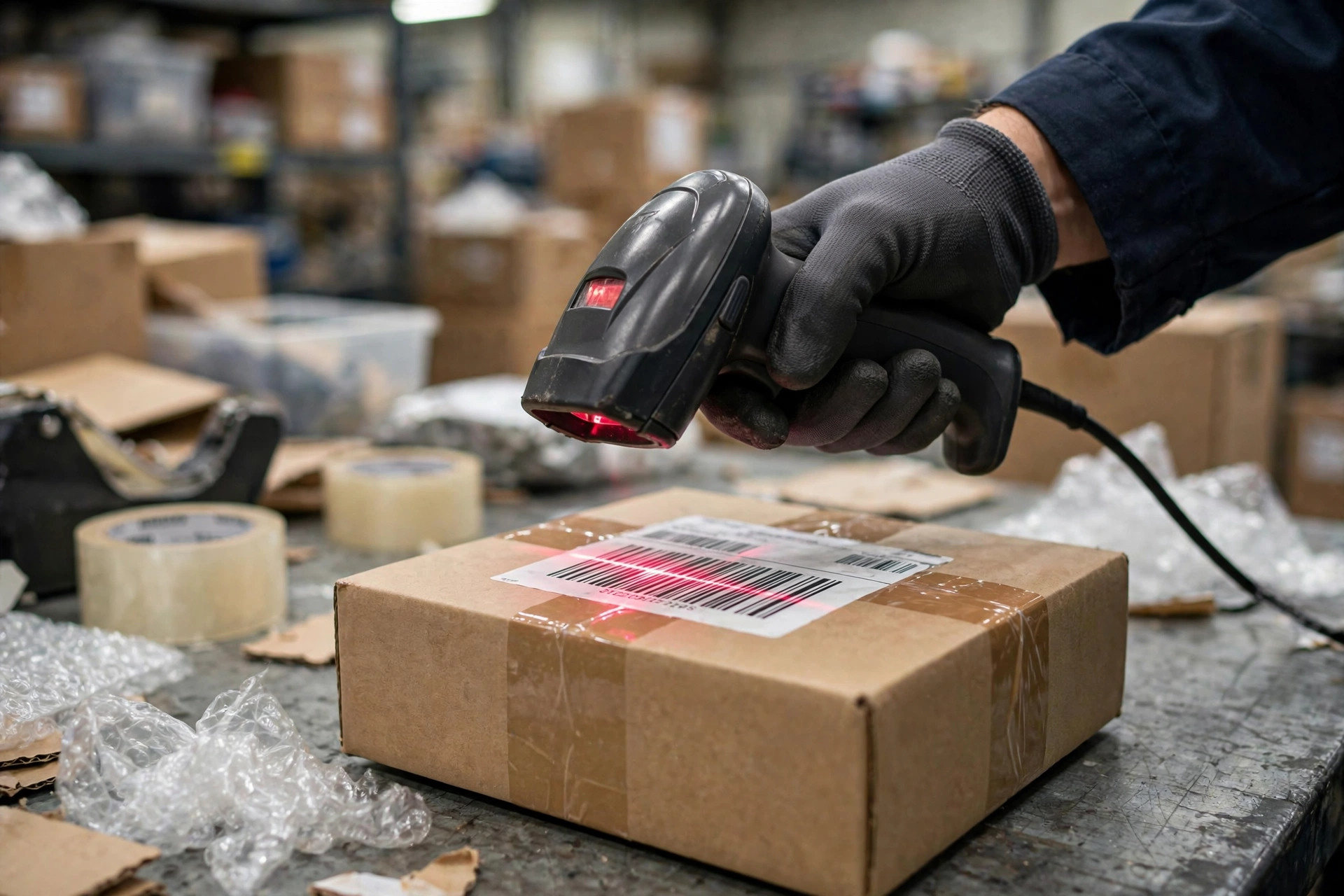
There is a companion step at the pack station: after the label goes on the parcel, the operator scans the label barcode with a handheld scanner, and the WMS verifies on the spot that the scanned number matches the one stored in the system. Three seconds per parcel. It catches the low-level but fatal mistake of labels on the wrong parcels. Do not skip it to save time — one mix-up costs more in customer service hours than a year of scanning.
Breakpoint 3: The WMS Has the Number, Downstream Never Gets It
The WMS shows every tracking number present, but the OMS and the sales channels still show blanks. I have seen this pit three times, and the root cause is identical every time: the push API returned HTTP 200, and the developer treated it as success.
A 200 only means "the request was received," not "it was processed successfully." At one warehouse, the WMS pushed to the OMS, the OMS returned 200, and the WMS marked the order "pushed." But the OMS database write had failed — the error was sitting in the response body, which the WMS never parsed. The loss rate was low, a few dozen orders a month, all "fake successes" of this kind. How to find it: store the full response body of every push in the logs, and sweep weekly for bodies containing error keywords. How to fix it: success must be judged by the other side's business status — either call their query API for a second confirmation or require an acknowledgment receipt. If a second confirmation is not possible, at minimum parse the body and raise an alert on error keywords.
The Counterintuitive Part: Stop Worshipping Real-Time Sync
Many teams believe real-time API write-back is the most reliable option — the more real-time the chain, the better. After 30-plus go-lives, my judgment is the opposite: the more links a real-time chain has, the bigger the failure surface, and wms tracking number sync failure almost always grows out of the belief that "real-time means bulletproof."
The trade-off is clear. Pure real-time: low latency, but any hiccup on the label side, the network, or the WMS drops numbers, and you are entirely dependent on retry logic — which is exactly the thing most likely to get cut before go-live. Real-time plus scheduled reconciliation: run a full reconciliation job twice a day, comparing every labeled order in the WMS against the label system's tracking-number records, and backfill whatever is missing. Reconciliation lags by a few hours, but the loss rate drops to near zero. My recommendation is both: keep the real-time write-back, and make the reconciliation job mandatory. It takes about two developer-days to build, and it is the only thing that lets you sleep at night.
The math makes it even clearer. At 3,000 orders a day with a 2% loss rate, roughly 60 orders a day need manual intervention. Each one — looking up the order, contacting the customer, reissuing the tracking number — takes about 5 minutes. That is roughly 150 hours a month, about a third of a full-time customer service rep. On the other side: a reconciliation job, two developer-days, running automatically every day, pushing losses below 0.1%. The arithmetic speaks for itself.
Go-Live-Night Checklist
| Check | How | Pass criteria |
|---|---|---|
| Label-created and number-received stored separately | Inspect shipment table status fields | Two independent fields, both required |
| Callback idempotency | Push the same tracking number twice | Second push recognized as duplicate, no dirty data |
| Active lookup on callback timeout | Kill callbacks for 10 minutes | WMS fetches numbers itself, no manual work |
| Full write-back for multi-parcel orders | Test order: 3 items, 2 parcels | Both tracking numbers retrievable in WMS |
| Pack-station scan verification | Watch the operator on site | Barcode scan is the standard step |
| Fake-success pushes | Read push-log response bodies | Error keywords trigger alerts |
| Scheduled reconciliation job | Check the scheduler config | Runs at least twice daily, full comparison |
| Loss-rate baseline | Measure daily in week one | Above 0.5% means same-day root-causing |
I have seen this pit three times, and every time the team thought "labels are printing, we are done" before go-live — then tracking-number write-back taught them otherwise after go-live. Remember one line: a printed label is only half the integration. The integration is done when the tracking number lands safely back in the WMS and then safely reaches every downstream system.
By Lin Xiao, WMS Implementation Consultant