Conclusion first: edi vs api warehouse integration has no universal answer, but it has a universal wrong answer — and the wrong one costs you at least 3 months of rework. I've seen this pit three times, same script every time: sales says "we support both" at signing, and at go-live you discover "support" means something completely different from what the customer needed.
The Principle Difference, in One Paragraph
EDI (Electronic Data Interchange): think "the fax machine, digitized." Both sides agree on a message standard (ANSI X12, EDIFACT); orders, ship notices, and invoices travel in fixed formats on scheduled batches. Strength: standardized and stable. Weakness: heavy and slow (usually hourly or daily batches).
API (Application Programming Interface): think "a phone call, anytime." Systems call each other in real time — an order created pushes to the WMS in milliseconds. Strength: real-time and flexible. Weakness: both sides must build and maintain it, and it changes often.
Remember this dividing line: EDI is "batch + standard," API is "real-time + custom." Your choice depends on whether the business needs batch or real-time.
Three Project Stories: The Cost of Choosing Wrong
Story 1: Apparel brand meets big-box retail. Chose API. Rework.
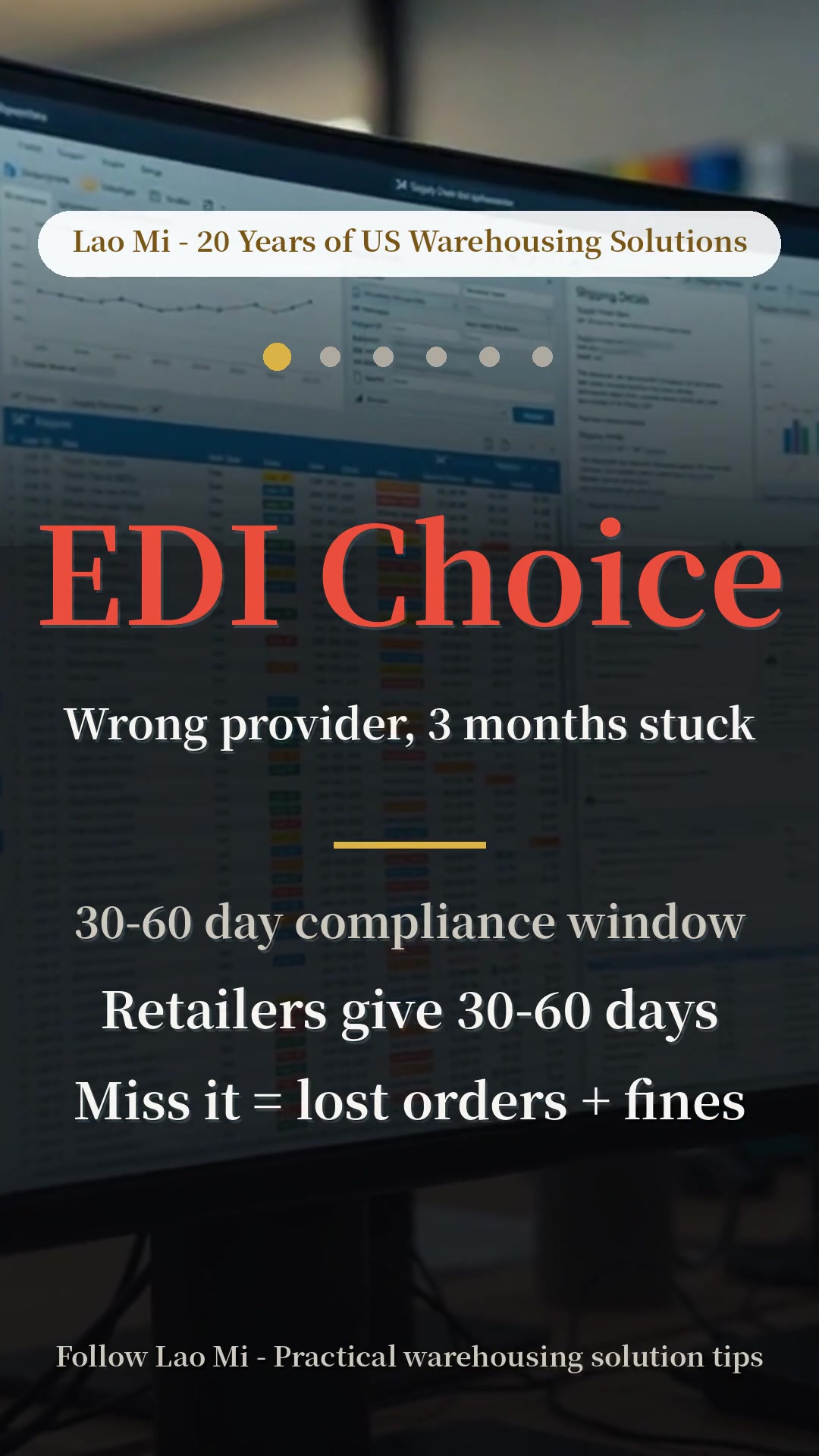
2023, an apparel client supplying 5 major retailers. The implementer took the easy path: all API. Then retailer number one — a large chain — only accepted EDI 850/856 documents. Their 30-year-old system wasn't changing for anyone. Rework: rebuild EDI mappings, 2 extra months, USD 80,000.
Lesson: you speak whatever your customer speaks. In big-box retail, EDI is the entry ticket, not an option.
Story 2: E-commerce brand. Chose EDI. Died slow.
2024, a DTC brand doing 5,000 orders a day. The IT lead came from traditional retail and insisted on EDI — "it's the standard." EDI batched orders hourly; during peak sales the 2-hour lag meant picking was perpetually half a beat behind, and customer service drowned in "why hasn't my order shipped." They tore it down and rebuilt on real-time APIs.
Lesson: past a thousand orders a day with real-time needs, EDI's batch mechanism is the bottleneck. Standards don't ship orders.
Story 3: 3PL. Needed both. Got it right.
Late 2024, a 3PL with 20 clients: half traditional brands (EDI), half e-commerce (API). We built hybrid: EDI through a standard message gateway, APIs through a middleware layer. Four months implementation — one month more than a single approach — but all 20 clients onboarded. Third time I'd seen this pit; third time we got it right.
Cost / Timeline / Maintenance Comparison
| Dimension | EDI | API |
|---|---|---|
| Implementation | 4-8 weeks per connection | 2-6 weeks per connection |
| Implementation cost | USD 10,000-30,000 per connection (incl. VAN/gateway) | USD 5,000-20,000 per connection (mostly dev) |
| Annual maintenance | VAN usage fees, a few thousand/year | Near zero (own development) |
| Real-time capability | Batch (hourly/daily) | Real-time (seconds) |
| Change cost | High (both sides must coordinate) | Medium (API versioning) |
| Best for | Big-box retail, traditional manufacturing, auto parts | E-commerce, new 3PL clients, real-time collaboration |
Ranges only — verify against actual project quotes. But the orders of magnitude hold: EDI costs you "perpetual rent" (VAN fees + coordination), API costs you "one-time construction."
The Hybrid Build: What Actually Sits in the Middle
Since the right answer is so often "both," here's what a working hybrid actually looks like — because "hybrid" on a slide and hybrid in production are two different animals.
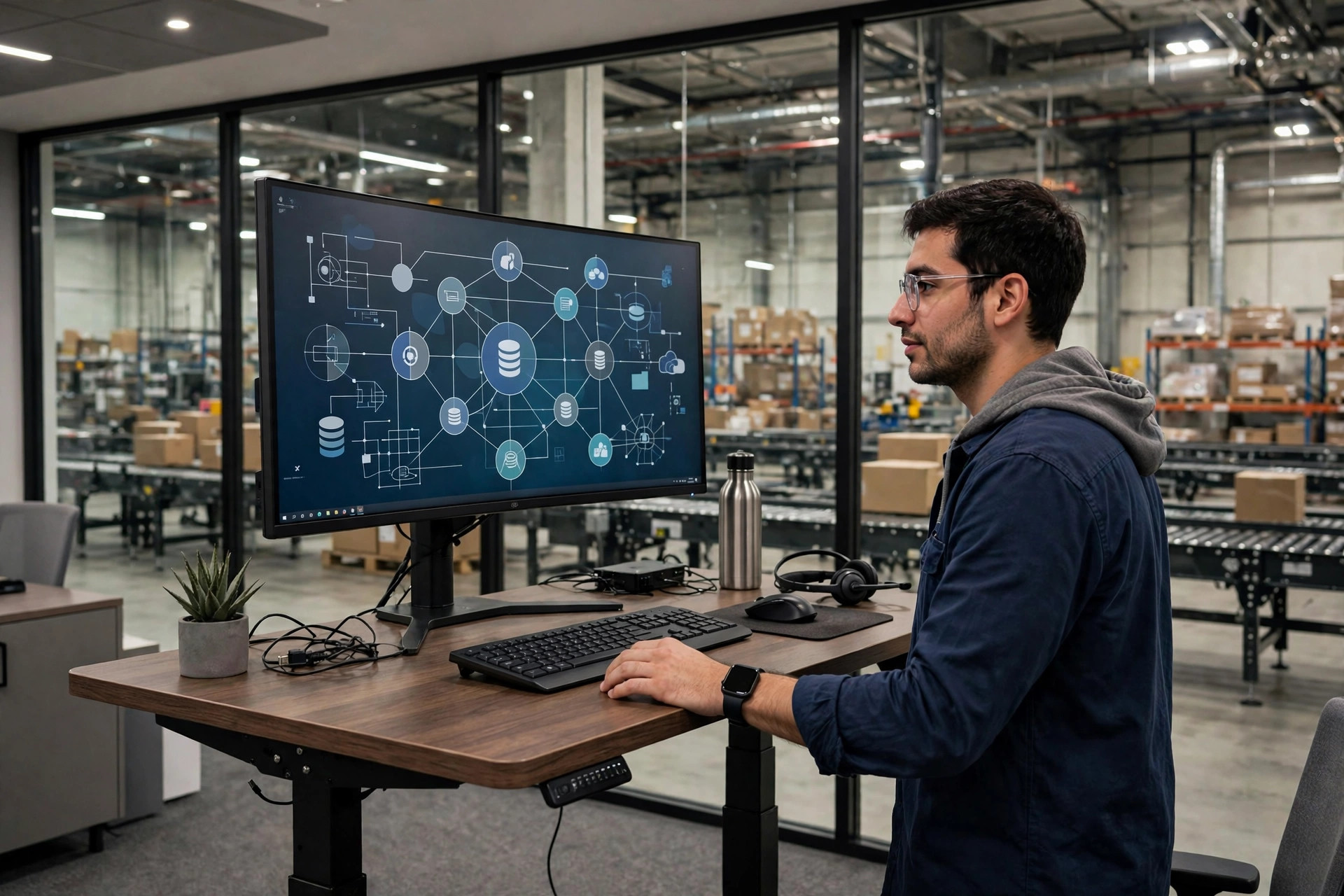
Three pieces, and you need all three. First, the EDI gateway: either a VAN mailbox or direct AS2, receiving 850/856/810 documents and doing the first pass of validation (partner ID, document structure). Second, the mapping layer — this is the real work. It translates the EDI document into your canonical order object: customer codes, ship-to addresses, line items, requested dates. Budget 60% of your EDI effort here, not on the connection itself; connections are commodities, mappings are where projects die. Third, the API gateway: REST endpoints and webhooks exposing that same canonical object to your WMS, OMS, and e-commerce partners in real time.
Here's why the canonical object matters. A 3PL client of ours receives EDI 850 purchase orders from a department store chain and simultaneously serves e-commerce brands pushing orders via API. The EDI 850 arrives, the mapping layer converts it to the canonical order, and the WMS gets it through the same API the e-commerce orders use — milliseconds later, same validation, same routing. One order pipeline, two doors. When that department store changes its 856 requirements (happens roughly once a year per partner), only the mapping changes; the WMS never notices.
Two maintenance realities nobody puts in the proposal. EDI specs drift slowly — a partner tweaks a segment once a year and you get a 30-day notice. APIs drift fast — versions deprecate quarterly, and somebody has to read the changelog. And the ownership question decides everything: mappings owned by IT get maintained; mappings owned by "whoever set them up" rot. Write the mapping owner into the runbook, not just the SOW.
Selection Checklist: The Go-Live Eve List
Ask yourself these 5 questions in order; the answers point to the right choice:
- What does your biggest customer use? If they use EDI, you learn EDI. Customers don't change systems for you. — This outranks everything else.
- Over 1,000 orders a day? Yes and real-time matters: API. A few hundred with batch processing: EDI works.
- Does inventory need real-time sync? Multi-channel e-commerce where overselling is a disaster: API. Traditional wholesale: EDI batches suffice.
- How big is your IT team? APIs need in-house developers, at least 1-2. No dev team: managed EDI service is less headache.
- Will your customer mix change in 3 years? Shifting traditional-to-e-commerce: build hybrid now, don't rebuild twice.
The counterintuitive take: most companies don't "choose wrong" — they "choose only one." Five years of traditional wholesale, then the first e-commerce brand arrives and EDI isn't enough. E-commerce native, then the first big-box retailer arrives and without EDI you can't even bid. My recommendation: build the middleware right once, with room for both an EDI gateway and an API gateway. 20% more implementation cost buys 3 years without rework. That math works.
Finally — zero tolerance for vagueness — write these three sentences into the SOW before signing: one, list every message/interface explicitly (not "supports EDI" but "supports EDI 850/856/810"); two, define how changes are billed (per-incident or annual); three, define go-live criteria (7 consecutive error-free days = live). Skip these three sentences and everything after is an argument.
By Lin Xiao, WMS Implementation Consultant