The bottom line first: WMS pick path optimization is not about how advanced the algorithm is. It comes down to three clean inputs — accurate location data, a clear order structure, and travel cost calculated honestly. If any one of those is dirty, the route the system produces will look beautiful on screen and fall apart on the floor. I have seen this exact failure three times, and the script never changes: on go-live day the pickers say "this route is wrong," the project team says the users don't understand it, and in the end we find that half the location coordinates were wrong.
I have led more than 30 WMS go-lives as an implementation consultant. Pick path optimization shows up in almost every project, and fewer than half of them get it right. It is not the algorithm that is hard. It is that people think "optimization" is too simple — install the system, flip a switch, and pickers walk less. That is not how it works. A system-planned route beats a veteran's instinct because the veteran relies on memory and habit while the system calculates the global optimum. But that "global" only exists if the underlying data is real.
Three pick path methods — tell them apart before you choose
The three most common WMS pick path methods are S-shape, return, and largest gap. The names sound like math homework, but on the floor they are obvious.
S-shape: the picker snakes through each aisle, walking it end to end, then moves to the next. It fits orders with many lines and picks in nearly every aisle. The route is simple and hard to get wrong, but you walk the full aisle even when there is only one pick in it.
Return: the picker enters an aisle from the front, picks the deepest location, and walks back out the same way. It fits orders with few lines and sparse picks. You skip the empty stretch, but you may enter the same aisle twice.
Largest gap: the system finds the biggest empty stretch between two adjacent pick locations in an aisle and splits the route there, so the picker enters from both ends. In theory this walks the least, but it demands the most from the system — location coordinates, aisle lengths, and pick distribution all have to be right.
| Method | Best fit | Strength | Risk |
|---|---|---|---|
| S-shape | Many order lines, dense picks per aisle | Simple route, few errors | Wastes walking on sparse orders |
| Return | Few order lines, sparse picks | Skips empty stretches | Same aisle may be entered twice |
| Largest gap | Uneven pick distribution, accurate data | Least travel in theory | One bad coordinate breaks everything |
You cannot choose by gut feeling. My approach: take a month of real orders, simulate all three methods, and compare total travel distance and picker feedback before deciding. I have seen this pitfall three times — a project copied a peer's method, ran S-shape in a sparse-pick warehouse, and pickers walked two extra kilometers a day. It took three months to find out.
Pick path and slotting are the same problem
Many teams treat pick path optimization and slotting as two separate modules and build them separately. That is wrong. Path optimization decides "how to walk," slotting decides "where the goods sit," and where the goods sit directly decides how the walk goes. Put fast-moving A-class goods at the far end of an aisle and no routing algorithm can save you.
In the fall of 2023 I was doing a go-live at an e-commerce warehouse in eastern China. The client had more than 300 A-class SKUs, and before go-live pickers walked over 400 meters per order on average (scenario illustration based on measurements at the time). The first thing we did was not tune the algorithm — we re-slotted. We moved A-class goods to the front of aisles near the packing stations and put items that are often ordered together in adjacent locations. After re-slotting, with the routing algorithm untouched, average travel distance dropped sharply. That project taught me one thing: the ceiling of path optimization is set by slotting.
So my checklist for a pick path go-live always includes these gates:
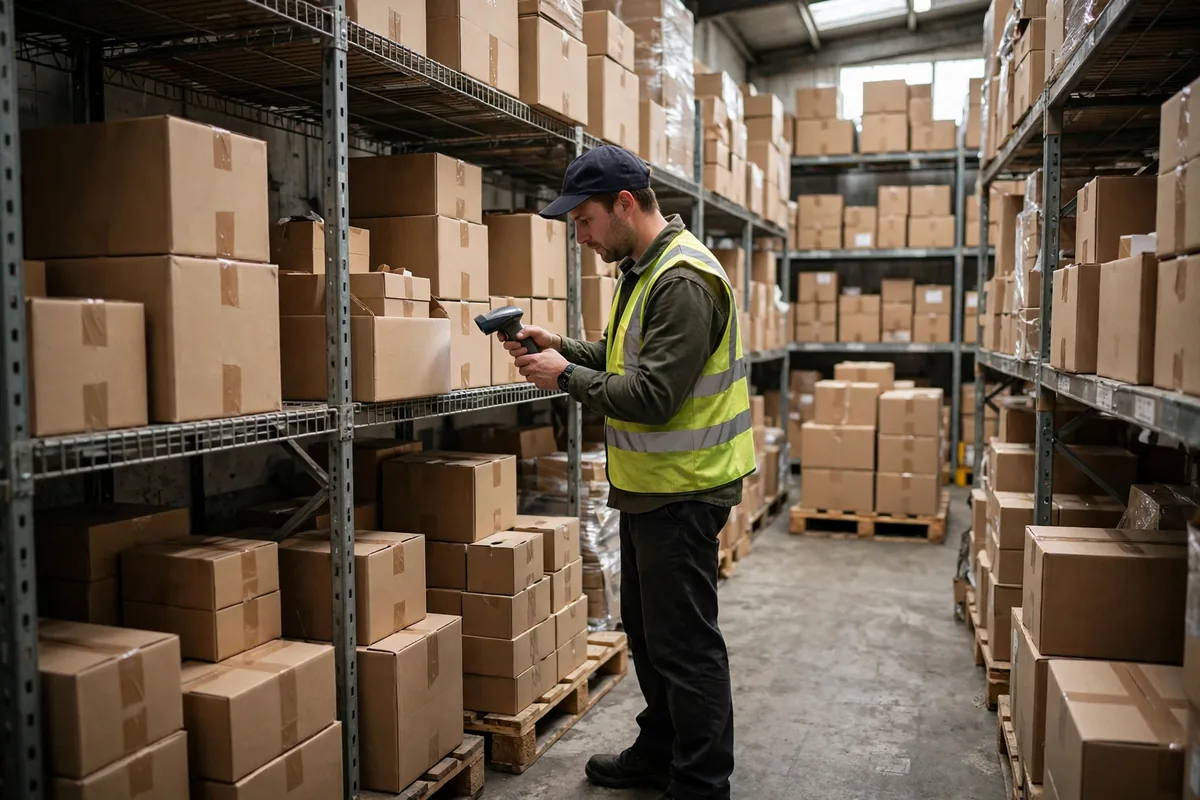
- Verify location coordinates in full: spot-check at least 20% of aisles and locations on the floor; one error means re-checking everything.
- Analyze order structure: line counts, SKUs per order, and co-order affinity across the last 30 days.
- Simulate all three methods against real orders — never demo data.
- Trial runs with pickers: two veterans and two newcomers, 20 orders each, recording travel distance and errors.
- Exception plan: when a location is occupied, stock is missing, or an aisle is closed, how does the system re-route? Test it live, don't just read the manual.
Batch picking and waves are the other half of the route
Half of path optimization lives in how orders are grouped. Single-order picking and batch picking produce completely different routes. In batch picking, the system merges pick points from several orders into one route, the point density goes up, and S-shape often beats return. Waves work the same way: cut a wave too big and the picker's cart overflows; cut it too small and the route optimization loses its meaning.
Here is a counterintuitive point: the better your pick path optimization, the more your order grouping matters. Time saved on the route is easily eaten by bad grouping. I saw a project where travel distance dropped after path optimization went live, but overall throughput did not move — the wave cutting hadn't kept up, and pickers were queuing at the packing stations waiting for orders to be split. The system optimized point A, the bottleneck moved to point B, and total efficiency stayed flat.
That is why my go-live night checklist always has this line: run 50 orders end to end — ordering, grouping, picking, verification, packing — and time the whole flow. Looking only at the picking numbers is self-deception.
Four classic ways this fails
First: inaccurate location data. I covered this above — it is the number one killer. A wrong coordinate, a wrong aisle length, or a location the system thinks is free when it is occupied, and every route is wrong.
Second: optimizing travel distance while ignoring pick actions. Some items need bending, climbing, or two people to lift. The route gets shorter, the handling time goes up, and total time doesn't improve. The routing calculation should include handling cost, at minimum by weight and difficulty class.
Third: no stress test at peak volume. Return routing looks great on a quiet day with few order lines; on a peak day with double the lines, aisle entries multiply and S-shape wins instead. Always simulate with peak order volumes before go-live.
Fourth: pickers don't trust the system. A system route looks "roundabout," the picker takes a shortcut from experience, and the result is a missed or wrong pick. In the first week after go-live, supervisors must walk the floor and find out whether the system is wrong or the picker didn't follow the route. If you can't tell those apart, the optimization will never stick.
One last point: WMS pick path optimization is not something you buy — it is something you tune. The algorithm is only the starting point. Locations, orders, people, and process are four wheels that have to turn together before the route truly saves anything. Walk through the checklist above item by item, and you will sleep well on go-live night.
By Lin Xiao, WMS Implementation Consultant