
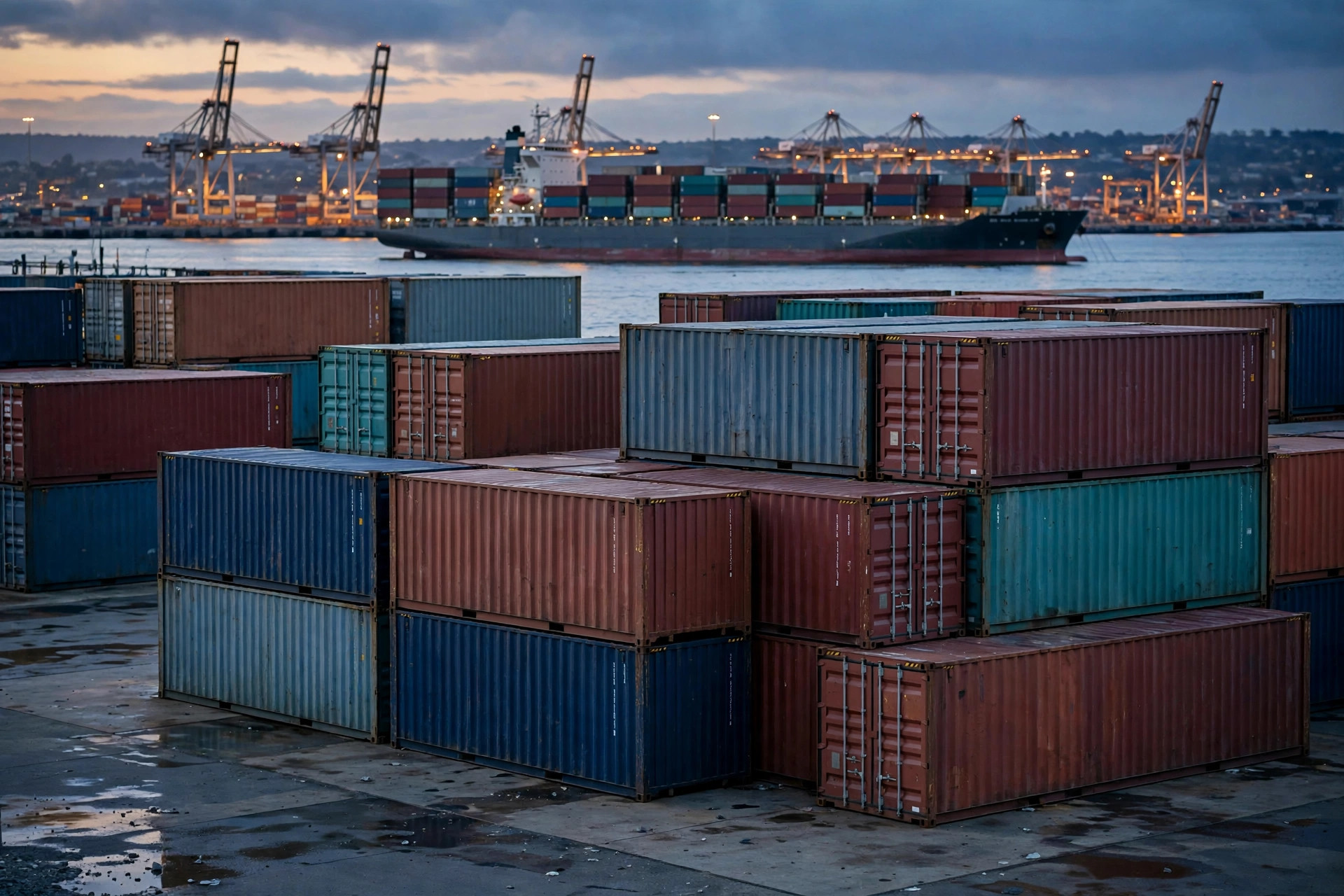
If you've ever asked when AES filing is required, you're not alone. In March 2025, an operations clerk at a Houston freight forwarder got a call at 5 p.m. on a Friday: a 40-foot container bound for Rotterdam was already sitting in the terminal yard, the vessel cutoff was early Sunday morning, and nobody had filed the AES yet. The box missed its sailing, rolled to the next week's vessel, and racked up several hundred dollars a day in demurrage for seven straight days. All for want of one ITN number that was never generated in time.
The AES (Automated Export System), administered by the U.S. Census Bureau, is the electronic system through which export data must be reported. Qualifying shipments need a filing accepted in AES — producing an ITN (Internal Transaction Number) — before they can be loaded. Officially it exists for trade statistics; in practice, CBP uses the data for outbound risk screening. No data, no sailing.
When Is AES Filing Required? The $2,500 Rule, Explained
According to the low-value exemption in the Foreign Trade Regulations (15 CFR Part 30, §30.37(a)), the rule works like this: for goods shipped from one USPPI (U.S. Principal Party in Interest) to one consignee on a single exporting conveyance, AES filing is required when the value per individual Schedule B number exceeds $2,500. At $2,500 or below, that line is exempt.
Three qualifiers, each one a trap:
First, it is per Schedule B number, not per shipment. A $30,000 shipment split across twelve Schedule B lines at $2,500 each requires no filing at all; a $2,600 shipment with a single $2,600 line does.
Second, the "one USPPI, one consignee, one conveyance" trio must hold simultaneously. The same consignee's goods split across two vessels are measured separately.
Third, the threshold is "over $2,500" — exactly $2,500 or less is exempt.
When AES Filing Is Required Regardless of Value
Several categories must be filed no matter the dollar amount: shipments requiring an export license (BIS or State Department licenses), and ITAR-controlled defense articles. Shipments to Canada are generally exempt — but ITAR items, licensed goods, and goods transiting Canada to a third country still require filing. Tools of the trade (for personal or business use, accompanying the traveler, returned within a year, not moving under a bill of lading) may also be exempt.
Filing deadlines, per Census Bureau requirements, differ by mode:
| Mode | Filing deadline |
|---|---|
| Vessel | 24 hours before loading cargo |
| Air | 2 hours before scheduled departure |
| Truck | 1 hour before arrival at the U.S. border |
| Rail | 2 hours before arrival at the U.S. border |
| Mail and other | 2 hours before exportation |
Approved USPPIs may apply for postdeparture filing, reporting up to 10 calendar days after export — but that privilege must be approved in advance; it is not automatic. Always confirm current requirements with the Census Bureau.
Once AES accepts a filing, it returns an ITN. That number must appear as the proof of filing citation on the bill of lading, air waybill, or other loading document — the carrier releases cargo against it. In practice, a surprising share of "failures to file" are really "filed, but the ITN never made it onto the paperwork." If the terminal system can't see it, it didn't happen.

Who Files: Liability Sits With the USPPI, Not the Forwarder
This is the most misunderstood point. Legally, the filing obligation belongs to the USPPI. The USPPI may authorize (via power of attorney or written authorization) a freight forwarder or customs broker to file on its behalf; in a routed export transaction, the foreign buyer (FPPI) may designate its own agent.
But authorization is not a transfer of liability. If the forwarder files late or files wrong, the penalty notice goes to the USPPI first. In 2024, a small dental-equipment company in San Diego shipped to Germany: three Schedule B lines, about $8,000 total, with spare parts alone valued at $2,900. The salesperson assumed the $2,500 threshold applied per shipment — and got the logic exactly backwards. The rule measures each Schedule B line separately, and the spare-parts line exceeded the threshold on its own. Three months later came an inquiry letter from Census, and the case was treated as a late filing. The lesson in one sentence: the $2,500 test runs per Schedule B number, never per shipment.
Penalties: Four Tiers
Under FTR Subpart H (15 CFR §30.70–30.72):
- Failure to file: civil penalty up to $10,000 per violation. A record filed more than 10 calendar days after the due date counts as a failure to file.
- Late filing: $1,100 per day of delinquency, capped at $10,000 per violation.
- False or misleading information: up to $10,000 per violation, potentially on top of other statutory penalties.
- Knowing violations: criminal penalties up to $10,000 in fines and/or 5 years imprisonment per violation.
There is, however, an elastic side to enforcement. A voluntary self-disclosure (VSD), submitted before Census learns of the violation from another source, can mitigate or remit penalties — and public enforcement cases show first-time violators have at times been fined as little as a few hundred dollars. Census wants complete data, not fine revenue; the VSD mechanism itself is the evidence.
The Decision Table: File or Not?
| Situation | File? |
|---|---|
| Any single Schedule B line over $2,500 | Yes |
| All lines at $2,500 or below | No (low-value exemption) |
| Export license required (BIS/State) | Yes, regardless of value |
| ITAR-controlled items | Yes, regardless of value |
| Canada destination (general merchandise) | No (exceptions apply) |
| Qualifying tools of the trade | No |
Here is the counterintuitive read: AES is fundamentally a Census statistical and enforcement dataset, not a customs "release" document — yet CBP screens exports against it. Many exporters treat AES as "the forwarder's problem." That attribution is wrong. The forwarder does the work; the USPPI carries the liability.
The trend line points one way. Export control lists keep growing, EAR/ITAR interplay with AES keeps tightening, and CBP is pushing electronic outbound vessel manifests with a new 24-and-2-hour filing schedule. "File before you load" is not going away. On that basis, the reasonable projection is that inquiries triggered by Schedule B misclassification will likely rise over the next two to three years.
Which leaves an open question worth sitting with: when every export record is matched in near real time, would your commodity classifications survive scrutiny? The boundary of the filing obligation is now clear. The real risk usually hides in the classification line — but that is a topic for another day.
By Dr. Chen, Supply Chain Researcher





