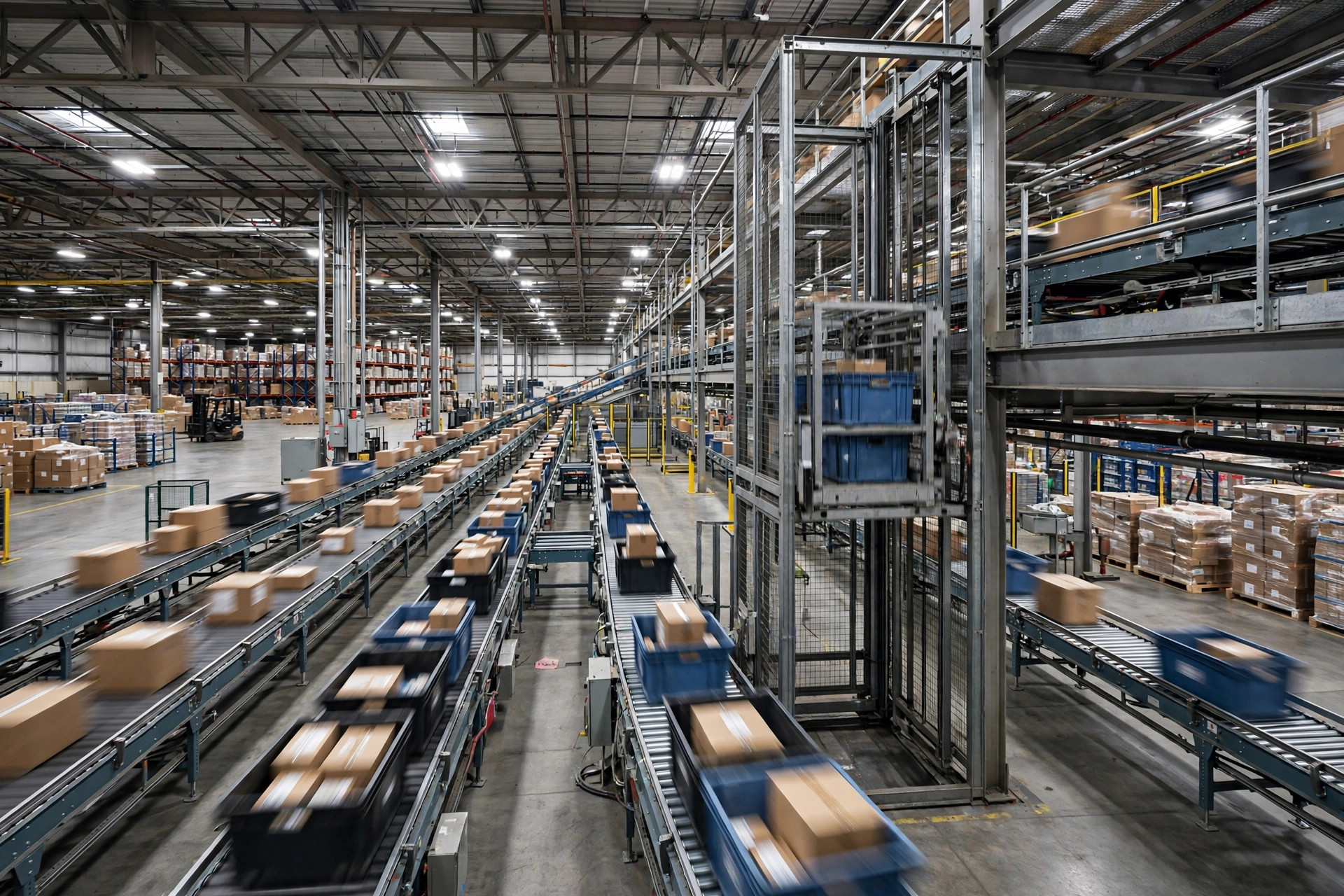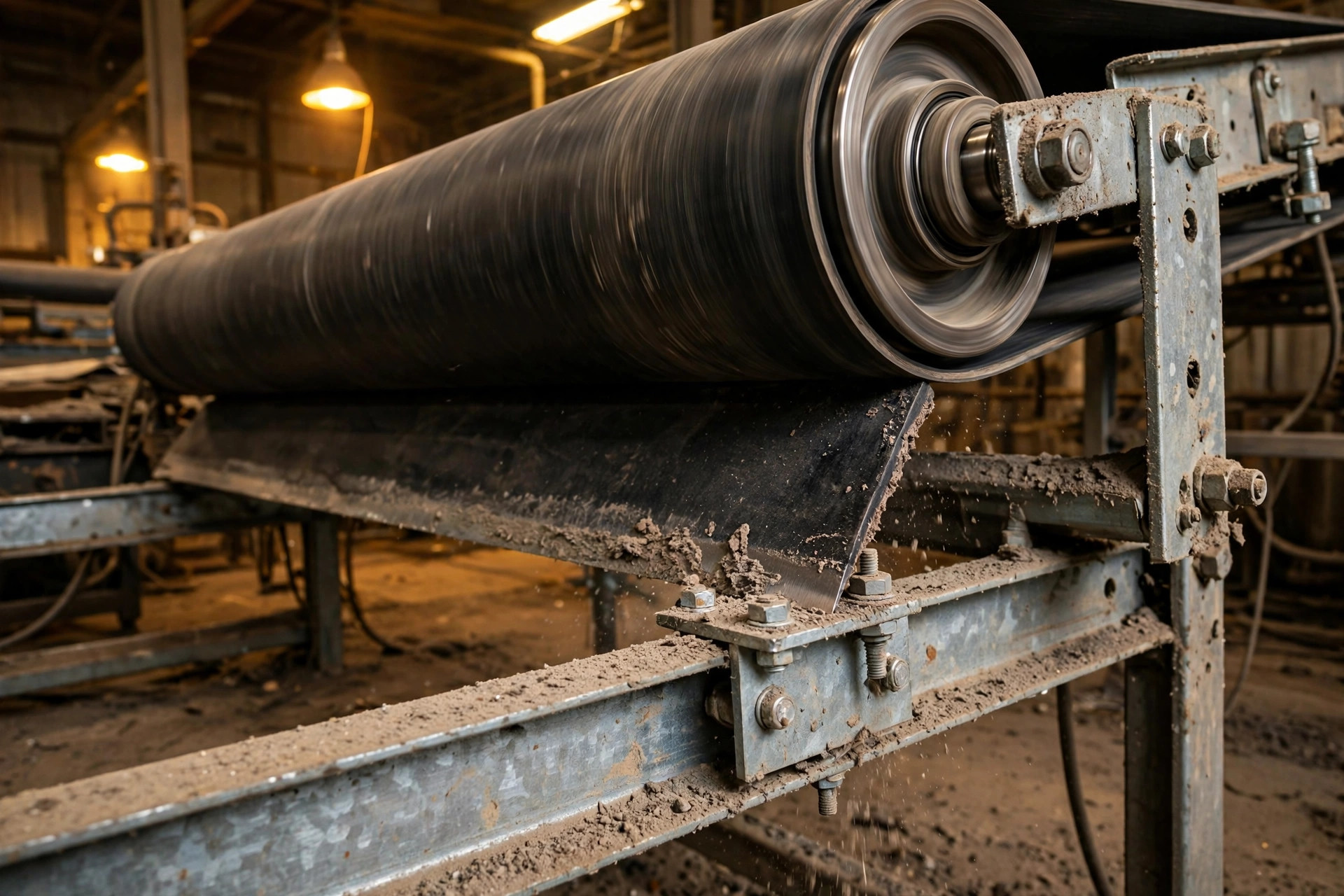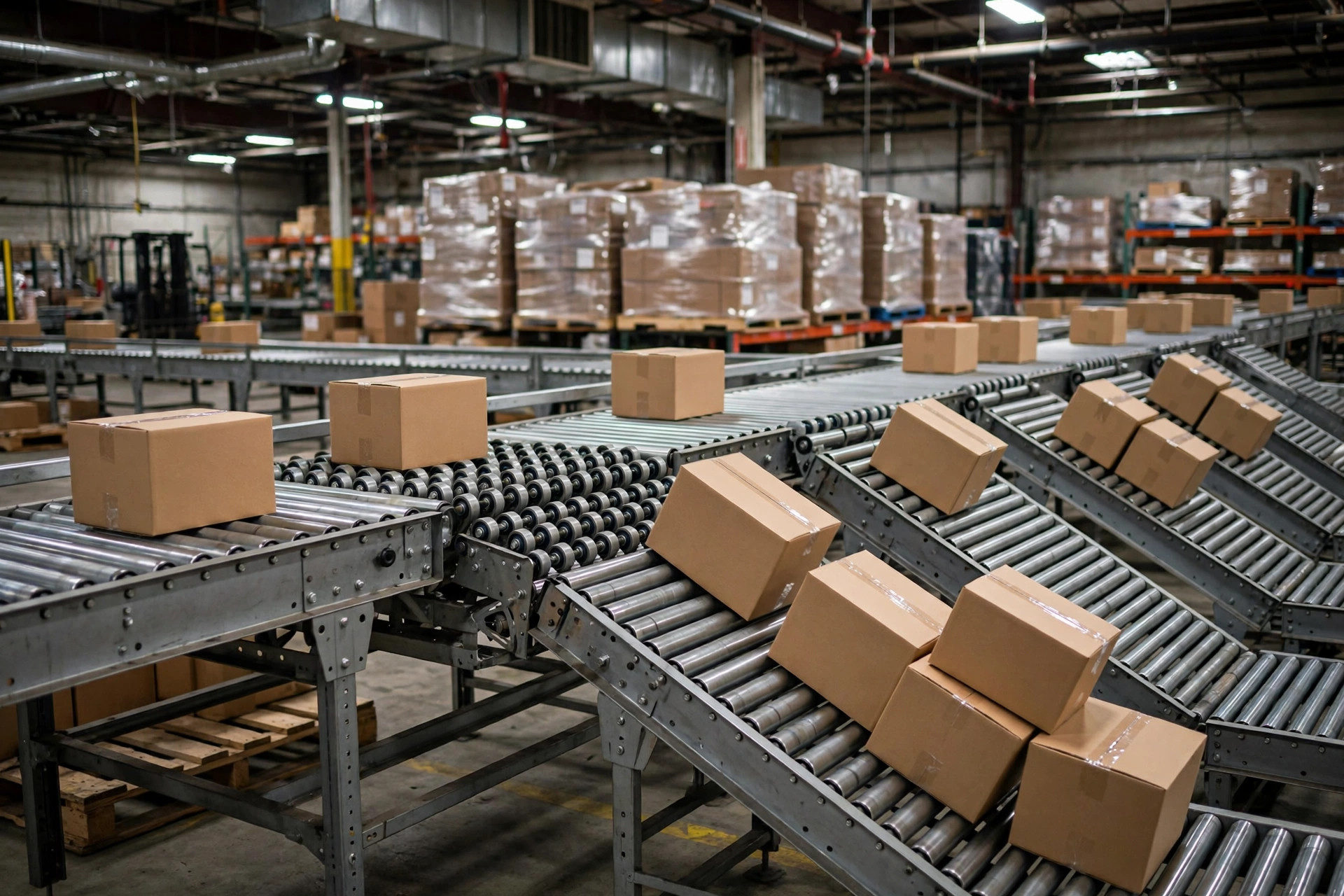
Here's my verdict up front: overpaying for a sorter stings, but buying the wrong sorter bleeds you every single day — jams, downtime, rework. Wheel diverters and sliding-shoe sorters can differ in price by multiples, yet the real dividing line isn't price. It's what your product looks like and how many pieces you need to move.
The two machines work in fundamentally different ways, and everything downstream follows from that.
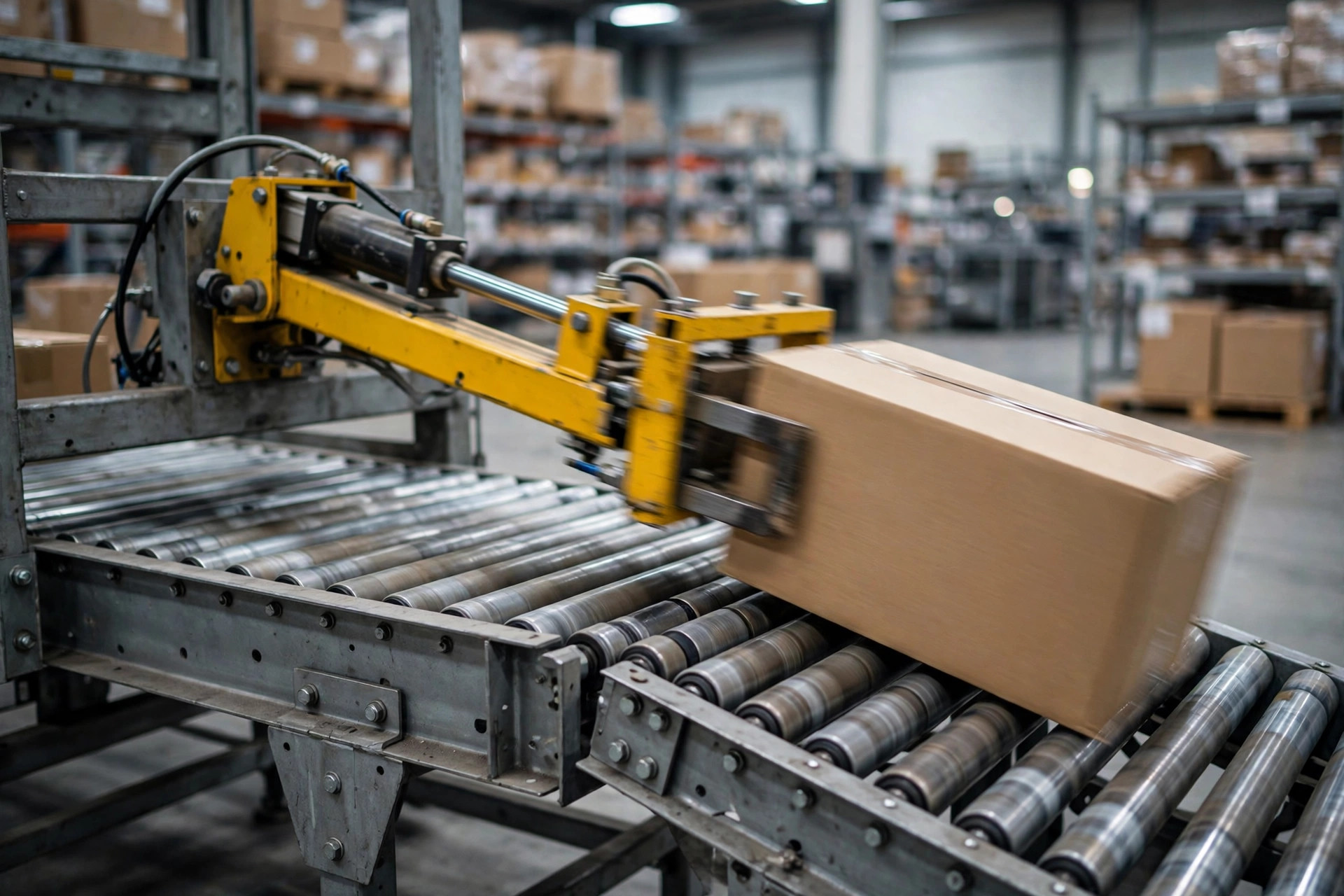
A pop-up wheel diverter keeps its wheels hidden below the conveying surface. When a carton reaches a divert point, a row of small wheels rises up, spins at an angle, and steers the carton sideways into the chute — then retracts. The product gets carried out from underneath, guided off the line by contact with its bottom face.
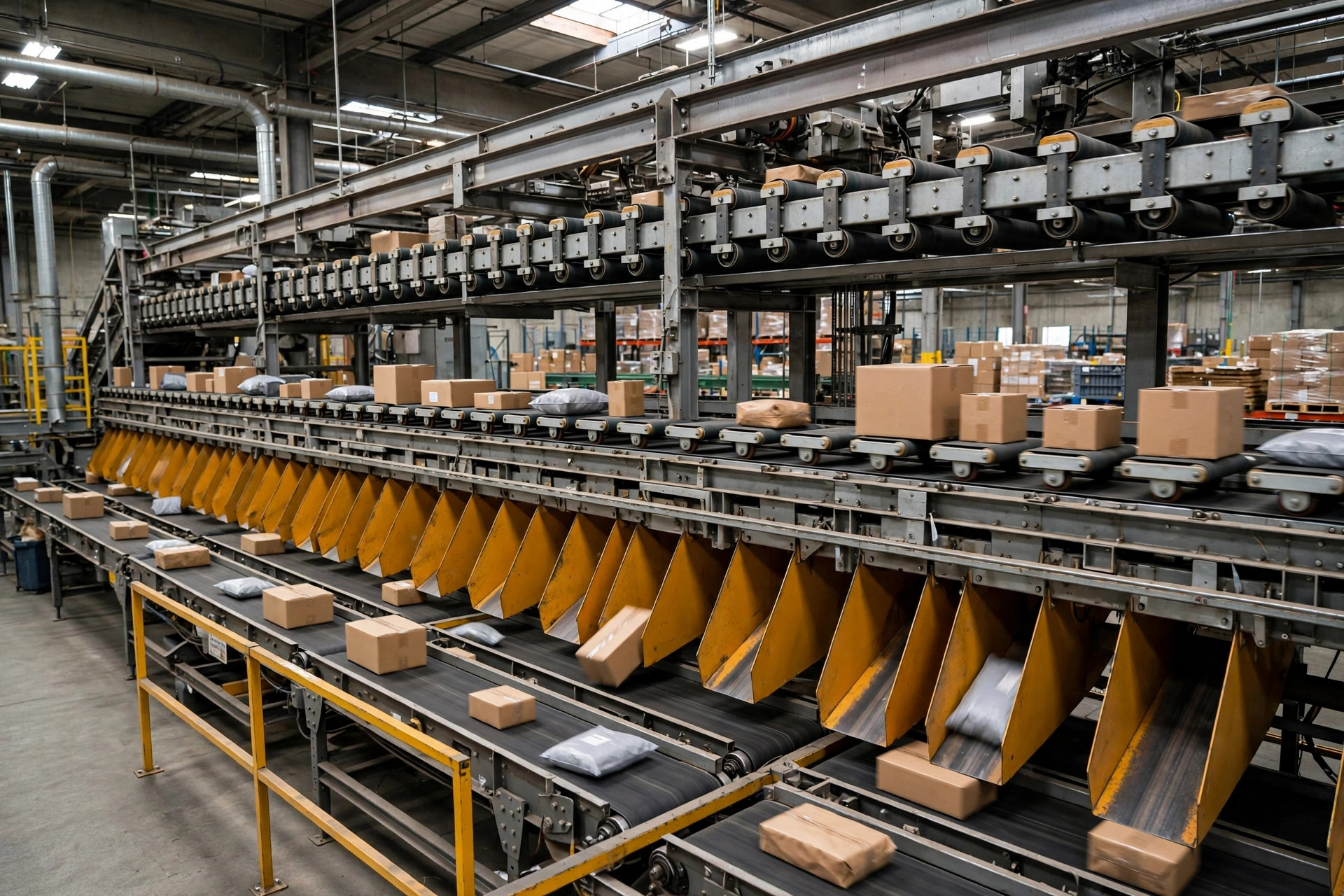
A sliding-shoe sorter works the other way. A row of "shoes" rides along the conveying surface with the product; at the divert point, the shoes slide sideways and push the item into the chute. The product stays flat on the slats the whole time — nothing lifts it, nothing tips it.
One steers, the other pushes. That sounds like a small mechanical detail until you realize it dictates what each machine can and cannot handle. Every selection criterion below grows out of it.
Zoom in a little further and the difference gets even more concrete. Wheel diverters typically divert at a 30-degree angle, and the pop-up height and wheel speed have to match the carton's weight — a box that's too light gets bounced around, one that's too heavy won't turn. Sliding-shoe sorters divert at 20 to 30 degrees, but the shoe pushes against the side of the product with a large contact area, so it's far less sensitive to weight. The wheel diverter's pickiness about product is built into its mechanics. The shoe sorter's tolerance is, too.
The first dividing line is product type, and it's a hard line. Wheel diverters eat rigid cartons with flat, firm bottoms — the wheels need stable contact to do their steering. Poly bags, irregular shapes, anything with an inconsistent bottom surface will wobble, miss the divert, or jam outright. If soft packs make up more than about a third of your mix, stop looking at wheels. Fragiles follow the same logic: the shoe gives a gentle lateral push, while the wheel lifts the carton and swings it. For anything breakable, the push wins.
The second line is speed and divert count. Wheel diverters typically run 60 to 80 cases per minute, topping out around 130. Sliding-shoe sorters run 80 to 350 cases per minute, with the fast ones clearing 300. Do the hourly math: a wheel sorter maxes out around seven or eight thousand cases an hour; a shoe sorter clears ten thousand without breaking a sweat and can push toward twenty. Divert counts tell the same story at a different scale — wheels generally support 1 to 13 diverts, shoes 10 to 100. Past about ten diverts, the wheel diverter is structurally out of the game. Line speed follows: wheels usually stay under 300 feet per minute, shoes run 200 to 600. It's a different tempo of operation entirely.
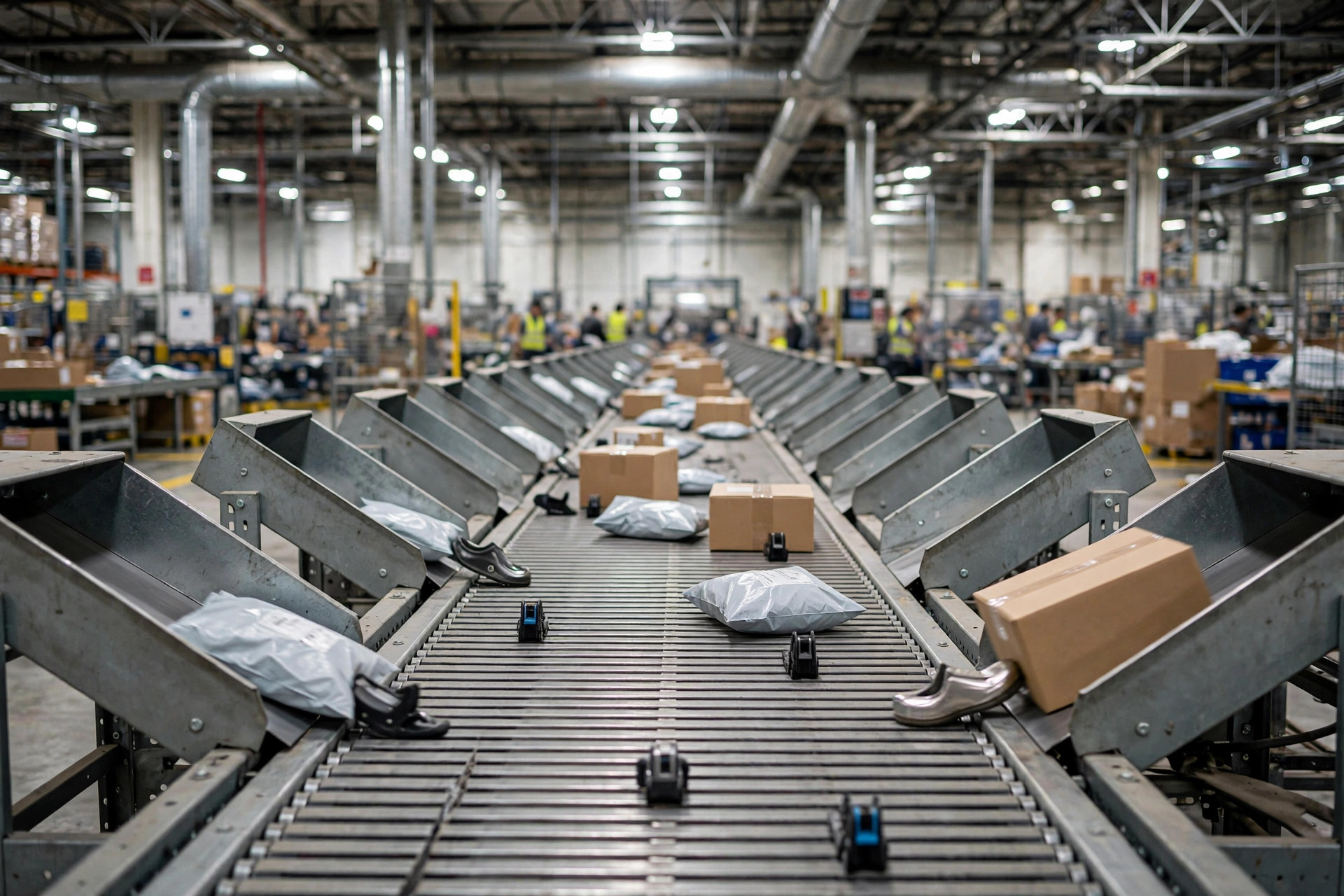
The third line is the one nobody puts in the evaluation spreadsheet: noise and maintenance. Wheel diverters are simple, cheap, and easy to fix — your own maintenance tech can handle most of it, and parts don't cost much. Shoe sorters are precision equipment: expensive, demanding on maintenance, and genuinely loud at speed. If people work alongside that line all day, noise belongs in the evaluation. Don't save money on sort labor just to spend it again on maintenance contracts and on the hiring problem of nobody wanting to work next to the roar.
There's also a hidden fourth line: footprint. More diverts means a longer line. A wheel sorter tops out around a dozen diverts, so the line stays short and fits into a small building. A shoe sorter with dozens of diverts stretches for tens of meters, and every chute needs accumulation space and a manned position at the end. Warehouse space is never free — lay the line out on the floor plan before you sign anything, not after the steel shows up and won't make the turn.
Small warehouses fall into two traps, and I watch it happen on repeat.
Trap one: buying wheels to sort poly bags because wheels are cheaper. A fashion-returns warehouse — mostly soft packs — installed a wheel diverter to save money. It jammed a dozen times a day. They stationed an operator at the divert just to rescue stuck bags, and when peak season hit, every stoppage backed up the whole line. They ended up buying the shoe sorter anyway. Paid twice, and lost a peak season in between. The owner told me later he wished he'd just bought the shoe sorter first. That tuition gets paid somewhere in this industry every single week. Whatever you save on the purchase price comes back as downtime and rework, with interest.
Trap two: buying a shoe sorter you don't have the volume for. Five thousand cartons a day, six diverts — and they bought a shoe sorter. It runs two hours a day and naps the rest. Utilization under thirty percent on a machine that cost several times what a wheel diverter would have. At that volume a wheel diverter would have been plenty, and the savings would have covered two operators for three years. Automation isn't better when it's more expensive. It's better when it fits. A machine running under fifty percent utilization long-term isn't capacity — it's anxiety with a power cord.
So the next time a vendor hands you a proposal, don't look at the price first. Ask three questions: with my poly-bag ratio, can your machine actually handle my mix? What peak hourly rate is this designed for, and how much headroom is built in? When I need more diverts later, can this machine grow with me? If the rep can't answer, or starts talking around the questions, throw the proposal back.
And when the quote lands on your desk, read three lines carefully: the spare-parts list and pricing (don't wait until something breaks to discover what a shoe module costs), the warranty terms (motors and controls covered separately — read them separately), and how open the control system is (what it costs to add an interface to your own WMS later). Those three lines decide your cost of ownership for the next five years. A sorter is a ten-year asset. Choose wrong once, and it hurts for ten years.