
Let me tell you something: the thing I dread most after fifteen years on the road is a dead WES at the warehouse dock — my freight stuck inside and nobody able to get it out.
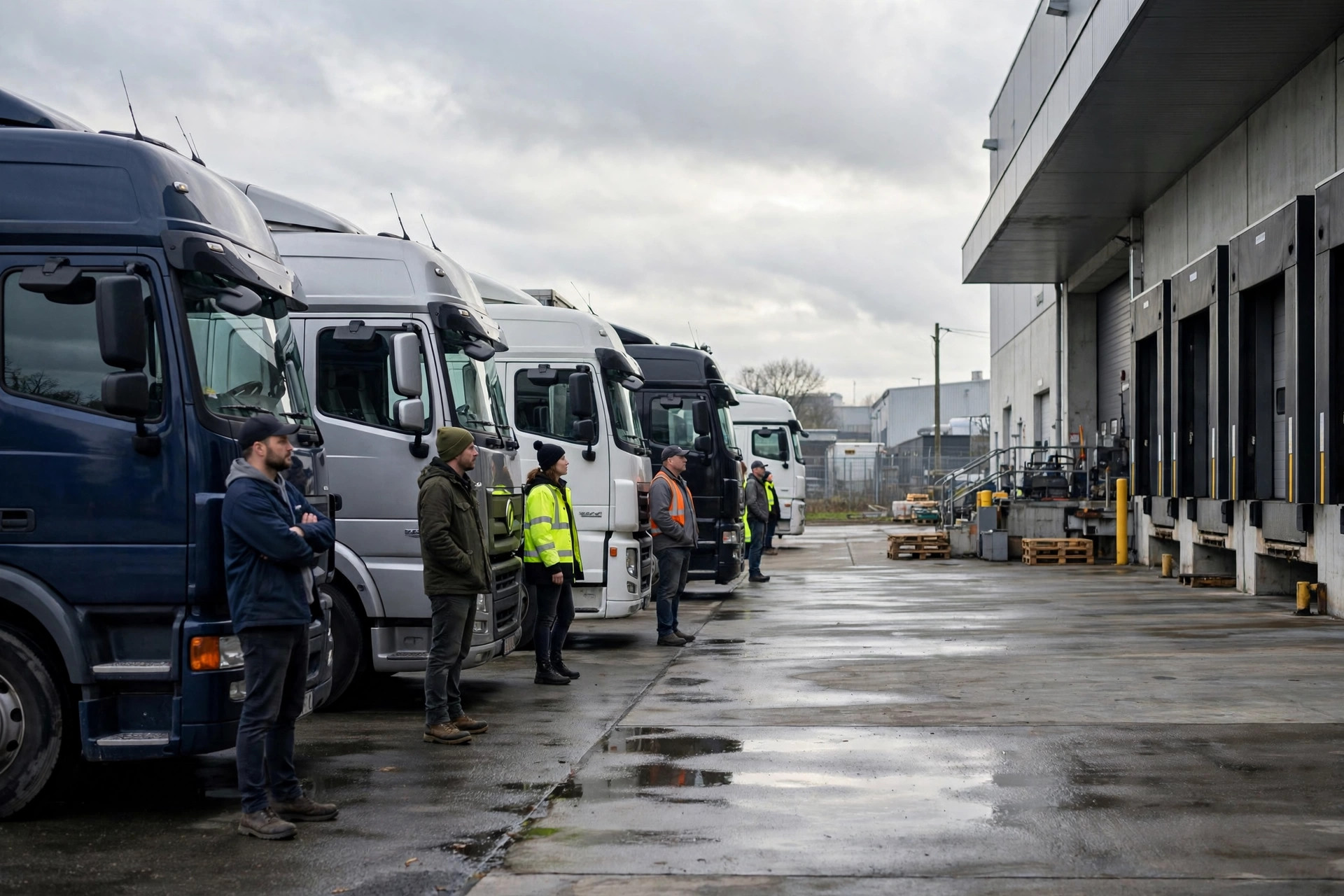
Fall of 2023. I was headed to a third-party warehouse in Fontana, just outside Los Angeles, for a pickup. Rolled in at 7:40 in the morning and there were already a dozen trucks lined up at the dock doors, drivers out of their cabs, some smoking, some pacing. I walked over and asked what was going on. The warehouse guy just shook his head: the dispatch system — what they call the WES — had gone down. No pick tickets printing. Every handheld scanner black.
Want to know what it looked like inside? Pickers standing in front of the racks, staring at nothing. On a normal day the terminal tells them which bay to walk to and how many cases to grab. Terminal goes dark, and nobody knows how to sequence anything. The shift manager was sweating through his shirt, on the phone begging IT for an ETA. They waited like that for over four hours. The system did not come back until 11:30. That warehouse basically shipped nothing all morning.
The Morning the WES Died, Trucks Lined Up at the Dock
I talked to that shift manager afterward. He told me the scariest part was not the four lost hours. It was realizing that out of two hundred-plus people in that building, not one of them knew what to do with the screens dark. Paper pick lists? Did not exist. Radios? They had a few in a cabinet somewhere, but the batteries were dead and nobody remembered the channels. Double-checking? Normally done by barcode scan — scanner dies with the system, so verification died too.
They muscled through on pure memory in the end. The manager assigned jobs from the top of his head — "you, go pull the fast movers in zone A" — and the guard at the gate wrote down license plates and BOL numbers in a notebook by hand. They got some freight out, but three orders shipped wrong, and the returns mess took a week to clean up.
That one stuck with me. And I will tell you why: it was not that warehouse's problem alone.
Here Is What It Tells You: The More Automated, the More Helpless
Fifteen years on the road teaches you a thing or two. Here is one: the more automated a warehouse gets, the less its people know how to run it by hand. Back in the day, a veteran with a paper list and an apprentice could ship freight just fine. Today? The system assigns the slots, the system sequences the waves, the barcode gun does the verifying. People have become the system's hands and feet. System dies, hands and feet go numb.
That is the trade-off, and there is no dodging it: automation lifts everyday efficiency, but it guts your ability to cope when the system goes down. Plenty of warehouse owners figure the system only crashes once or twice a year, so a dedicated fallback plan is not worth the trouble. Let me tell you, that is the wrong math —
Take a warehouse shipping around two thousand orders a day. One hour of WES downtime and picking is basically frozen — call it two or three hundred orders delayed, order of magnitude. Drivers sit at the gate burning hours, their appointment slots expire and have to be rebooked, and the queue keeps growing. I have seen twenty, thirty trucks stacked up outside by mid-afternoon. And when the system comes back, you are not done: everything logged by hand has to be keyed back in, two or three people burning a whole afternoon on data entry, and every mismatch has to be chased down order by order. Add it up. How much paper and how many radios would that money buy?
The Four-Piece WES Fallback Kit: Paper, Radio, People, Books
Talk is cheap. Here is a playbook I watched with my own eyes in 2024, at an e-commerce fulfillment warehouse in Ontario. They drill their downtime plan every quarter. A week before the holiday peak in November 2024, the system actually crashed — and they were on manual mode in about twenty minutes. Shipping ran only an hour behind that day. The owner bought me dinner afterward, and I wrote his whole setup down:
Piece one: paper. Pre-printed blank pick list templates, five hundred copies at a time, in a cabinet at the picking area entrance where anybody can grab them. Bay, item name, quantity, a sign-off box for verification — same layout as the system printout, so nobody has to learn a new form. And print the playbook itself and tape it to the wall. Do not keep it only on a computer — when the system is down, where exactly are you going to read it?
Piece two: radios. Channel assignments decided in advance and set in stone: channel one for pick instructions only, channel two for verification and exceptions, channel three for the manager. Nobody ties up a channel chatting on a normal day. Charge the radios once a month; check the batteries on drill day. In a real outage a radio beats a phone — no network needed, one channel reaches the whole floor.
Piece three: people. A fallback roster, posted on the wall ahead of time:
| Role | Job | Tools | | Duty manager | Declares the fallback, sets channels, calls the shots on exceptions | Radio, channel 3 | | Pick crew | Pick by paper list, sign off each list | Paper pick lists, pens | | Verifiers | Double-check at the outbound door, focus on fast movers and high-value goods | Verification log sheet | | Gate clerk | Hand-log license plates, BOL numbers, in/out times | Paper logbook | | IT / systems | Fight the outage, prep the back-entry | — |
Piece four: the books. After the system comes back, every hand-written log goes back into the WES, order by order. The duty manager signs off that the books match reality, and only then is the incident closed. Back-entry is not optional — skip it and your inventory is wrong forever, and next month's cycle count will make you cry.
Drill It Every Three Months — Do Not Wait for the Real Thing
How often? I asked that Ontario owner. Every three months, like clockwork, he said. Why three months? New hires have mostly cycled through by then, and veterans get rusty if they have not done it by hand in a while. You do not need a whole day — pick a slow half-day, have IT "pretend" the system is dead for two hours, and run the whole crew on paper. Afterward, a short huddle: which form was confusing, which channel got chaotic, whose radio was dead. Fix it on the spot.
Drills are where this lives or dies. Two hours of genuine practice beats ten meetings about it.
Two Straight Words — One for Warehouses, One for Shippers
To the warehouse owner: tomorrow morning, ask your warehouse manager one question — "if the system goes down, what do we do?" If he cannot answer, print the paper lists and charge the radios this week. It costs next to nothing. What it buys you is sleep the night before peak season.
To the shippers and to us truckers: when you are choosing a warehouse or negotiating a contract, ask one extra question — "do you have a downtime fallback plan?" A warehouse with a plan does not panic when things break. One without a plan might look sharp on a normal day, but when it matters, your freight does not move and drivers sit at the gate half the day. That is your business on the line.

Plenty of people think paper lists and radios are yesterday's tools, on their way out. I will tell you the opposite: paper does not care about power outages, network failures, or crashed servers. The paper you "save" on a normal day can save your operation on the bad day. A paper fallback is not backward. It is your safety net.
Hope for the best, plan for the worst. That is the whole game.
By Shifu Zhao, Trucking Veteran (15 yrs)



