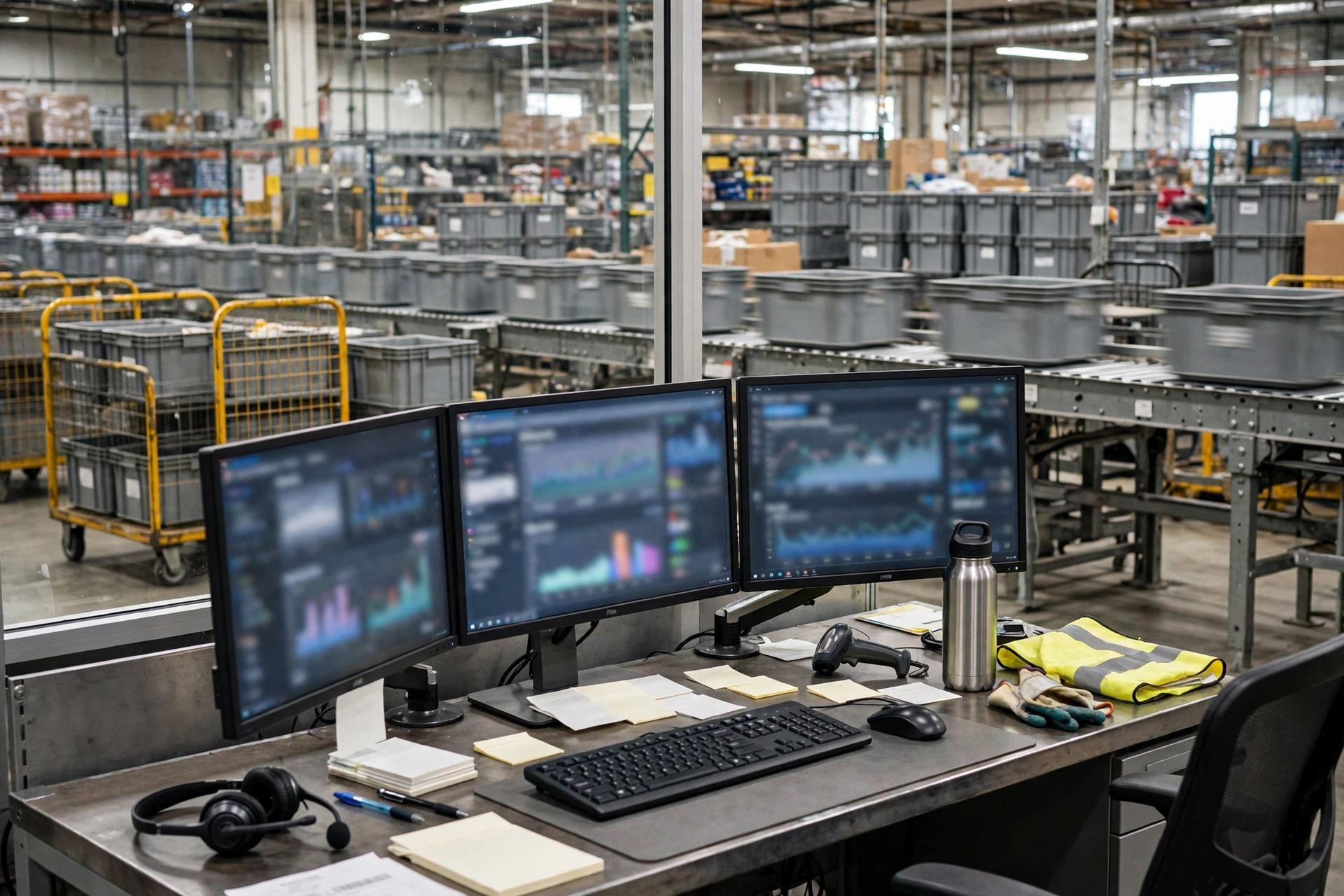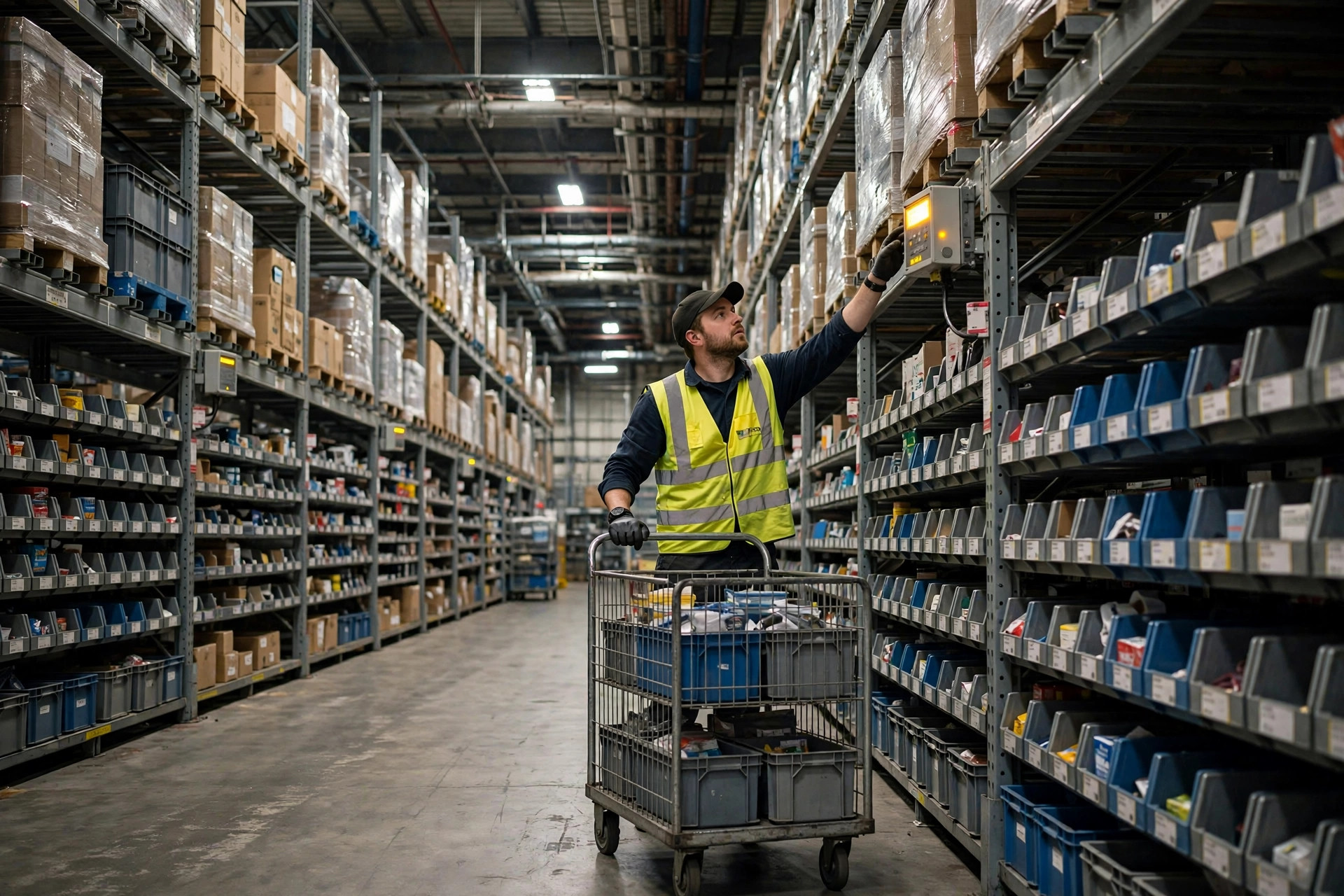
In a field survey I conducted last fall covering small and mid-sized warehouses, one pattern kept surfacing: in facilities running just three or four waves a day, pickers spent a noticeable share of each shift not picking, but waiting — waiting for the wave to release, for tasks to drop, for the system to finish batching orders. In comparable warehouses running WES real-time task flow, that waiting had all but disappeared.
This phenomenon deserves a serious look. Wave picking has been the default rhythm of warehouse operations for two decades, but its efficiency dividend has always come with a precondition — and a growing number of warehouses are quietly violating it: volume has to be large enough.
A Mid-Sized Warehouse Spending Two Hours a Day Waiting for Tasks
In 2024, I visited an auto parts distribution warehouse in the American Midwest: 700–900 orders a day, roughly 6,000 SKUs, a 22-person picking team, and a WMS releasing four fixed waves daily. The operations manager put it bluntly: our busiest moments are the minutes between waves.
Each wave release required the system to first accumulate orders, compute routes, and then release tasks — and during those 10–15 minutes of batching and computation, pick carts sat idle in the aisles while pickers stood around checking their phones. Four waves a day added up to nearly an hour of waiting per person per shift. Multiply by 22 people, and you get 22 labor-hours a day — the equivalent of nearly three full-time positions — consumed by waiting for tasks.
The last wave was the worst. With the daily cutoff at 4 p.m., the final wave's orders often weren't released until 3:30, cramming picking, verification, and packing into half an hour. Temporary overtime two or three days a week became routine. The wave system, designed to bring planning discipline, was instead producing pulse-like swings between idle and frantic.
In early 2025, the facility switched picking release to WES real-time task flow: as orders arrived from the OMS, the WES orchestrated them into tasks in real time and pushed them straight to pickers' RF guns — no batching step at all. According to the operations manager, the team shrank from 22 to 20 people, the cutoff moved up by about half an hour, and overtime essentially disappeared.
How Much Volume Does Wave Release Need to Pay Off?
The core value of wave picking is a single word: consolidation. Group orders sharing the same aisle or the same SKU, complete multiple orders in one trip, and amortize travel cost per order. It is a math game about density — and the math only pays out with enough volume.
Sorting the warehouses from my research into three tiers by daily order volume, the comparison looks roughly like this:
| Daily orders | Wave consolidation effect | Real-time flow vs. waves | Lean |
|---|---|---|---|
| Under 800 | Almost nothing to consolidate; aisles rarely hold multiple orders | Real-time flow clearly saves labor | Switch to real-time task flow |
| 800–2,500 | Some high-frequency SKUs can be grouped | Depends on order profile: high SKU overlap favors waves, scattered orders favor real-time | Hybrid, split by SKU zone |
| Above 2,500 | Consolidation works well; multi-order trips are the norm | Waves still win | Keep waves |
Back to the auto parts warehouse: 700–900 orders spread across 6,000 SKUs meant orders were naturally scattered. Waves tried to consolidate, but most waves couldn't gather even two or three orders for the same SKU — the one-trip-multiple-orders ideal almost never materialized. In other words, the facility paid the full price of waves — waiting, pulse-like workload swings, cutoff pressure — while capturing almost none of the benefit.
Here is the counterintuitive takeaway: many assume that a release mode that looks planned must be efficient, but for low-volume warehouses, waves function more like a ritual of planning. The mathematical payoff of route optimization is negligible at low volume, and the travel distance saved doesn't come close to offsetting the labor burned in four rounds of waiting.
Why So Many Still Cling to Waves
If the math is this clear, why do so many low-volume warehouses stay with waves? I see four reasons.
First, path dependence. Waves were the default operating mode of the WMS era; SOPs, shift schedules, and performance metrics were all built around the wave cadence. Changing the release mode means changing organizational habits — the resistance is in people, not systems.
Second, the illusion of managerial convenience. Waves give management a reportable rhythm: we completed four waves today reads better in a weekly report than tasks kept flowing. In a sense, the greatest value of waves in a low-volume warehouse may not be efficiency at all, but a sense of security for management.
Third, system inertia. WMS platforms support waves natively, while real-time task flow requires a WES layer for order-level orchestration plus real-time synchronization with the OMS and WMS. Many warehouses run IT architectures designed a decade ago, where the WES layer simply doesn't exist — they couldn't switch even if they wanted to.
Fourth, a superstition about planned-ness. Work that looks planned isn't necessarily efficient, but being planned feels reassuring. This is the hardest one to dismantle, because it isn't a technology problem — it's a cognitive one.
Where Real-Time Task Flow Stands Now
Zoom out, and waves reveal themselves as a compromise of the compute-scarce era: accumulate orders, then compute an optimal route once per batch, because systems back then couldn't afford to plan order by order. Today, compute is cheap enough to support order-level real-time orchestration — one order in, one task planned, one task released is no longer technically difficult for a WES.
According to publicly available case materials from multiple vendors, the share of new WES customers adopting real-time task flow is rising, concentrated in small and mid-sized warehouses shipping under 2,000 orders a day — the segment with the lowest retrofit cost and the most direct payoff. My read: over the next two to three years, small and mid-sized warehouses will switch first; large facilities will go hybrid, keeping waves for high-frequency SKUs while routing long-tail orders through real-time flow.
One trade-off must be stated up front: real-time task flow is not a free lunch. It compresses thinking time to zero — the waiting period before a wave release objectively served as a buffer for exception handling (shortages, packaging changes, address issues). Once you go real-time, exception orders land directly in pickers' hands. Warehouses adopting real-time flow must build exception-task handling as a backstop in parallel, or the labor saved will be spent twice over on firefighting. It also demands extreme system responsiveness: synchronization latency between the WES, OMS, and WMS must stay at the seconds level, or error rates climb.
So the real question may not be waves or real-time flow, but rather: what exactly is your warehouse waiting for? If every minute of waiting converts into travel distance saved through consolidation, waves are worth it. If you're waiting only because the system can't work any other way, that labor bill will come due sooner or later. As labor costs keep rising, how many warehouses will still hold on to the rhythm of four waves a day? That's an open question — and the answer will reveal itself in the retrofit wave of the next two years.
By Dr. Chen, Supply Chain Researcher