Here's my verdict up front: connecting two vendors' equipment to a single WCS is never about "can it connect." It's about "can it hit rated throughput after connecting." In every multi-vendor WCS project I've worked on, fewer than one in ten failed at the interface. Nine out of ten connected fine — and then never ran at full speed.
Think of the WCS as the conductor of an orchestra, and the two equipment brands as two sections of players. Getting everyone reading the same score (the communication protocol) is one thing. Getting everyone on the same beat (the takt time) is another. At project kickoff, everyone asks "can it connect." After go-live, you bleed every day on "can it run full."
What a WCS Actually Controls
A WCS really does only three things: routing (which divert this carton takes), pacing (when to release, and how fast), and status (which segment is jammed, which is starved). With a single vendor, all three live inside one "dialect." With multi-vendor integration, one system has to speak two dialects at once.
Vendor A's PLC scans every 10ms; Vendor B's every 50ms. Vendor A's photoeye signal is normally open; Vendor B's is normally closed. Alarm code 4001 means "motor overload" on A and "dirty photoeye" on B. The moment the protocol handshake succeeds is the moment the real trouble starts — the semantics never lined up. It's like two people who both speak English, one with a London accent and one with Texas slang. You recognize every word and misunderstand every sentence.
Where Multi-Vendor Projects Actually Break
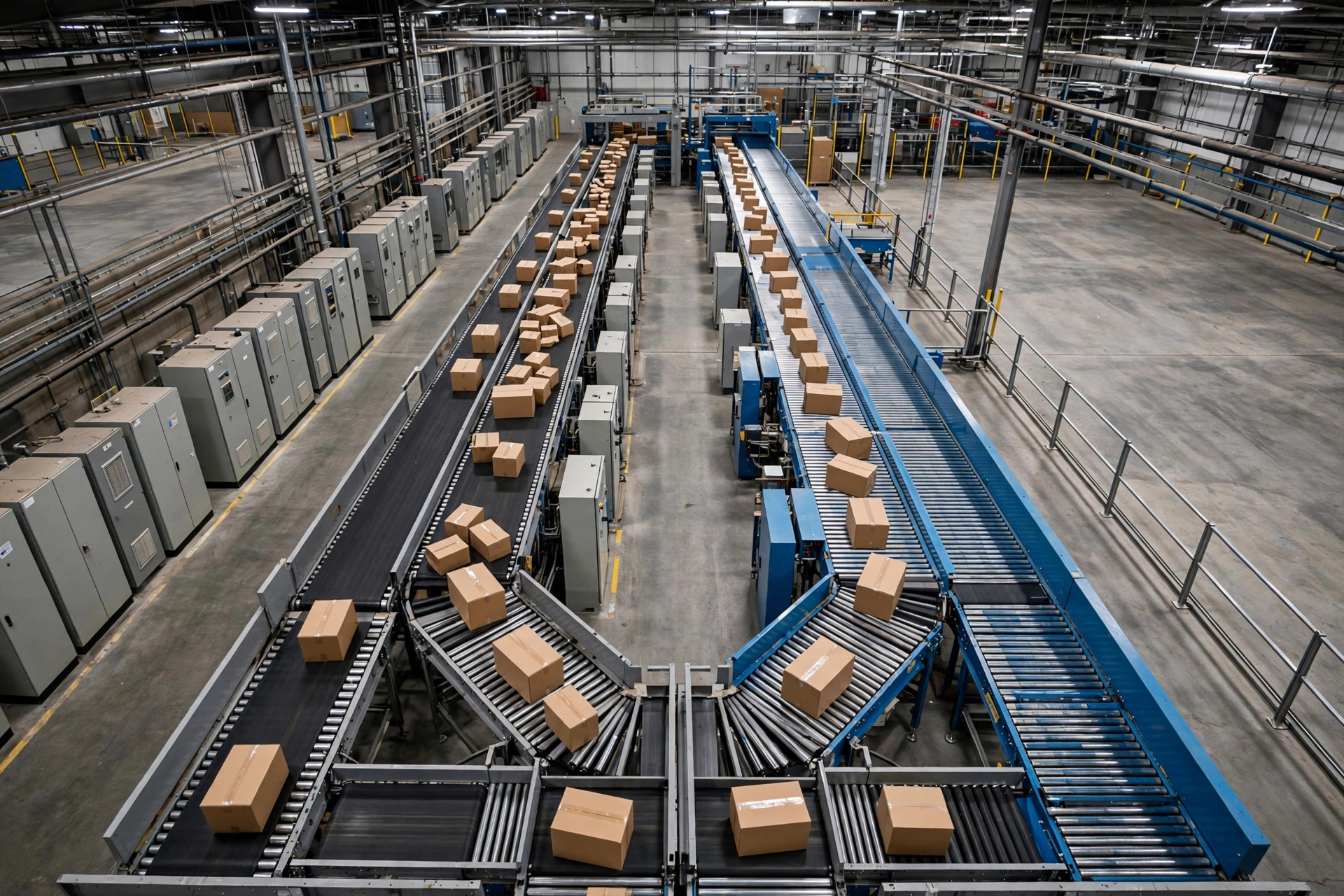
In 2023, a 3PL e-commerce warehouse in Kunshan, China. Phase one was an international brand's cross-belt sorter, installed in 2019. Phase two added a domestic belt conveyor line for pre-sorting, merging into phase one. One WCS, everything connected.
Two weeks after go-live, every day at 10 AM when the promo wave hit, the merge point turned into a pile-up: cartons came screaming in from phase two at 2 m/s while the phase-one line at 1.5 m/s hadn't cleared space yet. Cartons collided at the merge, and the damage rate jumped from 0.3% to 1.1%. It took a month to find the root cause, and it was almost funny: the two PLCs' "release confirmed" signals were 300ms out of sync — Vendor A thought "I already told you," Vendor B was still waiting for "the official instruction." The fix was gloriously low-tech: a 6-meter variable-speed buffer section before the merge, with it dynamically matching the phase-two infeed speed to the real-time speed of phase one. Damage rate dropped back to 0.35%. Ugly, but it works.
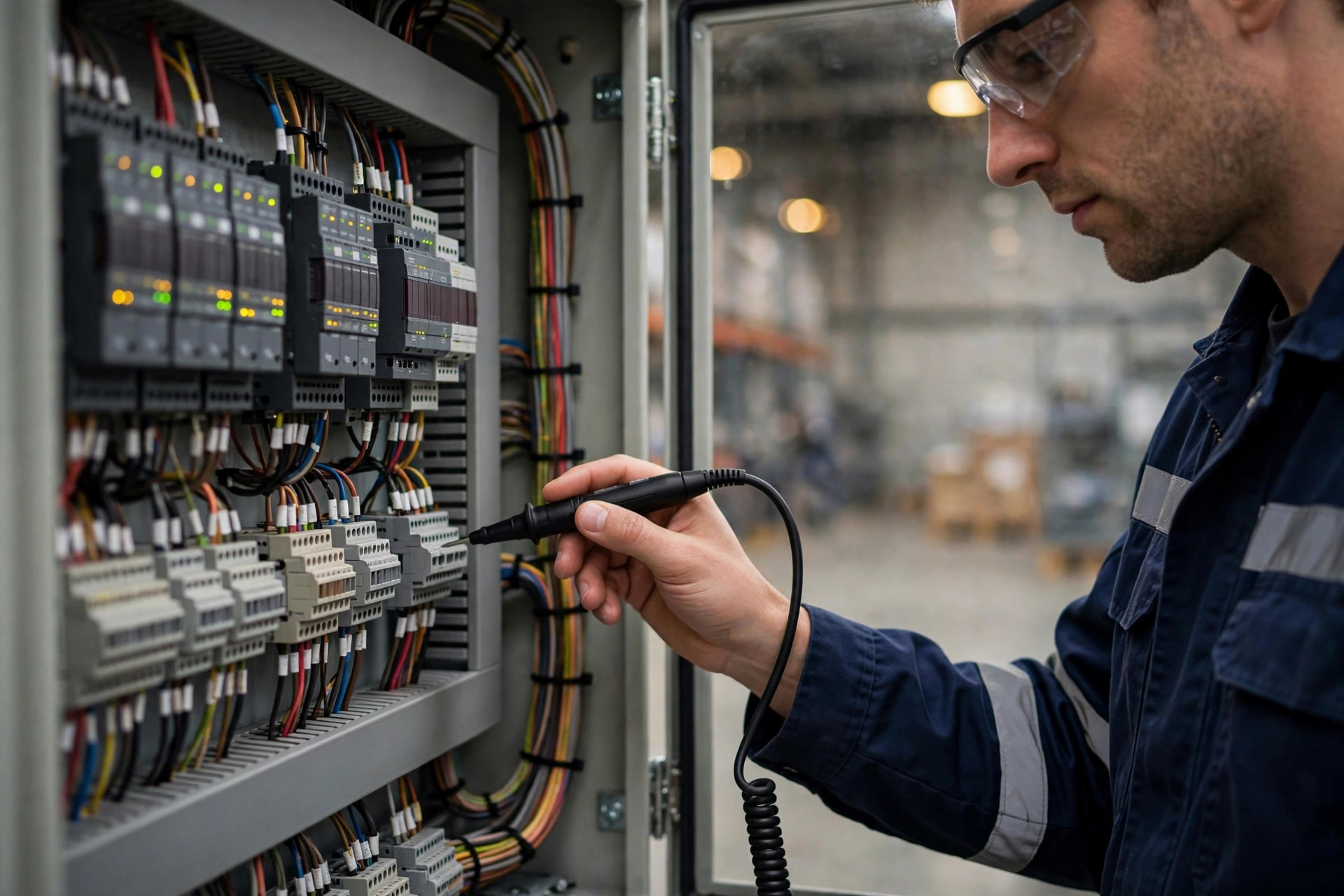
In 2024, an apparel distribution center in Ontario, California. The old line was Hytrol from 2015; the new line was roller conveyor from a local integrator. Two protocols at the interface layer: EtherNet/IP on the old line, Profinet on the new one, two drivers running on the WCS server. The more expensive trap was maintenance: the night-shift electrician could read the old line's alarms in his sleep, but the new line's codes meant digging through an 80-page English manual. One morning at 3 AM the new line threw "Error 2147" and sat dead for 40 minutes. The electrician assumed a burned-out motor and had it half disassembled before discovering a loose photoeye bracket — he couldn't read the code. The real tax on multi-vendor was never paid when you bought the equipment. It's paid at 3 AM when the line is down.
The Decision Line: Three Ways to Run Multi-Vendor Lines on One WCS
Principles and war stories are on the table. Now the line. There are exactly three ways to do multi-vendor WCS integration — there is no fourth:
| Approach | How it works | Upfront cost | Commissioning time | Throughput ceiling | Maintenance burden | Fits when |
|---|---|---|---|---|---|---|
| Keep them separate | Two WCS instances (or WCS plus vendor's own supervisory), system-level handoff | Low | Short | Whatever each can do | Low | Lines are physically independent, barely interact |
| One WCS, two PLC drivers | WCS plays translator, each side speaks its own dialect | Medium | Medium | Roughly 3,000–6,000 cartons/hour | High | Merges/diverts interact, but takt requirements are modest |
| One WCS, unified PLC platform | One vendor's PLC program rewritten to a common spec | High | Long | 6,000+ cartons/hour | Medium | High takt, many merge points, long-term expansion planned |
Where's the line? Two numbers: merge-point count and target takt. More than 3 merge points and a target above 6,000 cartons an hour — go with the third option, no hesitation. Below that line, the second option is the sweet spot. The first option is valid in exactly one situation: the two lines genuinely never touch. A single merge point turns it into a landmine.
Time to take a shot at a fake requirement I hear constantly: "We want one WCS running the whole building with a beautiful monitoring dashboard." A WCS earns its keep on takt and routing, not on dashboards. The prettiest screen on earth won't stop cartons from colliding at the merge, and you still pay for every damaged one. Here's another: "Let's standardize both lines on our preferred PLC brand for common spares." Do the math first: new PLC hardware, rewritten programs, recommissioning — one line's conversion cost buys you years of spare parts. Unless takt forces you to unify, don't touch it. If it ain't broke, don't standardize it.
The Maintenance Traps: Handover Day Is When the Bill Arrives
The day the project gets signed off is the day multi-vendor integration starts charging you. Four hard rules:
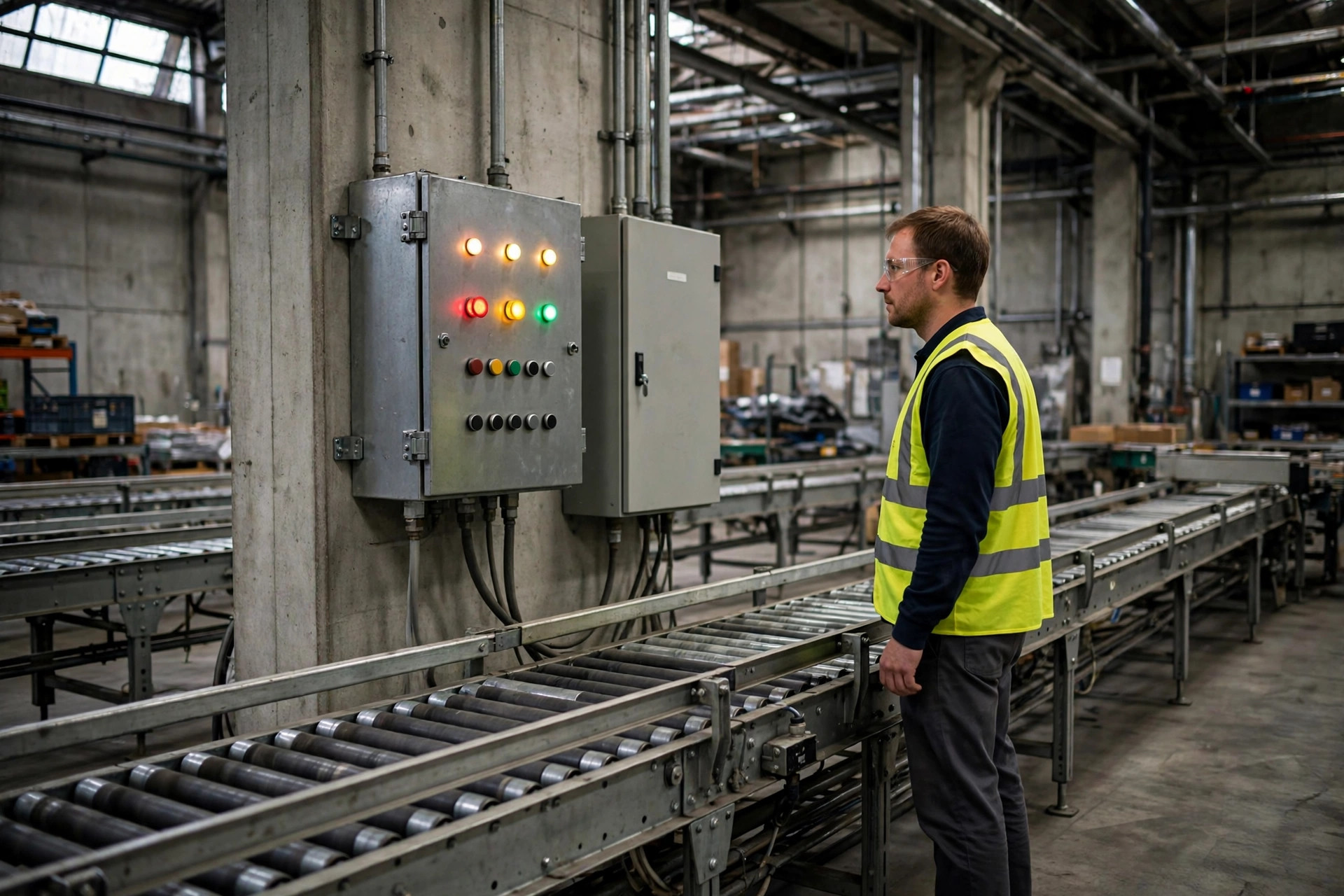
First, alarm codes need a translation sheet. WCS alarm number → Vendor A code → Vendor B code → corrective action, printed and stuck inside the control cabinet door. That 40-minute 3 AM outage in Ontario? One laminated sheet would have prevented it.
Second, doubled spare-parts inventory is non-negotiable. Two PLC families, two photoeye types, two VFD brands — your spares SKUs double overnight. At project budgeting, everyone counts the equipment price delta and nobody counts spares and training. In my projects, multi-vendor sites run 30–50% higher annual spares-plus-training cost than single-vendor sites.
Third, any firmware or program change from either vendor must soak in the test environment for a full 72 hours first. One vendor pushed a firmware update that changed a message format; the WCS driver didn't keep up, and the whole line sat down for half a day. I've seen that exact accident twice. Both times someone said "I thought it was just a minor update."
Worth It or Not? Watch This One Number
Here's the counter-intuitive call: ninety percent of the equipment savings from multi-vendor sourcing get paid back within three years in another currency — manual intervention, damage, spares, downtime. Run the numbers: a 6,000-carton-per-hour merge line losing takt sync will push roughly 2% of cartons to manual handling daily. Twelve operating hours means 72,000 cartons, 2% is 1,440 cartons, 30 extra seconds each — that's 12 labor-hours, an entire shift thrown away every single day. In a US facility at fully loaded labor rates, that's well into six figures a year, gone.
So stop asking "how much did multi-vendor save us." Ask this one number instead: mixed-vendor loss rate = (rated takt − actual sustained takt) ÷ rated takt. Above 15%, the integration failed, and the savings will come back to collect with interest. Kept under 5%, the money was well spent.
Multi-vendor integration isn't a technology problem. It's an accounting problem. Get the math right and one WCS can run as many vendors as you like. Get it wrong, and even one vendor is too many.
By Da Liu, Automation Engineer