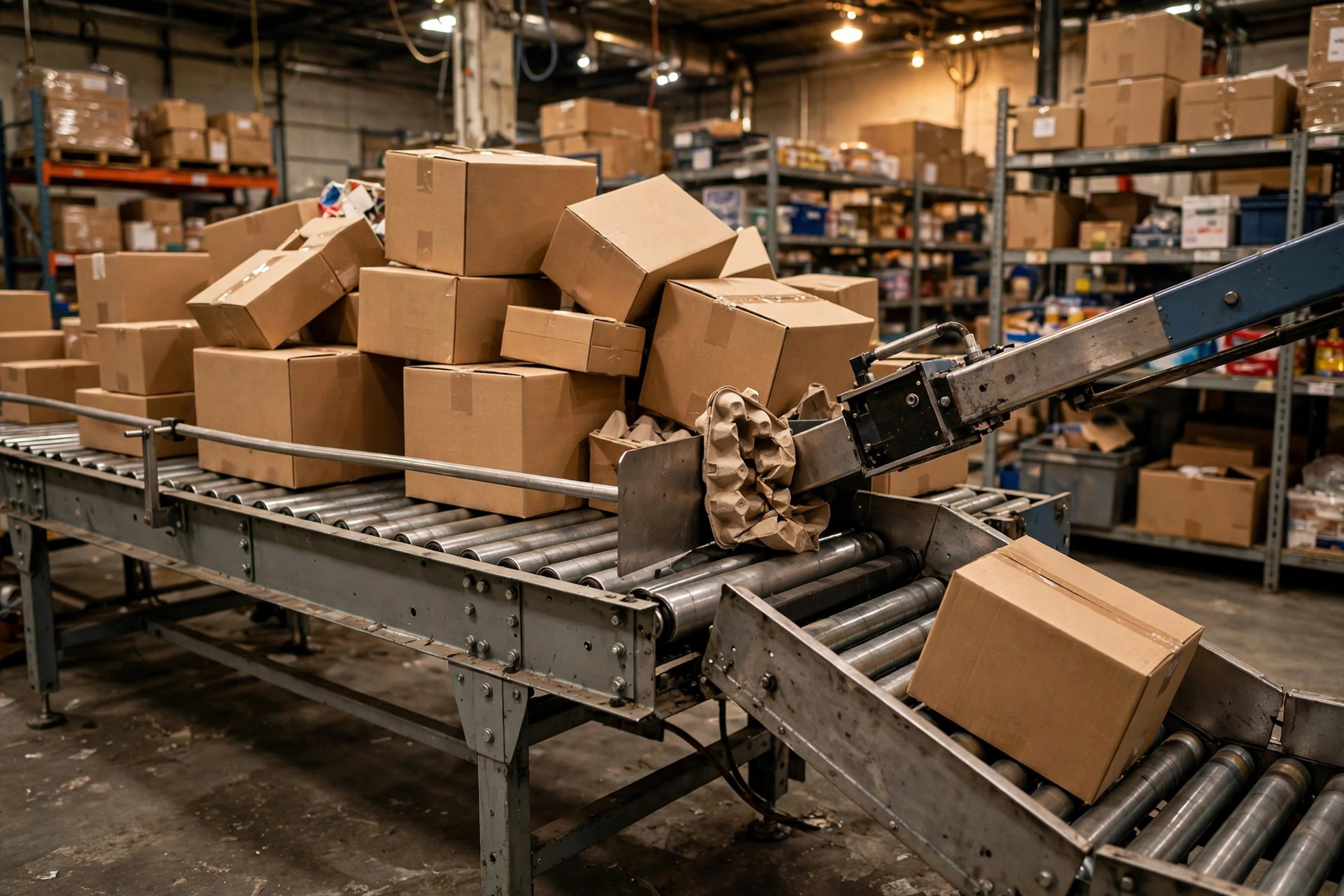
Nobody buys a sorter for the good days. The brochure number — twelve thousand units an hour, 99.9% read rate — assumes every chute stays clear and every label scans. Real warehouses don't work that way. I learned this at 2 a.m. on the Tuesday after Thanksgiving 2023, standing in a 120,000-square-foot 3PL in Ontario, California, watching a cross-belt sorter choke on its own success. Chute 3 filled up, the photo-eye had been alarming for a while, and the shift supervisor figured they would clear it "after this wave." The WCS kept diverting into chute 3. Parcels slid off the chute and piled onto the floor, eventually blocking the scan tunnel's read zone. No-reads spiked, the exception chute filled up too, and the whole line went into recirculation — trays looping empty for the better part of an hour while the UPS cutoff sailed by.
The postmortem was uncomfortable because the equipment was fine. The WCS exception routing was configured wrong. Full chutes, unread barcodes, oversized items — these happen every single day in every sortation system. They are normal exceptions. Misconfigure them and a machine worth hundreds of thousands of dollars gets defeated by a handful of settings. Here is what I got wrong over the years and what I finally settled on.
When a chute is full, who does the WCS listen to?
The common mistake is treating a full chute as a labor problem — just send someone to clear it. But a full chute is fundamentally a routing decision. The moment the photo-eye says "full," the system has roughly one sorter revolution to do three things: stop diverting to that chute, reroute the affected parcels to a backup chute, and alert a human to come clear it.
The failure mode I see most often is a lag between "stop divert" and "reroute." Some systems don't refresh their routing tables until the next wave drops, so for 30 to 60 seconds the sorter keeps feeding a chute that is already full. I once walked into a site where the "chute full" signal came from a photo-eye at the bottom of the chute instead of the entrance. By the time that sensor tripped, parcels were already backing up over the chute lip and onto the floor.
My configuration rules are three. First, chute-full detection uses the entrance photo-eye plus a fill-level calculation: at 85% of design capacity the WCS sends a warning and starts diverting new parcels to the backup chute; at 100% it stops diverting outright. Second, every chute gets an "overflow buddy" hard-coded in the routing table — an adjacent chute or a centralized exception chute. The floor crew never has to improvise this decision at 2 a.m. Third, when the chute is cleared, the WCS restores normal routing automatically. Never depend on a human clicking a button to resume — at 3 a.m., that click gets forgotten nine times out of ten.
A cautionary counter-example: in 2021 I toured an apparel warehouse whose WCS was configured to stop the entire sorter when any chute filled, waiting for a manual clear. Sounds conservative, right? In peak season a chute filled roughly every forty minutes. The sorter started and stopped more than twenty times a day, and effective throughput dropped by nearly a third — never mind what it did to the motors and brakes. They switched to automatic reroute on full and throughput recovered the same day. Stopping the line is the most expensive exception handling there is. Reserve it for last resort.
The no-read problem is about hesitation, not failure
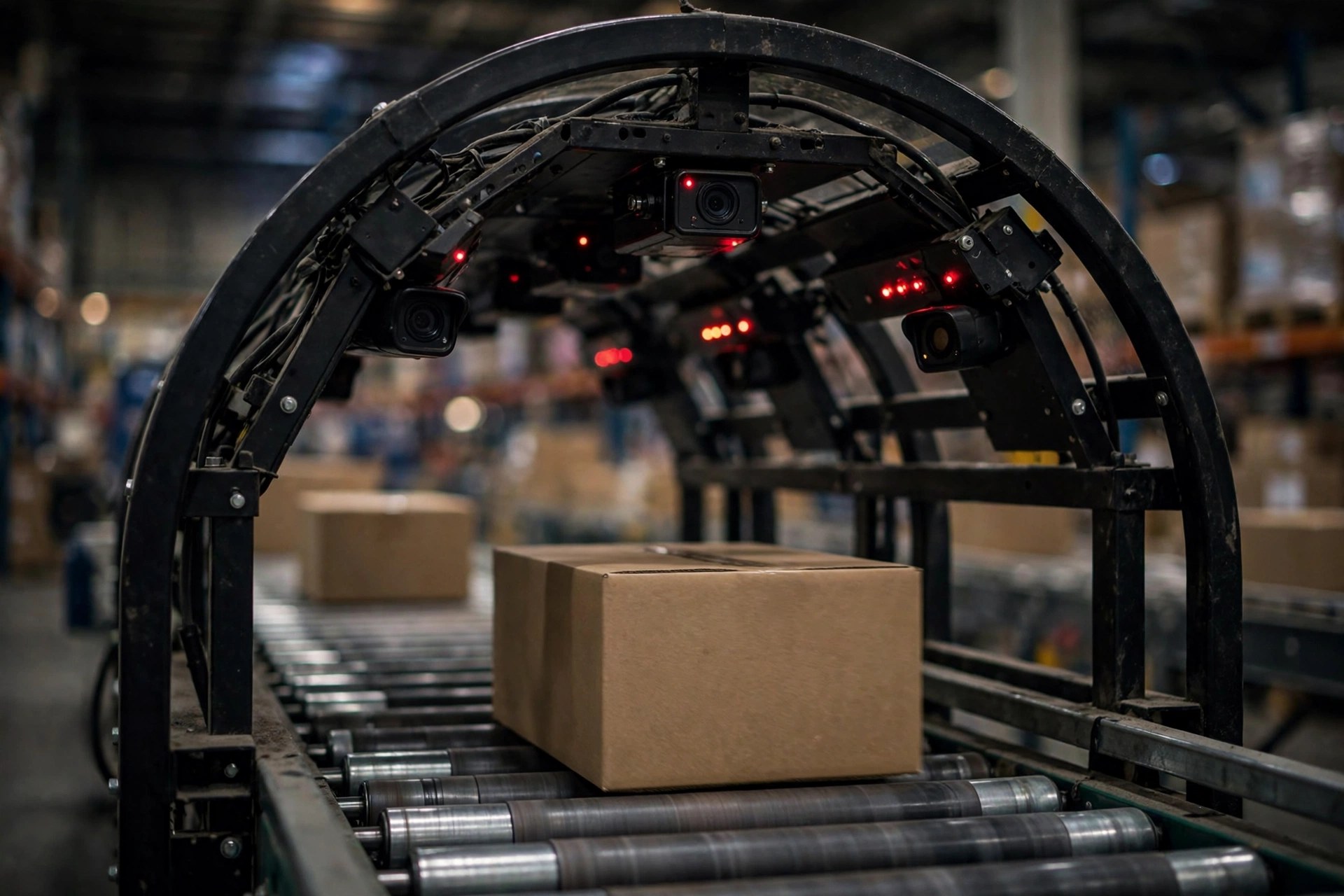
Scan tunnel vendors quote 99.9% read rates. On the floor, creased labels, half-taped shipping labels, and tipped-over boxes make no-reads a daily event. The read rate isn't the issue — what the WCS does with a failed parcel is.
I've seen three approaches. The first: stop the line and alarm on every no-read. This is the worst option. On a line running near ten thousand units an hour at peak, every stop costs restart time plus upstream congestion, and the bill accrues by the minute. The second — the one I recommend — diverts no-reads to an exception chute, where an operator at a rework station scans the parcel, keys in the destination or reprints the label, and the WCS binds the correction to the parcel's exception ID and re-inducts it into normal flow. The third approach recirculates no-reads for extra loops "just in case the camera catches it next time." Yes, people really configure this — five recirculation loops of pure wasted capacity.
One detail decides whether the second approach works: where the exception chute sits. It must be downstream of the scan tunnel, reachable by a human, and on its own conveyor segment that doesn't fight normal chutes for slide space. On one project the exception chute ended up on the far side of the sorter, and operators had to push a cart eighty meters to re-induct corrected parcels. During peak the no-reads piled up faster than humans could walk them back, and the exception chute became the new bottleneck.
Don't cheap out on exception chutes and manual stations
Exception chutes and manual rework stations are the first line items cut in budget reviews — "normal flow works, how many exceptions can there be?" That sentence sounds reasonable in a bid meeting and absurd at 2 a.m. on Black Friday.
My minimum configuration: at least two exception chutes on the line (one for no-reads, one for oversized and non-conveyable items) plus one manual induction station. Oversized items deserve their own paragraph: the WCS must enforce dimension and weight limits at induction, and anything over the limit gets rejected to the manual station before it ever touches the sorter. I watched a six-foot rolled carpet get inducted onto a cross-belt once. It jammed in a curve and stopped the line for twenty-five minutes — all because induction had no oversize rejection.
The manual station also needs one feature most people forget: operator-assigned divert. Some parcels are no-reads with destroyed labels. The operator looks up the destination in the WMS, assigns a chute at the workstation, and the WCS diverts the parcel there. This feature ships disabled in many WCS packages. Turn it on.
And don't skip the label printer at the manual station. Roughly a third of no-reads are just damaged labels — reprint one and the parcel goes back into normal flow. Without a printer, operators hand-key tracking numbers all shift, and the error rate climbs visibly. A printer and a year's worth of ribbon costs a few hundred dollars. Best money on the line.
Alarm thresholds: better noisy than silent
My most expensive alarm mistake was being too polite — setting the chute-full alarm to fire after five minutes of "full" so we wouldn't bother the floor. By the time it sounded, parcels were stacked chest-high.
My current thresholds: 85% chute fill sends a warning to the shift supervisor's handheld, no siren. At 100% the divert stops and the siren sounds. More than twenty parcels in an exception chute triggers an alarm with a fifteen-minute clear SLA. A no-read rate above 2% sustained for ten minutes triggers an alarm — that almost always means the scan tunnel needs cleaning or a batch of bad labels came in from upstream, and someone should go check. Alarms must be tiered: warnings go to handhelds, faults get lights, sirens, and text messages. Without tiering you get the boy-who-cried-wolf problem: everything alarms, the floor eventually unplugs the siren. I've seen that too.
One more rule: the WCS must log every exception-routing action. Which parcel, what time, why it was rerouted, which chute it went to, who handled it, when it cleared. That log is gold in the post-peak review — it lets you cost out exception labor precisely, and next year's budget has real numbers behind it.
Sortation vendors know normal flow better than I do. But exception routing is where vendor defaults are written for an ideal warehouse, and there are no ideal warehouses. Chutes will fill. Barcodes won't read. Oversized items will sneak in. A WCS isn't judged by how fast it runs on a good day — it's judged by how little it panics on a bad one. At your next WCS acceptance test, don't just run the normal divert cases. Stage an exception drill: block two chutes, feed ten unlabeled parcels, drop in one oversized item, and watch whether the system stabilizes itself within five minutes. If it can't, fix the configuration now — it's a lot cheaper than tuition at 2 a.m. on Black Friday.