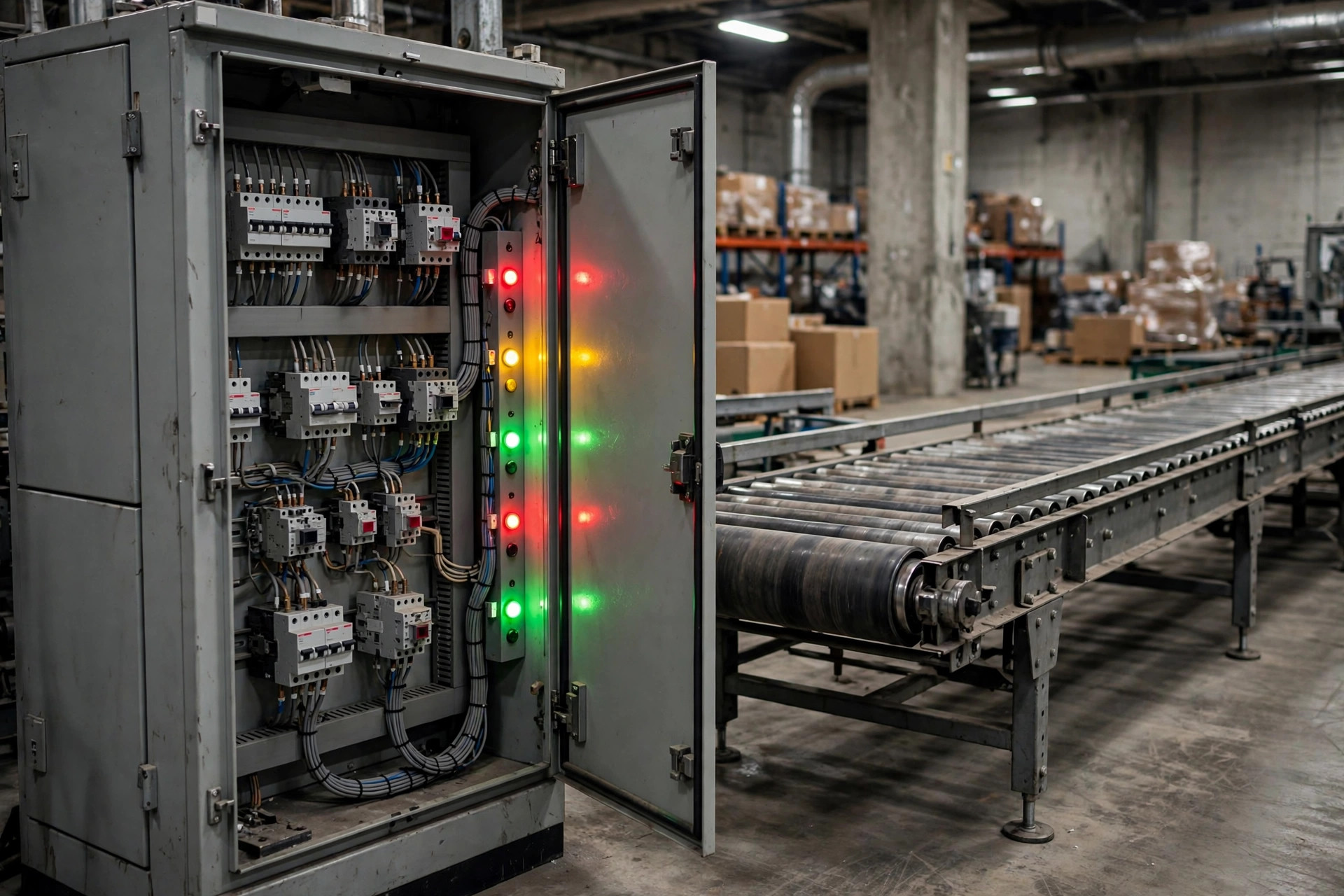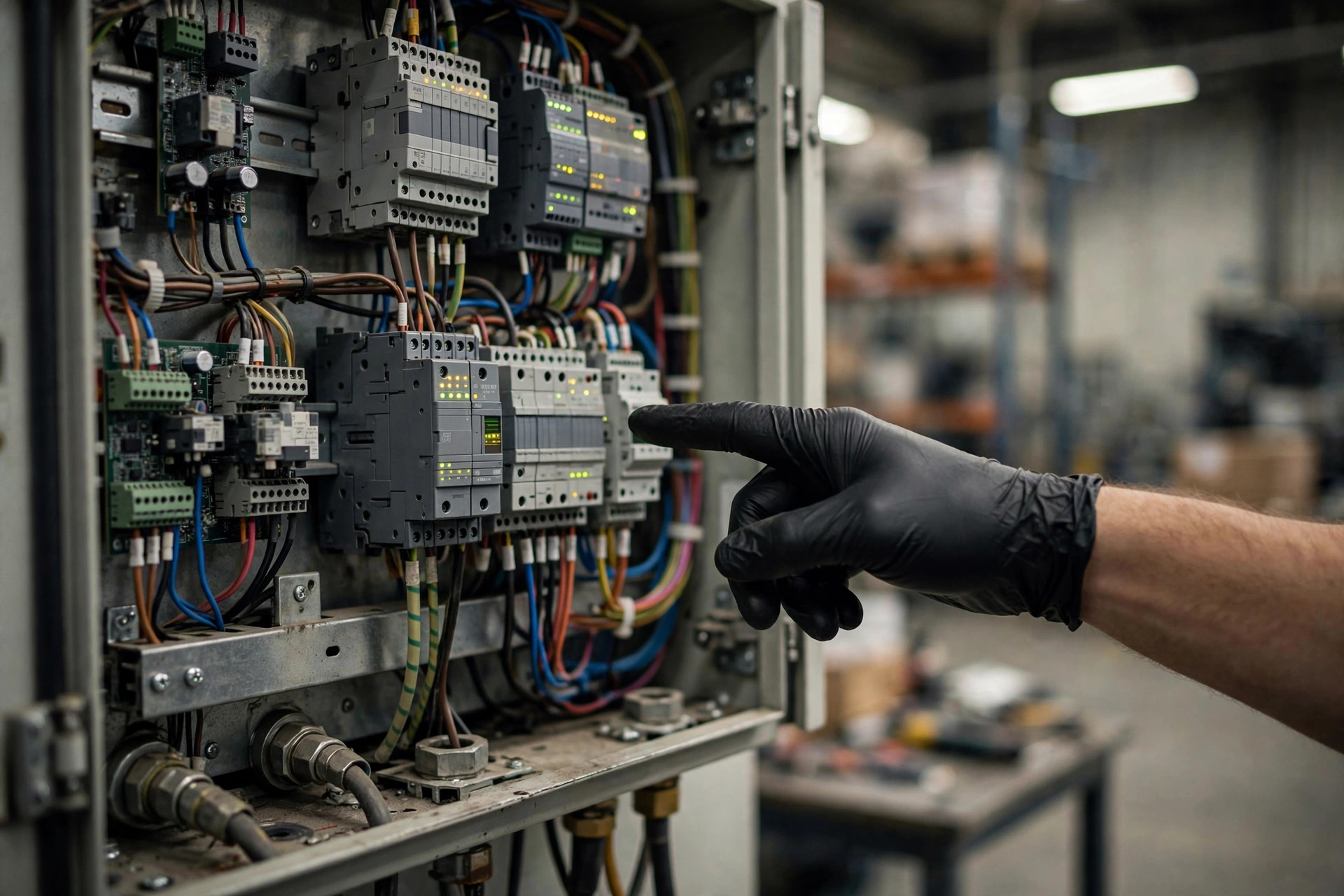
One warehouse's WCS threw 4,000+ alarms a day. The maintenance tech just muted the sound.
That was 2019, a 300,000-square-foot automated facility in the Chicago suburbs that had just commissioned a new sortation line. The WCS (warehouse control system) ran the conveyors, scanning, induct merges, and diverts — hundreds of photoeyes, dozens of motors, over a hundred communication nodes, each pushing an alarm to the control room on every state change. A photoeye blinded by dust: one alarm. A motor current flicker: one alarm. A PLC heartbeat arriving 200 milliseconds late: one alarm. Over 4,000 a day, more than any screen could scroll through.
Too many alarms, and people learn to ignore them. The danger isn't the false alarms — it's the real one buried inside 4,000 that nobody sees. That warehouse later had a sorter jam. The alarm had fired 15 minutes earlier. Nobody in the control room noticed, and half the line backed up for a 40-minute stop. I happened to be on site that day, and the maintenance lead told me: "It's not that I don't look. Looking doesn't help."
That's alarm flooding. You don't fix it by adding people. You fix it with prioritization and root-cause convergence.
Forget five levels. Three is enough.
Many WCS vendors ship with four or five severity levels: critical, major, minor, warning, info. It sounds precise. In practice, nobody on shift remembers the difference between five levels, so everything gets treated as one.
I use three:
Fatal: stops the line or touches safety. Motor overload trip, e-stop pressed, safety light curtain blocked, main PLC comms lost. These get sound, a big-screen popup, and if nobody acknowledges in 15 minutes, an automatic phone call. My rule: more than 3 fatal alarms in a day means the equipment has a problem, not the alarm system.
Production-impacting: the line runs, but slower. A chute full and auto-rerouted, scan rate dropping below 95%, a conveyor section running derated. These go to the control-room screen and the on-duty phone — no siren. The shift must handle or document them within an hour.
Advisory: log only, bother nobody. A single photoeye misfire, one successful comms-node reconnect, a brief motor current wobble. This tier is 90%+ of total volume. Its only value is post-incident analysis. It should never appear on anyone's screen.
My one test for severity: if nobody looks at this alarm, does it become a money problem within two hours? Yes — top two tiers. No — advisory.
At that Chicago facility, we spent two weeks re-grading all 4,000+ alarms against that standard. Result: 11 fatal, 87 production-impacting, and 3,900+ advisory. The tech turned the sound back on — because now every alarm that made noise was worth standing up for.

Five alarms, one crooked photoeye
Prioritization solves "can't read them all." Convergence solves "can't fix them all."
One night shift, the control room lit up with 200+ alarms in an hour: scan failures in zone A, merge timeouts in zone B, motor overloads in zone C, comms jitter in zone D, parcel dwell in zone E. Two techs ran around all night. The line kept limping. At dawn I walked the floor and found all five alarm types pointing at one spot: a photoeye at merge point 3, knocked 3 millimeters crooked by a pallet. Crooked eye, wrong scan timing; wrong timing, chaotic merges; chaotic merges, straining motors; straining motors, jittery comms. One loose screw, 200 alarms.
That's the most common truth about WCS alarms: alarms fire per device, but faults propagate along a causal chain. One alarm maps to one device, but one fault detonates a string of alarms down the chain.
My convergence method is crude but works: before end of shift each day, cluster the day's alarms by equipment location plus time window. Three or more different alarm types in the same area within ten minutes — don't fix them one by one. Go look at that area. Odds are it's one root cause. I also had maintenance build an "alarm family tree": which photoeye going crooked produces which downstream alarms. After three months, the shift crew could guess the root cause from the alarm combination alone. Average time-to-locate dropped from 40 minutes to under 10.
And one hard rule: the same device firing 20+ advisory alarms in 24 hours auto-escalates to production-impacting. A photoeye misfiring once is dust. Misfiring daily is loose or dying. Don't let "advisory" become a chronic condition.
MTTR only means something after prioritization
MTTR (mean time to repair) is a KPI at plenty of warehouses, but before alarm prioritization, the number is fiction. With 3,900 advisories mixed into 4,000 alarms, MTTR looks great — because advisories get "resolved" fast (glance and dismiss). When something real breaks, MTTR tells you nothing.
After prioritization, track MTTR separately: fatal on its own, production-impacting on its own, advisory not at all. At the Chicago site, the blended MTTR before prioritization was 22 minutes — looked fine. After splitting it out, the real fatal-alarm MTTR turned out to be 55 minutes, because nobody had been seeing those alarms promptly in the first place. Three months after prioritization, fatal MTTR was under 15 minutes. The crew didn't get faster. The alarms finally reached the right people.
For the alarm-MTTR link I do exactly three things: fatal alarms auto-create a work order and start a timer; production-impacting alarms auto-escalate when unhandled past their window; and every Monday I put the three tiers' counts and MTTRs side by side — if counts climb while MTTR stays flat, the severity thresholds have probably gone soft.
Starter checklist: five things for week one
If your WCS is drowning in alarms, skip the big project. Do these five first:
- Export the last 7 days of alarms, sorted by count. The top 20 alarm sources usually account for 80% of volume. Hit those first for the fastest win.
- Land "advisory goes to log only" first. Highest ROI move there is — one day to clear the screens. Note: you're muting the push, not the record. Keep every log.
- Give fatal alarms a real escalation path. Sound plus big screen plus automatic phone call after 15 minutes unacknowledged. Prioritization without escalation is decoration.
- Start the alarm family tree. Begin with the 5 most common alarm combinations, expand to 20 within a month. It's the most valuable knowledge asset your maintenance team will own.
- Review the top 10 alarm sources weekly. The same photoeye on the list two weeks running isn't "false alarming" — it's due for replacement. Fifteen minutes, top 10 only, actions only.
One judgment to close: WCS alarm flooding is never a technology problem. It's a management problem. Out of 4,000 alarms, 3,900 are the system talking to itself and 100 are telling the truth. Your job isn't to make the system talk less — it's to make the truth audible.