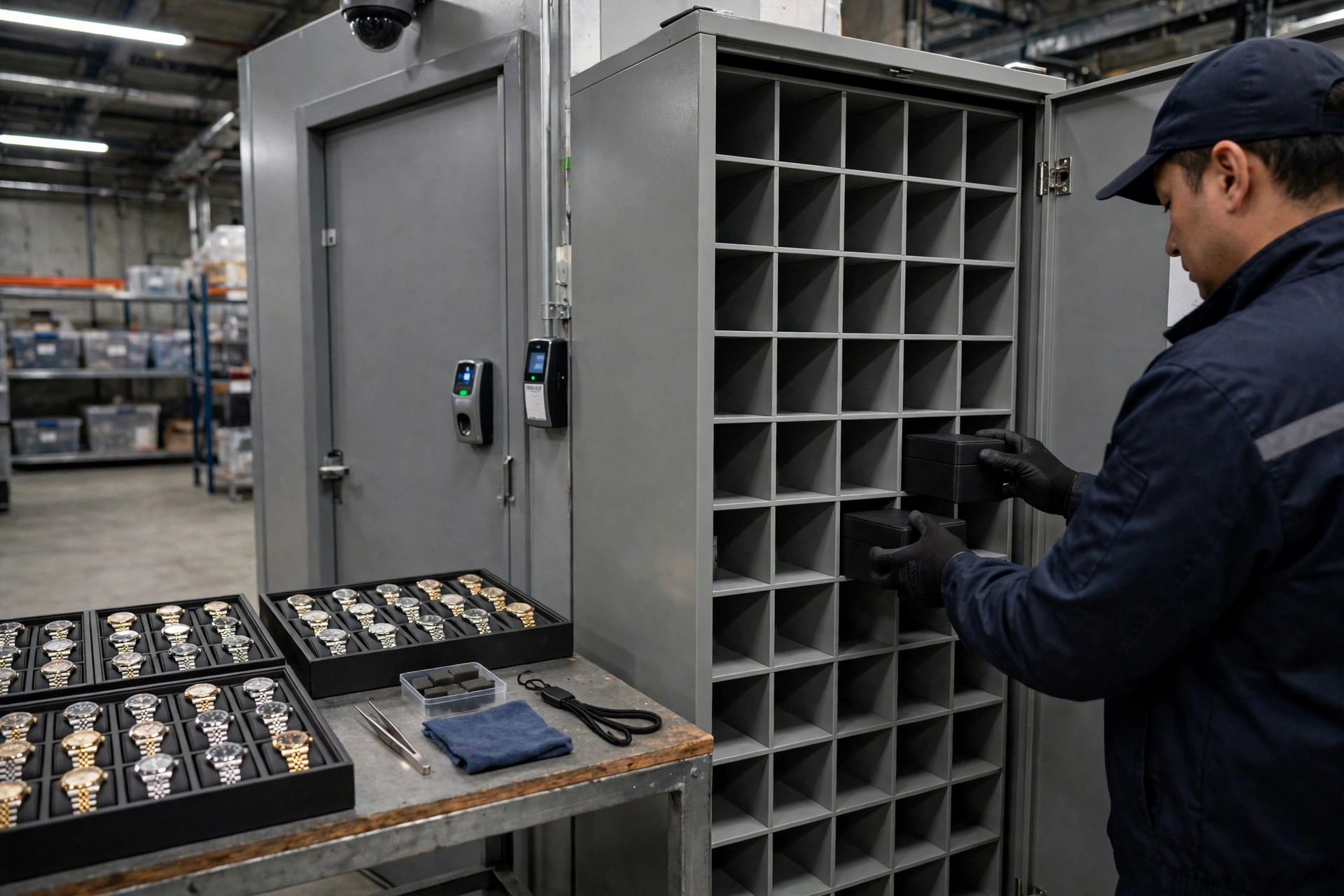
We had a client who came to us last fall to talk about watch warehouse storage: an independent watch brand out of Los Angeles. His studio was overflowing. Sales were growing, and watches were stacked in every spare corner of the workshop and at home. At our first meeting he asked only one question: have you ever lost anything in your warehouse? I did not rush to reassure him. Instead I asked three questions back: mechanical or quartz, roughly what value band per piece, and whether he shipped one piece at a time or in batches to dealers. Those three answers basically decide how the watches should be stored, how they should be handled, and what the contract ought to say.
Watches are, frankly, one of the hardest categories a 3PL can take on. They are small enough to slip into a pocket. A single pallet can be worth more than several racks of household appliances next to it. And they are fussy: mechanical watches hate magnetism, shock, and damp; quartz watches still hate knocks and leaking batteries. On top of that, watch clients tend to care about counting accuracy far more than the average shipper. One piece missing is not a rounding error. It is an incident. So the first step in watch warehouse storage is not price. It is deciding how the goods will live in the building.
Let me tell you about that Los Angeles brand. In the peak season at the end of 2024, shortly after the stock moved into our warehouse, we had a scare. A picker picked a limited edition piece, the system showed it shipped, and the customer said it never arrived. We traced the whole chain and eventually found the watch in a tote beside the packing bench, covered by dunnage from another order. The scan-out had been done, but the piece itself had never made it into the box. Nothing was lost, but it frightened all of us. From then on, that client's orders went through two-person verification: one person picks, a second person checks the order against the physical piece, and the sealed box is photographed before it leaves. It costs extra labor. But for high-value small goods, that step is not optional. The labor you save by skipping it will not cover one lost shipment, let alone the trust you lose with it.
The second story comes from a small vintage-watch restoration team in California that came to us in early 2025. Before that, they had kept their stock in a rented storeroom, in plastic boxes on ordinary racking, next to magnetic tools and a speaker. Over time, several mechanical watches started running fast. A watchmaker found they had been magnetized. Once they moved in with us, we did something simple and unglamorous: we separated the watch area completely from magnetic equipment and tools, kept high-power motors out of the zone, switched the picking tools to non-magnetic ones, and moved every watch in and out on fixed trays rather than setting it down on whatever bench happened to be free. Demagnetizing can fix some of the damage after the fact, but by then the client has already lost confidence. Magnetism prevention costs very little. The trick is writing it into the operating procedure, not leaving it to individual good habits.
Theft, magnetism, and counting in watch warehouse storage are one trade-off
Theft prevention, magnetism protection, and counting accuracy belong in the same conversation, because they pull against each other. Many people assume tighter security is always better and want the watches locked in a vault that opens once a day. I have seen warehouses run that way, and their counting was actually worse. When the door opens rarely, staff tend to pull extra stock in one trip, and the system record drifts away from what is physically on the shelf. When a big annual count finally opens everything up, the discrepancies have been accumulating for months and nobody can trace them back to a person or an order. Here is the counterintuitive part: for watches, frequent small cycle counts are usually safer than one grand annual count. Count a small random sample every day, rotate through the whole range every week, and any discrepancy can be pinned to that day's transactions. The window in which something can go missing without being noticed shrinks dramatically.
This is the comparison I walk clients through when we scope a watch storage solution. Hold it up against any 3PL proposal and you will quickly see whether they genuinely understand this category.
| Storage approach | Theft protection | Magnetism and moisture control | Counting ease | Best for |
|---|---|---|---|---|
| Open racking with trays | Weak, relies on cameras and access control | Average, relies on zoning | Easiest, count anytime | Lower-value quartz pieces that move fast |
| Locked cabinets with zoned storage | Strong, two-person cabinet access | Good, environment can be controlled per zone | Fairly easy, cabinet access needs scheduling | Most independent brands and dealer stock |
| Separate secure room with full traceability | Strongest | Best, temperature and humidity can be controlled | Slowest, every entry leaves a record | High-value limited editions and collector-grade pieces |
There is no universally right answer here. Putting fast-moving, lower-value stock in a separate secure room is like hiring a vault to guard pocket change: all cost, no benefit. Putting limited editions on open racking leaves the risk exposed to everyone. When you negotiate, do not just ask about monthly rent and handling fees. Ask whether watch stock sits in its own zone, whether entry requires two people or at least leaves a record, whether count frequency is written into the service standard, how the liability cap for loss or damage is calculated, and whether insurance is bought by the warehouse or by the shipper. Most disputes do not start when something goes missing. They start earlier, when the contract never spelled out these points and both sides argue from memory afterward.
Counting discipline decides watch warehouse storage quality
Counting deserves a few more words, because this is where watch operations most often fail quietly. The danger is not an inaccurate count; it is a late one. My recommendation is layered: sample-count high-value pieces every week, rotate through the ordinary range every month, and use a quarterly or half-yearly full count only as a check. Make the sample random. A fixed schedule that always counts the same zone on the same day is effectively an announcement of when and where you will look. Reconcile the result the same day, raise a variance note the same day, and trigger a recheck once the variance passes an agreed threshold, rather than letting differences pile up until month-end. This routine is not flashy, but when it is actually followed, stock-record mismatches get caught on the day they happen.
One more piece of inside knowledge from the 3PL side: the cost watch clients most often underestimate is not storage. It is verification and photo documentation labor. A warehouse that looks cheap on its rate card may list two-person verification, box photography, and variance rechecks as billable extras. Run the peak-season volume through that price list and the total can be a shock. When you compare quotes, ask the provider to break out those items separately, then compare totals, not headline rents.
So here is my honest verdict. A good watch operation is not judged by how big or new the warehouse is. It is judged by whether three things are written down and actually enforced: zoned storage, a magnetism and moisture handling procedure, and frequent cycle counting with same-day reconciliation. If those three are in the contract and in the work instructions, and someone actually audits them, the operation is real. Otherwise, however pretty the building, it is just a set of shelves.
Next time you negotiate a contract, remember to ask these three questions: which zone will my watches sit in, and who controls entry? How often do you count, and will I see the variance result the same day? If one piece goes missing, how is compensation calculated? Get clear answers to those three, and you will know whether the provider truly understands watch warehouse storage.
By Susan, 3PL Sales Director