We had a client who leased a 50,000-square-foot warehouse outside Phoenix in 2023, selling outdoor gear. Two weeks after go-live, the warehouse manager called me, voice completely shot: the PDAs kept dropping connection mid-scan, and pickers were standing at the ends of aisles holding their devices up in the air like torches, hunting for a signal. Outbound throughput had fallen by a third. He asked me whether the lease was even worth keeping.
"How to fix WiFi dead zones in warehouse" — that is the exact phrase clients type into Google, and it is one of the questions I get asked most often. Here's the answer up front: dead zones are not a luck problem. They are a contract problem. Nine times out of ten, the root cause is that nobody did a signal survey before signing.
I've watched this exact movie twice
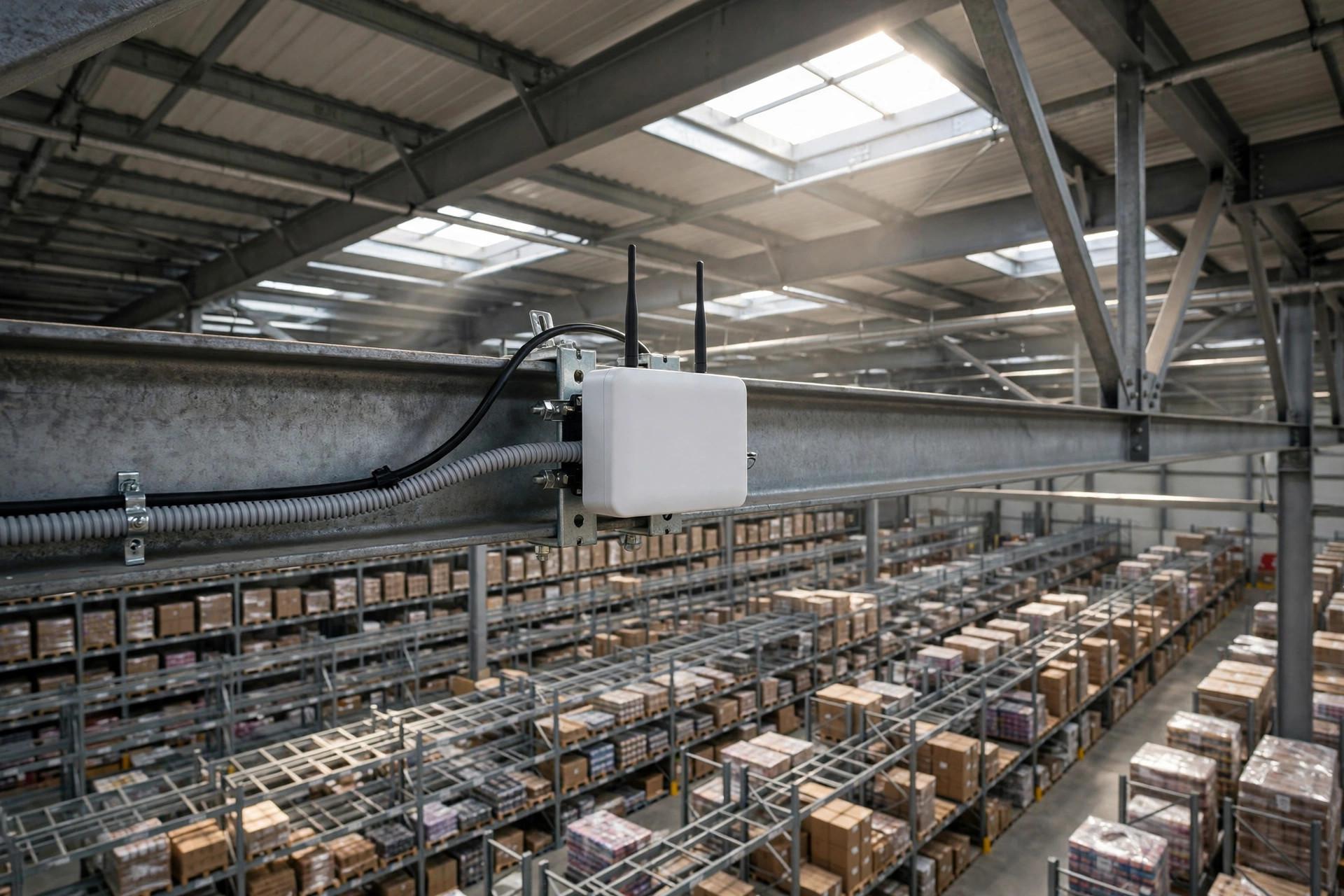
At the Phoenix site, I walked the floor with an engineer and the problem was obvious in about ten minutes. The access points had been installed by the general contractor as an afterthought — six of them, all dead center on the ceiling, placed the way you'd wire an office. The warehouse had 36-foot clear height and seven-level racking; steel uprights plus fully loaded cartons meant the signal barely survived to the end of any aisle. The fix: eight more APs in the racking zones plus a full roaming retune. It cost just under twenty thousand dollars and pushed the schedule back three weeks. The client's words: "If we'd spent a few thousand on a survey before signing, this whole mess would never have happened."
Then there was the Los Angeles client in 2024, leasing space inside a 3PL. Network coverage never came up during contract talks. Come peak season, with the racks fully loaded, the steel plus the cartons turned the building into a Faraday cage, and scanning at the far ends of aisles simply froze. The 3PL pulled out the contract: coverage wasn't in the SLA, and remediation would be scheduled "as resources allow." That meant two months of waiting. The client ended up paying out of pocket for an integrator to survey and add APs. I'll never forget what the 3PL's account manager told me: "Anything not written into the contract gets billed separately."
Two stories, one disease: at signing time, everyone negotiates rent, payment terms, and free-rent periods. Nobody negotiates signal. WiFi is invisible, and nobody walks the whole building with a PDA during acceptance testing. That's how the trap gets set.
The insider part: how survey reports get faked
Here's something the industry doesn't say out loud. A lot of "site survey reports" are drawn up in an office from a floor plan — AP dots scattered by experience, report delivered. I can spot one at a glance: every dot sits perfectly centered over an aisle, spaced with suspicious uniformity, and there isn't a single dead-zone warning in the whole document. Anyone who's done a real survey knows a warehouse is never "uniform."
There's another layer in the pricing. Network buildout is usually buried inside a line item called "system implementation" or "IT onboarding," where the client never sees the breakdown. And to make the total quote look lean, AP count is the first thing a salesperson cuts — four fewer APs shaves the quote noticeably and lifts the close rate. The dead zones won't surface until three months after go-live, by which point the contract is signed and the remediation is a separate invoice. That's why I say: this is a contract problem, not a technology problem.
And here's the counterintuitive part: more APs are not automatically better. The worst site I ever saw had thirty APs crammed into 80,000 square feet, with co-channel interference so bad the PDAs kept bouncing between radios down the same aisle — scanning was worse than when the place had six. WiFi is about placement and tuning, not stacking hardware. Adding APs blindly is just paying for new problems.

How to fix a WiFi dead zone starts with the cost of doing nothing
Before we talk solutions, let's do the math. Using the Phoenix client as an example, here's what I put in front of him:
| Item | Number |
|---|---|
| Pickers on the floor | 20 |
| Disconnects per picker per day | ~50 |
| Reconnect plus wait, each time | ~2 minutes |
| Wasted labor per day | 20 × 50 × 2 ÷ 60 ≈ 33 hours |
| At $25/hour fully loaded | ~$800 a day, gone |
Over a three-month peak season, that's north of $70,000. A professional survey plus remediation cost under $20,000. He approved the budget on the spot. So my advice: when you ask the boss for money, don't lead with technology. Lead with this table.
The actual fix: four steps
Step one: a real on-site survey, not a desk exercise. Insist the integrator walks the floor with test gear while the racks are fully loaded — an empty building surveys clean and lies to you; peak-season inventory is the real shield. The deliverable must include a heat map with dead-zone locations and remediation recommendations. A survey report without a heat map is a survey that didn't happen.
Step two: design AP placement around the racking, not the ceiling. In a warehouse, APs belong at the ends of rack runs or low over the aisles, firing signal down the aisle — not blasting down from 36 feet up. Steel racking kills radio; an AP hidden behind a rack might as well not exist. Remember the trade-off: the higher the AP, the wider the coverage looks on paper, and the more dead zones you get at the bottom of the racks.
Step three: think about 5 GHz and 2.4 GHz separately. 2.4 GHz reaches far but is slow and crowded; 5 GHz is fast but won't punch through two rows of racking. For PDA scanning — tiny packets, high real-time demand — 2.4 GHz is usually the steadier choice. Don't buy the "full 5G coverage" pitch. That's office logic, not warehouse logic.
Step four: acceptance-test with real PDAs in real hands. After remediation, don't just read the report. Send two pickers through every aisle and every bay with the actual devices — scan, submit, roam, all of it. Write the acceptance bar into the contract: four straight hours of operation without a drop, or it doesn't pass.
Next time you negotiate a contract, ask these three questions
One: is there a network coverage SLA in the contract, and how fast must the provider remediate a dead zone? A promise that isn't in the contract is just politeness.
Two: can I see the original survey report, and does the AP placement map match the floor plan in the contract? Dots drawn on paper fall apart under one question.
Three: who pays for the productivity lost to PDA disconnects, and how is it compensated? This one is the sharpest, and the most effective — tie the provider's money to signal quality, and dead zones suddenly get managed.
The technology to fix WiFi dead zones in a warehouse has been mature for years. The hard part was never the engineering; it's who pays and who's accountable. A few thousand dollars on a real pre-signing survey, plus an SLA in the contract, is the highest-ROI small spend in any warehouse project. Don't wait until your pickers are holding PDAs up like torches before asking how to fix WiFi dead zones in warehouse.
By Susan, 3PL Sales Director