RF scanner battery management warehouse discipline sounds like a big-site procedure. In a small warehouse like mine, it is simply whether a peak-season night shift falls apart. Last peak season, three handhelds went dark after midnight. The cradle was full of empty packs, and the crew queued for the two guns that still had charge. Nobody was slacking. The guns clocked out first.
I run a small warehouse with a small team. We cannot burn money copying a large operation — a full smart charging cabinet got a polite laugh and a closed quote sheet. But dead guns are not optional either. Waiting for a gun is a visible loss; borrowing one is a hidden one, and the hidden one scares me more.
What RF scanner battery management warehouse failure actually costs
Start with an illustrative scenario — the numbers here are a worked example, not an industry benchmark. Suppose eight pickers are on a peak night shift and only five guns have charge. Three people wait an average of twenty minutes each for a free device. That is one full labor hour burned in a single night, and it understates the damage. Picking runs on rhythm: stop, lose your place in a wave, restart cold, and errors climb for the rest of the shift.
Borrowing is worse. A handheld, its user, and its task are linked in the system. When Picker A's gun dies and he grabs Picker B's gun, every scan lands under B's name. We lived this once, again as an illustrative scenario from our own floor: a borrowed gun scanned two pallets in a rushed outbound wave, and the next morning's log review pointed at the wrong person. Nothing was lost, but that is exactly the problem — the goods were right and the record was wrong. Next time something really goes missing, you cannot tell an operator error from a system error. That data gap is the real price of sloppy rf scanner battery management warehouse practice.
My working definition is simple: on any shift, any picker should be able to grab a charged gun with a clean identity. If you cannot promise that, efficiency talk is decoration.
The low-tech rotation that actually works: numbers, a fixed charging spot, and a paper log
Our system will not impress anyone, and it works. Three pieces: numbered batteries, a fixed charging location, and a sign-in, sign-out log.
First, number every battery. We write a big number on each pack with a paint marker — 1 through N — and no unnumbered battery is allowed into circulation. Numbering turns guesswork into tracking. When one pack keeps dying mid-shift, the log tells you which number it is.
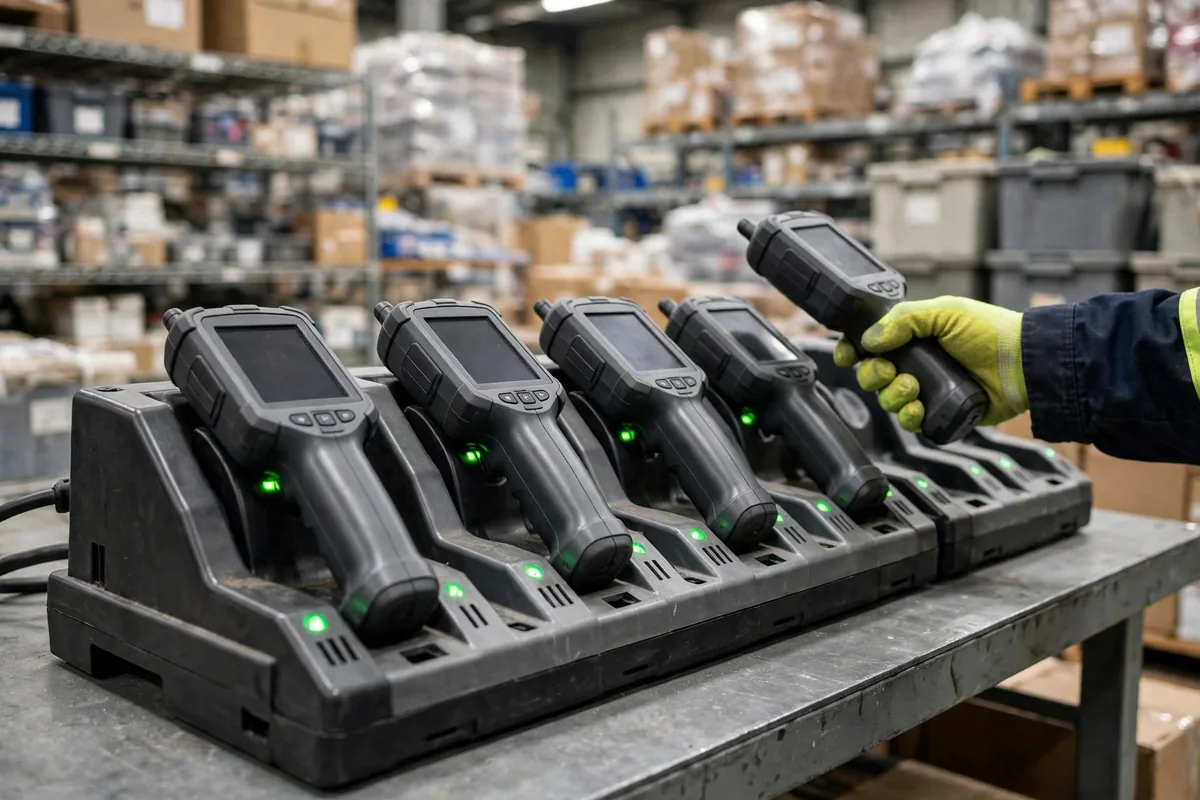
Second, fix the charging spot. We do not own a smart cabinet. We use a plain multi-slot charger next to the packing bench, split into two zones: fully charged and needs charging. One rule only: a swapped-out battery goes straight into the charging zone. Leave a dead pack on a desk and you get named at the next huddle. It sounds like managing schoolkids, because warehouse discipline mostly is managing schoolkid-level details, consistently.
Third, log on paper, not in a system. One sheet taped next to the charger records date, shift, user, gun number, battery number, and charge on return. We tried digital logging; the extra scan step vanished the moment the shift got busy, and the data ended up faker than paper. Paper is written on the spot, and the lead spots a missing battery at a glance.
Handover is where this cheap system earns its keep. Outgoing and incoming leads count together: how many guns, how many charged packs, how many on charge. A mismatch gets resolved on the spot, never left for tomorrow. Since we made that count non-negotiable, we have not had another three-guns-dead night — the batteries did not get better, dead batteries just stopped being a surprise.
Here is the counterintuitive part: for a small site, a log that happens on time beats a log that happens in software. A paper sheet filled in honestly beats a beautiful system nobody uses. Digitize when paper genuinely stops scaling, not before.
Judging battery health without inventing numbers
I will not pretend to be a battery engineer. You will see specific cycle counts online presented as retirement thresholds. I do not copy them. Cell chemistry, brand, and duty cycle vary too much, and the honest line is this: service life follows the manufacturer's guidance. What the manual and the maker's support say is what you follow.
What we watch is behavior. Flag a pack for close observation when the same shift it used to finish now triggers a low-battery warning halfway through; when it seems to charge suspiciously fast and also drains suspiciously fast; or when the casing swells, runs unusually hot, or the contacts are badly corroded. Swelling or abnormal heat is not an observation case — pull that pack from service and isolate it immediately. Saving money never outranks that call, not even in a small warehouse. Rotate packs evenly through hard shifts, too — let weak packs reveal themselves early, not all at once in peak season.
When do we retire a pack? When it reliably cannot finish a normal shift and close observation shows no recovery, it leaves front-line duty — demoted to emergency spare or handled per the manufacturer's guidance. We do not gamble peak season on it. One delayed peak night costs more than a battery.
How many spares? The RF scanner battery framework, run with your own numbers
Spare count is the small owner's classic squeeze: too few and the night shift stalls, too many and cash sits in a drawer. Here is the framework we use. Every number below is an illustrative example — plug in your own.
You need three inputs. P is guns in use at peak shift. S is swaps per user per shift — zero if a pack outlasts a shift, one if it does not. R is your rotation factor: how many shifts a pack needs from swap-out to fully charged again. Slow charging pushes R up.
The rough math: total packs in circulation is about P times (1 plus S) times R, plus a small buffer for packs pulled out of service. Illustrative example only: peak shift runs 6 guns, each user swaps once per shift, and charging turnaround needs one full shift of cushion. Circulation is roughly 6 times 2 times 1, so 12 packs, plus 2 buffer packs, for about 14 total. Do not copy my numbers — pack life and charge time must come from the manufacturer's guidance and your own floor experience.
Run the math and a pattern appears: you are mostly paying for turnaround, not headcount. Slower charging and tighter handovers mean more spares. So the real savings lever is often not buying fewer batteries — it is charging earlier. Charge the night shift's packs during the day shift, not at shift start.
Smart cabinets: the honest line between small and large sites
Large warehouses buy smart charging cabinets for real reasons: automatic charge records, automatic flagging of weak packs, and centralized control once dozens of guns make paper tracking collapse. At that scale, one lost pack costs more than the cabinet.
A small site should not copy it on pride. If you run roughly a dozen guns or fewer, two shifts or fewer, and one lead who will actually own the handover count, numbering plus paper solves most of the problem — and the savings are better spent on genuine spare packs. But if the log already goes unwritten and a battery can vanish unnoticed, stop blaming the crew. Your scale has outgrown the low-tech method, and a managed charging setup stops being a luxury.
One trade-off to keep straight: a smart cabinet fixes management and traceability. It does not fix aging cells. A worn-out pack placed in an expensive cabinet still dies mid-shift. Build the rotation and retirement discipline first, then upgrade the hardware. Reverse the order and you have simply bought a more expensive mess.
We cannot burn money chasing a large site's setup, but we cannot afford a peak night of pickers queuing for two live guns either. Write the numbers on, tape the log up, count at handover — that is RF scanner battery management practice at small scale. Not glamorous. It saves the night.
Small warehouse, small warehouse rules. Charged guns, calm crew, and peak season stays survivable.
By Xiao Ma, Small Warehouse Owner